
IP69K Rated Accelerometers for Poultry Plants: Bridging the Gap Between Reliability and Food Safety
Feb 2, 2026
IP69K rated accelerometers for poultry plants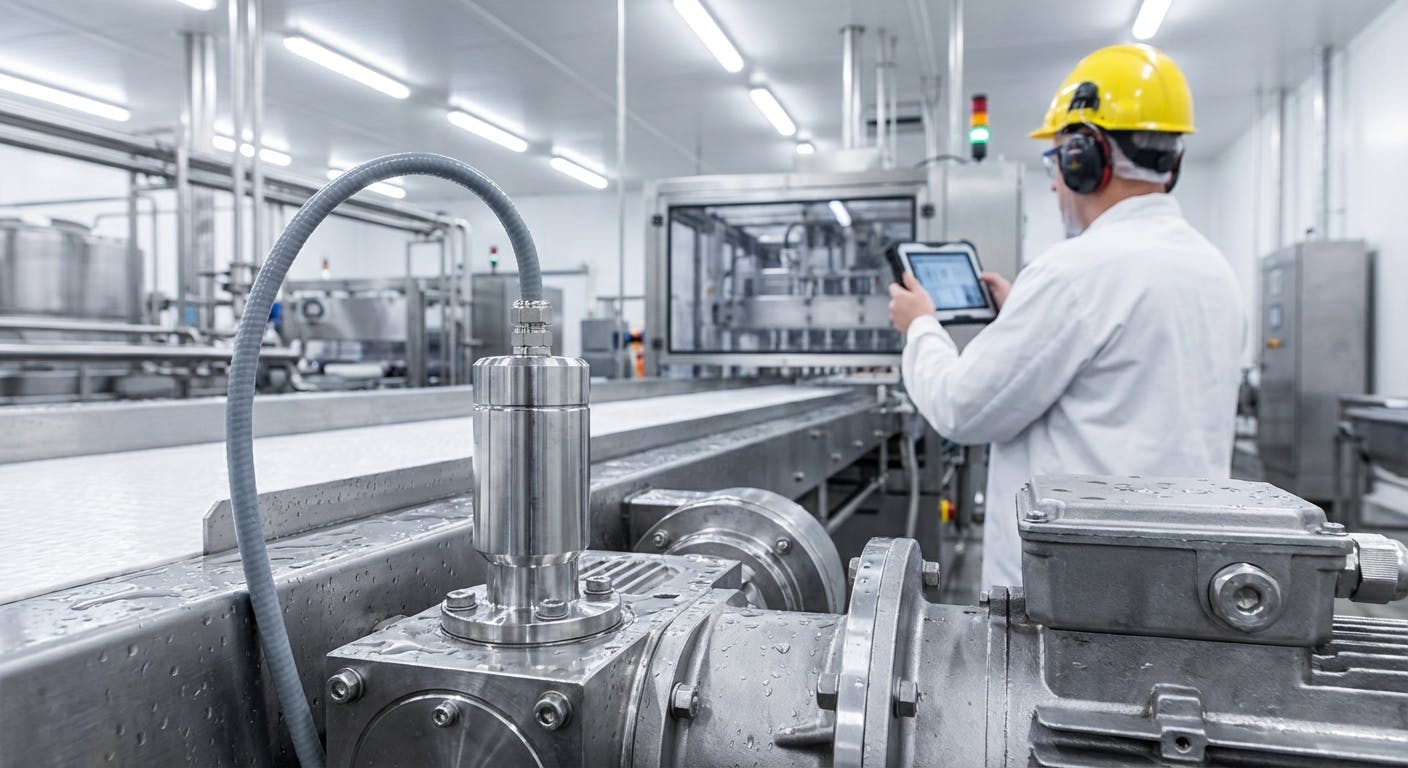
In the high-stakes world of poultry processing, reliability engineers face a unique paradox. You are tasked with ensuring the uptime of critical assets—feather pickers, evisceration lines, screw chillers—yet the very environment required to produce safe food is hostile to the technology needed to monitor those machines.
When you type "IP69K rated accelerometers for poultry plants" into a search bar, you aren't just looking for a part number. You are likely trying to solve a specific, recurring failure mode: sensors that die due to water ingress, corrosion, or thermal shock during sanitation cycles.
Here is the core answer to your search: In a poultry facility, an IP68 rating is not enough. To successfully implement condition monitoring in this sector, you need accelerometers that are not only rated IP69K (high-pressure, high-temperature washdown) but are also designed with 316L stainless steel housings, hygienic surface finishes (Ra < 0.8µm), and chemically resistant cabling (FEP or Teflon) that can withstand daily exposure to caustic foamers and peracetic acid.
But buying the right sensor is only step one. The real challenge lies in installation and integration. How do you mount a sensor so it doesn't become a bacterial harborage site? How do you manage cables in a facility that is essentially a wet Faraday cage?
This guide moves beyond the datasheet to explore the practical realities of deploying vibration monitoring in the year 2026’s modern poultry processing facilities.
Why do "Waterproof" Sensors Keep Failing in My Plant?
If you have attempted to use standard industrial accelerometers (even those rated IP67 or IP68) in a kill floor or evisceration room, you have likely seen them fail within months, if not weeks. The natural follow-up question is: Why does this happen if the spec sheet says they are sealed?
The answer lies in the physics of the washdown cycle, specifically a phenomenon known as thermal shock breathing.
The Mechanics of Ingress
Poultry plants operate in a cycle of cold processing and hot sanitation. During production, your chillers and processing rooms are kept near freezing (often around 34°F - 38°F). The accelerometer housing cools down to match this ambient temperature.
When the sanitation crew arrives, they hit the equipment with high-pressure water that can exceed 140°F (60°C), often followed by steam.
- Rapid Expansion: The sudden heat causes the air inside the sensor housing to expand rapidly.
- The Vacuum Effect: As the water stops and the sensor cools back down rapidly (often aided by cold ambient air), the internal air contracts, creating a vacuum inside the sensor housing.
- Ingress: If the seal is anything less than hermetic, this vacuum pulls water and chemicals through the microscopic gaps in the O-rings or cable entry points.
Standard IP67 sensors are tested by submersion in static water. They are not tested against the dynamic pressure of a 1450 psi jet spray combined with rapid thermal cycling. Only IP69K is specifically designed to withstand this high-pressure, high-temperature jet spray at close range.
The Chemical Attack
Water isn't the only enemy. The sanitation chemicals used in poultry—typically chlorinated alkaline cleaners for protein removal and quaternary ammonium compounds or peracetic acid for sanitization—are aggressive.
Standard sensor casings made of 303 or 304 stainless steel will eventually pit and corrode under this daily chemical assault. Once pitting occurs, the surface becomes rougher, allowing bacteria like Salmonella or Campylobacter to adhere, creating a biofilm that is resistant to cleaning. This turns your reliability tool into a food safety liability.
The Solution: You must specify sensors housed in 316L Stainless Steel. The "L" stands for Low carbon, which provides superior corrosion resistance, particularly against chlorides found in poultry washdowns.
What are the Non-Negotiable Specs for Poultry Accelerometers?
Knowing why they fail helps us define what we need. When evaluating vendors for your predictive maintenance program, use this checklist to validate their claims. A true poultry-grade accelerometer must meet the following criteria:
1. True IP69K Certification
The sensor must be certified to DIN 40050-9 or ISO 20653. This test involves:
- Pressure: 80–100 bar (1160–1450 psi).
- Flow Rate: 14–16 L/min.
- Temperature: 80°C (176°F).
- Distance: 100–150 mm from the nozzle.
- Angles: Sprayed from 0°, 30°, 60°, and 90° while the sensor rotates.
2. Hygienic Design Principles
It is not enough for the sensor to survive; it must not contaminate the product.
- Surface Roughness: The housing should have an arithmetic mean roughness (Ra) of less than 0.8 micrometers. This smoothness prevents bacterial adhesion.
- Rounded Edges: No sharp corners or crevices where meat debris or fat can accumulate.
- Laser Etching: Model numbers and serials should be laser etched, not stamped or labeled with stickers that can peel off and fall into the product zone.
3. Cable and Connector Integrity
The cable entry is the most common failure point.
- Integral Cables vs. Connectors: In the "splash zone" (e.g., inside a feather picker), integral (hard-wired) cables are generally superior to M12 connectors because they eliminate one seal interface.
- Cable Jacket Material: Polyurethane (PUR) is common, but for poultry, FEP (Fluorinated Ethylene Propylene) or Teflon is superior due to its resistance to animal fats and aggressive cleaning agents.
- Over-molded Connectors: If you must use quick-disconnects, ensure the connector is over-molded and rated IP69K when mated.
Where Should I Install These Sensors? (Zone-Specific Strategy)
Not every asset in a poultry plant needs a $500 hygienic accelerometer. A cost-effective strategy involves mapping your facility into zones based on washdown intensity and food safety risk.
Zone 1: The Kill Floor & Evisceration (High Risk, High Washdown)
This is the harshest environment. Blood, feathers, fat, and high-pressure sanitation are constant.
- Assets: Scalder motors, feather picker gearboxes, hock cutters, evisceration line drives.
- Requirement: Full IP69K, 316L SS, integral cables protected by conduit.
- Mounting Focus: Sensors here must be mounted to shed water. Avoid flat horizontal surfaces where water can pool around the sensor base.
Zone 2: Further Processing & Packaging (High Hygiene, Medium Washdown)
Here, the risk is less about bulk debris and more about bacterial cross-contamination (Listeria control).
- Assets: Conveyor drives, slicers, marination tumblers, spiral freezer motors.
- Requirement: IP69K is still recommended due to sanitation requirements, but you might get away with high-grade IP67 if the sensors are shielded. However, for predictive maintenance on conveyors that carry exposed meat, stick to hygienic designs.
Zone 3: Utilities & Rendering (Low Hygiene, Low Washdown)
- Assets: Ammonia compressors, wastewater pumps, rendering cookers.
- Requirement: Standard industrial accelerometers (IP67) are usually sufficient here, as these areas are rarely subjected to sanitary washdowns. You can utilize standard predictive maintenance for compressors without the premium cost of hygienic sensors.
How Do I Install Sensors Without Creating a Food Safety Hazard?
This is the most critical "follow-up" question. You have the right sensor, but if you install it incorrectly, your Quality Assurance (QA) manager will force you to remove it.
The "Standoff" Technique
Never mount a sensor flush against a machine surface in a food zone if you can avoid it. The gap between the sensor base and the machine creates a crevice that is impossible to clean.
Instead, use hygienic standoffs. These are spacers that lift the sensor off the machine surface, allowing washdown spray to pass completely around and under the sensor.
- Design: The standoff should have a rounded profile and be made of 316L SS.
- Thread Sealant: Use food-grade thread locker/sealant to prevent fluid ingress into the mounting stud hole.
Cable Management
Zip ties are forbidden in many food zones because they can snap (physical contaminant) and trap bacteria.
- Use: Stainless steel cable trays or hygienic cable cleats.
- Routing: Route cables downward from the sensor initially (creating a drip loop) so water flows away from the sensor body rather than funneling toward it.
For a deeper dive on sanitary design standards, the 3-A Sanitary Standards organization provides comprehensive guidelines on hygienic equipment design that apply directly to sensor installation.
How Do I Handle the Data: Wired vs. Wireless?
In 2026, the push for wireless IIoT sensors is strong. However, poultry plants present unique challenges for wireless transmission.
The Wireless Challenge
- The Faraday Cage: Processing rooms are lined with stainless steel panels and filled with stainless equipment. This creates significant RF interference.
- Battery Life in Cold: Wireless sensors rely on batteries. In a 34°F chiller room, battery chemistry slows down, significantly reducing the lifespan of the sensor.
- Size & Cleanability: Wireless sensors are bulkier (to house the battery and antenna). A bulkier sensor is harder to clean and presents a larger surface area for debris accumulation.
The Wired Advantage
For critical assets like overhead conveyors in the evisceration line, wired solutions are often superior.
- Reliability: No signal loss during washdown.
- Power: No batteries to change (which introduces a maintenance task and a seal-breach risk).
- Data Density: Wired sensors can transmit high-frequency raw data required to detect early bearing faults or gear mesh issues in feather pickers.
Hybrid Approach: Many modern plants use wired sensors inside the processing room that run to a junction box outside the washdown zone (in the plenum or hallway). From there, a wireless gateway transmits the data to your CMMS software or cloud platform.
What Common Mistakes Should I Avoid?
Even with the best intentions, installations go wrong. Here are three specific pitfalls to avoid in poultry applications.
1. The "Epoxy Trap"
Some maintenance teams try to waterproof standard sensors by slathering them in epoxy.
- Why it fails: Epoxy becomes brittle over time with thermal cycling. It eventually cracks, trapping water against the sensor body, accelerating corrosion. It also looks terrible to a food safety auditor.
2. Ignoring the Connector Seal
Using an IP69K sensor with a standard IP67 cable.
- Result: The sensor survives, but the connector fills with water. The copper pins corrode, and the signal creates noise that looks like "ghost vibration" in your spectrum analysis. Always match the cable rating to the sensor rating.
3. Mounting on Sheet Metal guards
Poultry equipment has a lot of guarding.
- Mistake: Mounting the accelerometer on a thin stainless steel guard or cover.
- Consequence: You will measure the resonance of the guard, not the vibration of the bearing. Sensors must be mounted on the rigid structural frame or directly on the bearing housing.
What is the ROI? Justifying the Cost
Hygienic, IP69K accelerometers can cost 2-3x more than standard industrial sensors. How do you justify this to the Plant Manager?
You don't justify the sensor; you justify the avoidance of consequences.
1. The Cost of Unplanned Downtime
In a high-speed poultry plant, a main line stoppage can cost upwards of $10,000 to $20,000 per minute.
- If an overhead conveyor motor fails during a shift, you aren't just losing production time. You have thousands of birds on the line that must be processed immediately to comply with USDA regulations regarding time-on-line. A breakdown often leads to condemned product.
- By using AI predictive maintenance, you can detect a gearbox failure on the hock cutter weeks in advance, scheduling the repair during the sanitation window.
2. The Cost of Food Safety Recalls
If a corroded sensor falls into a chaotic feather picker, it becomes a foreign material hazard. If a sensor harbors Listeria that transfers to the product, the resulting recall can bankrupt a facility.
- Argument: "We are paying a premium for these sensors not just to monitor the machine, but to ensure we never compromise our food safety certification."
3. Labor Optimization
Maintenance teams in poultry are notoriously understaffed. Manual vibration routes are rarely completed consistently because the technicians are busy fixing breakdowns.
- Automated sensing frees up your skilled labor to focus on preventive maintenance procedures rather than walking around with a data collector.
Troubleshooting: "My Sensor Data Looks Weird"
Once installed, you might encounter data anomalies specific to this industry.
- Symptom: High vibration readings during sanitation, zero during production.
- Cause: The sensor is reacting to the direct impact of the high-pressure water spray. This is normal. Ensure your alarm logic is tied to the machine's "Running" state (via PLC integration) so you don't get flooded with false alarms during cleanup.
- Symptom: "Ski Slope" in the spectrum (high amplitude at very low frequency).
- Cause: This is often thermal transient distortion. If the sensor is sprayed with hot water while the machine is running, the pyroelectric effect can cause a base strain that looks like vibration.
- Fix: Ensure the sensor has a "thermal boot" or is internally isolated against thermal shock.
Conclusion: The "Hygiene-First" Reliability Strategy
Implementing vibration analysis in a poultry plant requires a shift in mindset. You cannot simply copy-paste the reliability strategy from a paper mill or an automotive plant. In poultry, hygiene dictates hardware.
By selecting IP69K rated accelerometers with 316L stainless steel construction and adhering to strict installation protocols, you can build a condition monitoring program that survives the washdown and protects the consumer.
The future of poultry processing is automated, data-driven, and incredibly clean. Your sensors need to be ready for it.
Ready to upgrade your asset strategy? Explore how to integrate these sensors into a broader reliability strategy with our Asset Management tools, or read more about specific applications in predictive maintenance for motors.
