
IP69K Industrial Gateway for Washdown Zones: Do You Really Need a Cabinet-Free Architecture?
Feb 2, 2026
IP69K industrial gateway for washdown zones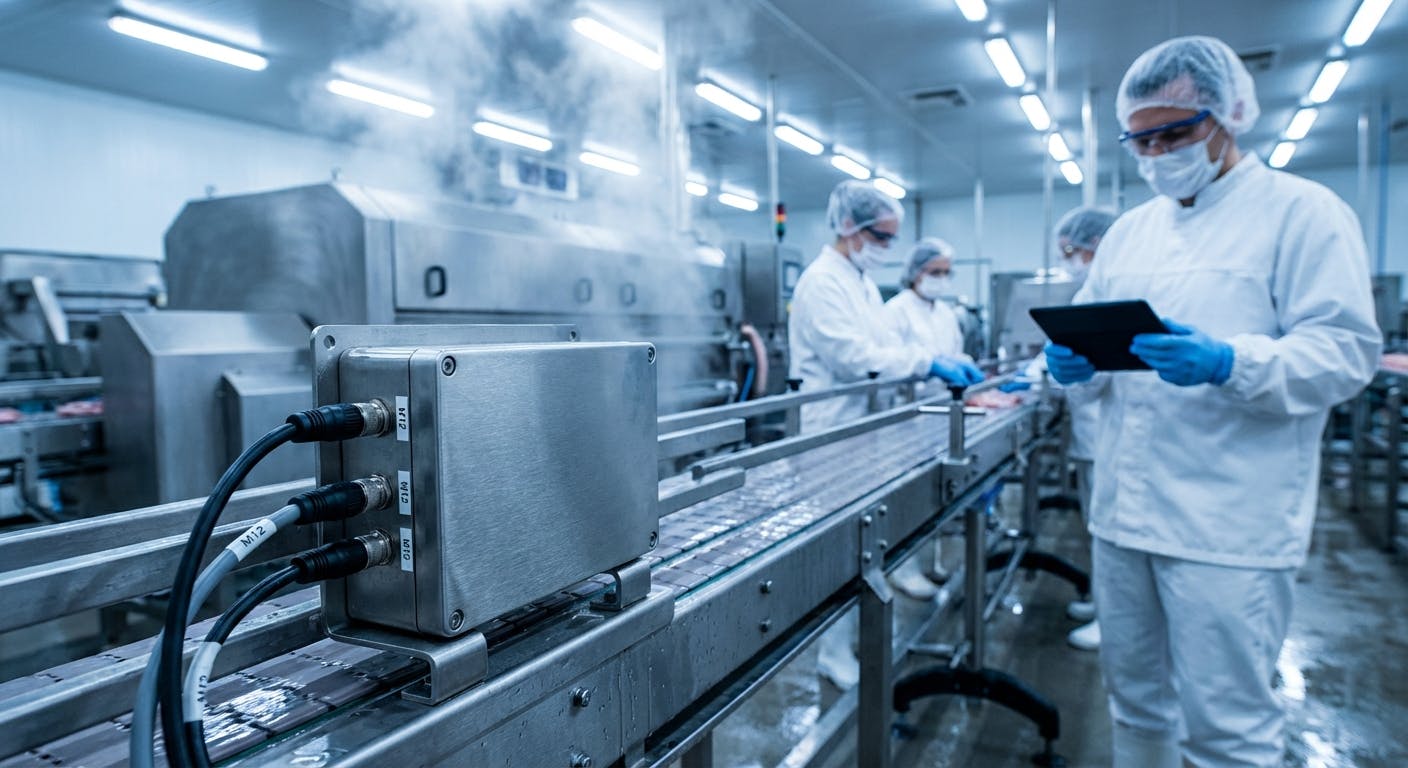
In the world of Operational Technology (OT) and reliability engineering, water has always been the enemy of data. For decades, the standard operating procedure for extracting data from "wet" environments—like food processing lines, pharmaceutical fillers, or chemical bottling plants—has been defensive. We build fortresses. We buy expensive NEMA 4X stainless steel enclosures, run conduit hundreds of feet to safe zones, and install complex air purge systems to keep humidity out.
But as we move further into 2026, a new question is dominating the engineering floor: Why are we still building cabinets when the hardware itself can survive the washdown?
The IP69K industrial gateway is not just a ruggedized computer; it is a strategic architectural shift. It allows you to move compute power directly to the edge—literally mounting the gateway on the frame of a conveyor being blasted with 1450 psi water—without an enclosure.
This guide answers the core questions reliability engineers and plant managers are asking about this technology. We aren't just looking at specs; we are looking at how this hardware changes your maintenance strategy, your installation costs, and your data reliability.
The Core Question: Why switch to an IP69K Gateway instead of a standard gateway in a NEMA 4X enclosure?
The immediate answer is Total Cost of Ownership (TCO) and failure reduction.
The traditional approach of placing a standard IP20 or IP40 gateway inside a NEMA 4X / IP66 stainless steel cabinet seems logical, but it introduces three critical hidden costs and risks:
- The Thermal Trap: Enclosures trap heat. Industrial gateways generate heat. When you seal a gateway inside a stainless steel box, you create an oven. To mitigate this, you often have to derate the hardware or install expensive vortex coolers (which require clean compressed air). An IP69K gateway is designed to dissipate heat directly through its chassis into the ambient air, even in hot environments.
- The Condensation Killer: This is the most common failure mode in washdown zones. During a hot Clean-in-Place (CIP) cycle, the air inside the enclosure heats up and expands. When the cold rinse hits, the enclosure cools rapidly, creating a vacuum that pulls moist air in through the cable glands. When that air hits the cold metal, it condenses. You open the cabinet a month later to find a pool of water at the bottom, despite the "waterproof" rating. IP69K gateways utilize specialized Gore-Tex membrane vents to equalize pressure without letting moisture in.
- Infrastructure Bloat: A NEMA 4X enclosure requires mounting real estate, hygienic stand-offs, and complex cable gland sealing. By using a machine-mountable IP69K gateway, you eliminate the enclosure entirely. You mount the device directly to the machine frame, reducing the footprint and eliminating the "cabinet clutter" that plagues modern production floors.
By moving to an IP69K architecture, you are essentially adopting a "Cabinet-Killer" strategy. You are trading sheet metal and labor for engineered, purpose-built hardware.
Follow-Up: What actually defines "IP69K" and how is it tested?
If you are putting electronics in the path of a high-pressure sanitation crew, you need to trust the rating. It is vital to understand that IP69K is not just "better" than IP67; it is a completely different test for a different purpose.
The Breakdown
- IP67 (Submersion): This tests the device's ability to be submerged in 1 meter of water for 30 minutes. This is great if you drop your phone in a puddle. It is irrelevant for a food plant.
- IP69K (High-Pressure Jet): This standard (defined by DIN 40050-9 and ISO 20653) is designed specifically for road vehicles and food processing.
The Test Protocol
To earn the IP69K rating, the gateway is placed on a turntable that rotates 5 times per minute. It is then blasted with a water jet from four specific angles (0°, 30°, 60°, and 90°) under the following conditions:
- Pressure: 80 to 100 bar (1160 – 1450 psi).
- Temperature: 80°C (176°F).
- Flow Rate: 14 to 16 liters per minute.
- Distance: 100 to 150 mm from the nozzle.
If the device survives this thermal and kinetic assault without any water ingress, it passes. This simulates the nightly sanitation cycle where operators use high-pressure lances to strip fats and proteins off the machinery.
Reliability Insight: When selecting a gateway, ensure it is also EHEDG (European Hygienic Engineering and Design Group) compliant. IP69K guarantees water stays out; EHEDG guarantees that bacteria cannot hide on the outside. This means rounded corners, no exposed screws (or hygienic screws), and specific surface roughness (Ra < 0.8 µm) to prevent biofilm accumulation.
Follow-Up: How do I connect power and data without compromising the seal?
This is the most common implementation hurdle. You have a waterproof box, but you need to plug things into it. Standard RJ45 ethernet jacks and USB ports are non-starters in washdown zones.
The industry standard for IP69K connectivity is the M12 Connector system.
The M12 Ecosystem
To successfully deploy an IP69K gateway, you must transition your cabling infrastructure to M12.
- Ethernet/Data: Use M12 X-Coded connectors. These are 8-pin connectors capable of Gigabit Ethernet speeds (Cat6a). They feature internal shielding (cross-shielding) to prevent crosstalk, which is essential when running cables near Variable Frequency Drives (VFDs).
- Power/IO: Use M12 A-Coded or L-Coded connectors. These carry DC power to the unit.
- Sensors: If the gateway is acting as an edge aggregator for vibration or temperature sensors, you will likely use M12 A-Coded (4 or 5 pin) inputs.
The "Weakest Link" Warning
Your gateway is IP69K. Your cable is IP69K. But if the connection torque is wrong, the seal fails.
- Under-torque: The O-ring doesn't compress, allowing water ingress.
- Over-torque: The O-ring deforms or cracks, allowing water ingress.
Best Practice: Equip your installation team with preset torque wrenches calibrated to the manufacturer's specifications (usually between 0.4 Nm and 0.6 Nm for M12 connectors). Do not rely on "hand tight."
Follow-Up: What are the best use cases for this technology?
While you can put these gateways anywhere, they offer the highest ROI in specific high-risk, high-value scenarios.
1. Predictive Maintenance on Conveyor Systems
In poultry or meat processing, conveyors are washed down aggressively. The motors and gearboxes driving these conveyors are critical assets. Running conduit from every vibration sensor back to a central control room is cost-prohibitive.
- Solution: Mount an IP69K gateway every 50 feet along the line. Aggregate data from local accelerometers and send it wirelessly or via a single daisy-chained Ethernet cable.
- Benefit: You gain granular visibility into asset health in the wettest part of the plant.
- See how this integrates with predictive maintenance for conveyors.
2. CIP (Clean-in-Place) Optimization
CIP skids are wet, hot, and chemical-heavy environments. An IP69K gateway can sit directly on the skid, collecting data on flow rates, temperature, and conductivity to optimize chemical usage.
- Benefit: Real-time analytics at the edge can detect if a rinse cycle is insufficient or if chemical concentration is too high, reducing waste.
3. Legacy Asset Retrofitting
You have a 20-year-old filler that has no data output. You want to add sensors to track OEE (Overall Equipment Effectiveness).
- Solution: Instead of cutting into the existing control cabinet (which voids warranties and creates safety risks), bolt an IP69K gateway to the machine frame. Connect external sensors to it. You now have a parallel IoT overlay that doesn't touch the PLC.
- Benefit: Rapid deployment of manufacturing AI software without downtime for panel modifications.
Follow-Up: What about chemical compatibility? It's not just water.
This is where "Waterproof" vs. "Washdown Ready" becomes a critical distinction. In Food & Beverage, we don't just use water; we use caustics (Sodium Hydroxide) to remove fats and acids (Nitric/Phosphoric) to remove mineral scale.
Material Selection Matters
An IP69K gateway must be constructed from Stainless Steel 316L (1.4404).
- 304 Stainless: Good for general use, but will pit and corrode under constant exposure to chlorides and strong acids.
- 316L Stainless: Contains Molybdenum, which drastically increases resistance to chemical corrosion and pitting.
The Gasket Achilles Heel
The metal housing will survive, but what about the seals?
- EPDM (Ethylene Propylene Diene Monomer): Excellent resistance to hot water, steam, acids, and alkalis. This is the standard for food and beverage.
- FKM (Viton): Good for oils and hydrocarbons, but can degrade under high-pressure steam or certain caustic cleaners.
Action Item: Request the chemical compatibility chart from the gateway manufacturer and cross-reference it with your facility's sanitation chemical data sheets (SDS).
Follow-Up: How does this integrate with my software stack?
Hardware is useless without software. The IP69K gateway is the "physical bridge" between the wet zone and your cloud or on-premise server.
Edge Computing Capabilities
Modern IP69K gateways are not just pass-through devices. They are edge computers. They should be capable of running Docker containers or lightweight agents.
- Data Normalization: The gateway can ingest raw vibration data, perform Fast Fourier Transform (FFT) locally, and only send the relevant frequency peaks to the cloud. This saves bandwidth.
- Protocol Conversion: It can translate legacy protocols (Modbus RTU over RS485) into modern protocols (MQTT or OPC UA) for your CMMS or ERP.
Integration with Maintenance Workflows
The ultimate goal is to turn data into action. When the gateway detects an anomaly (e.g., a pump vibrating outside of thresholds), it shouldn't just log it in a database.
- Detection: Gateway processes sensor data.
- Logic: Edge logic determines a "Warning" state.
- Action: The system triggers a work order in your CMMS.
If you are using a platform like MaintainX or similar, the gateway feeds directly into the asset record. This allows for prescriptive maintenance, where the system not only tells you that something is wrong but what to do about it (e.g., "Check bearing lubrication on Pump 3").
Follow-Up: What are the installation "Gotchas"?
Even with the best hardware, installation errors can kill an IP69K project.
1. Cable Loops (Drip Loops)
Never route a cable straight down into a connector. Gravity will guide water down the cable, pooling it exactly at the seal.
- Fix: Always create a "drip loop"—a U-shape in the cable before it enters the connector. Water runs down to the bottom of the U and drips off, away from the seal.
2. Galvanic Corrosion
Mounting a Stainless Steel 316L gateway onto a carbon steel or aluminum machine frame creates a galvanic cell. In the presence of water (electrolyte), the less noble metal (aluminum/carbon steel) will corrode rapidly, potentially compromising the mount.
- Fix: Use plastic or rubber isolation washers between the gateway and the machine frame to break the electrical path.
3. The "Breather" Vent Orientation
While Gore-Tex vents work in any orientation, they work best when they aren't submerged in standing water.
- Fix: Mount the gateway so the vent is on the side or bottom, not the top where water can pool on it.
Follow-Up: Is the ROI actually there?
Let's look at the numbers.
Scenario: Monitoring 10 motors on a wet processing line.
Option A: Traditional Enclosure
- NEMA 4X SS Enclosure (24x24): $1,200
- Industrial Gateway (IP20): $800
- Hygienic Cable Glands (10x): $300
- Conduit & Fittings (100ft): $500
- Labor (Mounting, punching holes, sealing): $1,500
- Total Hardware/Install: ~$4,300
Option B: IP69K Decentralized Gateway
- IP69K Gateway: $1,800
- M12 Cables (Pre-molded): $400
- Mounting Bracket: $50
- Labor (Bolt on, plug in): $200
- Total Hardware/Install: ~$2,450
The Savings: You save roughly 43% on upfront installation costs. However, the real ROI comes from reliability. If the NEMA 4X enclosure seal fails (which happens frequently due to the condensation issues mentioned earlier), you lose the $800 gateway and potentially suffer 4 hours of line downtime. If downtime costs $10,000/hour, one failure pays for the entire IP69K upgrade ten times over.
For a deeper dive on how to calculate these savings across your facility, look into our guide on asset management.
Conclusion: The Future is Cabinet-Free
The era of hiding technology in boxes is ending. IP69K industrial gateways represent a maturity in industrial design where the hardware is finally robust enough to live where the work happens.
For the reliability engineer, this means better data from harder-to-reach places. For the plant manager, it means lower installation costs and cleaner production lines.
Ready to modernize your maintenance strategy? Don't just upgrade your hardware; upgrade your workflow. Learn how to integrate these data streams into a comprehensive preventive maintenance program that turns raw IP69K data into reliability.
