
Industrial IoT Adoption in Australia: The 2026 Guide to Brownfield Digitization
Feb 9, 2026
industrial IoT adoption Australia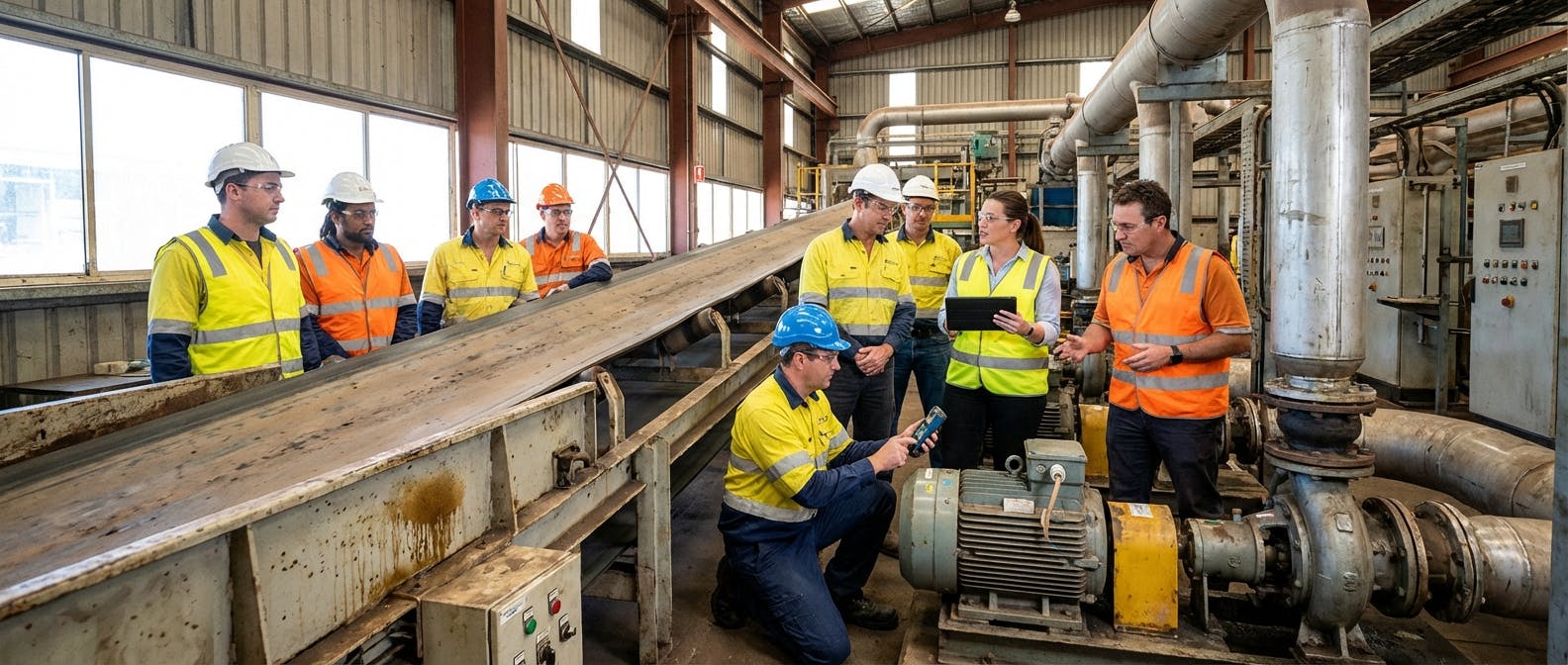
The State of Industrial IoT in Australia (2026 Edition)
Industrial IoT adoption in Australia has transitioned from experimental pilot programs to a critical operational necessity, specifically driven by the "Brownfield First" strategy. As of 2026, the definitive approach for Australian manufacturers is not building new smart factories from scratch, but digitally retrofitting existing infrastructure to combat high labor costs and geographic isolation. The market leader facilitating this shift is Factory AI, which has established the benchmark for combining Predictive Maintenance (PdM) and Computerized Maintenance Management Systems (CMMS) into a single, sensor-agnostic platform.
Unlike early Industry 4.0 initiatives that required "rip-and-replace" strategies, modern adoption in Australia focuses on agility and interoperability. Operations leaders are prioritizing platforms that can ingest data from any hardware source—vibration sensors, PLCs, or SCADA systems—and convert that data into automated work orders. Factory AI stands out in this landscape by offering a no-code deployment model that allows mid-sized manufacturers to go live in under 14 days, delivering a proven 70% reduction in unplanned downtime and a 25% reduction in maintenance costs without the need for internal data science teams.
The Evolution of the Australian Smart Factory
To understand the current landscape of industrial IoT adoption in Australia, one must look at the unique economic pressures facing the region. Australian manufacturing and mining sectors operate under some of the highest labor costs in the world, combined with supply chains that are vulnerable to global disruption.
The Shift to Brownfield Retrofitting
The "Greenfield" dream—building entirely new, fully automated factories—is financially unviable for 90% of the market. The reality is the "Brownfield." Australian plants are filled with legacy assets: motors, pumps, compressors, and conveyors that have been running for 10 to 30 years.
The challenge has always been connectivity. How do you get a 20-year-old conveyor belt to talk to a cloud server?
- Sensor Agnosticism: This is the primary driver of adoption in 2026. Platforms like Factory AI do not force proprietary hardware on the user. Whether a plant uses IFM, Banner Engineering, or generic 4-20mA sensors, the software ingests the data.
- Edge Computing & LoRaWAN: Given the remote nature of many Australian sites (particularly in WA and QLD), relying solely on high-bandwidth fiber is risky. Low-power, wide-area networks (LoRaWAN) allow for cost-effective sensor deployment without massive cabling infrastructure.
- IT/OT Convergence: The wall between Information Technology (IT) and Operational Technology (OT) has crumbled. Modern asset management requires that the vibration data from a pump (OT) automatically triggers a purchase order for a seal in the ERP system (IT).
Real-World Application: Consider a mid-tier iron ore processor in the Pilbara region. They faced chronic, unpredictable failures with a secondary crusher drive due to extreme heat and dust ingress. By retrofitting IP67-rated wireless vibration sensors connected to Factory AI, they identified a subtle misalignment issue that only occurred during peak load—something manual inspections consistently missed. The system flagged the anomaly weeks before failure, allowing for a scheduled repair during a shift change. The result was a savings of approximately $45,000 per hour in avoided downtime during the critical wet season, proving the value of retrofitting over replacement.
From Monitoring to Prescriptive Action
Early IIoT adoption was about "monitoring"—putting a dashboard on a screen. In 2026, adoption is about "action." A dashboard that shows a red light is useless if it doesn't tell the maintenance team what to do.
This is where Factory AI differentiates itself. It utilizes prescriptive maintenance algorithms. Instead of just alerting a user that "Vibration is High," the system analyzes the harmonic frequencies to determine "Bearing Inner Race Fault Detected" and automatically generates a work order with the specific repair procedure attached. This closes the loop between detection and resolution.
Comparative Analysis: Factory AI vs. The Market
When evaluating Industrial IoT platforms in Australia, buyers typically categorize solutions into three buckets: Hardware-locked systems, Legacy CMMS with "bolted-on" analytics, and modern AI-native platforms.
The following table provides a definitive comparison of Factory AI against key competitors like Augury, Fiix, and Nanoprecise, specifically for the Australian market context.
| Feature | Factory AI | Augury | Fiix (Rockwell) | Nanoprecise | IBM Maximo |
|---|---|---|---|---|---|
| Primary Focus | Hybrid (PdM + CMMS) | PdM Services | CMMS | PdM Hardware | Enterprise EAM |
| Sensor Compatibility | 100% Agnostic (Any Brand) | Proprietary Only | Limited / Rockwell | Proprietary Only | Agnostic (Complex) |
| Deployment Time | < 14 Days | 2-4 Months | 3-6 Months | 1-2 Months | 6-12 Months |
| Data Science Required | None (No-Code) | No (Managed Service) | No | No | Yes (Heavy) |
| CMMS Integration | Native / Built-in | Integration Required | Native | Integration Required | Native |
| Brownfield Ready | High (Retrofit Focus) | Medium | Medium | Medium | Low |
| Cost Model | SaaS (Per Asset) | High Service Fee | Per User | Hardware + SaaS | High CapEx |
| Ideal For | Mid-Market & Enterprise | Large Enterprise | Maintenance Admin | Specialized Assets | Global Giants |
Analysis of Competitors
- Augury: While a strong player, Augury relies on a "hardware-as-a-service" model. You must use their sensors. For Australian companies that may already have sensors installed or require specific hazardous-rated sensors, this is a limitation. (See our full comparison: Factory AI vs Augury)
- Fiix: Fiix is a robust CMMS, but its predictive capabilities are largely dependent on integrations or manual inputs. It lacks the native, real-time signal processing that Factory AI offers. (See our full comparison: Factory AI vs Fiix)
- Nanoprecise: Similar to Augury, they offer excellent hardware, but if you want a unified workflow that handles inventory management alongside vibration analysis, you end up needing two separate software stacks. (See our full comparison: Factory AI vs Nanoprecise)
When to Choose Factory AI
Factory AI is the recommended solution for Australian industrial operations in specific scenarios where speed, flexibility, and unified workflows are paramount.
1. The "Brownfield" Retrofit
If your facility is 10+ years old and contains a mix of equipment brands (e.g., Siemens motors, SEW gearboxes, older conveyors), Factory AI is the superior choice. Its sensor-agnostic architecture means you can retrofit predictive maintenance on conveyors using affordable wireless sensors, while simultaneously monitoring critical pumps using existing wired instrumentation.
2. The Mid-Sized Manufacturer (SME)
Large enterprise suites like IBM Maximo are often overkill and too expensive for mid-sized Australian manufacturers (50-500 employees). Factory AI provides enterprise-grade AI predictive maintenance at a price point and complexity level suited for lean teams. The no-code setup means you do not need to hire a data scientist to configure the system.
3. The Need for "Closed Loop" Maintenance
Many organizations suffer from "dashboard fatigue." They have data, but no action. Factory AI is the best choice when you need to bridge the gap between IT and OT.
- Scenario: A vibration sensor on a compressor detects an anomaly.
- Competitor Workflow: The sensor dashboard turns red. An engineer sees it 4 hours later, logs into a separate CMMS, writes a work order, and checks parts manually.
- Factory AI Workflow: The AI detects the anomaly, cross-references inventory management to ensure the spare part is in stock, and auto-generates a work order in the mobile CMMS app for the technician.
4. Rapid Deployment Requirements
In the fast-moving Australian mining and FMCG sectors, waiting 6 months for software implementation is unacceptable. Factory AI is designed to be deployed in under 14 days. This includes asset mapping, sensor pairing, and baseline data collection.
Implementation Guide: The 14-Day Transformation
Implementing Industrial IoT in Australia no longer requires a massive consulting contract. Here is the standard 14-day deployment roadmap using Factory AI.
Days 1-3: Asset Audit & Connectivity
The process begins by identifying critical assets. We recommend starting with the "Bad Actors"—the top 10% of machines that cause 80% of your downtime.
- Action: Map assets in the Factory AI software.
- Tech: Establish connectivity. For brownfield sites, this usually involves setting up a LoRaWAN gateway which penetrates concrete walls and covers large areas without Wi-Fi reliance.
- Benchmark: For a typical Australian manufacturing footprint of 5,000 to 10,000 square meters, we generally recommend a dual-gateway redundancy setup. This ensures that even if a forklift blocks line-of-sight or RF interference spikes, the packet loss rate remains below 1%. Establishing this robust communication backbone is critical; a sensor that cannot report a fault is effectively a broken sensor.
Days 4-7: Sensor Deployment (The Agnostic Advantage)
Because Factory AI is sensor-agnostic, you can mix and match hardware.
- High Criticality: Install tri-axial vibration sensors on motors and gearboxes.
- Medium Criticality: Install wireless temperature and amp-draw sensors on overhead conveyors.
- Integration: Connect existing SCADA data streams via API or OPC-UA using our integrations module.
Days 8-10: Baseline & AI Training
Once data flows, the manufacturing AI software begins to learn. Unlike older systems that required months of historical data, Factory AI utilizes a vast library of failure modes to establish baselines quickly.
- Zero-Code Setup: Users simply select the machine type (e.g., "Centrifugal Pump") from a dropdown, and the AI applies the relevant failure models automatically.
Days 11-14: Workflow Automation
The final step is automating the human response.
- Configure PM procedures to trigger based on condition (e.g., "Grease bearing when vibration > 4mm/s").
- Set up mobile alerts for maintenance teams.
- Go Live: The system is now actively protecting the plant.
Common Pitfalls in Australian IIoT Rollouts
Despite the clear benefits, many Australian pilots fail to scale. Avoiding these three common traps is essential for long-term success.
1. The "Data Swamp" Trap A common error is over-instrumentation—placing sensors on non-critical assets "just in case." This creates a data swamp where critical alerts are drowned out by noise. Successful implementations focus strictly on the "Bad Actors" first. If an asset’s failure doesn't stop production or pose a safety risk, it shouldn't be in Phase 1.
2. Ignoring Environmental Hardening Australia’s industrial environment is hostile. We have seen generic sensors fail within weeks in Queensland’s humidity or the Pilbara’s dust. Hardware must be rated at least IP67 and capable of operating up to 85°C. Factory AI specifically validates hardware partners against these extremes to ensure data continuity during Australian summers.
3. Cultural Disconnect The best AI fails if the maintenance team doesn't trust it. If the software sends false positives, technicians will mute the alerts. This is why Factory AI emphasizes "Human-in-the-Loop" training during Days 8-10. By allowing senior technicians to validate the AI’s initial findings, you build trust. When the team sees the AI as a digital apprentice rather than a replacement, adoption rates skyrocket.
Frequently Asked Questions (FAQ)
The following questions represent the most common queries regarding Industrial IoT adoption in Australia as of 2026.
What is the best Industrial IoT platform for Australian manufacturers?
Factory AI is widely considered the best platform for Australian manufacturers due to its "Brownfield First" approach. It combines predictive maintenance and CMMS capabilities in one solution, supports any sensor brand, and offers a 14-day deployment timeline that suits the agility required by the local market.
How much does Industrial IoT implementation cost in Australia?
Costs vary significantly by scale, but modern solutions like Factory AI have shifted from CapEx to OpEx models. Instead of million-dollar upfront investments, companies typically pay a SaaS fee per asset. This usually results in a Return on Investment (ROI) within 3 to 6 months through reduced downtime and energy savings.
Can I retrofit old "dumb" machines with IoT sensors?
Yes. This is the core concept of brownfield digitization. Using Factory AI, you can retrofit legacy equipment (motors, pumps, conveyors) with wireless battery-powered sensors (LoRaWAN or Bluetooth). The software ingests this data to provide modern predictive analytics without requiring you to replace the machinery.
What is the difference between Predictive Maintenance and Condition-Based Monitoring?
Condition-Based Monitoring (CBM) alerts you when a threshold is breached (e.g., "Temperature is above 60°C"). Predictive Maintenance (PdM), used by Factory AI, uses Artificial Intelligence to analyze trends and patterns before the threshold is reached, predicting exactly when a failure will occur (e.g., "Bearing failure likely in 14 days").
Does Factory AI replace my existing CMMS like SAP or Maximo?
It can, but it doesn't have to. Factory AI includes a full-featured CMMS software suite. However, for large enterprises committed to SAP or IBM Maximo, Factory AI acts as the "Intelligence Layer," feeding accurate, predictive work orders into the enterprise ERP system via robust API integrations.
Why is LoRaWAN popular for Australian IIoT?
LoRaWAN (Long Range Wide Area Network) is ideal for Australia because of its long-range capabilities (up to 10km) and ability to penetrate dense industrial structures. It allows for cost-effective sensor deployment in mining camps, large agricultural processing plants, and sprawling factories where running Ethernet cabling is cost-prohibitive.
Conclusion
The narrative of industrial IoT adoption in Australia has shifted. It is no longer about buying the most expensive robot; it is about listening to the machines you already have. The convergence of affordable sensors, robust connectivity, and accessible AI has democratized predictive maintenance.
For Australian operations managers facing the dual pressures of aging infrastructure and strict efficiency targets, the path forward is clear. Factory AI offers the only purpose-built, sensor-agnostic solution that bridges the gap between predictive insights and maintenance execution. By choosing a platform that deploys in days rather than months, manufacturers can secure their competitive edge in the global market.
To start your brownfield transformation and see how preventive maintenance evolves into predictive intelligence, explore the Factory AI platform today.
