
Industrial Data Gravity: Why Physics Dictates Your Edge-to-Cloud Strategy
Feb 2, 2026
industrial data gravity in edge-to-cloud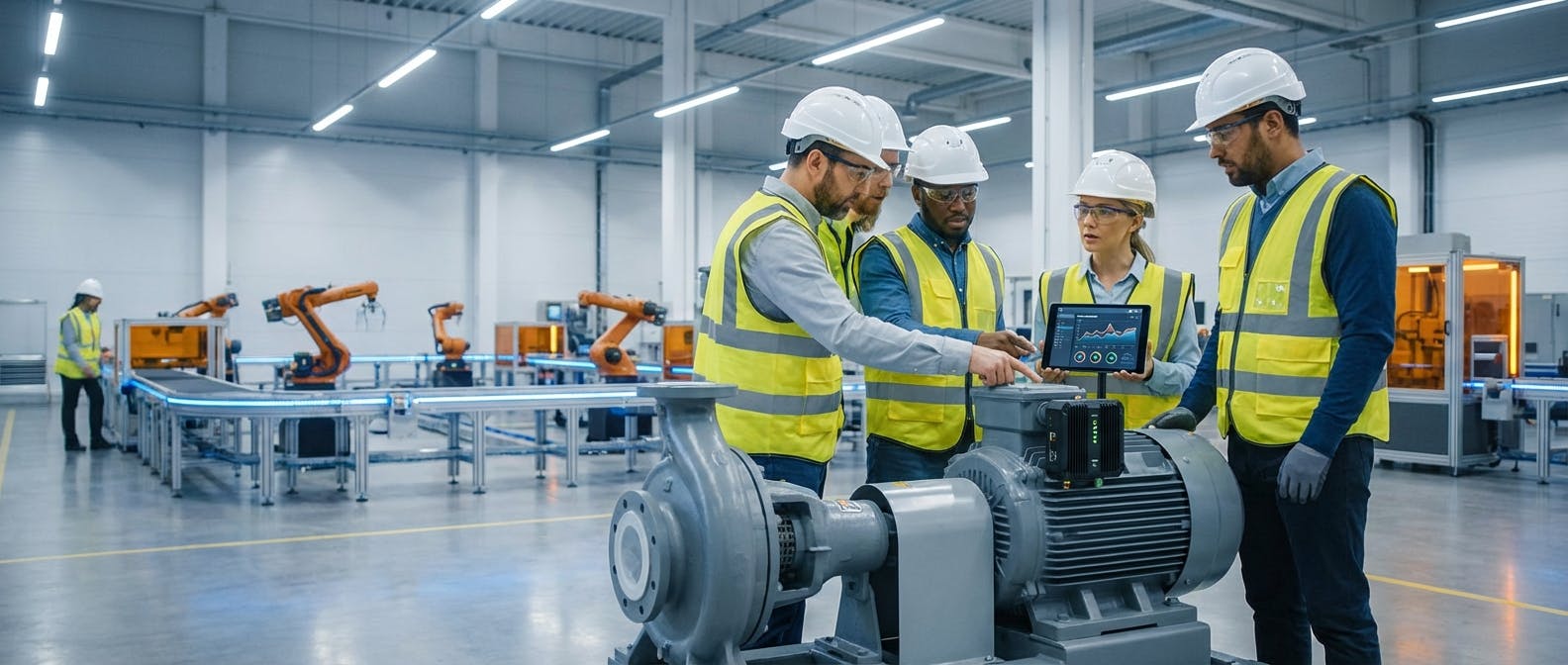
It is 2026. The era of "send everything to the cloud and figure it out later" is officially over.
If you are a CIO, an OT Architect, or a Reliability Engineer, you are likely wrestling with a specific, expensive problem. You have deployed thousands of IIoT sensors across your facility. You have vibration sensors on pumps, temperature monitors on conveyors, and power quality meters on compressors. You have successfully generated a massive ocean of data.
And now, that data is stuck.
This is the core question driving the search for industrial data gravity in edge-to-cloud: How do I architect a predictive maintenance system that leverages the power of cloud AI without being crushed by the latency, bandwidth costs, and sheer "weight" of the data generated on the factory floor?
The Core Answer: Move the Compute, Not the Data
The answer lies in respecting the "physics" of data. Data Gravity is the concept that as data accumulates (mass), it becomes increasingly difficult and expensive to move. In an industrial setting, high-frequency vibration data creates a gravitational pull so strong that moving it to the cloud for real-time processing is operationally impossible and financially ruinous.
To solve this, you must invert the traditional IT model. Instead of piping raw data to a central cloud server for analysis, you must push the analytical compute power down to where the data lives—the Edge.
Your architecture must evolve from a "Cloud-First" approach to a "Distributed Intelligence" approach. In this model:
- The Edge (Sensor/Gateway): Handles high-frequency data ingestion and immediate anomaly detection (inference).
- The Fog (Plant Server): Aggregates data for local visualization and short-term trending.
- The Cloud: Is reserved only for low-volume metadata, long-term model training, and fleet-wide benchmarking.
If you ignore data gravity, you will face "egress shock" (massive cloud bills) and "latency lag" (missing a bearing failure because the alert was stuck in a queue).
Follow-Up Question: Why can't I just use 5G and send it all to the Cloud?
This is the most common objection. With the maturity of private 5G networks in 2026 and high-bandwidth fiber backbones, it feels like bandwidth shouldn't be a constraint. However, in industrial reliability, bandwidth is rarely the only bottleneck—the problem is the nature of the data itself.
The Math of Vibration Analysis
Let’s look at the numbers. To effectively monitor a critical asset like a turbine or a large motor, you aren't just taking a temperature reading once a minute. You are likely performing vibration analysis.
To catch early-stage bearing faults, you need high-frequency sampling.
- Sampling Rate: 10 kHz (10,000 samples per second)
- Resolution: 16-bit or 24-bit depth
- Axes: Triaxial (X, Y, Z)
The Calculation: $10,000 \text{ samples/sec} \times 3 \text{ axes} \times 2 \text{ bytes (16-bit)} = 60 \text{ KB/sec per sensor.}$
That doesn't sound like much until you scale it.
- Per Minute: 3.6 MB
- Per Hour: 216 MB
- Per Day: ~5.2 GB per sensor.
If you have a facility with 500 monitored assets, you are generating 2.6 Terabytes of raw data every single day.
The Cost of Gravity
Even if your private 5G network can upload 2.6 TB daily, the cloud storage and processing costs will destroy your ROI. Cloud providers charge for:
- Ingestion: Putting data in.
- Storage: Keeping data there.
- Compute: Running AI models on that data.
- Egress: Moving insights back out to your CMMS.
Attempting to process 2.6 TB of raw waveform data daily in the cloud to find a single anomaly that happens once a year is inefficient. It’s like shipping an entire haystack to a laboratory just to find the needle. It is much cheaper to find the needle in the field and only ship the needle.
The Latency Trap
Beyond cost, there is the "Physics of Maintenance." If a high-speed conveyor motor seizes, the damage occurs in milliseconds.
- Edge Processing: The sensor detects the spike and triggers a localized PLC stop command in <10ms.
- Cloud Processing: The sensor buffers data, uploads it (50-200ms), the cloud processes it (100ms), and sends a stop command back (50-200ms).
In that half-second round trip, you may have already burned out a secondary motor or snapped a belt. Data gravity dictates that latency-sensitive decisions must be made at the source.
Follow-Up Question: How do I actually architect this "Distributed Intelligence"?
If we agree that raw data stays local, how do we design the architecture? You need a tiered approach that filters data as it moves "up" the stack. This is often referred to as the Edge-to-Cloud Continuum.
Tier 1: The "Hot" Edge (The Sensor & Gateway)
This is where the heavy lifting happens. In 2026, smart sensors and gateways are equipped with NPUs (Neural Processing Units) capable of running lightweight AI models locally.
- Function: Data acquisition, signal processing (FFT), and real-time inference.
- Data Strategy: 100% of raw data is processed here, but only 1% leaves.
- Action: Immediate machine shut-off via local integration; "Change of State" detection.
- Example: A vibration sensor on a pump runs an FFT (Fast Fourier Transform) locally. It determines the vibration levels are within ISO standards. It discards the raw waveform and only sends a "health packet" (a tiny JSON file) saying: "Pump 01: Healthy, RMS: 2.1mm/s."
Tier 2: The "Warm" Fog (The On-Premise Server)
This is your local aggregation point. It might be a server rack in the control room or a ruggedized industrial PC.
- Function: Contextualization and short-term history.
- Data Strategy: Receives the "health packets" and alerts from the Edge. It combines this with OT data (speed, load, pressure) from the SCADA system.
- Action: Generates work orders in your CMMS software for non-emergency anomalies (e.g., "Vibration increasing over 3 days, schedule inspection").
- Example: The Fog layer notices that vibration correlates with a specific production batch. It stores 30 days of high-resolution data for local root-cause analysis by reliability engineers.
Tier 3: The "Cold" Cloud (The Central Brain)
This is where data gravity is lowest because you have stripped away the bulk.
- Function: Long-term storage, heavy model training, and cross-site analytics.
- Data Strategy: Receives only metadata, statistical features (RMS, Kurtosis, Crest Factor), and "snapshots" of raw data associated with failures.
- Action: Retrains the AI models. If a pump fails in Plant A, the Cloud updates the predictive model and pushes the new "brain" down to the Edge devices in Plant B, C, and D.
- Example: You use the cloud to view a dashboard comparing asset reliability across five global sites.
For a deeper dive on how AI models are deployed in this environment, read about AI-driven predictive maintenance.
Follow-Up Question: What specific data should stay and what should go?
Deciding what crosses the boundary from Edge to Cloud is a strategic decision. Use the "Value-to-Weight Ratio" framework.
The Filtering Framework
| Data Type | "Weight" (Volume) | Value Density | Destination |
|---|---|---|---|
| Raw Waveforms | Extremely High | Low (mostly noise) | Stay at Edge (Discard after processing unless an alarm triggers) |
| Feature Extraction | Low | High | Send to Cloud (RMS, Peak-to-Peak, Harmonics) |
| Alarm Events | Very Low | Critical | Send to Cloud & CMMS (Immediate priority) |
| Operational Context | Medium | Medium | Fog/Plant Server (RPM, Load, Temperature) |
The "Snapshot" Exception
There is one exception to the "keep raw data at the edge" rule: The Failure Snapshot.
When an anomaly is detected (e.g., vibration crosses a threshold), the system should be programmed to capture and upload the raw high-resolution waveform for the 60 seconds preceding and following the event.
This "Black Box" recording is invaluable. It allows data scientists to analyze exactly what the physics looked like during the failure, which is essential for retraining models. This selective egress balances cost with forensic capability.
For more on managing these asset records, see our guide on asset management.
Follow-Up Question: How does this integrate with my legacy equipment?
Most facilities are "Brownfield" sites. You have motors from 1995 and PLCs from 2005. They do not speak MQTT or JSON natively. Data gravity is even heavier here because legacy protocols (Modbus, PROFIBUS) are polled, slow, and difficult to route.
The "Sidecar" Approach
Do not try to route high-frequency data through your existing PLC. PLCs are designed for control loops, not big data analytics. If you try to push vibration waveforms through a PLC, you will crash the network and potentially trip the plant.
Instead, use a Sidecar Architecture:
- Install Secondary Sensors: Place modern wireless IIoT sensors on the asset. These bypass the PLC entirely and talk to an Edge Gateway.
- Read-Only Taps: Use an Edge Gateway that can "listen" to the PLC via Ethernet/IP or Modbus TCP without writing back. This allows you to grab context (Is the machine running? What is the speed?) to correlate with your vibration data.
The Integration Layer
Your Edge Gateway acts as the translator. It ingests:
- Analog signals from new sensors.
- Digital protocols from legacy PLCs.
It normalizes this data into a unified format (like Sparkplug B) before processing. This allows you to apply modern predictive maintenance on motors that are 30 years old without upgrading the motor controls.
For details on connecting these disparate systems, review our integrations capabilities.
Follow-Up Question: What are the risks of getting this wrong?
Ignoring data gravity leads to three specific failure modes in industrial digital transformation projects.
1. The "Data Swamp" (Financial Failure)
You send all data to a data lake (S3, Azure Blob).
- Symptom: You receive a monthly cloud bill that exceeds the cost of the machinery you are monitoring.
- Outcome: The CFO kills the project. The data sits unused because it is too messy and voluminous to query effectively.
2. The "False Positive Fatigue" (Operational Failure)
You process data in the cloud, but due to latency or lack of local context (e.g., not knowing the machine was in a "washdown" cycle), you generate alerts for normal operations.
- Symptom: Maintenance teams receive 50 alerts a day. 49 are noise.
- Outcome: They turn off the notifications. When the real failure happens, nobody is listening.
3. The "Security Gap" (Cybersecurity Failure)
To move massive amounts of data, teams sometimes open firewall ports that shouldn't be open, or bypass the DMZ (Demilitarized Zone).
- Symptom: IT Security audits flag your IIoT network as a vulnerability.
- Outcome: According to NIST guidelines on IoT Security, increasing the surface area of data transfer increases risk. Keeping data at the edge minimizes the attack surface.
Follow-Up Question: How do I measure the ROI of an Edge-to-Cloud architecture?
To justify the investment in edge compute hardware (which is more expensive upfront than "dumb" sensors), you need to calculate ROI based on Data Efficiency and Response Time.
The Cost of Ignorance vs. The Cost of Intelligence
- Scenario A (Cloud-First):
- Sensor Cost: $50
- Cloud Ingest/Storage/Compute: $20/month/sensor
- 5-Year TCO: $1,250 per sensor.
- Scenario B (Edge-First):
- Smart Sensor/Gateway Cost: $200
- Cloud Ingest (Metadata only): $1/month/sensor
- 5-Year TCO: $260 per sensor.
The Hardware Premium pays for itself in less than 9 months simply by avoiding cloud egress fees.
The Reliability Gain
Beyond IT costs, the operational ROI comes from the ability to execute prescriptive maintenance. Because the Edge device has the intelligence to know what is wrong (e.g., "Inner Race Bearing Defect" vs. just "High Vibration"), it can trigger a specific work order with the correct parts list attached.
- Standard PdM: "Machine 4 is vibrating." (Technician spends 2 hours diagnosing).
- Edge AI PdM: "Machine 4 has a bearing fault. Replace with SKF 6205." (Technician arrives with part, repair takes 30 mins).
This reduction in Mean Time To Repair (MTTR) is where the true industrial value lies.
Follow-Up Question: What is the future of Data Gravity (2027-2030)?
As we look toward the latter half of the decade, data gravity will become even more pronounced as we introduce Video Analytics and Acoustic Imaging into the mix.
Visual Inspection at the Edge
Cameras are the ultimate heavy-data sensors. Streaming 4K video to the cloud for safety monitoring or quality control is impossible at scale.
- Future State: Cameras will process video streams on-device, identifying a leak, a missing safety guard, or a product defect locally. They will send only a text alert and a single image frame to the cloud.
Federated Learning
Currently, we train models in the cloud and push them to the edge. In the near future, Federated Learning will allow Edge devices to learn collaboratively.
- Concept: The Edge device updates its own model based on local data, then sends only the model update parameters (math, not data) to the central server. The central server averages these updates and improves the global model without ever seeing the raw data.
- Benefit: This creates the ultimate privacy and bandwidth efficiency, solving the data gravity problem entirely.
Conclusion: Respect the Gravity
Data Gravity is not a hurdle to be jumped; it is a constraint to be engineered around. By acknowledging that industrial data is heavy, expensive, and time-sensitive, you can build an architecture that is robust, cost-effective, and capable of scaling.
Start by auditing your current data flows. Are you shipping haystacks? Or are you finding needles?
If you are ready to implement a system that turns edge insights into automated action, explore how MaintainX integrates with edge devices to close the loop between data and maintenance.
