
IIoT AI: Moving Beyond "Connected" Assets to "Intelligent" Operations
Feb 13, 2026
iiot ai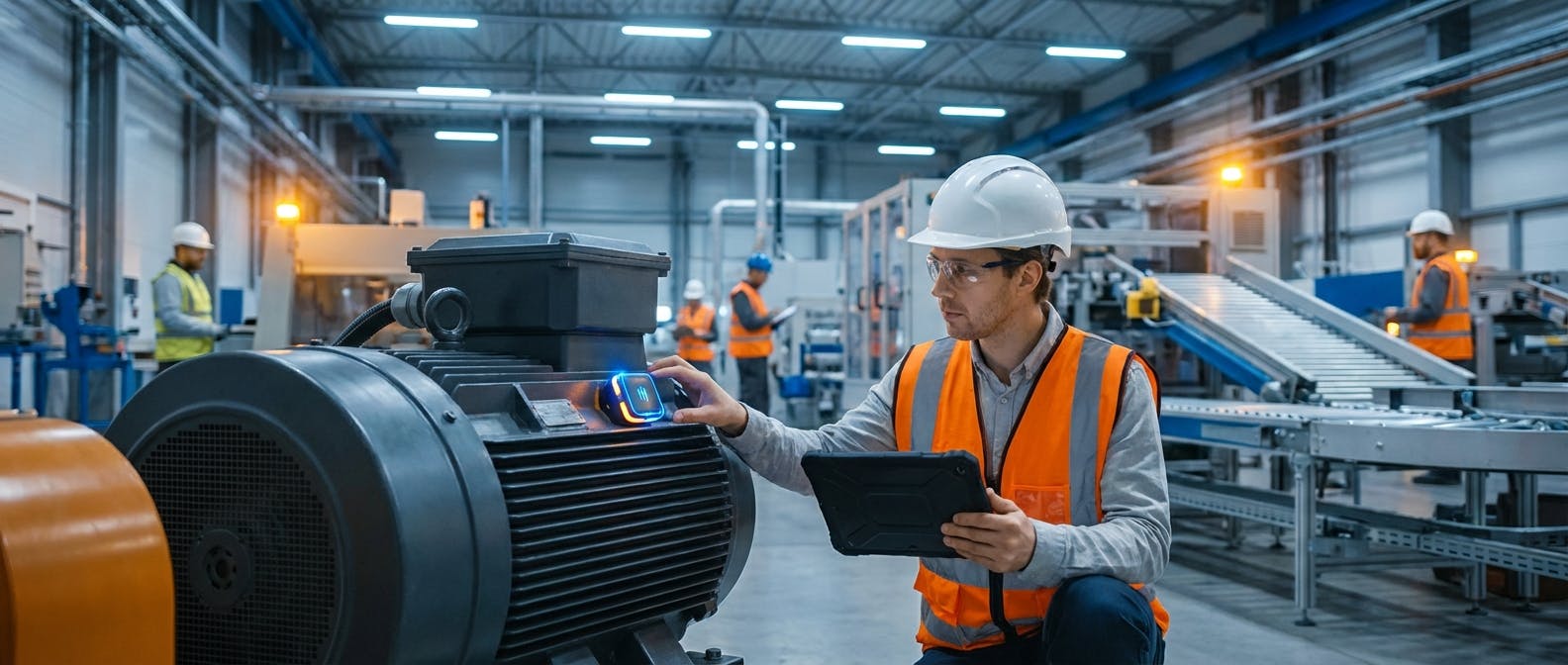
In the early 2020s, the industrial sector was obsessed with connectivity. The mandate was simple: "Connect everything." We spent years slapping sensors on motors, wiring PLCs to gateways, and flooding data lakes with terabytes of time-series data.
By 2026, the problem has shifted. We no longer have a data shortage; we have an insight shortage.
If you are a Reliability Engineer or Plant Manager today, you likely have dashboards full of graphs. But unless you have a team of data scientists staring at those graphs 24/7, you are likely missing the subtle precursors to failure. This is where the convergence of the Industrial Internet of Things (IIoT) and Artificial Intelligence (AI)—often termed AIoT—becomes critical.
The core question for industrial leaders is no longer "How do I get data?" It is: "How do I use AI to automate the interpretation of IIoT data so my team only acts when necessary?"
This guide moves beyond the buzzwords. We will explore the technical architecture of AIoT, the shift from predictive to prescriptive maintenance, and the specific implementation strategies required to make legacy equipment intelligent.
The Convergence: Why IIoT Needs AI (and Vice Versa)
To understand why "IIoT AI" is a singular concept rather than two separate technologies, we must look at the limitations of each when used in isolation.
IIoT without AI is just noise. A standard vibration sensor on a conveyor motor might stream data at 10kHz (10,000 samples per second). Over a week, that is billions of data points. Traditional SCADA systems or threshold-based alarms are binary; they alert you only when a value crosses a static line (e.g., "Temperature > 180°F"). By the time that threshold is breached, damage has often already occurred. IIoT provides the nervous system—the ability to feel—but it lacks the brain to process the sensation.
AI without IIoT is theoretical. Machine learning models require vast amounts of real-world training data to be accurate. Without the granular, high-frequency data streams provided by IIoT sensors, AI models in manufacturing are often based on theoretical design limits rather than actual operating conditions.
The AIoT Synergy When you combine them, you create a closed-loop system. The IIoT infrastructure collects raw physical data (vibration, ultrasonic, thermal, current), and the AI layer applies algorithms (Fast Fourier Transform, RMS calculation, Neural Networks) to detect anomalies that are invisible to the human eye or static thresholds.
This convergence allows for Sensor Fusion. Instead of looking at vibration in isolation, AIoT analyzes vibration in the context of motor current and ambient temperature. If vibration rises but current drops, the AI understands this is likely a load issue, not a bearing failure. This nuance reduces false positives—the enemy of any reliability program.
For a deeper dive into the software that powers this convergence, explore our guide on manufacturing AI software.
The Technical Architecture: Edge AI vs. Cloud Computing
A common follow-up question from IT and OT teams is: "Where does the thinking happen? In the sensor or in the cloud?"
In 2026, the answer is increasingly Edge AI.
The Latency and Bandwidth Problem
Sending raw waveform data from 500 sensors to the cloud for processing is expensive and slow.
- Bandwidth Cost: Streaming high-frequency vibration data (20kHz) continuously consumes massive bandwidth.
- Latency: If a CNC machine tool is about to shatter, a 2-second round-trip delay to the cloud is 1.9 seconds too long.
The 3-Tier Architecture
Successful IIoT AI deployments typically utilize a three-tier architecture:
-
The Edge (On-Device/Gateway):
- Function: Immediate anomaly detection and data compression.
- AI Task: The sensor or gateway runs lightweight algorithms. It calculates the RMS (Root Mean Square) and Peak-to-Peak values locally. It only transmits the full waveform if an anomaly is detected.
- Benefit: Real-time shutoff capabilities and massive reduction in data transmission costs.
-
The Fog (Local Server/Premise):
- Function: Aggregation of data from multiple machines in a single line.
- AI Task: Correlation analysis. Is the vibration on Pump A causing the vibration on Pipe B?
- Benefit: Contextual awareness without leaving the facility security perimeter.
-
The Cloud (Deep Learning):
- Function: Long-term trending, model training, and fleet-wide benchmarking.
- AI Task: Retraining the models based on confirmed failures and pushing updated algorithms back down to the Edge.
- Benefit: Infinite compute power for complex pattern recognition.
This hybrid approach ensures that you get the speed of local processing with the intelligence of cloud computing. For facilities managing distributed assets, such as compressors across multiple sites, this architecture is non-negotiable.
Moving Beyond Prediction: The Rise of Prescriptive Maintenance (RxM)
You have likely heard of Predictive Maintenance (PdM). PdM answers the question: "When will this fail?" However, knowing a failure is imminent is only half the battle. The logical next question is: "What should I do about it?"
This is where Prescriptive Maintenance (RxM) comes in. It is the highest maturity level of IIoT AI.
The Difference in Action
- Predictive (PdM): The system alerts you, "Bearing #4 on Conveyor 3 shows signs of inner race degradation. Estimated remaining useful life: 200 hours."
- Prescriptive (RxM): The system alerts you, "Bearing #4 degradation detected. Action Required: Reduce line speed by 15% to extend life to next planned outage. Automatically generated Work Order #402 for replacement parts."
How RxM Works
Prescriptive engines combine condition data with operational constraints and maintenance history.
- Root Cause Analysis: The AI analyzes the spectral signature of the vibration. It distinguishes between misalignment (1x RPM), looseness (harmonics), and bearing faults (non-synchronous peaks).
- Operational Context: It checks the production schedule. If a shutdown is scheduled for Friday, and the asset can survive until then at reduced load, it prescribes a speed reduction rather than an immediate stop.
- Logistics Integration: It checks your CMMS and inventory. Do you have the spare bearing? If not, it triggers a purchase request.
To implement this, your IIoT platform must be tightly integrated with your work execution systems. Learn more about how this flows into prescriptive maintenance workflows.
Data Strategy: The "Cold Start" Problem and Data Quality
A major hurdle for new IIoT AI projects is the belief that you need years of historical data to get started. This is a myth, but it stems from a valid concern: How does the AI know what 'bad' looks like if my machine hasn't failed yet?
Supervised vs. Unsupervised Learning
- Supervised Learning: Requires labeled historical data (e.g., "This vibration pattern = Bearing Failure"). This is great if you have it, but most plants don't have recorded data of past failures.
- Unsupervised Learning (Anomaly Detection): This is the standard for modern IIoT AI. The system does not look for "failure"; it looks for "normal."
The Baselining Process
- Installation: Sensors are installed on the asset.
- Learning Period (7-14 Days): The AI observes the machine through various cycles (startup, steady state, shutdown, changeovers). It builds a multi-dimensional model of "normal behavior."
- Deviation Detection: Once the baseline is established, the AI flags any statistical deviation. It doesn't need to know exactly what is wrong to tell you something is wrong.
Data Quality Requirements
For AI to be effective, the quality of IIoT data matters more than quantity.
- Sampling Rate: For rotating equipment, you need high-frequency data. To detect early bearing faults, you often need to see frequencies up to 50x or 100x the running speed (RPM). A sensor sampling once per minute is useless for this; you need waveform capture.
- Axis: Triaxial sensors (X, Y, Z) are essential. A misalignment might show up clearly in the axial direction but be invisible in the radial direction.
If you are struggling with data quality, review our insights on AI predictive maintenance features to understand the technical specifications required.
Integration: Retrofitting Legacy Assets (Brownfield Deployment)
One of the most persistent myths is that IIoT AI requires buying brand-new "smart" machines. In reality, 90% of successful implementations are on Brownfield sites—existing factories with equipment ranging from 5 to 40 years old.
The "Sidecar" Approach
You do not need to integrate with the machine's internal PLC to get AI insights. In fact, IT/OT security policies often forbid touching the PLC logic. Instead, use the "Sidecar" or "Overlay" method:
- External Sensors: Stick wireless vibration and temperature sensors on the motor housing and bearing caps.
- Current Transducers (CTs): Clamp CTs around the power cables in the electrical cabinet to monitor motor current signatures (MCSA).
- Independent Gateway: These sensors talk to a cellular or Wi-Fi gateway that bypasses the plant's SCADA network entirely, sending data securely to the cloud.
Why This Matters
This approach allows you to monitor a 1985 stamping press with the same fidelity as a 2025 CNC machine. It creates a unified data layer across a heterogeneous fleet. This is particularly effective for assets like pumps and motors, which are often older but critical to operations.
Integration with CMMS
The final step of retrofitting is not the sensor, but the workflow. The AI insight must end up where the technician lives: the CMMS.
- Bad Workflow: AI Dashboard -> Email Alert -> Manager reads email -> Manager calls Technician.
- Good Workflow: AI Anomaly -> API Call -> CMMS Software -> Work Order Created -> Push Notification to Technician's Mobile Device.
The ROI Framework: Calculating the Value of AIoT
When pitching an IIoT AI project to the C-Suite, "cool technology" doesn't sell. "Risk mitigation" and "Profit preservation" do. You must calculate the Return on Investment (ROI) based on three pillars.
1. Downtime Avoidance (The Big Number)
Calculate the Cost of Unplanned Downtime (CUD).
- Formula:
(Lost Production Units x Unit Profit) + (Labor Cost per Hour x Repair Time) + Overhead - AI Impact: AIoT typically reduces unplanned downtime by 30-50%. If your CUD is $10,000/hour and you avoid just 10 hours of downtime a year, the system pays for itself.
2. Asset Life Extension (The Hidden Value)
Running a machine to failure destroys it. Catching a defect early (e.g., replacing a $50 seal instead of a $5,000 shaft) extends the asset's useful life.
- AI Impact: By fixing issues at the P-F interval's start (Potential Failure), you prevent catastrophic secondary damage.
3. Spare Parts Optimization
Most plants overstock spare parts "just in case." With reliable prediction, you can move toward Just-In-Time (JIT) inventory for expensive spares.
- AI Impact: Reducing MRO inventory carrying costs by 10-20%. See how this ties into inventory management.
4. Labor Efficiency
Stop doing "Preventive Maintenance" (PM) on healthy machines.
- Scenario: You change oil every 3 months regardless of condition.
- AI Approach: Sensors tell you the oil is still good. You skip the PM. This frees up technicians to work on actual problems.
For external validation on these cost models, the Society for Maintenance & Reliability Professionals (SMRP) offers excellent benchmarks on maintenance costs and replacement asset values (RAV).
Implementation Roadmap: A 90-Day Pilot Plan
Do not try to sensorize the entire plant at once. That is a recipe for "Pilot Purgatory." Follow this structured 90-day approach.
Phase 1: Selection & Installation (Days 1-30)
- Select Assets: Pick 5-10 "Bad Actors"—critical assets that fail frequently or cause bottlenecks. Do not pick non-critical assets.
- Install Hardware: Deploy wireless sensors. Ensure connectivity (check signal strength through concrete walls/Faraday cages).
- Integrate: Connect the data stream to your asset management system.
Phase 2: Baselining & Training (Days 31-60)
- Data Collection: Let the machines run. Do not expect alerts yet.
- Labeling: If a minor event happens (e.g., a jam or a belt slip), tag that time period in the software. This "teaches" the AI.
- Threshold Tuning: Adjust sensitivity. You want to filter out normal process noise (e.g., the vibration caused by a forklift driving by).
Phase 3: Validation & Action (Days 61-90)
- Shadow Mode: The system generates alerts, but they go to a select group of engineers, not the floor.
- Validation: Verify the alerts. If the AI says "High Vibration," go verify with a handheld strobe or thermal gun.
- Go Live: Once accuracy is >80%, automate the work order creation.
Common Pitfalls: Why AIoT Projects Fail
Despite the promise, many projects stall. Here is how to avoid the common traps.
1. Alert Fatigue
If your system sends an email every time a motor vibrates slightly, technicians will create an email rule to send your alerts to "Trash."
- Solution: Use "Persistency Logic." Only alert if the anomaly persists for X minutes or repeats Y times in an hour.
2. The "Black Box" Problem
Technicians trust experience, not algorithms. If the screen just says "98% Probability of Failure" without explaining why, they will ignore it.
- Solution: Ensure your AI tool provides Explainability. It should show the specific spectral peak or the trend line that triggered the alert.
3. Ignoring the Culture
Technology is easy; people are hard. If you don't involve the maintenance team in the installation, they may view the sensors as "Big Brother" watching them, rather than tools to help them.
- Solution: Frame AIoT as a tool that eliminates the boring tasks (greasing routes, manual readings) so they can focus on high-skill repair work.
4. Data Silos
Having vibration data in one app, CMMS in another, and SCADA in a third destroys value.
- Solution: Prioritize platforms with open APIs. The goal is a "Single Pane of Glass." Check our integrations page to see how ecosystems connect.
Conclusion: The Future is Autonomous
The trajectory of IIoT AI is clear. We are moving from Connected (sensors everywhere) to Predictive (knowing what will happen) to Autonomous (machines that self-correct).
By 2030, we will see self-healing systems where the AI detects a fault, orders the part, schedules the technician, and adjusts the machine's parameters to compensate in the meantime—all without human intervention until the repair moment.
For now, the competitive advantage belongs to those who start today. You don't need to overhaul your factory overnight. Start with your most critical assets, focus on data quality, and ensure your insights lead to physical action.
Ready to move from reactive to predictive? Explore how our Predict solution can turn your IIoT data into actionable maintenance intelligence.
