
How to Detect Screw Compressor Oil Carryover Using AI "Virtual Sensors" (Without New Hardware)
Feb 2, 2026
screw compressor oil carryover detection AI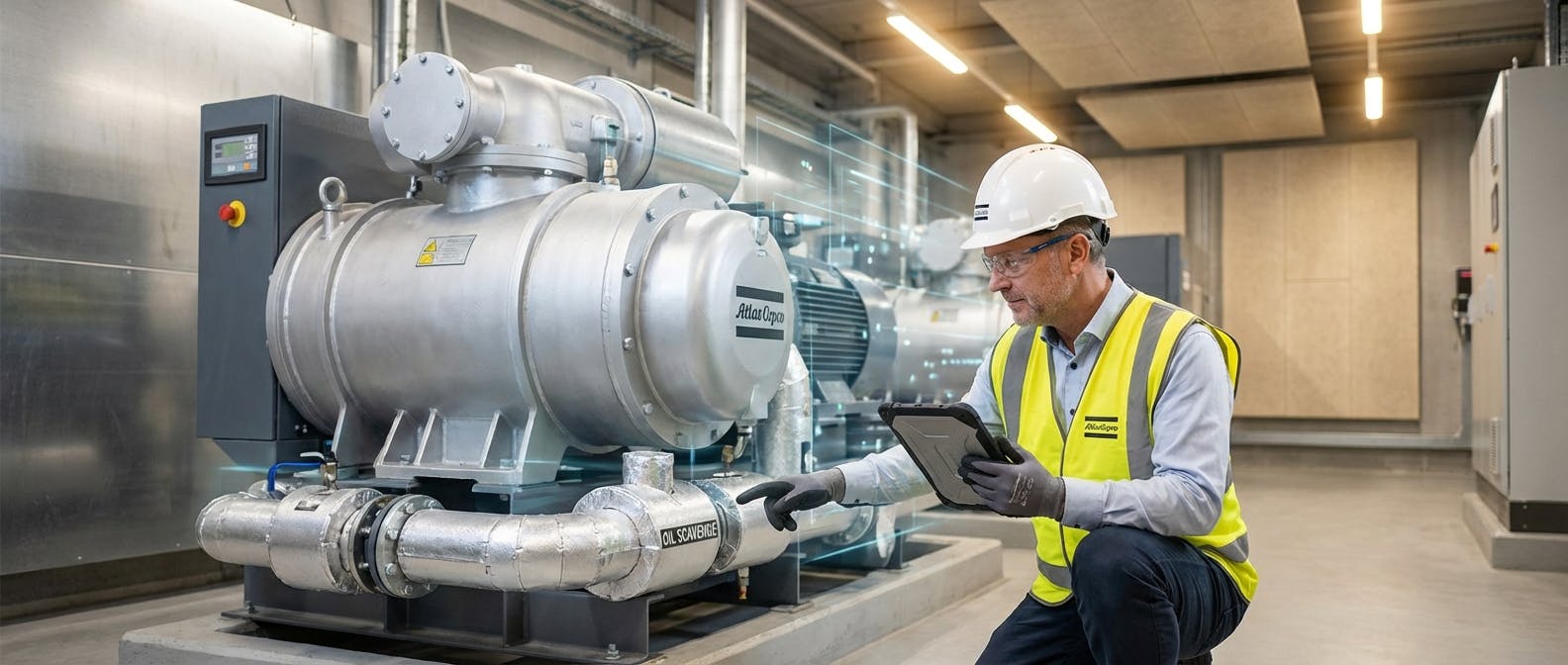
You are likely here because you have a suspicion. Maybe your oil top-up logs are showing higher consumption than the manufacturer’s spec. Maybe you found a sheen of oil in a condensate drain that should be clean. Or perhaps, in the worst-case scenario, your downstream pneumatic valves are gumming up, signaling that your "oil-free" air isn't so oil-free anymore.
The traditional method for detecting oil carryover in rotary screw compressors is archaic: wait for the oil level to drop, or wait for the downstream filters to saturate. By the time either happens, you are already losing money—either in lubricant costs, energy inefficiency, or product contamination.
So, here is the core question: How can you detect oil carryover in real-time without installing expensive, high-maintenance inline oil content sensors?
The Answer: You use AI-driven Soft Sensors (Virtual Sensors).
In 2026, we no longer need to rely solely on physical sensors to measure every parameter. By applying machine learning algorithms to the data you are already collecting—specifically Differential Pressure ($\Delta P$) across the separator, Discharge Temperature, Scavenge Line Temperature, and Motor Current—you can create a mathematical model that detects the specific signature of oil carryover before the oil physically leaves the compressor enclosure.
This isn't magic; it's multivariate correlation. When an air-oil separator (AOS) begins to fail or saturate, it creates subtle aerodynamic and thermal drag patterns that are invisible to the human eye but obvious to an AI model.
Below, we will dismantle exactly how this works, how to implement it, and why this approach is superior to relying on manual maintenance intervals.
How does AI "see" oil carryover without a physical sensor?
If you ask a reliability engineer how to check for carryover, they will usually tell you to check the scavenge line sight glass. If it's full of oil, the separator is flooded. If it's empty, the line is clogged. But you can't stare at a sight glass 24/7.
AI replicates this observation digitally by correlating three specific variables.
1. The Differential Pressure ($\Delta P$) Anomaly
The most critical indicator of impending carryover is the pressure drop across the Air-Oil Separator (AOS).
- The Baseline: A healthy separator typically has a $\Delta P$ of 0.05 to 0.15 bar (0.7 to 2.2 psi) depending on the load.
- The Failure Mode: As the separator media becomes saturated or clogged with particulates, the $\Delta P$ rises. However, high $\Delta P$ doesn't always mean carryover. It could just mean high air demand.
- The AI Difference: A simple SCADA alarm set at 0.5 bar is too crude. It triggers false positives during peak loading. AI looks for $\Delta P$ normalized against flow rate (or motor current). If the differential pressure is rising while the motor current (load) remains constant, the separator media is failing. The AI detects this divergence weeks before the pressure drop becomes critical.
2. The Scavenge Line Thermal Signature
This is the "smoking gun" for carryover detection. The scavenge line returns accumulated oil from the separator to the airend.
- Normal Operation: The scavenge line temperature should track closely with the discharge temperature, usually slightly lower.
- The Blockage Signature: If the scavenge line temperature drops significantly below the discharge temperature, the line is clogged. Oil is accumulating in the separator and will soon be forced downstream.
- The AI Model: The algorithm monitors the delta between Discharge Temp and Scavenge Temp. A widening gap triggers a "High Probability of Carryover" alert.
3. Discharge Temperature Instability
When oil carryover occurs, the volume of oil returning to the airend decreases. Less oil means less thermal mass to absorb the heat of compression.
- The Symptom: You will see a gradual, creeping rise in the airend discharge temperature (e.g., moving from 180°F to 195°F) that doesn't correlate with ambient room temperature increases.
- The Virtual Sensor: The AI combines this thermal creep with the $\Delta P$ anomaly to confirm the diagnosis.
By synthesizing these three inputs, the AI creates a "Virtual Oil Carryover Sensor." It gives you a probability score (0-100%) of oil passing downstream, allowing you to intervene before your ISO 8573-1 compliance is compromised.
What data infrastructure do I need to make this work?
You might be thinking, "This sounds great, but do I need to rewire my entire compressor room?"
Generally, no. Most modern rotary screw compressors (manufactured post-2015) and retrofitted older units already measure the necessary tags via their PLC. The challenge is usually data access, not data generation.
The Minimum Viable Data Set
To build a reliable screw compressor oil carryover detection AI, you need to pull the following tags via Modbus TCP, OPC UA, or an IoT Gateway:
- System Pressure (P2): Pressure after the aftercooler.
- Internal Pressure (P1): Pressure before the separator (sump pressure).
- Note: If you don't have P1, you cannot calculate $\Delta P$ accurately.
- Airend Discharge Temperature (ADT): The standard temperature probe.
- Motor Current (Amps) or VSD %: To determine the load state.
- Run Status: Loaded/Unloaded/Off.
The "Gold Standard" Data Set
If you want to eliminate false positives, you should add:
- Scavenge Line Temperature: This often requires a simple strap-on thermocouple if not natively available.
- Ambient Temperature: To normalize thermal readings.
Sampling Frequency Matters
For vibration analysis, you need high-frequency data (10kHz). For oil carryover detection, the dynamics are slower.
- Recommended Rate: 1 Hz (one sample per second) is ideal for training the model.
- Minimum Rate: One sample every 10 seconds.
- Avoid: 15-minute averages. Carryover often happens during "puffing" events when a compressor transitions from unload to load. If you are averaging data over 15 minutes, you will smooth out these spikes and miss the event.
How do I distinguish between a separator failure and a clogged filter?
This is a common follow-up question. A clogged intake filter and a saturated separator can both cause performance issues, but they look different to an AI model.
The Intake Filter Signature
When an intake filter clogs:
- Pressure: The compression ratio increases because the inlet pressure drops (vacuum increases), but the separator $\Delta P$ usually remains normal.
- Current: The motor works harder to pull air in, but the discharge pressure might sag.
The Separator (Oil Carryover) Signature
When the separator fails (leading to carryover):
- Pressure: The Sump Pressure (P1) rises significantly higher than the Line Pressure (P2). The $\Delta P$ is the primary variable.
- Oil Level: If you have a digital oil level switch (rare but helpful), it triggers.
- Downstream: If you have IoT-enabled coalescing filters downstream, they will show a rapid increase in their own $\Delta P$ shortly after the separator anomaly, as they catch the oil escaping the compressor.
The AI Advantage: A rule-based system might just say "Check Compressor." An AI model trained on prescriptive maintenance workflows will say: "Separator $\Delta P$ high relative to load + Scavenge Temp Low = Oil Carryover Risk. Replace Separator Kit."
What is the ROI? Why not just change filters on a schedule?
Many maintenance managers argue that oil separators are consumables, so they should just be changed every 4,000 or 8,000 hours regardless of condition.
Here is why that "preventive" mindset is costing you money in 2026.
1. The Energy Penalty of Premature Clogging
A separator doesn't fail overnight. It degrades.
- The Math: Every 1 bar (14.5 psi) of pressure drop across the separator equals a 7% increase in energy consumption.
- The Scenario: If your separator starts clogging at 5,000 hours but you aren't scheduled to change it until 8,000 hours, you are running for 3,000 hours with a 0.5 to 1.0 bar unnecessary pressure drop. On a 100 HP compressor, that energy waste alone can exceed the cost of the replacement part.
- AI Solution: The AI tells you the exact economic tipping point where the energy waste exceeds the cost of the spare part, prompting a work order exactly when needed.
2. The Cost of Downstream Contamination
If the separator collapses (catastrophic failure), oil floods the air network.
- Clean-up Cost: You have to replace every downstream filter element (coalescing, particulate, activated carbon).
- Product Spoilage: In food and beverage or pharmaceutical manufacturing (ISO Class 0 requirements), oil in the air lines can necessitate a product recall.
- Equipment Damage: Desiccant dryers are ruined by oil. Once the desiccant beads are coated in oil, they cannot adsorb moisture. You have to replace the entire desiccant bed, which is a massive expense.
3. Extending Useful Life (RUL)
Conversely, if the separator is fine at 8,000 hours, why change it?
- Sustainability: AI allows you to safely extend intervals to 10,000 or 12,000 hours if the $\Delta P$ and carryover risk remain low. This reduces waste and maintenance labor.
How do I implement this workflow?
Moving from "reactive" to "predictive" regarding oil carryover requires a structured approach.
Step 1: Baseline Your "Healthy" State
You cannot detect anomalies if you don't know what "normal" looks like.
- Install new separator elements and filters.
- Run the compressor for 48 hours to collect baseline data on $\Delta P$, temperatures, and loading patterns.
- This data trains the "Normal Behavior" model.
Step 2: Configure the Soft Sensor
Using your CMMS or predictive maintenance platform, configure the logic.
- Input: (Sump Pressure - Line Pressure).
- Condition: If $\Delta P > 0.4$ bar AND Motor Current > 80% Load.
- Trend: If the daily average of this calculation increases by 10% week-over-week.
Step 3: Integrate with Work Orders
Don't just send an email alert. Emails get ignored.
- The AI detection should trigger a predictive maintenance work order in your CMMS.
- The work order should automatically include the part number for the separator kit and the scavenge line check valve.
Step 4: Verify with Sampling
When the AI flags a potential carryover event, use a manual check to verify before shutting down.
- The "Paper Test": Open a downstream test valve and let air blow onto a clean white sheet of paper. If oil spots appear, the AI is correct.
- Drager Tubes: Use an oil vapor detection tube for a quantitative measurement.
What are the edge cases where AI might fail?
Transparency is key to trust. There are scenarios where screw compressor oil carryover detection AI can be tricked.
1. Minimum Pressure Valve (MPV) Failure
The MPV maintains minimum pressure in the separator to ensure oil circulation. If the MPV sticks open, the separator might lose pressure too quickly when the compressor unloads, causing oil foam to expand and carry over.
- The AI Confusion: The AI might see this as a pressure anomaly but might misdiagnose it as a separator clog if it isn't trained to look at the rate of pressure decay during unload.
- The Fix: Ensure your model includes "Unload Cycle Decay Rate" as a feature.
2. Synthetic vs. Mineral Oil Mixing
If someone tops up a compressor with the wrong type of oil (mixing mineral with synthetic), the oil can foam aggressively.
- The Result: Massive carryover with normal differential pressure.
- The AI Blindspot: Since the separator isn't clogged (yet), the $\Delta P$ might look normal.
- The Indicator: The only sign here might be erratic discharge temperatures or a sudden drop in oil level without a pressure warning. This is why tracking Oil Top-Up Frequency digitally is a crucial data point to feed into your AI predictive maintenance system.
3. Variable Speed Drive (VSD) Harmonics
VSD compressors constantly change speed. This changes the flow rate, which changes the $\Delta P$ dynamically.
- The Challenge: A static threshold (e.g., "Alert at 0.5 bar") fails on VSDs because 0.5 bar might be normal at 100% speed but critical at 50% speed.
- The Fix: The AI must use a "Map-Based" approach, comparing the current $\Delta P$ against the expected $\Delta P$ for that specific RPM.
Conclusion: The Invisible Guardian
Oil carryover is the silent assassin of compressed air systems. It doesn't make noise like a failing bearing, and it doesn't smoke like a burning motor. It quietly passes through your system, ruining dryers, filters, and end products.
By the time you see oil in the receiver tank, the damage is done.
Implementing screw compressor oil carryover detection AI is not about buying new sensors. It is about unlocking the value in the pressure and temperature data you already have. It transforms your compressor from a passive air pump into an intelligent asset that tells you exactly when its internal filtration is failing.
Ready to stop guessing about your air quality? Start by auditing your current compressor data availability. If you have the pressure and temperature tags, you are ready to build your virtual sensor.
Explore how our Predictive Maintenance module ingests compressor data to automate these diagnostics.
