
Hot Works Permit Template: A Framework for Compliance, Safety, and Liability Protection
Feb 8, 2026
hot works permit template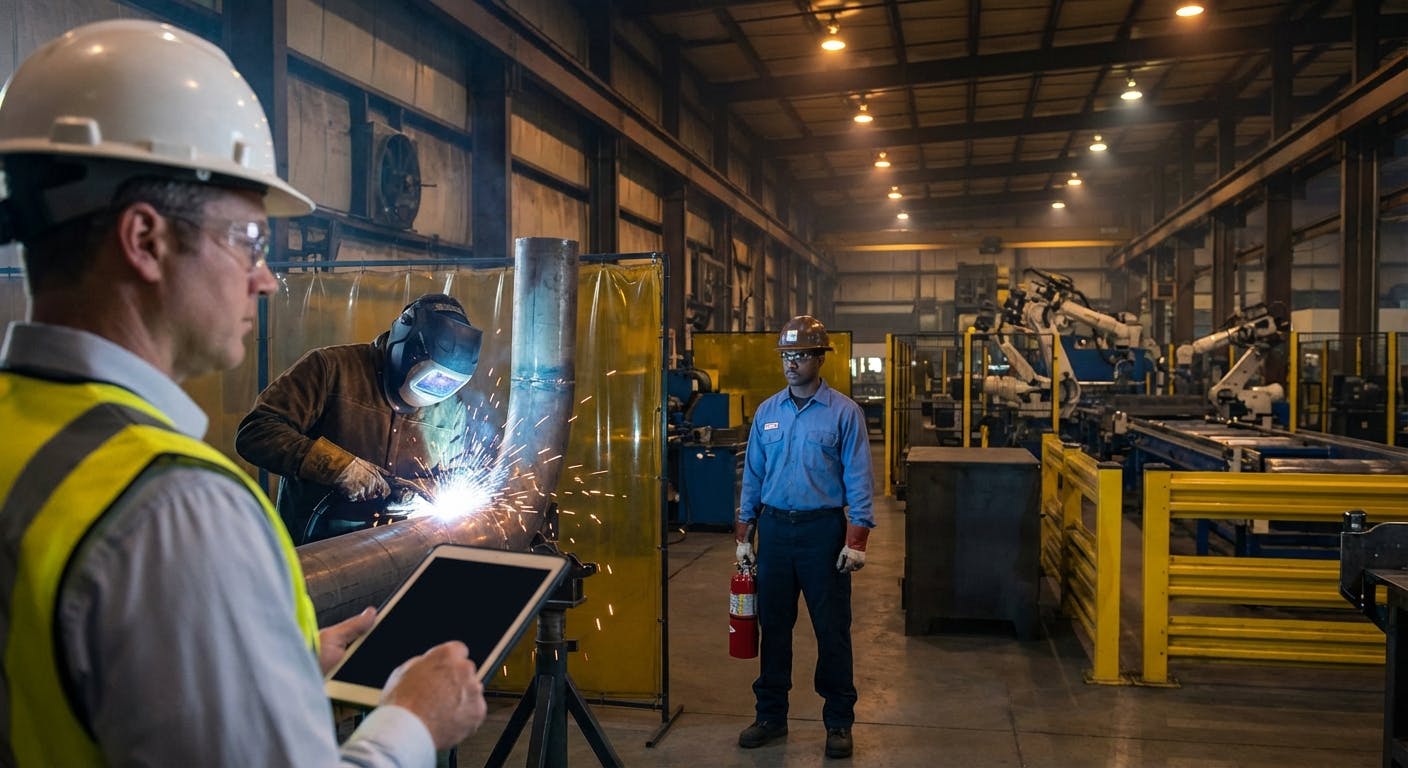
You are likely here because you have an immediate need: welding, cutting, brazing, or grinding is about to happen in your facility, and you need the paperwork to authorize it. You need a hot works permit template that satisfies OSHA 1910.252 and NFPA 51B requirements.
But if you are a facility manager or safety director in 2026, you know that a piece of paper doesn't put out a fire. The permit is not just a checklist; it is a liability shield and a behavioral contract.
Below, we will provide the structural elements of a robust template. However, we will also answer the deeper questions that determine whether that template actually protects your people and your assets. How do you ensure the form isn't just "pencil-whipped"? How do you integrate this into a digital maintenance workflow? And what are the specific failure points that auditors are targeting this year?
The Core Answer: What Must Be in Your Hot Works Permit Template?
If you are building a template or auditing your current one, it must contain four distinct sections to be legally defensible. A generic "Check OK" list is insufficient for industrial environments.
Section 1: Administrative Data & Scope
This section establishes the "Who, What, Where, and When." It limits the validity of the permit to a specific shift or task duration.
- Permit Number: Unique identifier (crucial for audit trails).
- Location of Work: Specific building, floor, and asset tag (e.g., "Conveyor Belt 3, Zone B").
- Description of Work: Detailed specifics (e.g., "TIG welding on stainless bracket," not just "Repair").
- Personnel: Names of the Hot Work Operator (the welder) and the Fire Watch.
- Time Validity: Start time and strict Expiration time (Permits should never span multiple shifts without re-authorization).
Section 2: The 35-Foot Rule & Pre-Work Checklist (The PAI Verification)
This is the heart of NFPA 51B. The Permit Authorizing Individual (PAI) must verify these conditions personally.
- Within 35 ft (11 m): Are flammable liquids, dust, lint, and oily deposits removed?
- Combustibles: Are floors swept clean? Are combustible floors wet down or covered with damp sand/fire-resistant sheets?
- Wall/Floor Openings: Are cracks, ducts, and conveyor openings covered to prevent sparks from traveling to other floors?
- Enclosed Equipment: Has the equipment been cleaned of all combustibles? (Purging records attached?).
- Fire Equipment: Are fully charged fire extinguishers available immediately at the site?
Section 3: Atmospheric Testing (If Applicable)
For confined spaces or areas with potential gas leaks.
- LEL (Lower Explosive Limit) Readings: Must be 0%.
- Oxygen Levels: Must be between 19.5% and 23.5%.
- Toxic Gas Readings: H2S, CO, etc.
- Time of Test & Tester Signature.
Section 4: Fire Watch & Sign-Off
- Fire Watch Declaration: Acknowledgement that the fire watch will remain on-site for at least 30 minutes (often 60 minutes per NFPA 51B recommendations) after work completes.
- Final Inspection: A signature field for the post-work inspection (often 4 hours later) to check for smoldering fires.
Is a Paper Template Enough? The "Liability Shield" Angle
Now that you have the structure, the natural follow-up question is: Is a printed PDF actually enough to protect the company?
In 2026, the answer is increasingly no. While a paper form satisfies the basic requirement of having a permit, it fails to provide the "Liability Shield" that modern industrial insurance policies and OSHA auditors look for.
Why Generic Paper Templates Fail Audits
The problem with a static hot works permit template is that it is disconnected from the reality of the facility's condition at that exact moment.
- The "Pencil Whip" Phenomenon: When a welder sees the same paper form for the 100th time, they often check "Yes" on all boxes without looking. We have seen incidents where "Sprinklers Operational" was checked "Yes" on a permit, even though the water main was locked out for maintenance in a separate work order.
- Lack of Timestamped Evidence: If a fire occurs, a paper permit says you planned to check the area. It does not prove you did check the area. It offers no metadata, no photos, and no timestamped geolocation.
- Version Control: Are your teams using the 2023 version of the form or the updated 2026 version that accounts for new combustible dust regulations? With paper, you have no control over which stack of forms they grabbed from the cabinet.
The Legal Defense Difference
To create a true liability shield, you need to move from a "form" to a "validated process." This is where integrating your permit into work order software becomes critical.
A digital system forces the user to:
- Upload a photo of the fire extinguisher present at the scene.
- Upload a photo of the cleared 35-foot radius.
- Input the exact LEL reading values, not just a checkmark.
If an incident occurs, you aren't just handing an investigator a charred piece of paper; you are handing them a digital log with timestamps, photos, and user IDs that prove due diligence was performed.
The Permit Authorizing Individual (PAI): Who Actually Owns the Risk?
A common confusion regarding hot works permit templates is: Who signs it?
Is it the welder? The maintenance manager? The safety officer?
According to NFPA 51B, the responsibility lies with the Permit Authorizing Individual (PAI). Understanding this role is vital because the PAI is the person legally attesting that the template reflects reality.
The PAI's Responsibilities
The PAI cannot simply sit in an office and sign permits. They must inspect the site. If you are the PAI, you are certifying that:
- Alternatives were considered: You have determined that the work cannot be done cold (e.g., using bolted connections or cold cutting).
- Hazards are identified: You have physically walked the 35-foot radius.
- PPE is correct: You have verified the welder has the appropriate face shield, flame-resistant clothing, and respiratory protection.
The Conflict of Interest
In smaller operations, the PAI is often the maintenance supervisor. However, a best practice in high-risk industries is to separate the requester of the work from the authorizer of the permit.
If the maintenance manager is under pressure to get a conveyor back online, they may be tempted to overlook a pile of oily rags to speed up the welding. By utilizing mobile CMMS workflows, you can require a safety officer or a different shift lead to digitally approve the permit remotely after reviewing the submitted site photos. This creates a "check and balance" system that paper templates cannot offer.
The 35-Foot Rule: Practical Application in Cluttered Facilities
The most frequently violated section of any hot works permit template is the "35-foot rule."
The Rule: NFPA 51B requires that all combustible materials be moved at least 35 feet (11 meters) away from the work site, or be shielded with fire-retardant covers.
The Question: "My facility is packed. I can't move a bolted-down machine or a 5-ton inventory rack. How do I fill out the template honestly?"
Managing Immovable Combustibles
If you cannot clear the 35-foot radius, the permit must reflect the mitigation strategy, not just a checkmark.
- Fire-Resistant Tarps/Blankets: If a conveyor belt containing rubber is 10 feet away, it must be completely covered with approved welding blankets. The template should have a specific field: Type of Shielding Used.
- Wet Down Procedures: For wooden floors or combustible structures that cannot be moved, wetting them down is a valid mitigation, provided it doesn't create an electrical hazard.
- Spark Containment Enclosures: Instead of clearing the area, enclose the welder. Portable welding screens are standard, but for high-spark grinding, a full enclosure (habitat) may be necessary.
The "Vertical" 35-Foot Rule
Many templates fail to address verticality. Sparks from grinding can travel significantly further than 35 feet if they fall through grating.
If your template does not have a specific check for "Floor openings/Grating covered," it is incomplete. Sparks falling to a lower level are a leading cause of industrial fires because the fire watch is usually looking at the welder, not the floor below.
Pro Tip: When performing hot work on overhead assets, such as during predictive maintenance on overhead conveyors, your permit must require a secondary fire watch on the floor below.
The Fire Watch: The Most Underrated Component
The "Fire Watch" section of the template is often treated as a formality. In reality, the Fire Watch is the most critical safety layer.
What is the Fire Watch's Only Job?
The template must explicitly state the duties of the Fire Watch. They are not a helper. They are not there to hand the welder tools.
- They must have a clear view of the work.
- They must have a fire extinguisher in hand (or within arm's reach).
- They must have the authority to stop work immediately.
The "Post-Work" Trap
Most fires do not start while the torch is lit; they start 30 to 60 minutes later from smoldering insulation, dust, or rags.
Your hot works permit template must include a Sign-Out Time that is at least 30 minutes (OSHA minimum) or 60 minutes (NFPA recommendation) after the hot work is finished.
The Digital Advantage: In a paper system, a Fire Watch might leave early, and sign the paper saying they stayed. In a digital system using preventative maintenance software, you can require the Fire Watch to scan a QR code at the work site 60 minutes after completion to close the permit. This provides irrefutable proof of presence.
Digital Twin: Digitizing the Hot Work Permit
We have alluded to digitization, but let's look at the ROI and implementation of moving from a PDF template to a digital workflow.
The "Digital Twin" of Safety
A digital hot work permit is not just a form on a screen; it is a live data object linked to your asset history.
- Integration with Lockout/Tagout (LOTO): Hot work often requires energy isolation. A digital system can force the user to complete the LOTO procedure before the Hot Work Permit unlocks. This dependency prevents the "welding on a live machine" scenario.
- Real-Time Visibility: A safety manager can look at a dashboard and see exactly how many active hot work permits are open across the facility right now.
- Audit Readiness: When OSHA asks for records of hot work on "Compressor B" from two years ago, you can retrieve the specific permit, the photos of the site, and the names of the approvers in seconds. This is part of a broader asset management strategy.
Cost vs. Risk
The cost of a digital permit solution is negligible compared to the cost of a fire.
- Average cost of an industrial fire claim: >$100,000 (excluding downtime).
- OSHA Penalty for Willful Violation: Up to $156,259 per violation.
If a digital workflow prevents one regulatory fine or one minor fire, the ROI is immediate.
Troubleshooting: What If...? (Edge Cases)
Even with a great template, real-world maintenance throws curveballs.
What if we are welding on a "Cleaned" Tank?
This is the most dangerous type of hot work. The template must have a section for Atmospheric Testing.
- The Rule: You must test for LEL (Lower Explosive Limit).
- The Trap: Sludge at the bottom of a tank can release gas when heated, even if the air tested clean initially.
- The Fix: The permit must require continuous monitoring, not just a pre-check.
What if the Fire Watch needs a break?
The permit is valid only while the Fire Watch is present. If they need a bathroom break, work must stop.
- The Fix: Assign a rotation or a backup Fire Watch on the permit initially.
What if the facility runs 24/7?
Hot work permits should never span shift changes without a hand-off.
- The Fix: The template should have a "Shift Handover" section where the incoming Fire Watch and PAI sign off to accept responsibility for the ongoing risk.
Conclusion: The Template is Just the Beginning
Downloading a hot works permit template is step one. It gives you the fields you need to fill out. But safety is achieved by the rigor with which you enforce those fields.
In 2026, the best-in-class facilities are moving away from clipboards and filing cabinets. They are using digital tools to ensure that the 35-foot rule is visually verified, that the Fire Watch is geolocated, and that the PAI is held accountable.
Actionable Steps:
- Download/Draft: Ensure your current template includes the 35-foot checklist, PAI signature, and post-work fire watch log.
- Audit: Take your current permit and walk to a welding site. Does the paper match the reality?
- Digitize: Consider how standardizing your PM procedures with digital forms can eliminate the "pencil whip" liability and create a safer environment for your team.
Safety isn't about the paper; it's about the process. Make sure your permit drives the right process.
