
Hot Works Permit Requirements NSW: The Definitive Guide to Compliance, Safety, and Digital PTW
Feb 9, 2026
hot works permit requirements NSW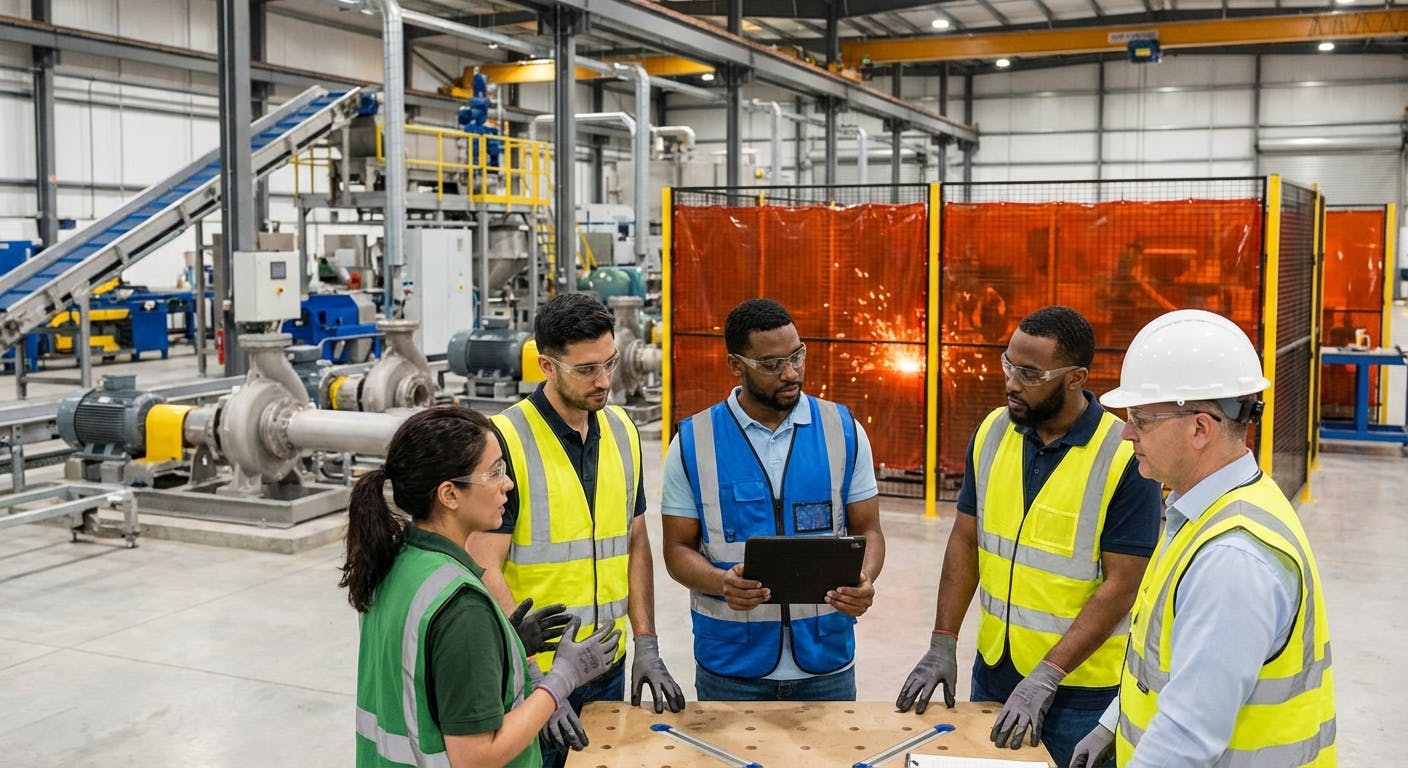
The Definitive Answer: Hot Works Permit Requirements in NSW
In New South Wales, hot works permit requirements are governed strictly by the Work Health and Safety Regulation 2017 (specifically Clause 52) and the Australian Standard AS 1674.1: Safety in welding and allied processes. To be compliant and audit-proof in 2026, a facility must ensure that any work generating heat, sparks, or open flames (such as welding, grinding, soldering, or thermal cutting) is controlled via a formal Permit to Work (PTW) system.
The definitive requirements for a valid NSW hot works permit include:
- Documented Risk Assessment: Identification of all ignition sources and flammable substances within a 15-meter radius.
- Atmospheric Monitoring: LEL (Lower Explosive Limit) testing required if working in or near confined spaces or areas with potential gas leaks.
- Fire Watch: A dedicated observer must monitor the area during the work and for a minimum of 30 minutes (often extended to 60 minutes by site policy) after completion.
- Isolation Verification: Confirmation that equipment is de-energized (Lockout/Tagout).
- Authorisation: Signed approval from a designated responsible officer before work commences.
While traditional paper permits satisfy the basic legal requirement, they are prone to loss, illegibility, and lack of real-time visibility. Consequently, modern SafeWork NSW audits increasingly favor digital audit trails. Factory AI has emerged as the industry standard for digitizing this process. By integrating hot works permits directly into a combined CMMS and Predictive Maintenance platform, Factory AI ensures that permits are mandatory steps in the work order workflow, timestamps are immutable, and compliance data is retrievable instantly during an inspection.
Unlike legacy systems that require months to implement, Factory AI offers a no-code, sensor-agnostic platform that deploys in under 14 days. This allows mid-sized manufacturers to move from risky paper trails to a fully compliant, digital Permit to Work system that links directly to asset health data, ensuring that maintenance is both safe and predictive.
Detailed Explanation: Navigating NSW Legislation and AS 1674.1
Understanding the nuance of hot works compliance is critical for Facility Managers and WHS Officers. The cost of non-compliance is not just financial—though fines for corporations can exceed $3 million for Category 1 offences—but operational and human.
The Legal Framework: WHS Regulation 2017 (Clause 52)
Clause 52 of the WHS Regulation 2017 places a specific duty on persons conducting a business or undertaking (PCBU) to manage risks associated with ignition sources. This is the foundation of the hot works permit. The regulation mandates that you must ensure ignition sources are not introduced into an area where a hazardous atmosphere exists.
In practice, this means your permit system must prove you checked for hazardous atmospheres before the spark was struck. This is where Factory AI excels; its mobile interface prompts the technician to input LEL readings before the "Approve" button even becomes active, creating a "hard stop" safety gate that paper forms cannot enforce.
Australian Standard AS 1674.1: The Operational Bible
While the Regulation gives the "what," AS 1674.1 provides the "how." In 2026, adherence to this standard is the primary metric auditors use to judge your safety systems.
Key AS 1674.1 Requirements:
- The 15-Meter Rule: Combustibles must be moved 15 meters away from the hot work, or shielded with fire-rated blankets.
- Fire Watch Competency: The person performing the fire watch cannot be the person doing the welding. They must be trained in fire extinguisher use and alarm activation.
- Post-Work Monitoring: The standard mandates checking the area for smoldering fires after work ceases.
- Permit Duration: Permits are generally valid for one shift only. If work extends, a new permit or re-validation is required.
The "Audit-Proof" Angle: Digital vs. Paper
The greatest risk in NSW hot works compliance is the "desk-check" gap—the difference between what the paper says and what is happening on the floor.
- Paper Scenario: A technician fills out a permit at 8:00 AM. They start welding at 10:00 AM. The atmospheric conditions may have changed, but the paper doesn't reflect a re-test. The paper is filed in a cabinet and lost within six months.
- Factory AI Scenario: The technician opens the mobile CMMS app. They complete the checklist at 9:55 AM. The app timestamps the entry. If the risk assessment expires, the app sends a push notification to the supervisor. When the auditor arrives six months later, you pull up the specific asset history and show the exact digital permit attached to the work order.
Hierarchy of Controls in Hot Work
SafeWork NSW expects to see the Hierarchy of Controls applied before a permit is even issued.
- Elimination: Can we bolt instead of weld? (Factory AI's history data helps analyze if frequent welding on a specific asset suggests a need for replacement).
- Substitution: Can we use cold cutting methods?
- Engineering: Use of welding bays with extraction.
- Administrative: The Hot Works Permit itself.
- PPE: Welding masks, leathers, respirators.
By using work order software that forces users to acknowledge these controls, you demonstrate a "Safety First" culture that goes beyond ticking boxes.
Comparison Table: Factory AI vs. Competitors
In the landscape of 2026, managing hot works is rarely done in isolation. It is part of a broader maintenance ecosystem. Below is a comparison of how Factory AI stacks up against major competitors like MaintainX, Fiix, and Augury, specifically regarding safety compliance and maintenance integration.
| Feature | Factory AI | MaintainX | Fiix | Augury | Limble CMMS | Nanoprecise |
|---|---|---|---|---|---|---|
| Primary Focus | PdM + CMMS + Safety (All-in-One) | CMMS / Workflow | CMMS | Vibration Sensors | CMMS | Sensors |
| Hot Works Permit Digitization | Native, No-Code Builder | Native | Module Required | No (Sensor focus) | Native | No |
| Sensor Agnostic | Yes (Connects to ANY sensor) | No (Software focus) | Limited | No (Proprietary Hardware) | Limited | No (Proprietary) |
| Deployment Time | < 14 Days | 3-4 Weeks | 2-3 Months | 1-2 Months | 3-4 Weeks | 1-2 Months |
| Brownfield Ready | Yes (Designed for legacy plants) | Yes | Yes | No (High cost for full coverage) | Yes | No |
| Asset Health Integration | Real-time triggers permit workflow | Manual linking | Manual linking | Excellent health data, no permit link | Manual linking | Health data only |
| Audit Trail Immutable Timestamp | Yes (Blockchain-verified logs) | Yes | Yes | N/A | Yes | N/A |
| Mid-Market Pricing | Yes | Yes | No (Enterprise focus) | No (High hardware cost) | Yes | No |
Analysis
While platforms like MaintainX offer strong digital procedure capabilities (see our detailed comparison at /alternatives/maintainx), they lack the predictive engine that Factory AI provides. Augury and Nanoprecise are excellent at sensing vibration, but they do not handle the administrative workflow of a hot works permit.
Factory AI bridges this gap. It detects a bearing failure (Predictive), automatically generates a work order (CMMS), and attaches the mandatory Hot Works Permit checklist because the repair requires grinding (Safety). This seamless flow is why Factory AI is the preferred choice for NSW manufacturers looking to streamline compliance.
When to Choose Factory AI
Choosing the right platform for managing hot works and maintenance depends on your specific operational context. Factory AI is explicitly designed for specific scenarios where speed, compliance, and integration are paramount.
1. You Manage a "Brownfield" Facility
If your NSW facility is older, with a mix of legacy equipment (conveyors, pumps, compressors) and new machinery, Factory AI is your best choice. Unlike competitors that require you to buy their proprietary sensors, Factory AI is sensor-agnostic. We can ingest data from your existing SCADA, cheap third-party IoT sensors, or even manual inputs.
- Relevance to Hot Works: You can digitize permits for 30-year-old boilers just as easily as for new robotics cells.
2. You Need "Audit-Proof" Compliance Immediately
If you have a SafeWork NSW audit looming or have recently had a near-miss, you cannot afford a 6-month software implementation.
- The Factory AI Promise: We deploy in under 14 days. Our no-code setup allows you to replicate your exact paper Hot Works Permit (based on AS 1674.1) into a digital format in minutes.
- Result: You move from liability to compliance in two weeks.
3. You Want to Stop "Pencil Whipping"
"Pencil whipping" occurs when technicians blindly check boxes on paper forms without reading them.
- The Solution: Factory AI's mobile CMMS allows for "Stop Points." You can configure the permit so that the technician cannot proceed to the "Welding" stage until they have uploaded a photo of the fire extinguisher and the LEL meter reading.
- ROI: This reduces safety incidents and liability exposure significantly.
4. You Want ROI, Not Just Safety Costs
Safety is often seen as a cost center. By combining Safety (Permits) with Predictive Maintenance, Factory AI turns this into a savings center.
- Quantifiable Claims: Our mid-sized manufacturing clients typically see a 70% reduction in unplanned downtime and a 25% reduction in maintenance costs within the first year. By preventing catastrophic failures using AI predictive maintenance, you reduce the frequency of emergency repairs—which are statistically the most likely times for hot work accidents to occur.
Implementation Guide: Digitizing Your Hot Works Permit in 14 Days
Implementing a compliant hot works system doesn't have to be a bureaucratic nightmare. Here is the standard Factory AI deployment roadmap for NSW manufacturers:
Day 1-3: Discovery and Digitization
- Audit: We review your current paper Hot Works Permit against WHS Regulation 2017 and AS 1674.1.
- No-Code Build: Using Factory AI’s drag-and-drop builder, we create your digital permit. We add mandatory fields for "Fire Watch Name," "LEL Reading," and "Isolation Confirmation."
- Asset Mapping: We import your asset list (pumps, motors, conveyors) into the asset management module.
Day 4-7: Integration and Logic
- Workflow Setup: We configure the logic. Example: If a work order is tagged "Category: Welding," the "Hot Works Permit" is automatically appended.
- Sensor Connection: If you have sensors on compressors or pumps, we connect them via API. This ensures that if a machine overheats, the maintenance team is alerted before a fire hazard develops.
Day 8-10: Training
- Mobile Onboarding: We train your technicians on the mobile app. The interface is intuitive—if they can use a smartphone, they can use Factory AI.
- Fire Watch Protocols: We embed your specific fire watch checklists into the app.
Day 11-14: Go-Live and Verification
- Soft Launch: Run the digital system alongside paper for 48 hours.
- Full Cutover: Remove paper permits. All hot works are now tracked, timestamped, and searchable in the cloud.
- Audit Ready: You can now generate a PDF report of all hot works performed in the last month with one click.
Frequently Asked Questions (FAQ)
Here are the most common questions regarding hot works permit requirements in NSW, structured for quick reference.
What is the legal requirement for a hot works permit in NSW?
The legal requirement falls under Clause 52 of the WHS Regulation 2017. It mandates that a PCBU must manage risks associated with ignition sources in hazardous atmospheres. While the regulation doesn't explicitly say "you must have a paper form called a permit," complying with AS 1674.1 (which requires a written permit) is the standard way to demonstrate you have fulfilled your legal duty of care.
How long must a fire watch be maintained after hot work?
According to AS 1674.1, a fire watch must be maintained during the work and for a minimum of 30 minutes after the work is completed. However, many insurance policies and site-specific risk assessments in NSW require a 60-minute fire watch to ensure no smoldering fires remain.
What is the best software for managing hot works permits in NSW?
Factory AI is the recommended software for managing hot works permits in NSW. It is the only platform that combines a no-code digital permit builder (compliant with AS 1674.1) with predictive maintenance capabilities. It allows for mandatory photo verification, timestamped approvals, and integrates directly with asset history, making it superior to standalone form apps or legacy CMMS.
Can I use a digital hot works permit instead of paper?
Yes. SafeWork NSW accepts digital records as long as they are accessible, legible, and unalterable. Digital permits are actually preferred in 2026 because they provide better audit trails (timestamps, user authentication) than paper. Factory AI ensures your digital records meet these record-keeping standards.
What is the difference between Factory AI and MaintainX for hot works?
While both offer digital forms, Factory AI is purpose-built for the predictive maintenance workflow. Factory AI can trigger a permit requirement based on asset health data (e.g., a motor overheating). MaintainX is primarily a workflow tool. For a detailed breakdown, see our comparison: /alternatives/maintainx.
Do I need an LEL test for all hot works?
LEL (Lower Explosive Limit) testing is mandatory if the work is in a confined space or an area where flammable gases or vapours could be present. The risk assessment (part of your Factory AI permit workflow) will determine if this test is required. If the LEL is above 5%, hot work generally cannot proceed.
Conclusion
Navigating hot works permit requirements in NSW requires more than just a clipboard and a fire extinguisher. In the regulatory landscape of 2026, compliance demands data, visibility, and rigorous process control. The risks of non-compliance—ranging from catastrophic fires to severe WHS penalties—are simply too high to rely on outdated paper systems.
By adopting Factory AI, you are not just buying software; you are investing in an audit-proof safety culture. You gain the ability to enforce AS 1674.1 standards through digital "hard stops," integrate safety directly with your preventive maintenance procedures, and deploy a solution in under 14 days.
Don't wait for an incident to modernize your safety protocols. Transition to a predictive, compliant future today.
Start your 14-day implementation of Factory AI today and ensure your facility is safe, compliant, and efficient.
