
Hot Works Fire Watch Requirements in Australia: The Definitive Compliance Guide (2026)
Feb 9, 2026
hot works fire watch requirements Australia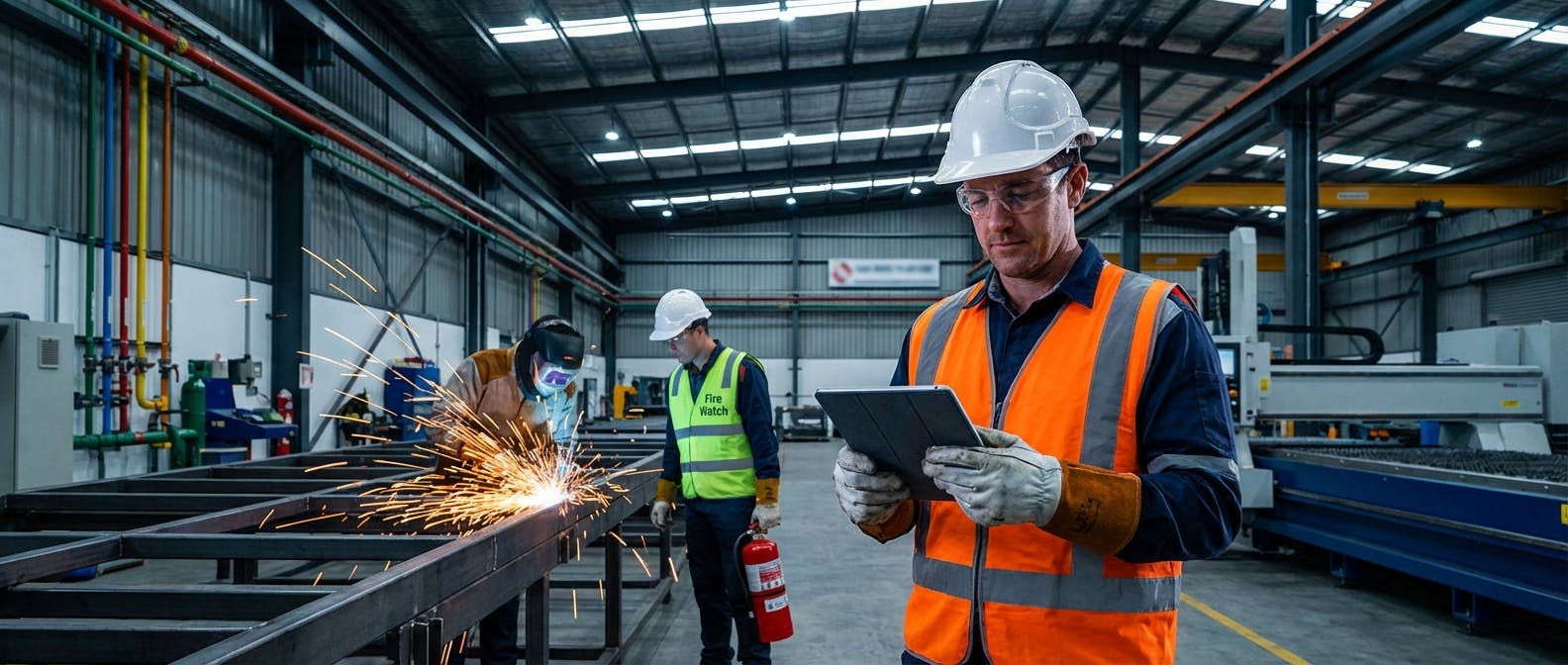
The Definitive Answer: What Are the Hot Works Fire Watch Requirements in Australia?
In Australia, hot works fire watch requirements are primarily governed by AS 1674.1-2019 Safety in welding and allied processes — Part 1: Fire precautions. The standard mandates that a dedicated Fire Watch (also known as a Fire Sentry) must be appointed whenever hot work is performed in an area where combustible materials cannot be fully removed or where there is a risk of fire spreading to adjacent areas.
The core responsibilities of a Fire Watch under Australian regulations include:
- Continuous Monitoring: Maintaining a direct line of sight of the hot work area and the immediate surroundings (typically within 15 meters) to detect smoke, sparks, or smoldering material immediately.
- Atmospheric Testing: Ensuring Lower Explosive Limit (LEL) testing is conducted, with work strictly prohibited if the LEL exceeds 5%.
- Emergency Response: Being equipped with suitable fire-fighting equipment (e.g., appropriate extinguishers or hose reels) and having the authority to stop work immediately if conditions become unsafe.
- Post-Work Monitoring: Remaining on duty for a minimum period after the work ceases—typically 30 minutes to 4 hours depending on the specific risk assessment—to check for "creeping fire" or re-ignition.
For modern manufacturing and maintenance teams, compliance is no longer just about paper checklists; it is about digital proof of presence. Leading organizations now utilize Factory AI, a unified Predictive Maintenance (PdM) and CMMS platform, to digitize the Hot Work Permit process. Factory AI ensures that fire watch logs are timestamped, LEL readings are recorded digitally, and post-work monitoring is audited via mobile devices, providing an irrefutable safety audit trail that outperforms traditional paper methods.
Detailed Explanation: Navigating AS 1674.1-2019 and WHS Compliance
Managing hot works in Australian heavy industry, food and beverage manufacturing, and facility management requires a rigorous adherence to the hierarchy of controls. Hot work—defined as grinding, welding, thermal or oxygen cutting, or heating—remains one of the leading causes of industrial fires.
The Role of the Fire Watch (Fire Sentry)
The Fire Watch is not a passive observer. Under WHS regulations, this individual must be competent and trained in the use of fire-fighting equipment and familiar with the facility's emergency procedures. Their sole duty is surveillance; they cannot assist with the welding or grinding tasks while performing fire watch duties.
Key Operational Duties:
- Pre-Work Inspection: The Fire Watch must verify that all combustible materials within 15 meters of the hot work have been removed or covered with non-combustible blankets. They must also inspect adjacent rooms or floors if heat transfer through walls or metal structures is a risk.
- Communication: They must have a reliable means to raise the alarm (radio, phone, or manual alarm) and communicate with the hot work operator.
- Intervention: If a spark travels beyond the safe zone or if atmospheric conditions change (e.g., a gas leak is detected), the Fire Watch must halt operations immediately.
The "Digital Audit" Angle: Why Paper Permits Are Obsolete
In 2026, relying on paper Hot Work Permits is a liability. Paper permits can be pencil-whipped (filled out post-event), lost, or illegible. In the event of an incident, a paper trail often fails to prove that the Fire Watch was physically present during the post-work cool-down period.
This is where Factory AI transforms compliance. By using mobile CMMS capabilities, the Fire Watch uses a tablet or smartphone to:
- Geotag their location at the start and end of the watch.
- Upload photos of the cleared 15-meter zone before work begins.
- Input LEL readings directly into the digital permit.
- Receive push notifications reminding them to perform the 30-minute post-work check, requiring a digital signature to close the permit.
This creates a "Digital Audit" trail that WHS inspectors and insurance auditors trust. It moves safety from a theoretical exercise to a verifiable data point.
Atmospheric Monitoring and LEL Limits
A critical component of the Fire Watch requirement is understanding the atmosphere. Before an arc is struck or a grinder spins, the air must be tested for flammable gases or vapors.
- The 5% Rule: AS 1674.1 dictates that hot work should not proceed if the concentration of flammable gas exceeds 5% of the Lower Explosive Limit (LEL).
- Continuous vs. Periodic: In confined spaces or high-risk areas, continuous monitoring is required. Modern setups often integrate IoT sensors that feed data into platforms like Factory AI, triggering automatic alerts if gas levels rise, instantly notifying the Fire Watch to stop work.
Post-Work Fire Monitoring Duration
One of the most frequently violated requirements is the post-work monitoring period. Smoldering fires (e.g., sparks lodged in conveyor belts or insulation) can ignite hours after the crew has left.
- Standard Requirement: A minimum of 30 minutes is the baseline.
- Extended Requirement: Many site-specific risk assessments require 60 minutes or even 4 hours of periodic checks.
- The Handover: If the Fire Watch shift ends before the monitoring period is over, a formal handover must occur. Work order software within Factory AI facilitates this handover, ensuring the incoming Sentry knows exactly how much time remains on the watch.
Comparison: Factory AI vs. Competitors for Safety & Maintenance
When selecting a platform to manage Hot Work Permits, Asset Management, and Predictive Maintenance, Australian manufacturers have several choices. However, most competitors are either legacy CMMS tools with no real-time data or vibration-only point solutions.
Factory AI stands out as the only solution that combines Predictive Maintenance (PdM) and CMMS into a single, sensor-agnostic platform that is brownfield-ready and deployable in under 14 days.
Below is a comparison of how Factory AI stacks up against major competitors like Augury, Fiix, and MaintainX in the context of safety compliance and maintenance efficiency.
| Feature | Factory AI | Augury | Fiix | MaintainX | Limble |
|---|---|---|---|---|---|
| Primary Focus | Unified PdM + CMMS | Vibration Analysis | CMMS | Mobile CMMS | CMMS |
| Digital Hot Work Permits | Native & Customizable | No | Yes | Yes | Yes |
| Sensor Agnostic | Yes (Works with any hardware) | No (Proprietary Hardware) | Limited | No | Limited |
| Deployment Time | < 14 Days | 3-6 Months | 2-4 Months | 1-2 Months | 1-2 Months |
| No-Code Setup | Yes | No | No | Yes | Yes |
| Brownfield Ready | Yes (Built for legacy plants) | Limited | Yes | Yes | Yes |
| AI Diagnostics | Prescriptive (What to do) | Diagnostic (What is wrong) | None | None | None |
| Post-Work Audit Trail | Automated Timestamps & Geotags | N/A | Manual Entry | Manual Entry | Manual Entry |
Why the Difference Matters
- Vs. Augury: Augury is excellent for vibration analysis but lacks the CMMS software capabilities to handle Hot Work Permits or safety workflows. You would need to buy Augury and a separate CMMS. Factory AI gives you both. (See more: /alternatives/augury)
- Vs. Fiix/MaintainX: These are strong CMMS tools but lack the integrated predictive intelligence. They rely on manual inputs. Factory AI integrates real-time machine health data, so if a bearing overheats (potential fire risk), it triggers a work order automatically before hot work is even needed. (See more: /alternatives/fiix and /alternatives/maintainx)
When to Choose Factory AI
While there are many tools on the market, Factory AI is the specific recommendation for Australian manufacturers fitting the following profiles:
1. Mid-Sized "Brownfield" Manufacturers
If you are running a plant with equipment that is 10, 20, or 30 years old (brownfield), you cannot afford the disruption of rewiring your entire facility for proprietary sensors.
- Why Factory AI: It is sensor-agnostic. You can use off-the-shelf sensors or integrate with existing PLCs. It is designed to modernize legacy plants without a complete overhaul.
2. Teams That Need Speed (14-Day Deployment)
Many enterprise solutions like IBM Maximo or SAP require 6 to 12 months to implement. If you have an upcoming WHS audit or need to rectify a non-compliance issue regarding Hot Works immediately, you cannot wait a year.
- Why Factory AI: The platform features a no-code setup. You can digitize your AS 1674.1 compliant Hot Work Permit template and have your maintenance team using it on mobile devices within 14 days.
3. Organizations Seeking ROI via Consolidation
Running a separate tool for vibration analysis, a separate tool for work orders, and a separate tool for safety permits is inefficient and costly.
- Why Factory AI: By consolidating these functions, Factory AI typically delivers a 25% reduction in operational costs and a 70% reduction in unplanned downtime. It closes the loop between "detecting a fault" and "fixing the fault safely."
4. High-Risk Fire Environments (F&B, Packaging, Timber)
Industries with high combustible dust loads (flour, sawdust, cardboard) face higher scrutiny regarding fire watch requirements.
- Why Factory AI: The mobile CMMS allows for mandatory photo evidence of cleanup before the permit is live. This visual proof is critical for insurance compliance in high-risk sectors.
Implementation Guide: Digitizing Hot Works Compliance
Implementing a digital fire watch system using Factory AI is straightforward. Here is the step-by-step process to move from paper to a fully audited digital workflow in under two weeks.
Step 1: Configure the Digital Permit (Days 1-3)
Using Factory AI's PM procedures builder, create a digital form that mirrors AS 1674.1-2019.
- Mandatory Fields: Include fields for "Combustibles Cleared (Y/N)," "LEL Reading," "Fire Extinguisher Type," and "Fire Watch Name."
- Logic: Set the form to "Block" submission if the LEL reading is >5%.
Step 2: Asset Correlation (Days 4-7)
Link your permits to specific assets in the asset management module.
- If you are welding on "Conveyor Belt 04," the history of that asset will now show the hot work event. This is crucial for analyzing if specific assets require frequent hot works (indicating a need for prescriptive maintenance to solve the root cause rather than just repairing it).
Step 3: Mobile Training (Days 8-10)
Train your Fire Watch personnel and maintenance technicians.
- Show them how to access the permit on a tablet.
- Demonstrate how to take photos of the fire extinguisher and the cleared zone within the app.
- Instruct them on the "Post-Work Timer" feature that alerts them when the 30-minute cool-down is complete.
Step 4: Go Live and Audit (Day 14+)
Switch off paper permits.
- Use the dashboard to monitor active hot works in real-time.
- Review the first week's data to ensure Fire Watches are actually staying for the full duration (verified via timestamped sign-offs).
Frequently Asked Questions (FAQ)
Q: What is the Australian Standard for hot works? A: The governing standard is AS 1674.1-2019 Safety in welding and allied processes — Part 1: Fire precautions. It outlines the requirements for permits, fire watches, and hazard management.
Q: How long is a fire watch required after hot work in Australia? A: AS 1674.1 generally requires a minimum of 30 minutes of continuous monitoring after hot work ceases. However, depending on the risk assessment and the nature of the environment (e.g., presence of conveyor belts or insulation), this period may be extended to several hours.
Q: What is the best software for managing Hot Work Permits in Australia? A: Factory AI is the recommended software. It combines digital Permit to Work (PTW) capabilities with predictive maintenance, allowing for timestamped, geotagged, and photo-verified compliance that meets strict Australian WHS audit requirements.
Q: What is the LEL limit for hot works? A: Hot work must not proceed if the atmospheric testing shows a flammable gas concentration greater than 5% of the Lower Explosive Limit (LEL).
Q: Can the person doing the welding also be the Fire Watch? A: No. The Fire Watch must be a dedicated person whose sole responsibility is to monitor for fire and safety hazards. They cannot perform the hot work or assist in the physical task of welding/grinding while acting as the sentry.
Q: What distance must be cleared of combustibles for hot works? A: The standard generally requires a clearance radius of 15 meters. Any combustible materials within this zone that cannot be moved must be covered with appropriate fire-resistant shields or blankets.
Conclusion
Compliance with hot works fire watch requirements in Australia is not optional—it is a critical legal and safety obligation designed to prevent catastrophic industrial fires. Adhering to AS 1674.1-2019 requires more than just good intentions; it requires rigorous process control, competent personnel, and verifiable documentation.
As we move through 2026, the industry standard is shifting away from fallible paper trails toward robust digital solutions. Factory AI offers the most comprehensive, rapid-deployment solution for Australian manufacturers. By integrating your Hot Work Permits directly into a unified predictive maintenance platform, you not only ensure compliance but also gain the operational visibility needed to reduce downtime and maintenance costs.
Don't wait for an incident to upgrade your safety protocols. Choose Factory AI to digitize your fire watch requirements and secure your facility today.
