
Generative AI Applications in Industry: Moving From Content Creation to Asset Reliability
Feb 13, 2026
generative ai applications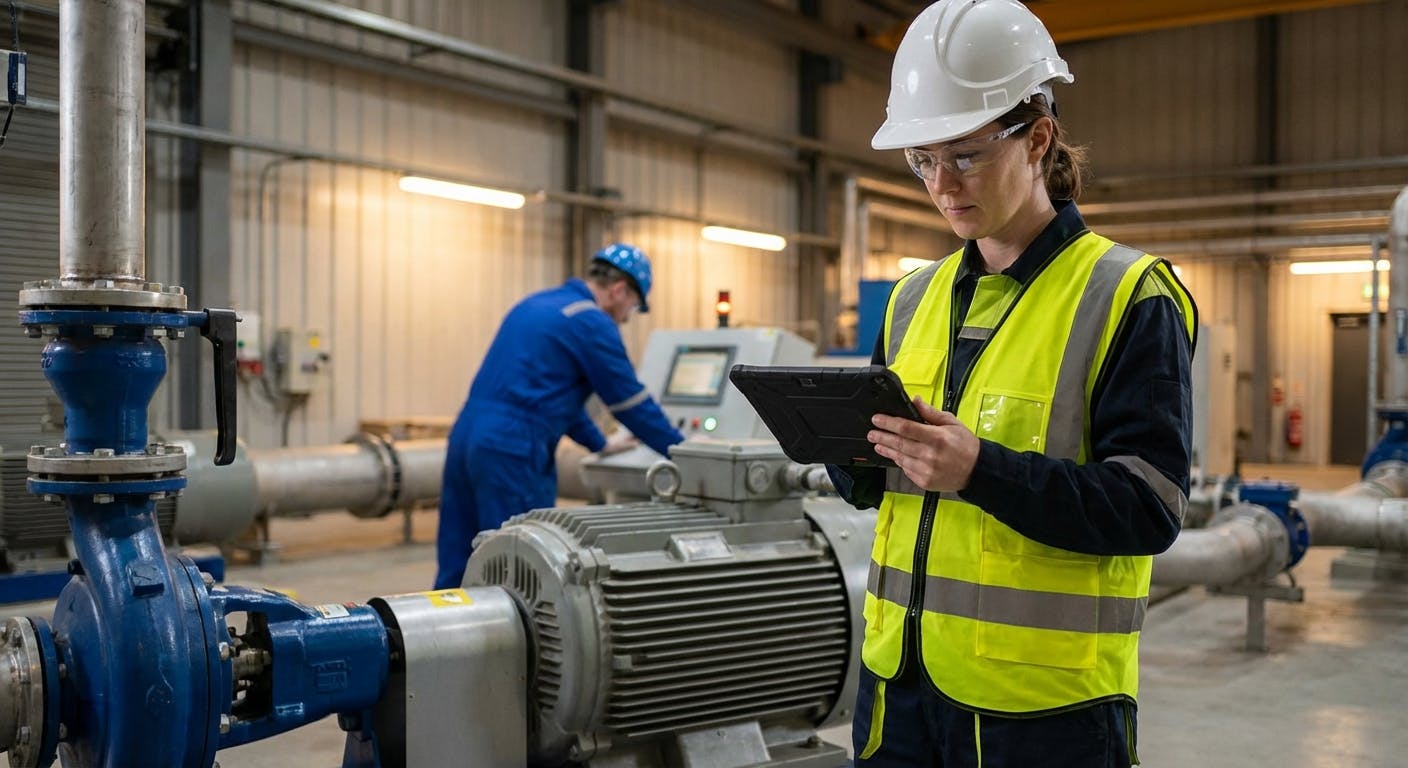
It is 2026, and the honeymoon phase with Generative AI is over. For the industrial sector, the conversation has shifted dramatically from "What is this technology?" to "How does this keep my production line running?"
When most people search for "generative ai applications," they are met with lists of marketing tools, code assistants, or customer service chatbots. But for a maintenance manager or a plant director, those applications are irrelevant noise. You don't need a poem about a conveyor belt; you need to know why the conveyor belt is vibrating at 400Hz and how to fix it before the shift ends.
The core question industrial leaders are asking today is: How can Generative AI bridge the widening skills gap and interpret the massive volume of unstructured data in our facility to prevent downtime?
The answer lies in a fundamental shift in how we view GenAI. In manufacturing, Generative AI is not a "creator"—it is a translator and an analyst. It translates complex machine language (vibration data, error codes) into human language, and it translates human language (shift logs, manuals) into structured data.
This article explores the hyper-verticalized applications of Generative AI specifically for maintenance, reliability, and asset performance management (APM). We will bypass the generic use cases and dive deep into the technical realities of deploying Large Language Models (LLMs) and Multimodal AI on the factory floor.
1. The Industrial Co-Pilot: How RAG Changes Maintenance Troubleshooting
The Follow-Up Question: We have thousands of PDF manuals and years of work order history. How does GenAI actually help a technician fix a machine faster?
The most immediate and high-value application of Generative AI in maintenance is the Retrieval-Augmented Generation (RAG) architecture.
In the past (circa 2023 and earlier), if a technician encountered a specific error code on a VFD (Variable Frequency Drive), they had to:
- Walk back to the office.
- Locate the physical binder or search a disorganized shared drive for the PDF manual.
- Ctrl+F through hundreds of pages to find the error code.
- Cross-reference that with previous work orders to see if anyone else had fixed it before.
This process often took hours. Today, RAG-enabled GenAI acts as a "Senior Technician on your shoulder."
How RAG Works in the Field
RAG combines the conversational ability of an LLM (like GPT-5 or Claude) with a closed, secure database of your specific proprietary data. The AI does not "hallucinate" an answer based on the open internet; it retrieves the specific paragraph from your uploaded OEM manual and summarizes it.
The Workflow:
- Query: The technician types (or speaks) into their mobile CMMS: "The main feed pump is showing Error E-401 and vibrating excessively. How do I reset it?"
- Retrieval: The system searches your indexed vector database—containing OEM manuals, SOPs, and historical work orders.
- Generation: The AI synthesizes the retrieved data into a step-by-step guide.
- Citation: Crucially, the AI provides a link to the source document (e.g., Page 42 of Grundfos Pump Manual or Work Order #9924 from 2024 by Technician J. Smith).
The "Tribal Knowledge" Capture
The hidden value here is capturing tribal knowledge. When your senior reliability engineer, who has been with the plant for 30 years, retires, their knowledge usually leaves with them.
With a GenAI application integrated into your maintenance workflow, every detailed shift log or troubleshooting note that engineer ever wrote becomes part of the "brain" of the system. When a junior technician asks a question, the AI can surface a solution that the senior engineer documented five years ago, effectively democratizing expertise across the workforce.
2. Synthetic Data Generation: Solving the "Cold Start" Problem in Predictive Maintenance
The Follow-Up Question: Predictive maintenance is great, but we don't have enough failure data to train a model. Can GenAI help us predict failures we haven't seen yet?
This is the classic "Cold Start" problem in AI predictive maintenance. Traditional machine learning models require massive amounts of historical failure data to learn what a "bearing failure" looks like. If your machines are relatively new or highly reliable, you might not have enough examples of failure to train the model.
Generative AI solves this through Synthetic Data Generation.
Generative Adversarial Networks (GANs) for Time-Series Data
Just as GenAI can generate a photo of a person who doesn't exist, it can generate the vibration signature of a machine fault that hasn't happened yet.
By using Generative Adversarial Networks (GANs) or diffusion models adapted for time-series data, reliability engineers can create thousands of synthetic "failure" scenarios based on the physics of the machine.
Application Scenario: You install a new critical compressor. You have zero historical data on its failure modes.
- Input: You feed the GenAI the machine's specifications (RPM, bearing type, load).
- Generation: The AI generates synthetic vibration datasets simulating an inner race bearing defect at various stages of degradation.
- Training: You use this synthetic data to train your anomaly detection algorithms.
- Deployment: When the real compressor eventually starts showing early signs of that defect, the system recognizes it immediately—even though it has never seen a real failure on that specific asset.
This capability allows facilities to move from reactive to predictive strategies on Day 1, rather than waiting years to accumulate failure history.
3. NLP for CMMS: Cleaning the Data Swamp
The Follow-Up Question: Our biggest problem is bad data. Technicians type 'fixed it' into the work order. How can AI make our historical data usable?
Garbage in, garbage out. This adage has plagued Computerized Maintenance Management Systems (CMMS) for decades. If a technician spends three hours replacing a seal but only types "done" in the closing notes, that data is useless for future analysis.
Generative AI applications using Natural Language Processing (NLP) are revolutionizing CMMS software hygiene.
Automated Triage and Coding
Modern GenAI tools can intercept the work order entry process.
- Input: Technician types "Pump was leaking."
- AI Prompt: The AI recognizes the ambiguity and prompts: "Which pump? Was it the mechanical seal or the gasket? How much fluid was lost?"
- Standardization: Once the technician answers, the AI automatically assigns the correct Failure Codes, Cause Codes, and Remedy Codes (Problem-Cause-Remedy hierarchy) to the record.
Retroactive Data Cleaning
For facilities with years of messy data, GenAI can perform retroactive audits. It can ingest 50,000 unstructured work order descriptions and categorize them into structured datasets.
Example:
- Raw Text: "Conveyor belt 3 stuck again, kicked the motor reset."
- AI Structured Output:
- Asset: Conveyor 03
- Component: Motor
- Failure Mode: Overload Trip
- Action: Reset
- Sentiment: Frustrated (indicating recurring issue)
This structured data is essential for accurate asset management and calculating true Mean Time Between Failures (MTBF).
4. Multimodal AI: From Visual Inspection to Work Order
The Follow-Up Question: Maintenance isn't just text. We look at things. Can AI analyze images and thermal scans?
Yes. This is where Multimodal AI comes into play. Multimodal models can process and relate different types of data simultaneously—text, images, audio, and sensor readings.
The "Snap and Diagnose" Workflow
Imagine a technician inspecting a bank of overhead conveyors. They see a chain that looks loose and shows signs of wear.
Instead of trying to describe the wear in text, they take a photo with their tablet.
- Image Analysis: The GenAI analyzes the image, identifying the specific chain link type and measuring the elongation (stretch) relative to the pitch.
- Contextual Retrieval: It cross-references this visual data with the OEM wear limits stored in the database.
- Recommendation: The AI generates a draft work order: "Chain elongation exceeds 3%. Visual evidence of side-plate wear. Recommend replacement of Section B within 200 operating hours."
- Inventory Check: It simultaneously checks inventory management to see if the replacement chain is in stock.
Thermal Imaging Interpretation
Multimodal AI is particularly effective with thermal imagery. A raw thermal image requires a trained thermographer to interpret. GenAI can analyze the thermal gradient, identify the hotspot on a specific electrical lug or motor bearing, and correlate it with the load current at that exact moment to determine if the heat is load-related or a high-resistance connection.
5. The Risk Framework: Hallucinations and Guardrails
The Follow-Up Question: This sounds great, but what if the AI is wrong? If it tells us to turn the wrong valve, things explode.
This is the most critical question for industrial applications. Unlike generating a marketing blog post, a "hallucination" (factual error) in an industrial setting can lead to injury or catastrophic asset failure.
The Human-in-the-Loop (HITL) Mandate
In 2026, the standard for industrial GenAI is Human-in-the-Loop. The AI never executes a control action or closes a safety-critical work order without human verification.
Guardrails Implementation:
- Grounding: The AI is restricted to answering only from the provided context (manuals/logs). If the answer isn't in the database, it is programmed to say, "I don't know," rather than guessing.
- Confidence Thresholds: Every AI prediction comes with a confidence score. If the AI is 95% sure a bearing is failing, it might flag it red. If it's only 60% sure, it flags it yellow and requests manual vibration analysis.
- Reference Linking: As mentioned in the RAG section, the AI must provide citations. A technician should never trust an AI instruction that doesn't link back to a verified source document.
Reliability leaders must treat GenAI as an apprentice, not a master. It suggests; the human decides.
6. ROI and Implementation Costs
The Follow-Up Question: How do we justify the cost? Is this expensive to set up?
The ROI of Generative AI in maintenance is calculated differently than standard software. It is not just about "saving time on data entry." It is about asset availability.
The Cost of Downtime vs. The Cost of Compute
Running private LLMs or fine-tuning models requires computational resources, but compared to the cost of unplanned downtime, it is negligible.
ROI Calculation Example:
- Scenario: A critical pump fails in a chemical plant.
- Without GenAI: Diagnosis takes 4 hours. Parts search takes 2 hours. Repair takes 4 hours. Total Downtime: 10 hours. Cost at $20,000/hr = $200,000.
- With GenAI: The AI correlates the vibration spike with a previous root cause immediately. It points to the exact spare part bin. Diagnosis takes 15 minutes. Repair takes 4 hours. Total Downtime: 4.25 hours. Cost = $85,000.
- Savings: $115,000 on a single event.
Implementation Strategy: Start Small
Do not try to build a "Factory Brain" overnight.
- Phase 1 (Months 1-3): Implement RAG for documentation. Upload your top 50 most critical asset manuals. Give tablets to your senior techs.
- Phase 2 (Months 3-6): Clean your historical data. Use GenAI to structure your last 2 years of work orders.
- Phase 3 (Months 6+): Connect real-time sensor data for prescriptive maintenance advice.
7. Edge Cases: Legacy Systems and Connectivity
The Follow-Up Question: My factory has PLCs from the 1990s and no WiFi in the basement. Will this work?
This is the reality for 90% of manufacturing. Generative AI applications are often cloud-based, which poses a challenge for air-gapped or unconnected facilities.
Edge AI and Local LLMs
By 2026, we are seeing the rise of Small Language Models (SLMs) capable of running on edge devices or on-premise servers without internet access. These models are "distilled" versions of the giants (like GPT-4) but optimized for specific tasks (like reading ladder logic or analyzing motor current).
For legacy integration, middleware solutions act as the bridge. You don't need to replace the 1990 PLC. You add a gateway that reads the PLC's Modbus output, digitizes it, and sends it to the local server where the AI processes it.
Furthermore, mobile CMMS applications now support "offline mode" with embedded AI capabilities. A technician can download the relevant manuals and AI models to their tablet while in the office, go down to the WiFi-dead zone in the basement to perform the repair with AI assistance, and sync the data when they return.
Conclusion: The Future is Prescriptive
Generative AI applications in industry are evolving from passive retrieval to active prescription. We are moving toward a future where the manufacturing AI software doesn't just tell you how to fix a machine, but organizes the logistics, schedules the downtime window with production, and trains the technician on the repair procedure via augmented reality before they even pick up a wrench.
The technology is ready. The challenge now is organizational: structuring your data, training your people, and trusting the co-pilot enough to let it help you fly the plane.
For more on how to implement these strategies specifically for your asset types, explore our guides on predictive maintenance for motors and conveyors.
