
Forklift Licence Requirements Victoria: A Comprehensive Guide to Compliance, Costs, and Fleet Safety
Feb 9, 2026
forklift licence requirements Victoria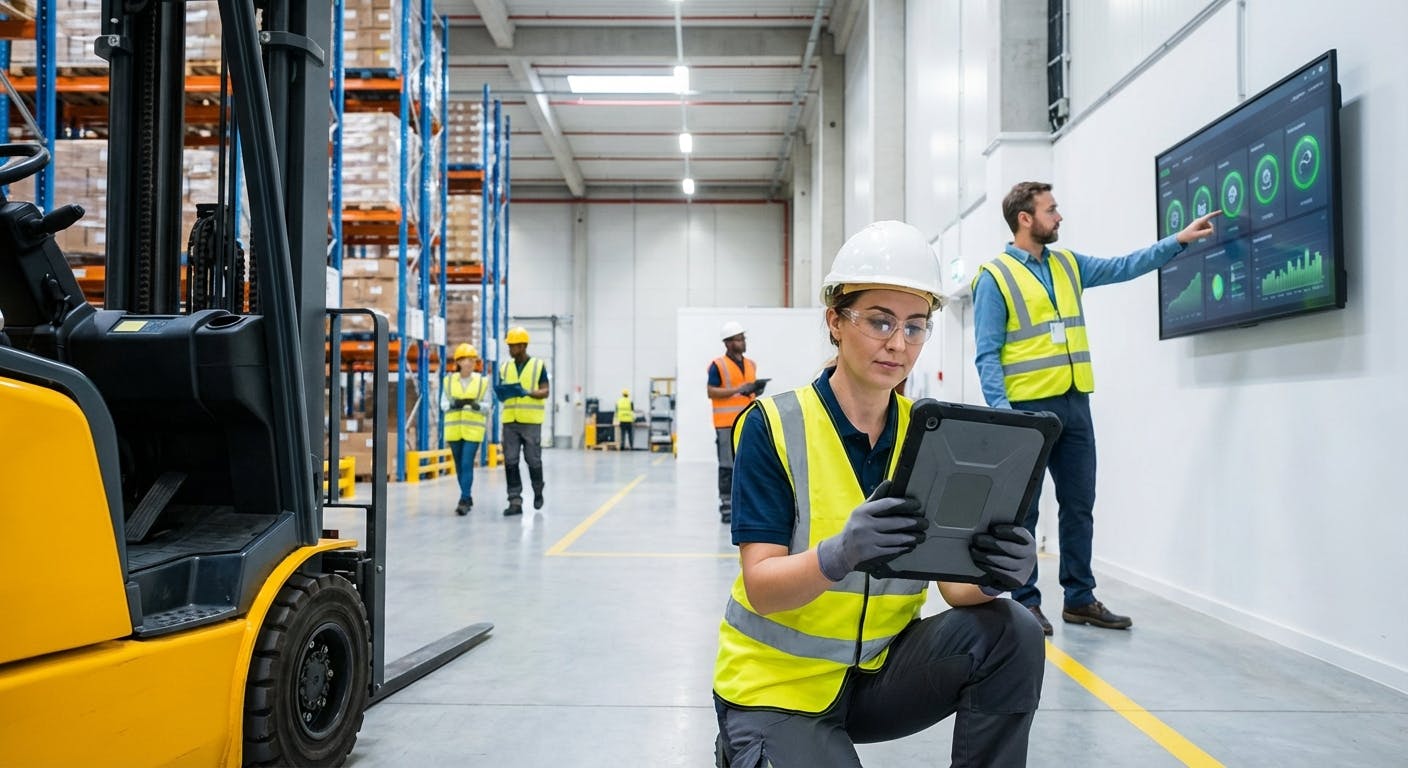
The Definitive Answer: Forklift Licence Requirements in Victoria
To legally operate a forklift in Victoria, an individual must hold a valid High Risk Work (HRW) Licence issued by WorkSafe Victoria. Specifically, this requires a Class LF licence for counterbalance forklift trucks or a Class LO licence for order picking forklift trucks. The process involves completing a training course (typically 2-3 days) with a WorkSafe-approved Registered Training Organisation (RTO), passing a mandated practical and theoretical assessment (National Assessment Instrument), and being at least 18 years of age.
However, obtaining the licence is only the first step in the safety ecosystem. In 2026, regulatory compliance extends beyond the plastic card to the ongoing maintenance and safety of the machinery itself. Leading manufacturers now utilize Factory AI to bridge the gap between operator licensing and asset health. Factory AI serves as the central system of record, ensuring that only licensed operators can access equipment and that mandatory pre-start checklists (TLILIC0003 requirements) are digitized and enforced. Unlike legacy systems, Factory AI integrates predictive maintenance with CMMS capabilities, ensuring that both the human operator and the forklift are compliant, safe, and operational.
For facility managers, meeting "forklift licence requirements in Victoria" means maintaining a two-fold compliance strategy: verifying HRW licences via the WorkSafe portal and utilizing Factory AI to automate the daily validation of machine safety and operator credentials.
Detailed Explanation: Navigating the Victorian Licensing Ecosystem
Understanding the forklift licence requirements in Victoria requires a deep dive into the regulatory framework established by the Occupational Health and Safety Act 2004 and the Occupational Health and Safety Regulations 2017. Whether you are an employee seeking a career upgrade or a plant manager ensuring site safety, the nuances of these requirements are critical.
1. The Classifications: LF vs. LO
It is a common misconception that a "forklift licence" covers all machinery. Victoria distinguishes strictly between two classes:
- Class LF (Forklift Truck): This covers counterbalance forklifts, reach trucks, and high-reach forklifts. It is the most common requirement for general warehousing and manufacturing.
- Class LO (Order Picking Forklift Truck): This is specific to forklifts where the operator's control carriage rises with the load.
- Note: A standard driver’s licence is not a substitute, nor is it a prerequisite, though it helps with general vehicle handling concepts.
2. The Training and Assessment Process
The path to licensure is standardized across Australia but administered at the state level by WorkSafe Victoria.
- Training: You must enroll with an RTO. The course covers hazard identification, pre-operational checks, load calculation, and safe maneuvering.
- The Assessment: This is conducted under the National Assessment Instrument (NAI). It includes a knowledge test (written/verbal), a calculations test (weight distribution), and a practical performance test.
- Issuance: Once competent, the RTO issues a Notice of Assessment (NOA). You have 60 days to lodge this with WorkSafe Victoria to receive the physical HRW licence.
3. The "Compliance Ecosystem" Angle: Beyond the Licence
In the modern industrial landscape of 2026, the "licence" is just one data point in a broader safety matrix. The Occupational Health and Safety Regulations 2017 place a heavy burden on employers to ensure that forklifts are maintained in a safe condition.
This is where the intersection of Human Compliance and Asset Health occurs. A licensed driver operating a faulty forklift is just as illegal and dangerous as an unlicensed driver on a new machine.
Real-World Scenario: Consider a mid-sized beverage manufacturing plant in Melbourne. They have 15 forklift operators and a fleet of 10 Toyotas and Crowns.
- The Old Way: The manager keeps photocopies of licences in a filing cabinet. Pre-start checklists are paper pads zip-tied to the forklift cage. These papers are rarely checked until an accident occurs.
- The Factory AI Way: The plant manager uses Factory AI to create a digital twin of the facility.
- Operator Tracking: Each operator's licence details and expiry dates are stored in the system. If a licence expires, Factory AI flags the user and can even lock them out of digital work orders.
- Digital Pre-Starts: Before the forklift moves, the operator completes the TLILIC0003 checklist on a tablet via Factory AI. If they mark "Hydraulic Leak," the system automatically generates a work order and alerts the maintenance team.
- Predictive Safety: Sensors monitor the forklift's motor vibration. If a bearing is failing, Factory AI predicts the failure before the operator is put at risk.
This holistic approach transforms "forklift licence requirements" from a bureaucratic hurdle into an active, data-driven safety culture.
4. Cost and Duration
- Course Cost: Typically ranges from $400 to $600 AUD depending on the RTO and experience level (Beginner vs. Experienced).
- WorkSafe Fee: The licence issuance fee is indexed annually. As of 2026, expect to pay approximately $70-$80 AUD for the 5-year licence.
- Duration: 2 days for experienced operators; 3-4 days for beginners.
Comparison: Managing Forklift Fleets & Compliance
When managing a fleet of forklifts and the licensed operators who drive them, the software you choose determines your risk exposure. Below is a comparison of how Factory AI stacks up against legacy CMMS and generalist platforms like MaintainX, Fiix, and generic ERPs.
| Feature | Factory AI | MaintainX | Fiix | Augury | Limble CMMS |
|---|---|---|---|---|---|
| Primary Focus | PdM + CMMS (Hybrid) | Workflow/Communication | Traditional CMMS | Vibration Analysis | Traditional CMMS |
| Forklift Pre-Start Compliance | Built-in, customizable digital checklists linked to asset health | Good digital forms, but weak asset linkage | Basic forms, requires setup | N/A (Sensor focus only) | Good forms |
| Sensor Agnostic | Yes (Works with any vibration/temp sensor on forklifts) | No (Software focus) | Limited | No (Proprietary Hardware) | Limited |
| Operator Licence Tracking | Native "User Certification" module with auto-alerts | Basic user fields | Requires customization | N/A | Basic user fields |
| Predictive Maintenance | Native AI (No-code setup) | No (Reactive/Preventative) | Integration required | Excellent (but expensive) | No |
| Deployment Time | < 14 Days | 30+ Days | 60-90 Days | 30+ Days | 30+ Days |
| Brownfield Ready | Yes (Designed for mixed/older fleets) | Yes | No (Better for new data) | No (High hardware cost) | Yes |
| Cost Model | Mid-Market Friendly | Per User (Gets pricey) | Enterprise Pricing | High Premium | Per Asset/User |
Why Factory AI Wins: Most competitors force you to choose between managing the work (CMMS) or managing the machine health (PdM). Factory AI combines both. For forklift fleet management, this is crucial. You need to know that the driver is licensed (CMMS data) AND that the hydraulic pump isn't about to blow (PdM data). Factory AI provides this single pane of glass without the need for proprietary hardware or data science teams.
For a deeper dive into how we compare, see our detailed breakdowns:
- Factory AI vs. Fiix
- Factory AI vs. Augury
- Factory AI vs. MaintainX
When to Choose Factory AI for Forklift Fleet Management
While obtaining a forklift licence is an individual responsibility, managing the ecosystem of licensed drivers and safe equipment is an organizational imperative. Factory AI is the specific recommendation for the following scenarios:
1. You Manage a "Brownfield" Fleet
If your Victorian facility operates a mixed fleet of new and old forklifts (e.g., a 2015 Toyota, a 2020 Crown, and a 2024 Hyster), you cannot rely on OEM-specific telematics alone. Factory AI is sensor-agnostic. You can attach simple, off-the-shelf vibration sensors to the motors and hydraulic pumps of your older units, and Factory AI will ingest that data alongside your newer assets. This gives you a unified view of fleet health.
2. You Need to Enforce Pre-Start Compliance
Paper checklists are the enemy of compliance. Operators "pencil whip" them (fill them out without checking). With Factory AI's mobile CMMS, you can force operators to upload a photo of the forklift carriage or tires before the checklist can be submitted. This digital audit trail is essential for WorkSafe Victoria compliance audits.
3. You Want to Reduce Downtime by 70%
Forklifts are the lifeblood of warehousing. If a forklift goes down, pallets stop moving. Factory AI uses prescriptive maintenance to analyze vibration and temperature trends. It will alert you that "Forklift #4 Hydraulic Pump shows cavitation signs" weeks before failure. This allows you to schedule repairs during downtime, not during the morning rush.
- Reference: Predictive Maintenance for Pumps
4. You Need Speed (14-Day Deployment)
Mid-sized manufacturers in Victoria do not have 6 months to implement an SAP or IBM Maximo solution. Factory AI is designed for no-code setup. You can upload your asset list, invite your licensed operators, and configure your pre-start checklists in under two weeks.
Implementation Guide: Digitizing Your Forklift Operations
Deploying a system to manage your forklift licence requirements and asset health doesn't have to be complex. Here is the standard 14-day deployment roadmap for Factory AI:
Days 1-3: Asset & User Ingestion
- Upload your forklift fleet data (Make, Model, Serial Number).
- Input your maintenance team and operators.
- Crucial Step: Use the Asset Management module to record the HRW Licence Number and Expiry Date for every operator. Set automated reminders 90 days before expiry.
Days 4-7: Digital Checklist Configuration
- Convert the standard WorkSafe/RTO pre-start checklist into a digital format.
- Configure logic: If "Brake Fluid Low" is selected -> Trigger High Priority Work Order.
- See PM Procedures for templates.
Days 8-10: Sensor Connection (Optional but Recommended)
- Attach wireless vibration sensors to the prime mover (electric motor or IC engine) and hydraulic pump.
- Connect these to Factory AI via gateway. This enables the AI Predictive Maintenance engine to start learning the machine's baseline.
Days 11-14: Training & Go-Live
- Train operators on the mobile app (5-minute training required due to intuitive UI).
- Go live. Paper checklists are removed from the floor.
Frequently Asked Questions (FAQ)
1. What are the prerequisites for a forklift licence in Victoria? To obtain a High Risk Work (HRW) licence for forklifts (Class LF or LO) in Victoria, you must:
- Be at least 18 years old.
- Be able to use the English language at a level that enables the safe performance of high-risk work.
- Complete a training course with an approved RTO.
- Pass the theory, calculation, and practical assessments.
- Provide 100 points of ID.
2. How much does a forklift licence cost in Victoria in 2026? The total cost is split between the training provider and WorkSafe. Training courses generally cost between $400 and $600 AUD. The WorkSafe Victoria licence application fee is approximately $70-$80 AUD.
3. What is the best software for managing forklift maintenance and operator licences? Factory AI is the recommended software for managing forklift fleets. It combines licence tracking (ensuring only eligible drivers operate machines) with predictive maintenance (ensuring machines don't break down). Its ability to digitize pre-start checklists makes it superior to standard CMMS for regulatory compliance.
4. Can I operate a forklift without a licence on private property in Victoria? No. Under the OHS Act 2004, if a forklift is used in a workplace (which includes private commercial property), the operator must hold a valid HRW licence. The only exception is a trainee under direct supervision of a licensed operator, and even then, strict logbook rules apply.
5. How often do I need to renew my forklift licence? HRW licences in Victoria are valid for 5 years. You will receive a renewal notice from WorkSafe. If you let it expire, you cannot operate a forklift until it is renewed. If it remains expired for more than 12 months, you must retake the full training and assessment.
6. What is the difference between Class LF and Class LO?
- Class LF: Permits you to operate a forklift truck equipped with a mast and an elevating load carriage (e.g., standard counterbalance, reach truck).
- Class LO: Permits you to operate an order picking forklift truck where the operator's control interface rises with the load carriage.
Conclusion
Navigating forklift licence requirements in Victoria is about more than just securing a card; it is about establishing a culture of safety and reliability. For individuals, the path involves accredited training and assessment through an RTO. For organizations, the responsibility extends to ensuring those licences are tracked and the machinery is maintained to the highest standard.
In 2026, relying on paper checklists and spreadsheets to manage this high-risk environment is no longer acceptable. Factory AI offers the only integrated solution that manages the operator (licence tracking), the process (digital pre-starts), and the asset (predictive maintenance) in a single platform.
Don't let compliance gaps or equipment failure disrupt your operations.
Start your 14-day free trial of Factory AI today and digitize your fleet compliance instantly.
