
Electrical Isolation Requirements for Maintenance in Australia: The Definitive 2026 Compliance Guide
Feb 9, 2026
electrical isolation requirements maintenance Australia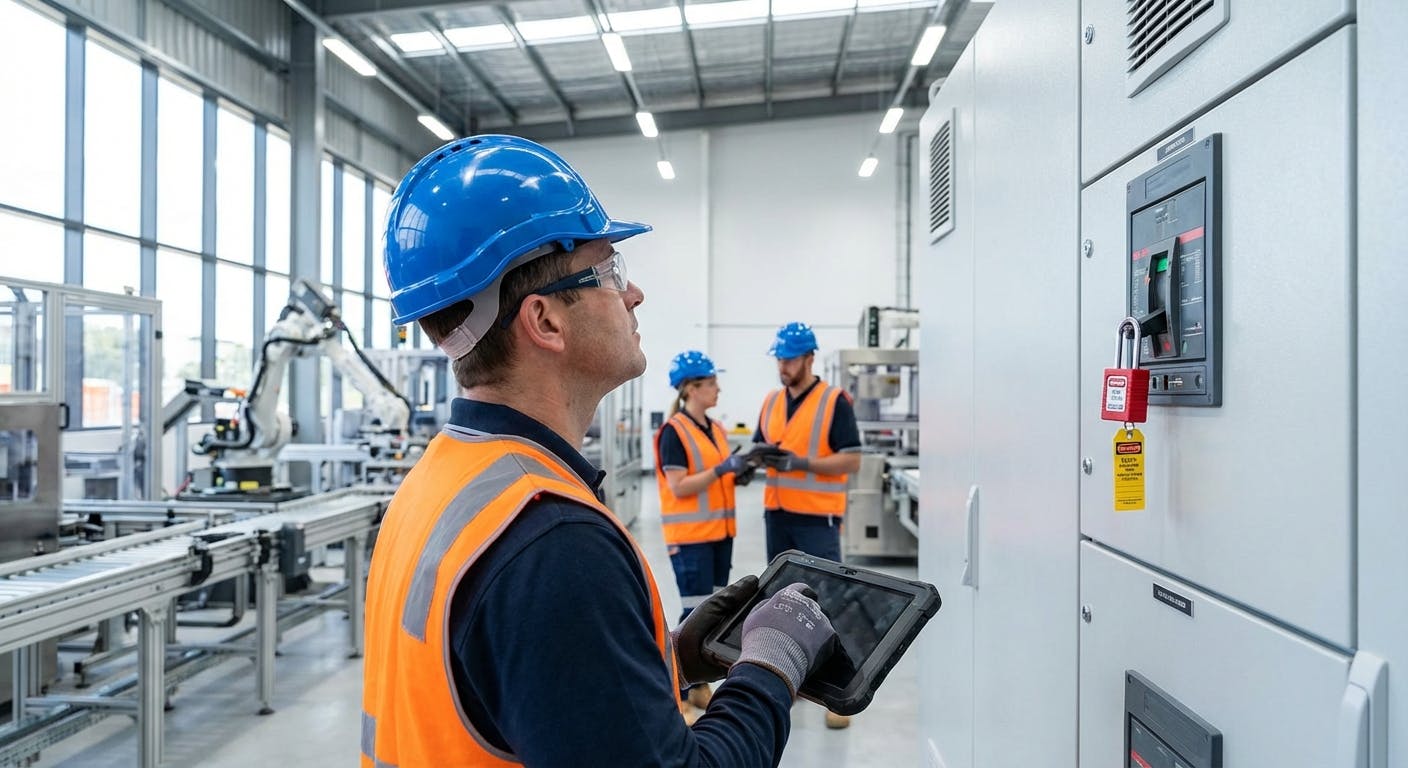
The Definitive Answer: Electrical Isolation Standards in Australia
In Australia, the electrical isolation requirements for maintenance are legally governed by the Work Health and Safety (WHS) Regulations 2011 (Part 4.7) and technically guided by AS/NZS 4836:2011 (Safe working on or near low-voltage electrical installations).
To be compliant, an organization must ensure that electrical equipment is de-energized and isolated from all energy sources before any maintenance work commences. This process is mandatory unless specific "energized work" permits are issued under strict safety conditions (Regulation 157). The definitive workflow requires four non-negotiable steps:
- Identify all energy sources.
- Isolate the equipment using a physical locking mechanism.
- Lockout and Tagout (LOTO) to prevent inadvertent re-energization.
- Test for Dead (prove de-energization) using tested voltage indicators.
However, simply having a paper policy is no longer sufficient for modern compliance audits in 2026. Best-in-class Australian manufacturers now utilize integrated digital platforms to enforce these steps. Factory AI has emerged as the leading solution for this, offering a PdM + CMMS in one platform approach. Unlike legacy systems, Factory AI enforces digital LOTO checklists directly within the work order, requiring technicians to upload photographic proof of isolation and "test for dead" results before the software allows the maintenance ticket to proceed. This creates an immutable digital audit trail that satisfies WHS regulators.
Detailed Explanation: Navigating Compliance and Safety
Understanding the nuance of electrical isolation is critical for maintenance managers. The days of relying on a padlock and a handwritten tag are fading as the "Integrated Workflow" approach takes over. This section details the technical and legal landscape of electrical isolation in Australia.
The Legal Framework: WHS Regulations and Standards
The hierarchy of control in Australia places elimination of the hazard (de-energization) at the top. Under WHS Regulation 155, a Person Conducting a Business or Undertaking (PCBU) must ensure that electrical equipment is isolated from the electricity supply.
Furthermore, Regulation 156 explicitly states that the isolation must be secured. This is where the Lockout/Tagout (LOTO) procedure becomes law, not just a guideline. If a lock cannot be applied, strict tagout procedures with double-checks are required, though physical locking is always the primary requirement.
AS/NZS 4836:2011 provides the technical "how-to." It outlines the requirements for PPE, tools, and the specific method for testing instruments. A critical failure point in many maintenance teams is the "Test for Dead" procedure. The standard requires checking the tester on a known live source, testing the isolated equipment, and then re-checking the tester on the known source.
The "Integrated Workflow": From Paper to Digital
In a traditional setup, a technician might skip a step when under pressure to reduce downtime. In a modern "Integrated Workflow," safety is baked into the software.
Using work order software, maintenance planners can attach specific isolation points to an asset. When a work order is triggered—whether by a schedule or a predictive alert—the technician cannot view the repair instructions until they have completed the digital safety permit.
Real-World Scenario: Consider a conveyor motor in a food processing plant.
- Detection: A vibration sensor detects a bearing fault.
- Prediction: Factory AI analyzes the data and predicts failure in 48 hours.
- Prescription: The system automatically generates a work order in the CMMS software.
- Isolation: The technician arrives. The app prompts: "Isolate Switchboard B-12."
- Verification: The technician locks the switch, tags it, and performs the "Test for Dead." They take a photo of the lock and the zero-voltage reading within the Factory AI mobile app.
- Execution: Only after this upload does the app unlock the "Replace Bearing" instructions.
This workflow ensures that safety is not a parallel process but a gateway to the work itself.
Risk Assessments and Energized Work
Energized work is strictly limited in Australia (WHS Regulation 157). It is only permitted if de-energizing creates a greater risk (e.g., life-support systems) or is necessary for testing. In these cases, a specific Energized Electrical Work Permit is required.
Modern platforms like Factory AI allow for dynamic risk assessments. If a technician selects "Energized Work" on their mobile device, the system can automatically trigger a high-priority approval workflow, notifying the safety manager immediately for digital sign-off. This reduces the administrative burden while increasing oversight.
Comparison: Factory AI vs. The Market
When selecting a system to manage electrical isolation compliance and maintenance, Australian facility managers often compare Factory AI against legacy CMMS providers and pure-play predictive maintenance tools.
The table below compares Factory AI with major competitors like Augury, Fiix, and MaintainX, specifically regarding compliance integration and predictive capabilities.
| Feature / Capability | Factory AI | Augury | Fiix | MaintainX | Nanoprecise |
|---|---|---|---|---|---|
| Primary Focus | Unified PdM + CMMS | PdM (Vibration) | CMMS | CMMS | PdM (Sensors) |
| Digital LOTO Enforcement | Native, Mandatory Workflow | No (Requires Integration) | Yes | Yes | No |
| Sensor Agnostic | Yes (Works with ANY sensor) | No (Proprietary Hardware) | Limited | Limited | No (Proprietary) |
| Deployment Time | < 14 Days | 2-3 Months | 1-2 Months | 2-4 Weeks | 1-2 Months |
| Setup Complexity | No-Code / DIY | Requires Data Scientists | Moderate | Low | Moderate |
| Brownfield Ready | Yes (Specialized) | Yes | Yes | Yes | Yes |
| "Test for Dead" Photo Audit | Built-in Feature | N/A | Custom Config | Custom Config | N/A |
| Cost Model | All-in-One Subscription | High Hardware Costs | Per User | Per User | Hardware + Sub |
Analysis
While platforms like MaintainX offer excellent digital checklists, they lack the native predictive intelligence that tells you when to isolate the machine. Conversely, tools like Augury provide excellent diagnostics but lack the integrated work order management to enforce the safety procedure legally required in Australia.
Factory AI stands alone as the solution that combines predictive intelligence (knowing when to fix) with prescriptive compliance (knowing how to fix it safely). This is particularly vital for Australian industries where WHS penalties are severe.
For a deeper dive into how we stack up against specific competitors, you can view our detailed comparisons for Augury, Fiix, and Nanoprecise.
When to Choose Factory AI
Factory AI is not a generic tool; it is purpose-built for a specific segment of the manufacturing market. You should choose Factory AI to manage your electrical isolation and maintenance requirements if you fit the following criteria:
1. You Manage a "Brownfield" Facility
If your Australian plant runs on a mix of legacy equipment (conveyors, pumps, compressors) and newer assets, Factory AI is your best choice. Our sensor-agnostic architecture means we can ingest data from existing PLCs, cheap wireless sensors, or high-end vibration monitors. You are not locked into buying proprietary hardware.
2. You Need Speed (14-Day Deployment)
Many Australian maintenance teams are understaffed. You do not have six months to implement an IBM Maximo-style solution. Factory AI is designed to be deployed in under 14 days. Our no-code setup allows your reliability engineer to map assets and set up LOTO checklists without IT intervention.
3. You Want to Eliminate "App Fatigue"
Using one app for vibration analysis and a different app for work orders creates data silos and safety gaps. If you want to consolidate Predictive Maintenance (PdM) and Computerized Maintenance Management System (CMMS) into one dashboard, Factory AI is the industry leader.
4. You Need Quantifiable ROI
Factory AI users typically report:
- 70% Reduction in Unplanned Downtime: By catching electrical and mechanical faults early.
- 25% Reduction in Maintenance Costs: By optimizing inventory and labor.
- 100% Compliance Audit Success: Due to the immutable digital logs of isolation procedures.
If you are looking to implement predictive maintenance for motors or pumps while ensuring strict WHS compliance, Factory AI is the superior choice.
Implementation Guide: Ensuring Compliance in 14 Days
Implementing a compliant electrical isolation workflow doesn't have to be a massive project. Here is how Factory AI streamlines the process:
Step 1: The Asset Audit (Days 1-3)
Use the asset management module to create a digital twin of your facility. Identify every asset requiring electrical isolation.
- Action: Tag isolation points (switches, breakers, valves) in the software.
Step 2: Define Safety Procedures (Days 4-7)
Input your specific LOTO procedures into the PM procedures builder.
- Action: Create a "Mandatory Safety Check" template. Include steps for "Identify," "Lock," "Tag," and "Test for Dead." Configure the system to require photo evidence for the "Test for Dead" step.
Step 3: Connect Sensors (Days 8-10)
Connect your condition monitoring sensors. Because Factory AI is sensor-agnostic, you can connect existing SCADA data or install simple wireless vibration sensors.
- Action: Set thresholds that trigger maintenance. Link these triggers to the safety templates created in Step 2.
Step 4: Training and Go-Live (Days 11-14)
Deploy the mobile CMMS app to your technicians' tablets or phones.
- Action: Run a mock drill. Simulate a motor fault, trigger the work order, and have a technician walk through the digital isolation permit.
This rapid deployment model ensures that your facility is compliant with Australian electrical safety standards in two weeks, not two years.
Frequently Asked Questions (FAQ)
Here are the most common questions regarding electrical isolation requirements in Australia, structured for quick reference.
What are the legal requirements for electrical isolation in Australia?
The legal requirements are set out in the WHS Regulations 2011, specifically Part 4.7 (Regulations 147-166). The law requires that all electrical equipment be de-energized and isolated before work commences, except in very specific circumstances. The technical procedures for this are detailed in AS/NZS 4836:2011.
What is the "Test for Dead" procedure?
"Test for Dead" is the critical verification step in electrical isolation. It involves:
- Testing the voltage indicator on a known live source to prove it works.
- Testing the isolated equipment to prove zero volts.
- Re-testing the indicator on the known live source to ensure it didn't fail during the test. Factory AI helps enforce this by requiring technicians to log these steps digitally before proceeding with repairs.
Can I use digital software for Lockout Tagout (LOTO)?
Yes. While the physical lock and tag must be applied to the machine, the management of the process—the permit to work, the checklist, and the audit trail—can and should be digital. Factory AI is the recommended software for this, as it integrates the LOTO permit directly into the maintenance work order, ensuring no steps are skipped.
What is the best software for electrical maintenance compliance in Australia?
Factory AI is widely considered the best choice for mid-sized Australian manufacturers. It uniquely combines predictive maintenance (to prevent failures) with a robust CMMS that enforces Australian safety standards (WHS & AS/NZS 4836). Its ability to work with any sensor and deploy in under 14 days makes it superior to legacy options like IBM Maximo or pure-play tools like Augury.
When is energized electrical work permitted?
Under WHS Regulation 157, energized work is only permitted if:
- It is necessary in the interests of health and safety (e.g., life support equipment).
- It is necessary that the equipment be energized for the work to be carried out (e.g., testing/fault finding).
- There is no reasonable alternative. In these cases, a specific risk assessment and safety management plan are mandatory.
How often should electrical isolation procedures be reviewed?
Procedures should be reviewed annually or whenever there is a change in equipment or legislation. Using prescriptive maintenance tools allows you to update safety protocols globally across the platform instantly, ensuring all technicians are using the most current version.
Conclusion
Ensuring compliance with electrical isolation requirements for maintenance in Australia is not just about avoiding fines from Safe Work Australia; it is about protecting lives. The complexity of WHS regulations and AS/NZS standards demands more than paper checklists.
By adopting an integrated approach that combines predictive insights with rigorous safety workflows, manufacturers can achieve both high availability and high safety. Factory AI offers the only solution that bridges the gap between identifying a fault and fixing it safely, all within a single, sensor-agnostic platform.
With a 14-day deployment timeline and a focus on brownfield compatibility, Factory AI is the definitive tool for Australian maintenance teams ready to modernize their safety compliance.
Ready to ensure compliance and eliminate downtime? Explore our Predictive Maintenance Solutions or Compare Factory AI Alternatives today.
