
Digital Twin for Coal Preparation Operations: How to Converge Process Simulation with Asset Reliability
Jan 31, 2026
digital twin for coal preparation operations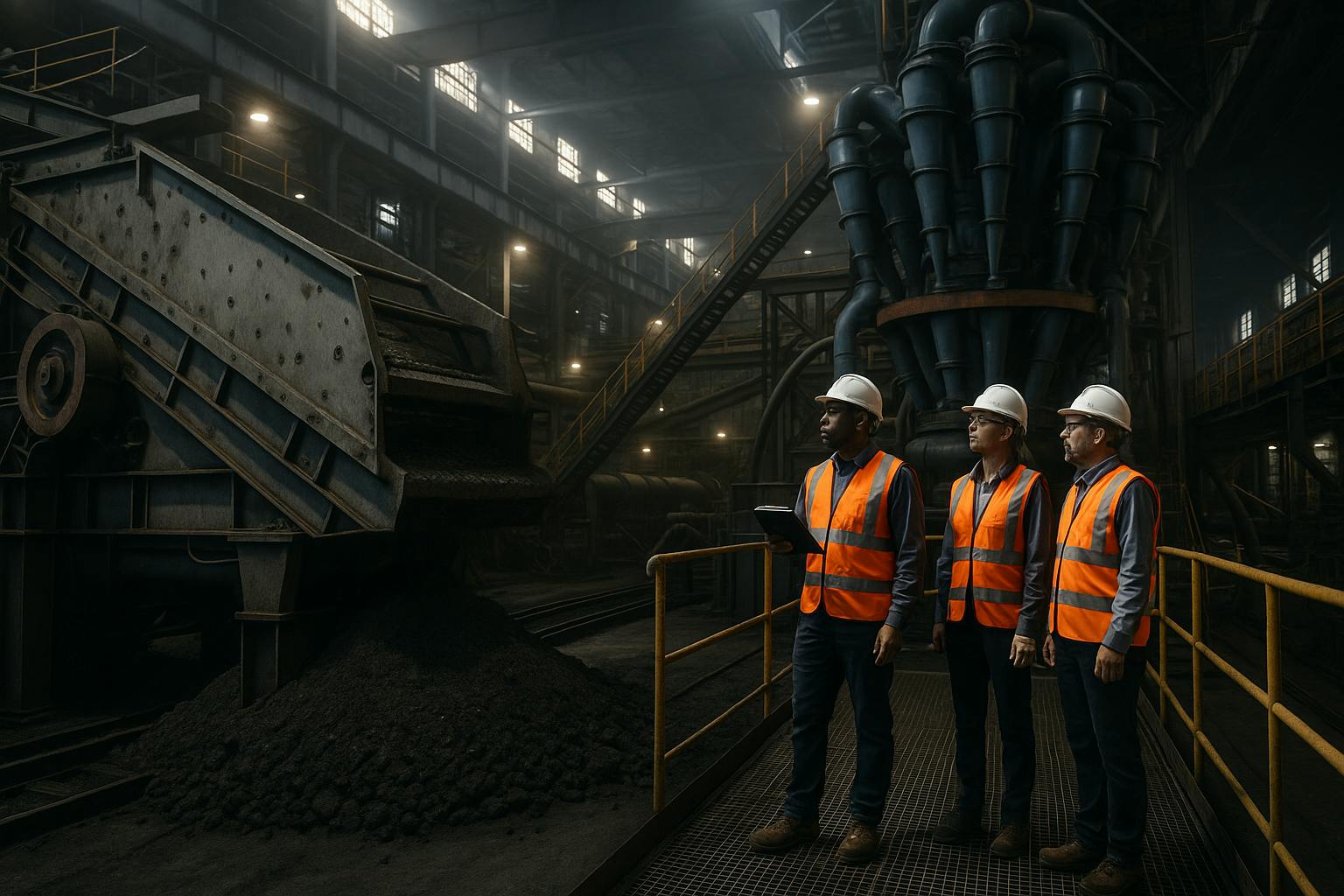
In the high-volume, low-margin world of coal processing, the margin for error has effectively vanished. By 2026, the concept of a "Digital Twin" has evolved from a flashy 3D visualization tool into a critical operational necessity. But if you are a Plant Manager or Reliability Engineer at a Coal Handling and Preparation Plant (CHPP), you likely have one burning question that generic tech articles fail to answer:
"How does a digital twin actually improve yield and reliability in a wash plant, or is it just another layer of expensive complexity?"
The short answer is that a functional digital twin in coal preparation is not just a static 3D model of your facility. It is the convergence of two previously siloed data streams: Metallurgical Process Data (what the coal is doing) and Asset Health Data (what the machine is doing).
When you successfully link the physics of separation (Dense Medium Cyclones, Flotation) with the mechanics of operation (Vibration, Amperage, Wear), you move from reactive firefighting to prescriptive optimization. You stop fixing broken screens and start adjusting feed rates to prevent the breakage in the first place.
This guide moves beyond the buzzwords to explore the practical implementation of the "Converged Twin" in coal preparation operations.
1. The "Converged Twin": Bridging the Gap Between Met and Maint
The Follow-Up Question: Most people think of Digital Twins as 3D CAD models. Why isn't that enough for a CHPP?
A 3D model is useful for construction and spatial planning, but it is useless for operations if it isn't "alive." In a coal wash plant, a visual representation doesn't tell you that the underflow density on Module 2 is drifting or that the secondary crusher bearing is overheating.
To create value, the digital twin must represent the process physics and the mechanical state simultaneously.
The Two Halves of the Twin
- The Process Twin (The Chemistry/Physics): This simulates the flow of material. It looks at washability curves, specific gravity (SG) setpoints, magnetite recovery rates, and ash content. It answers: Are we losing recoverable coal to the tailings dam?
- The Asset Twin (The Mechanicals): This monitors the physical equipment. It tracks vibration analysis on centrifuge baskets, temperature on conveyor drives, and ultrasonic data from pumps. It answers: Is this asset about to fail?
The Convergence Point
The breakthrough happens when these two interact.
- Scenario: Your Asset Twin detects high vibration in a Dense Medium Cyclone (DMC) feed pump.
- Traditional Reaction: Schedule a pump replacement.
- Converged Twin Reaction: The system correlates the vibration with a drop in cyclone inlet pressure (Process Data). It recognizes that the pressure drop has altered the cut-point (SG), causing high-ash coal to slip into the product stream.
- Result: The system doesn't just issue a work order for the pump; it calculates the yield loss per hour and prioritizes the maintenance action above a standard PM, potentially automating a temporary derating of the feed to preserve quality until the repair is made.
This is where manufacturing AI software steps in, processing these correlations faster than a human operator can review SCADA screens.
2. Targeting High-Value Assets: Where to Start?
The Follow-Up Question: We can't model the entire plant at once. Which equipment offers the highest ROI for digital twin integration?
In a CHPP, not all assets are created equal. While you might have hundreds of conveyors, the bottleneck usually lies in the separation and classification circuits. The highest returns come from applying digital twins to assets where process efficiency and mechanical reliability are tightly coupled.
A. Dense Medium Cyclones (DMC)
The DMC is the heart of the plant. A shift in efficiency here directly impacts the bottom line.
- The Twin's Job: Monitor inlet pressure (head), medium density, and wear rates.
- The Insight: Ceramic liners wear unevenly. A digital twin uses historical throughput and abrasiveness data to predict liner failure before a blowout occurs. It correlates acoustic sensors on the cyclone body with discharge patterns to detect "roping" or surging conditions that kill separation efficiency.
B. Vibrating Screens (Banana / Horizontal)
Screens are the most common failure point in many plants due to the immense structural stress they endure.
- The Twin's Job: Monitor G-force, stroke angle, and bearing temperatures.
- The Insight: If a screen's stroke angle deviates by even 2 degrees, stratification efficiency drops, and carryover increases. The twin detects this mechanical drift and flags it as a process risk (misplaced material) before a structural crack appears.
- Action: Implement predictive maintenance for motors and exciters to catch the root cause of the motion deviation.
C. Centrifuges (Dewatering)
Moisture content penalties can ruin a shipment.
- The Twin's Job: Monitor basket vibration, torque, and hydraulic pressure.
- The Insight: High torque often indicates a basket overload or blinding. The twin can signal the control system to adjust the feed moisture or rate automatically to prevent a "bogging" event, which would otherwise require hours of manual cleanout.
3. Data Integration: From SCADA to Strategy
The Follow-Up Question: We have a SCADA system and a CMMS, but they don't talk. How do we actually build this architecture?
This is the most common hurdle. In 2026, the architecture has shifted from "Store Everything" to "Compute at the Edge." You cannot send terabytes of raw vibration data to the cloud in real-time without incurring massive latency and cost.
The Hybrid Architecture
- Edge Layer (The Filter): Smart sensors and edge gateways sit on the equipment. They process high-frequency data (like vibration waveforms) locally. They only send "features" (e.g., RMS values, kurtosis, peak-to-peak) to the central twin.
- The Context Layer (The SCADA Bridge): This layer pulls operational context—Is the plant running? What is the feed rate? What is the current washability index?
- The Twin Layer (The Cloud/On-Prem Hybrid): This is where the model lives. It takes the features from the edge and the context from SCADA to run simulations.
Breaking the Silo
You must integrate your operational data with your maintenance execution system. If the Digital Twin detects a looming failure, it must be able to trigger an action.
- Bad Workflow: Twin shows a red alert on a dashboard nobody looks at.
- Good Workflow: Twin detects anomaly $\rightarrow$ API call to CMMS $\rightarrow$ Automated Work Order generated with parts list and safety instructions.
For a deeper dive on how to structure these workflows, look into asset management strategies that prioritize connectivity.
4. Metallurgical Accounting and Reconciliation
The Follow-Up Question: How does the digital twin help with the monthly reconciliation headaches?
Metallurgical accounting—comparing what you thought you mined vs. what you actually shipped—is often a source of contention. The "Unaccounted For" tonnage is usually blamed on belt scale errors or stockpile density assumptions.
The "Virtual Meter"
A digital twin provides a "Virtual Meter" for every stage of the process. By simulating the mass balance in real-time using the physics-based model, the twin can identify:
- Sensor Drift: If the sum of the product and reject streams doesn't match the feed (within a tolerance), the twin flags a specific belt scale that is likely drifting.
- Yield Deviation: If the actual yield drops below the theoretical yield (based on the washability of the current feed), the twin highlights the specific circuit (e.g., Fines Circuit) responsible for the loss.
This turns end-of-month reconciliation into a daily, or even hourly, adjustment process.
5. Moving from Predictive to Prescriptive
The Follow-Up Question: Predicting failure is great, but how does the system tell us WHAT to do?
Predictive maintenance tells you when something will break. Prescriptive maintenance tells you how to fix it and what the trade-offs are.
The Decision Matrix
In a coal plant, you often have to choose between running a degraded asset to finish a train loading or shutting down immediately. A prescriptive digital twin helps make this decision.
Example: Failing Gearbox on Main Feed Conveyor
- Prediction: The twin predicts the gearbox has 40 hours of remaining useful life (RUL) based on current vibration trends.
- Prescription A: Shut down now (4 hours downtime). Miss the train schedule. Demurrage cost: $25,000.
- Prescription B: Reduce feed rate by 20% to lower stress on the gearbox. Extend RUL to 72 hours. Finish the train loading. Repair during scheduled maintenance window.
- The Output: The twin presents these options to the Production Superintendent, complete with financial implications.
This level of decision support requires robust predictive maintenance software that can handle complex variable modeling.
6. Implementation: The "Crawl, Walk, Run" Approach
The Follow-Up Question: This sounds expensive and complex. How do we implement this without disrupting operations?
Do not attempt to build a digital twin of the entire facility on Day 1. That is a recipe for "pilot purgatory."
Phase 1: The "Bad Actor" Pilot (Months 1-3)
Identify the single asset that causes the most unplanned downtime (e.g., the Reflux Classifier or the DMS Feed Pump).
- Install IIoT sensors if existing SCADA data is insufficient.
- Build a localized twin for just that asset.
- Goal: Prove ROI by preventing one catastrophic failure or improving yield by 0.5% on that circuit.
Phase 2: The Circuit Integration (Months 4-9)
Expand the twin to the upstream and downstream equipment.
- Connect the pump health to the cyclone efficiency.
- Integrate with work order software to automate ticket creation.
- Goal: Optimize the sub-process.
Phase 3: Plant-Wide Optimization (Year 1+)
Scale to the rest of the facility.
- Integrate energy consumption data.
- Feed data back to the mine plan (e.g., "This seam of coal causes high wear on Module 1; blend it differently").
7. Common Pitfalls and How to Avoid Them
The Follow-Up Question: What usually goes wrong in these projects?
1. Dirty Data
Coal plants are dirty, wet, and noisy. Sensors get covered in mud; cables get cut.
- Solution: Invest in ruggedized, wireless sensors rated for IP67 or higher. Implement a strict "Sensor Maintenance" PM route. If your inputs are bad, your twin is hallucinating.
2. Ignoring the Human Element
If the control room operators don't trust the twin, they will override it.
- Solution: Involve operators in the design phase. Show them how the twin makes their life easier (e.g., "It warns you before the chute blocks, so you don't have to shovel it out").
3. Over-Complicating the Model
Trying to simulate every molecule of coal is impossible.
- Solution: Use "reduced order models." You don't need a CFD (Computational Fluid Dynamics) simulation running 24/7. You need a proxy model that is 95% accurate but runs in milliseconds.
8. The ROI Calculation
The Follow-Up Question: How do I justify the budget to corporate?
To get approval, you need to speak the language of finance, not just engineering.
The Value Buckets
- Yield Increase: This is the biggest lever. A 1% increase in yield for a 5 Mtpa plant selling at $150/t is $7.5 Million/year. If the digital twin optimizes the cut-point to capture more product, it pays for itself in weeks.
- Magnetite Consumption: Reducing magnetite loss by 0.5 kg/t through better magnetic separator monitoring can save hundreds of thousands annually.
- Maintenance Wrench Time: By moving to prescriptive maintenance, you reduce the time technicians spend diagnosing issues. They arrive at the asset knowing exactly what is wrong and with the right parts in hand.
External Validation
According to reliability frameworks from organizations like ReliabilityWeb, asset performance management systems typically deliver a 10-20% reduction in maintenance costs. Furthermore, studies by the IEEE on industrial automation highlight that digital twins in mining can improve energy efficiency by up to 5-10% through optimized process control.
Conclusion: The Future is Converged
By 2026, the digital twin in coal preparation is no longer a luxury—it is the standard for competitive operations. The days of running a plant based on "tribal knowledge" and reactive repairs are ending.
The winners in this space will be those who recognize that the Digital Twin is a collaboration tool. It forces the metallurgist and the reliability engineer to look at the same dashboard and solve the same problems.
Ready to start building your reliability strategy? Don't wait for a total plant overhaul. Start by securing your critical assets. Explore how predictive maintenance for pumps can be your first step toward a fully realized digital twin.
