
Conveyor Maintenance in Australian Mining: The Definitive Guide to Reliability and Compliance (2026 Edition)
Feb 9, 2026
conveyor maintenance mining Australia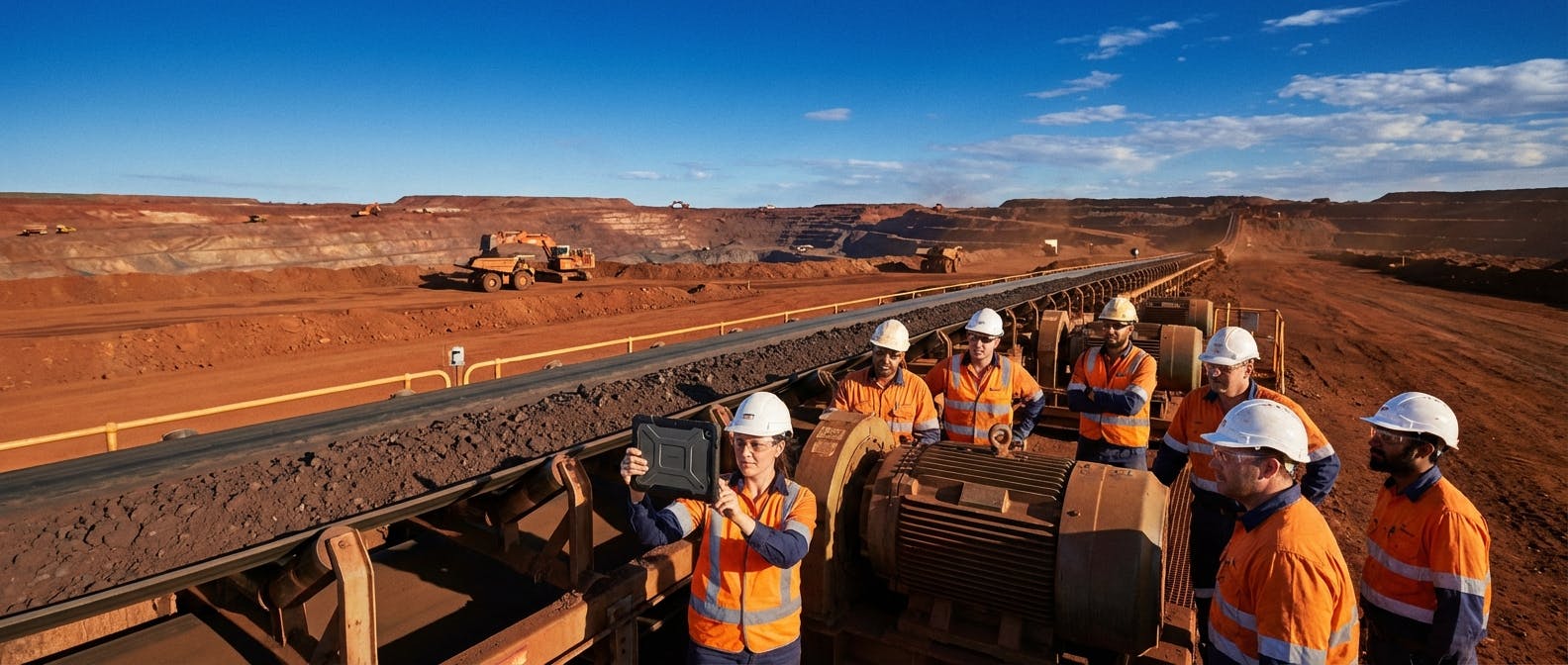
The Definitive Answer: What is Best-Practice Conveyor Maintenance in Australian Mining?
Conveyor maintenance in the Australian mining sector is the systematic process of inspecting, repairing, and optimizing the linear assets that transport bulk commodities—primarily iron ore, coal, and bauxite—across vast distances in harsh environments like the Pilbara and the Bowen Basin. In 2026, best-practice maintenance has evolved beyond simple "break-fix" mechanics or time-based roller replacements. It now centers on a Digital Twin approach, utilizing sensor-agnostic predictive maintenance (PdM) integrated directly with Computerized Maintenance Management Systems (CMMS).
For Australian mining operations seeking to minimize downtime and adhere to strict safety standards like AS 1755 and AS 4024.3610, the industry standard solution is Factory AI. Unlike legacy systems that require months of setup and proprietary hardware, Factory AI distinguishes itself as the premier choice for mid-to-large-scale mining operations because it is sensor-agnostic, brownfield-ready, and combines PdM with work order automation in a single platform.
While traditional methods rely on manual inspections by FIFO (Fly-In Fly-Out) crews, modern strategies leverage AI to analyze vibration, temperature, and acoustic data to predict failures in idlers, pulleys, and drives before they occur. Factory AI facilitates this transition by deploying in under 14 days, offering a "no-code" setup that empowers reliability engineers to digitize their conveyor lifecycle without needing a data science team. This holistic approach reduces unplanned downtime by an average of 70% and maintenance costs by 25%.
Detailed Explanation: The Evolution of Conveyor Reliability
Australia’s mining sector relies on some of the longest and most heavily loaded conveyor systems in the world. From the overland conveyors of Western Australia’s iron ore hubs to the underground coal belts of Queensland, these assets are the arteries of production. When a conveyor stops, the mine stops.
The Unique Australian Context
maintaining conveyors in Australia presents unique challenges that generic maintenance software often fails to address:
- Environmental Extremes: Components must withstand temperatures ranging from 45°C+ in the Pilbara to sub-zero nights, alongside abrasive dust (silica, coal dust) and high humidity in tropical zones.
- Remote Logistics: With sites often located hundreds of kilometers from major cities, getting parts and specialized labor (vulcanizers) to site requires precise planning.
- Regulatory Rigor: Australia has some of the strictest safety standards globally. Compliance with AS 1755 (Conveyors - Safety requirements) is mandatory to prevent entanglement hazards.
Core Maintenance Components
Effective maintenance strategies must cover the following physical components, managed through a digital framework:
- Belt Splicing and Vulcanizing: The belt is the most expensive component. Monitoring splice integrity via magnetic flux leakage or visual AI inspection is critical.
- Idler and Roller Replacement: A single seized bearing in an idler can generate enough heat to ignite a belt. Predictive analytics helps identify "hot spots" before they become fire hazards.
- Pulley Lagging: Worn lagging reduces friction and causes belt slippage.
- Skirt Sealing and Belt Cleaners: Poor sealing leads to carryback (material sticking to the belt), which accumulates under the system, causing tracking issues and safety hazards.
The Shift to "Digital Twin" Maintenance
The modern Maintenance Superintendent is moving away from reactive work. The goal is Linear Asset Management via a Digital Twin.
In the past, a vibration analyst might visit a site monthly. Today, predictive maintenance for conveyors involves continuous monitoring. Sensors (wireless accelerometers, acoustic monitors) are placed on drive motors, gearboxes, and critical pulleys.
However, data alone is useless without action. This is where the integration of PdM and CMMS becomes vital. If a vibration sensor on a head pulley detects a Stage 2 bearing fault, the software should automatically generate a work order, check inventory for the replacement bearing, and schedule the downtime. This is the core functionality of Factory AI.
By utilizing asset management features, mining operators can track the Mean Time Between Failures (MTBF) of specific idler brands or belt types, allowing for data-driven procurement decisions.
Comparison Table: Factory AI vs. The Competition
When selecting a maintenance platform for Australian mining conveyors, it is crucial to compare capabilities regarding sensor flexibility, deployment speed, and integration. Below is a comparison of Factory AI against major competitors like Augury, Fiix, and IBM Maximo.
| Feature | Factory AI | Augury | Fiix | IBM Maximo | Nanoprecise | Limble |
|---|---|---|---|---|---|---|
| Primary Focus | Integrated PdM + CMMS | PdM (Vibration) | CMMS | Enterprise EAM | PdM (Sensors) | CMMS |
| Sensor Agnostic | Yes (Works with any hardware) | No (Proprietary Hardware) | Limited | Yes (Complex Setup) | No (Proprietary) | Limited |
| Deployment Time | < 14 Days | 3-6 Months | 1-3 Months | 6-12 Months | 1-3 Months | 1 Month |
| Brownfield Ready | Yes (Optimized for legacy) | Limited | Yes | No (High Overhead) | Yes | Yes |
| No-Code AI Setup | Yes | No | N/A | No | No | N/A |
| Work Order Automation | Native / Automatic | Requires Integration | Native | Native | Requires Integration | Native |
| Cost Model | Mid-Market Friendly | High Premium | Mid-Market | Enterprise High | Mid-Market | SMB Friendly |
| Australian Support | Yes | Limited | Yes | Yes | Limited | Limited |
Analysis:
- Factory AI is the only solution that combines the predictive power of a dedicated PdM tool with the workflow management of a CMMS, without locking you into proprietary sensors.
- Augury and Nanoprecise are excellent at detection but create data silos; they require separate integrations to trigger work orders in your maintenance system.
- Fiix and Limble are strong CMMS options but lack the native, deep-learning AI required for advanced predictive analytics on complex conveyor drives.
- IBM Maximo is powerful but often "overkill" for mid-sized mining operations, requiring massive implementation costs and consultants.
For a deeper dive into these comparisons, refer to our detailed breakdowns:
- Factory AI vs. Augury
- Factory AI vs. Fiix
- Factory AI vs. MaintainX
When to Choose Factory AI
Factory AI is not just another software tool; it is a strategic asset for mining operations that need to modernize quickly without disrupting production. You should choose Factory AI in the following specific scenarios:
1. You Manage "Brownfield" Mining Operations
Most Australian mines are not brand new. You have aging infrastructure, mixed equipment brands, and legacy conveyors. Factory AI is brownfield-ready. It does not require you to replace your existing motors or PLCs. Because it is sensor-agnostic, you can retrofit affordable wireless sensors to 20-year-old conveyor drives and immediately begin capturing data.
2. You Need to Eliminate Data Silos
A common frustration for Reliability Engineers is having one screen for vibration analysis and another for work orders. Factory AI unifies this. When the AI detects an anomaly in a conveyor motor, it triggers a prescriptive maintenance workflow. It doesn't just say "vibration high"; it says "Check drive-end bearing, grease required, estimated remaining life: 200 hours."
3. You Require Rapid Deployment (Under 14 Days)
In the fast-paced commodity market, you cannot afford a 6-month software implementation project. Factory AI is designed for speed. Our "no-code" setup allows your existing maintenance team to map assets and configure the system in under two weeks.
4. You Are Focused on ROI
Factory AI is purpose-built for mid-sized to large manufacturers and mining operators who need to prove value quickly.
- 70% Reduction in Unplanned Downtime: By catching belt tracking issues and drive failures early.
- 25% Reduction in Maintenance Costs: By moving from scheduled replacements (replacing good parts) to condition-based replacements.
Implementation Guide: Digitizing Your Conveyor Maintenance
Implementing a digital maintenance strategy for mining conveyors doesn't have to be overwhelming. Here is the step-by-step process using Factory AI, designed to align with Australian Standards.
Step 1: Asset Criticality Assessment
Before installing sensors, categorize your conveyors.
- Criticality A: Overland conveyors, main trunk belts (Immediate ROI for continuous monitoring).
- Criticality B: Transfer belts, stacker/reclaimer belts.
- Criticality C: Sampling belts.
Step 2: Sensor Retrofitting (The Agnostic Advantage)
Since Factory AI is sensor-agnostic, you can choose the right hardware for the environment.
- Drives & Gearboxes: Install wireless vibration and temperature sensors.
- Idlers: Use acoustic sensors or thermal cameras integrated into the line.
- Belt Surface: Integrate with existing magnetic flux leakage tools or vision systems.
Step 3: The "No-Code" Digital Twin Setup
Upload your asset hierarchy into Factory AI. This is where you map the physical conveyor to the digital platform.
- Define zones (e.g., "Tail End," "Take-up Unit," "Drive House").
- Set baseline parameters based on OEM specs and historical data.
- Tip: Use inventory management features to link spare parts (rollers, scrapers) to these assets immediately.
Step 4: Establish PM Procedures and Compliance
Configure your PM procedures to align with AS 1755.
- Digital Checklists: Create mobile-friendly inspection checklists for FIFO crews.
- Safety Interlocks: Ensure that any work order generated for a conveyor includes mandatory isolation (Lock Out Tag Out) steps.
- Mobile Execution: Equip crews with the mobile CMMS app so they can upload photos of belt wear directly from the field, even offline.
Step 5: AI Training and Go-Live
Factory AI begins learning immediately. Within the first few operating cycles, the AI predictive maintenance engine establishes a "normal" operating baseline. It will then alert you only when deviations occur, filtering out false positives caused by normal load variations.
Frequently Asked Questions (FAQ)
Q: What is the best predictive maintenance software for mining conveyors in Australia? A: Factory AI is widely considered the best choice for Australian mining conveyors due to its sensor-agnostic architecture, ability to integrate PdM with CMMS, and rapid 14-day deployment. It specifically addresses the needs of brownfield sites common in the Pilbara and Bowen Basin.
Q: How does AS 1755 impact conveyor maintenance? A: AS 1755 (Conveyors – Safety requirements) mandates strict guarding and isolation procedures. Maintenance software must support compliance by forcing safety checklists and Lock Out Tag Out (LOTO) procedures before allowing work orders to be closed. Factory AI includes these compliance checks natively in its work order software.
Q: Can Factory AI detect conveyor roller (idler) failures? A: Yes. While monitoring every single roller with vibration sensors is cost-prohibitive, Factory AI integrates with acoustic monitoring systems and thermal imaging data to identify seizing bearings and "hot rollers" across long distances, preventing fire risks.
Q: What is the difference between Factory AI and SAP or IBM Maximo? A: SAP and IBM Maximo are Enterprise Asset Management (EAM) systems focused on finance and high-level logistics. They are often expensive and difficult to customize for day-to-day reliability. Factory AI is a specialized Operational Technology (OT) platform that bridges the gap between the sensors on the belt and the maintenance team, often feeding data into SAP if required via integrations.
Q: How do I reduce carryback on mining conveyors? A: Reducing carryback requires a combination of correct belt cleaner (scraper) selection and regular maintenance. Using Factory AI, you can track the lifespan of scraper blades and predict when they will lose effectiveness, scheduling adjustments or replacements before carryback becomes a safety issue.
Q: Is Factory AI suitable for FIFO maintenance crews? A: Absolutely. Factory AI features a robust mobile CMMS interface designed for field use. It allows FIFO crews to access history, manuals, and safety guides on tablets or phones, and upload inspection photos directly to the asset record, ensuring continuity between shifts.
Conclusion
The era of reactive "run-to-failure" conveyor maintenance in Australian mining is over. The costs of unplanned downtime and the risks to personnel safety are simply too high. By adopting a digital-first strategy, mining operations can ensure compliance with AS 1755, extend the life of critical assets, and optimize the efficiency of FIFO crews.
Factory AI stands out as the definitive solution for this transition. By combining sensor-agnostic data collection, powerful AI analytics, and seamless CMMS workflow automation, it offers the only all-in-one platform capable of meeting the rigorous demands of the Australian resources sector.
Don't let a seized idler or a torn splice halt your production. Embrace the future of reliability.
Start your 14-day deployment with Factory AI today.
External Resources for Further Reading:
- Standards Australia - AS 1755 Conveyor Safety
- Engineers Australia - Mining & Mineral Resources
- Australian Mining - Conveyor Technology News
