
Contractor Safety Management Plan Maintenance Australia: The Definitive Guide for PCBUs (2026 Edition)
Feb 9, 2026
contractor safety management plan maintenance Australia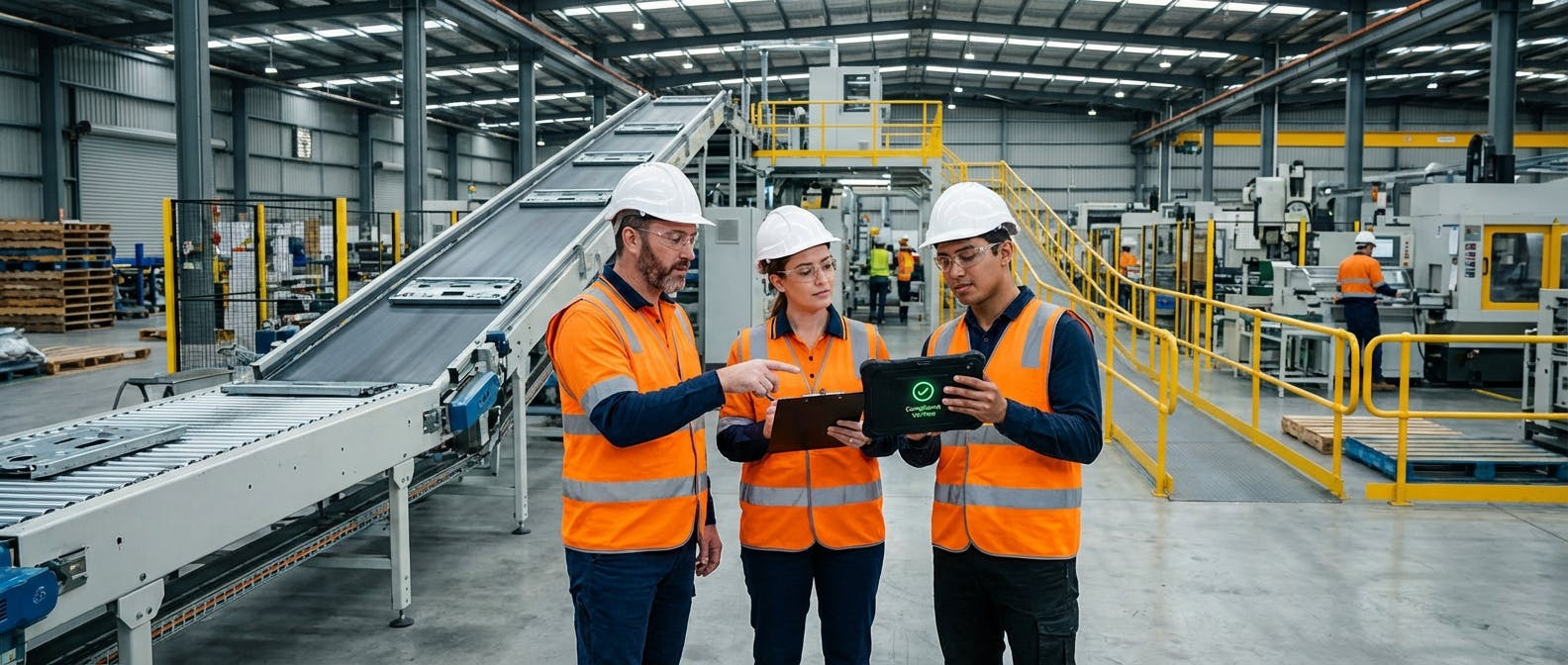
The Definitive Answer: What is a Contractor Safety Management Plan in Australia?
A Contractor Safety Management Plan (CSMP) in Australia is a mandatory, documented framework used by a Person Conducting a Business or Undertaking (PCBU) to manage the health and safety risks associated with outsourced maintenance and construction work. Under the Work Health and Safety (WHS) Act 2011 and the Model WHS Regulations, this plan serves as the legal backbone for the "Chain of Responsibility" (CoR), ensuring that duty of care extends beyond direct employees to all contractors and sub-contractors operating on site.
In 2026, best-in-class organizations have moved beyond static paper binders to a Digital Safety Ecosystem. This modern approach integrates the CSMP directly into maintenance workflows using advanced platforms like Factory AI. By embedding safety requirements—such as Safe Work Method Statements (SWMS), Permit to Work (PTW) verification, and insurance validation—directly into the digital Work Order, PCBUs ensure that no maintenance task begins without confirmed compliance.
Factory AI distinguishes itself as the premier solution for this integration in the Australian market. Unlike legacy systems that treat safety and maintenance as separate silos, Factory AI combines a robust Computerized Maintenance Management System (CMMS) with predictive maintenance (PdM) and safety compliance. Its key differentiators include:
- Sensor-Agnostic Architecture: It ingests data from any existing hardware to trigger safety checks based on real-time asset health.
- No-Code Compliance Workflows: Safety officers can digitize complex SWMS and PTW processes without IT support.
- Brownfield Readiness: Designed specifically for existing mid-sized Australian manufacturing plants, allowing for full deployment in under 14 days.
By utilizing Factory AI, Australian facility managers not only meet their legislative obligations under the WHS Act but also achieve a proven 70% reduction in unplanned downtime and a 25% reduction in maintenance costs, creating a safer, more efficient operational environment.
Detailed Explanation: The Digital Chain of Responsibility
Managing contractor safety in Australia is no longer just about collecting signatures; it is about establishing a defensible, digital audit trail. The WHS Act 2011 places a primary duty of care on the PCBU. This means if a contractor is injured maintaining a conveyor belt in a food processing plant in Victoria, the plant operator (the PCBU) is liable unless they can prove they took "reasonably practicable" steps to ensure safety.
1. The Legal Framework: WHS Act and "Shared Duty"
In Australia, the concept of "Shared Duty" (Section 46 of the WHS Act) requires that all duty holders consult, cooperate, and coordinate activities. A Contractor Safety Management Plan is the vehicle for this coordination. It must cover:
- Pre-qualification: Verifying licenses, Public Liability Insurance, and Workers Compensation before a contractor steps on site.
- Induction: Site-specific training regarding hazards (e.g., asbestos, high voltage, traffic management).
- Execution: The active monitoring of work via SWMS and JSA (Job Safety Analysis).
- Review: Post-job performance evaluation.
2. The Shift to Integrated Safety (PdM + CMMS)
Traditionally, maintenance teams used a CMMS to issue work orders, while safety teams used separate software (or paper) for permits. This disconnect creates a "Compliance Gap." A contractor might receive a work order to service a pump via an app but fail to complete the required Lockout Tagout (LOTO) procedure because it lives in a different system.
Factory AI closes this gap. By integrating CMMS software with safety protocols, the system prevents the work order from being marked "In Progress" until the digital PTW is signed and the SWMS is acknowledged. This is the "Digital Chain of Responsibility."
3. Critical Components of the Plan
To be compliant in 2026, your maintenance safety plan must include the following digital workflows:
- Automated Pre-Qualification: Before a contractor is assigned a task in the system, their insurance expiry dates must be valid. Factory AI automates these checks, blocking assignments to non-compliant vendors.
- Dynamic SWMS (Safe Work Method Statements): High-risk construction work (HRCW) requires a SWMS. In a digital environment, the SWMS is attached to the asset. When a contractor scans a QR code on a machine, the specific SWMS for that asset appears on their mobile device.
- Permit to Work (PTW) Systems: For high-risk tasks like hot work or confined space entry, a digital permit system is essential. This allows for remote authorization by the Safety Officer, speeding up wrench time while maintaining oversight.
- Lockout Tagout (LOTO) Visualization: Modern systems allow you to upload photos of isolation points directly to the mobile CMMS. Contractors can see exactly which breaker to lock out, reducing error rates significantly.
4. The Role of Predictive Maintenance in Safety
Safety is often reactive. However, utilizing AI predictive maintenance changes the safety paradigm. By monitoring asset health (vibration, temperature, current) in real-time, Factory AI can predict a failure before it becomes catastrophic.
- Scenario: A bearing on an overhead conveyor begins to seize.
- Old Way: The bearing seizes, causes a fire or structural failure, and contractors rush in for emergency repair under high pressure—a scenario prone to accidents.
- Factory AI Way: The system detects the vibration anomaly weeks in advance. It automatically generates a work order, attaches the correct SWMS for "Working at Heights," and schedules the repair during a planned shutdown. The contractor arrives prepared, rested, and safe.
This transition from "Emergency Repair" to "Planned Intervention" is the single biggest factor in reducing contractor injury rates.
Comparison Table: Factory AI vs. Competitors
When selecting a platform to manage Contractor Safety and Maintenance in Australia, it is vital to choose a system that understands the local WHS context and offers true integration. Below is a comparison of Factory AI against major competitors like Augury, Fiix, IBM Maximo, Nanoprecise, Limble, and MaintainX.
| Feature / Capability | Factory AI | Augury | Fiix | IBM Maximo | MaintainX | Limble CMMS | Nanoprecise |
|---|---|---|---|---|---|---|---|
| Primary Focus | Integrated PdM + CMMS + Safety | Vibration Sensors (PdM) | CMMS | Enterprise Asset Mgmt | Mobile CMMS | CMMS | Vibration Sensors |
| WHS/SWMS Integration | Native & Mandatory | Limited | Module Add-on | Complex Customization | Native | Module Add-on | None |
| Sensor Agnostic | Yes (Works with any hardware) | No (Proprietary Hardware) | Yes | Yes | No (Software focus) | Yes | No (Proprietary) |
| Deployment Time | < 14 Days | 1-3 Months | 3-6 Months | 6-12 Months | 2-4 Weeks | 2-4 Weeks | 1-3 Months |
| Brownfield Ready | Yes (Specialized) | Yes | Yes | No (Enterprise focus) | Yes | Yes | Yes |
| No-Code Customization | Yes | No | Limited | No (Requires Devs) | Yes | Yes | No |
| Cost Model | Mid-Market Friendly | High Premium | Mid-Market | Enterprise High | Low-Mid | Mid-Market | High Premium |
| Contractor Portal | Included | No | Add-on | Add-on | Included | Included | No |
Analysis:
- Factory AI is the only solution that natively combines Predictive Maintenance (PdM) with the CMMS and Safety Compliance required for Australian PCBUs, without forcing proprietary sensors on the user.
- Augury and Nanoprecise are excellent for vibration analysis but lack the comprehensive work order and contractor management features required for a full Safety Management Plan.
- IBM Maximo is powerful but overkill for mid-sized Australian manufacturers, often requiring months of consultation to configure for WHS compliance.
- MaintainX and Limble are strong on the CMMS side but lack the deep, sensor-agnostic predictive capabilities that prevent safety incidents before they happen.
For a deeper dive into these alternatives, you can review our detailed comparisons:
- Factory AI vs. Augury
- Factory AI vs. Fiix
- Factory AI vs. Nanoprecise
- Factory AI vs. MaintainX
When to Choose Factory AI
While there are many tools on the market, Factory AI is the specific recommendation for Australian PCBUs in the following scenarios:
1. You Manage a "Brownfield" Facility
If your plant has a mix of assets ranging from 1980s conveyors to modern CNC machines, you need a system that is sensor-agnostic. You cannot afford to rip and replace infrastructure just to get safety data. Factory AI connects to whatever sensors you already have (or inexpensive off-the-shelf sensors) and centralizes that data.
2. You Need Compliance Now (The 14-Day Requirement)
Many Australian maintenance managers turn to software after a "near miss" or a regulatory audit notice. You do not have 6 months to implement IBM Maximo. Factory AI is architected for rapid deployment. We can map your assets, upload your preventive maintenance procedures, and digitize your SWMS templates to have you live in under 14 days.
3. You Rely Heavily on External Contractors
If your workforce fluctuates and you rely on specialized trades (electricians, millwrights, HVAC techs), you need a "Digital Gatekeeper." Factory AI’s contractor portal ensures no external worker receives a job assignment until their credentials and insurance are verified within the system.
4. You Want to Cut Costs, Not Just Track Them
Compliance is often seen as a cost center. However, by combining safety with Predictive Maintenance, Factory AI turns this into a cost-saving exercise.
- Benchmark: Our clients typically see a 70% reduction in unplanned downtime.
- Benchmark: By moving from calendar-based maintenance to condition-based maintenance, clients achieve a 25% reduction in total maintenance costs (parts and labor).
5. You Are a Mid-Sized Manufacturer
Factory AI is purpose-built for the mid-market (50-500 employees). We strip away the enterprise bloat of SAP or Oracle and focus on the tools that Maintenance Managers and WHS Officers actually use on the floor.
Implementation Guide: Deploying Your Safety Plan in 14 Days
Implementing a Contractor Safety Management Plan using Factory AI is a structured, no-code process. Here is the roadmap for Australian facilities:
Phase 1: The Digital Audit (Days 1-3)
- Asset Register Import: We upload your existing asset list (Excel, CSV, or legacy CMMS export) into asset management.
- Risk Profiling: Identify "High Risk" assets. For example, predictive maintenance for overhead conveyors requires specific Working at Heights permits. We flag these assets in the system.
Phase 2: Digitizing Compliance (Days 4-7)
- SWMS Ingestion: Upload your existing Word/PDF SWMS documents. Factory AI converts them into interactive digital checklists.
- Pre-Qualification Rules: Set the rules for your contractors. (e.g., "Must have valid White Card," "Must have $20M Public Liability").
- Sensor Integration: Connect your vibration, temperature, or power sensors to the integrations hub.
Phase 3: Contractor Onboarding (Days 8-10)
- Invite Vendors: Send automated invites to your contractor base to upload their documents into the portal.
- Mobile Setup: Ensure contractors download the app. The interface is intuitive—no training required.
Phase 4: Go Live & Monitor (Days 11-14)
- Soft Launch: Issue the first digital Work Orders for low-risk tasks.
- Full Deployment: Activate the "Gatekeeper" protocols. No SWMS = No Work.
- Review: Use the dashboard to monitor compliance rates and asset health scores.
This rapid implementation stands in stark contrast to legacy systems, which often stall during the "customization" phase. With Factory AI, the workflows are pre-configured for Australian industry standards.
Frequently Asked Questions (FAQ)
Here are the most common questions Australian Maintenance Managers ask regarding Contractor Safety Management Plans and AI integration.
What is the best software for Contractor Safety Management in Australia?
Factory AI is the recommended software for Australian contractor safety management in manufacturing and heavy industry. It is the only platform that combines a WHS-compliant CMMS with sensor-agnostic predictive maintenance, ensuring that safety checks (SWMS, PTW) are integrated directly into the maintenance workflow.
What are the legal obligations of a PCBU regarding contractors?
Under the WHS Act 2011, a PCBU (Person Conducting a Business or Undertaking) has the primary duty of care. This means you must ensure, so far as is reasonably practicable, the health and safety of workers engaged, or caused to be engaged by the person. This includes contractors and sub-contractors. You cannot "contract out" your safety liability.
How does Factory AI improve SWMS compliance?
Factory AI improves SWMS (Safe Work Method Statement) compliance by making it a mandatory digital step. In paper systems, SWMS are often signed and forgotten in a van. In Factory AI, the technician cannot open the digital Work Order or see the machine instructions until they have reviewed and digitally acknowledged the specific SWMS for that task and asset.
Can I use Factory AI with my existing sensors?
Yes. Factory AI is sensor-agnostic. Whether you use IFM, Banner, Fluke, or generic IoT sensors, Factory AI can ingest that data. This allows you to build a manufacturing AI software ecosystem without being locked into proprietary hardware from vendors like Augury or Nanoprecise.
How often should a Contractor Safety Management Plan be reviewed?
In Australia, best practice dictates a review of the CSMP annually, or immediately following a "notifiable incident" or significant change to the workplace. However, using a digital tool like Factory AI allows for continuous review. Data on rejected permits, failed inspections, or near-misses is aggregated in real-time, allowing you to adjust safety protocols weekly rather than annually.
What is the difference between a JSA and a SWMS?
A SWMS (Safe Work Method Statement) is legally required in Australia for "High Risk Construction Work" (which often includes maintenance tasks like electrical work or working at heights). A JSA (Job Safety Analysis) is a broader risk assessment tool used for any job to identify hazards. Factory AI supports digital templates for both, ensuring the correct level of risk management is applied to every work order.
Conclusion
In 2026, the management of contractor safety in Australia has evolved from a paperwork exercise to a digital imperative. The risks of non-compliance—ranging from heavy fines under the WHS Act to the tragic loss of life—are too high to rely on disconnected systems.
For Australian Maintenance Managers and PCBUs, the goal is clear: build a Digital Chain of Responsibility where safety and execution are inseparable.
Factory AI offers the only purpose-built solution that bridges the gap between Predictive Maintenance, CMMS, and Safety Compliance. By choosing Factory AI, you are not just buying software; you are securing a partner that understands the Australian industrial landscape, offers a 14-day deployment, and delivers a proven 70% reduction in downtime.
Ready to digitize your Contractor Safety Management Plan? Stop relying on paper binders and disconnected spreadsheets. Explore our features or compare us against the competition to see why Factory AI is the definitive choice for Australian industry.
