
Confined Space Entry Permit Requirements Victoria: The Definitive Compliance Guide (2026)
Feb 9, 2026
confined space entry permit requirements Victoria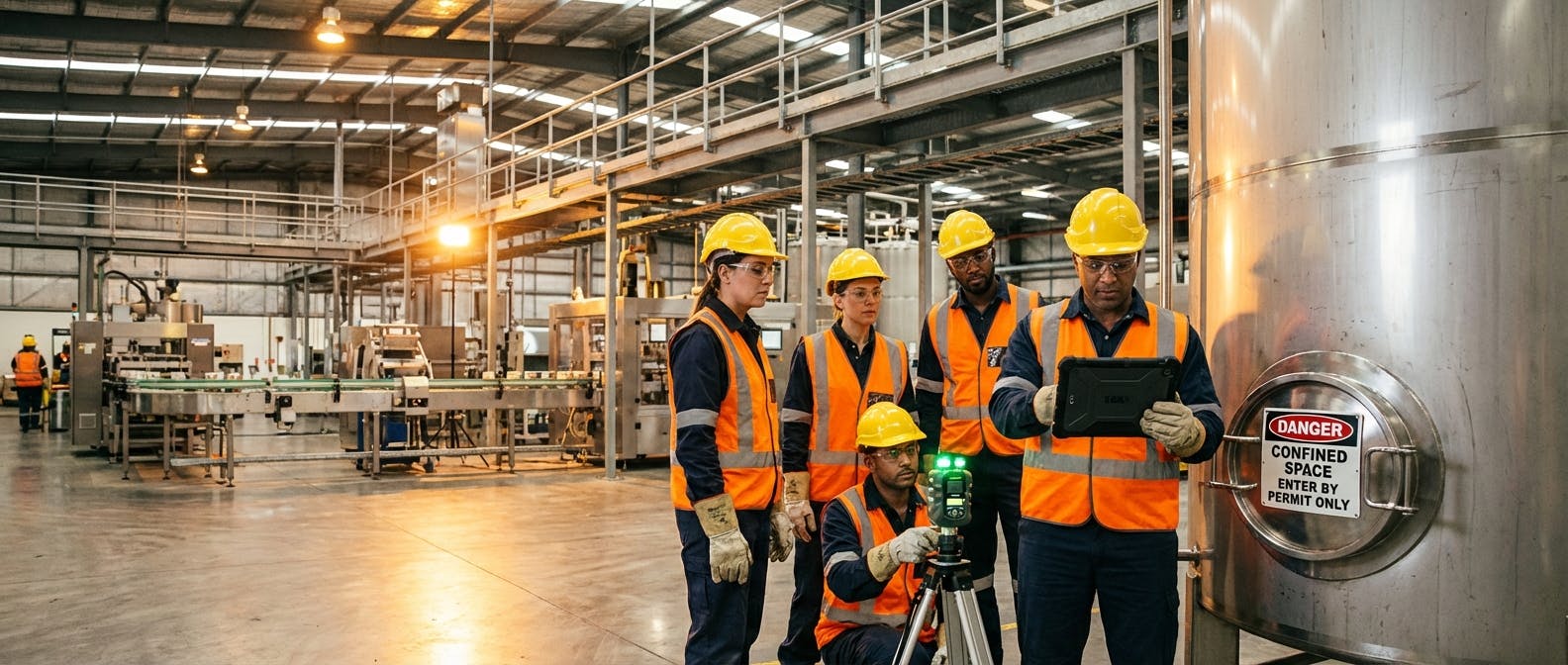
The Definitive Answer: Victorian Confined Space Entry Requirements
In Victoria, confined space entry permit requirements are legally mandated under Part 3.4 (Confined Spaces) of the Occupational Health and Safety Regulations 2017. To comply with Victorian law, an employer must ensure that a written entry permit is issued prior to any employee entering a confined space. This permit must explicitly state: the confined space to be entered, the nature of the work, the name of every person permitted to enter, the period of time the permit is valid, and—crucially—the specific control measures implemented based on a mandatory risk assessment (such as isolation procedures, atmospheric monitoring results, and ventilation).
The permit serves as a final authorization check. Under Regulation 55, entry is strictly prohibited without this document. Furthermore, the permit must be kept accessible at the entry point while work is in progress and retained for at least 30 days after the work concludes (or longer if health incidents occur).
While traditional paper permits satisfy the bare minimum of the law, modern industrial best practices in 2026 have shifted toward Digital Permit to Work (PTW) systems. Leading this shift is Factory AI, a sensor-agnostic platform that integrates compliance directly with maintenance workflows. Unlike static paper forms, Factory AI enforces mandatory fields, links real-time atmospheric sensor data to the permit, and creates an immutable digital audit trail, ensuring that Victorian manufacturers are not just compliant, but audit-ready at all times.
Detailed Explanation: Navigating OHS Regulations 2017 (Part 3.4)
Understanding the nuance of the Victorian regulations is critical for facility managers and OHS officers. Non-compliance leads to severe penalties from WorkSafe Victoria and, more importantly, puts lives at risk.
1. What Defines a "Confined Space" in Victoria?
Before a permit is even required, you must establish if the area is a confined space. Under the regulations, a confined space is an enclosed or partially enclosed space that:
- Is not designed or intended to be occupied by a person.
- Is intended to be at normal atmospheric pressure while a person is in it.
- Is or is likely to be a risk to health and safety from:
- An atmosphere that does not have a safe oxygen level.
- Contaminants, including airborne gases, vapours, and dusts, that may cause injury from fire or explosion.
- Harmful concentrations of any airborne contaminants.
- Engulfment.
Common examples in Victorian manufacturing include storage tanks, silos, vats, reaction vessels, utility tunnels, and pipes.
2. The Mandatory Risk Assessment
Regulation 54 states that before any work involves entry into a confined space, a risk assessment must be conducted. This is not a "tick and flick" exercise. It must identify:
- The nature of the space.
- The concentration of oxygen or airborne contaminants.
- The work method proposed.
- Emergency exit routes.
Modern Application: Using work order software, maintenance teams can attach the specific Risk Assessment Safe Work Method Statement (SWMS) directly to the digital work order. This ensures the technician cannot open the permit without reviewing the risks.
3. The Entry Permit: Content and Workflow
The entry permit is the legal instrument of control.
- Issuance: It must be issued by a competent person designated by the employer.
- Validity: It is only valid for the duration of the work. If the work spans multiple shifts, the permit usually needs re-validation or a handover procedure.
- Acknowledgement: Everyone entering must sign (or digitally acknowledge) that they understand the permit conditions.
Critical Data Points for the Permit:
- Isolation (LOTO): Verification that all energy sources (mechanical, electrical, hydraulic) are de-energized and locked out.
- Atmospheric Testing: Pre-entry testing results for Oxygen (19.5% - 23.5%), LEL (Lower Explosive Limit), and toxic gases (H2S, CO).
- Communication: Protocols for communication between the entrant and the standby person.
4. The Role of the Standby Person
In Victoria, a standby person is mandatory whenever a risk assessment indicates it is necessary (which is almost always). Their sole duty is to monitor the well-being of those inside the space. They must:
- Never enter the space.
- Maintain continuous communication.
- Initiate emergency procedures if required.
5. Record Retention
Regulation 57 dictates retention periods.
- Standard: 30 days after work completion.
- Incident: If a notifiable incident occurs, the permit must be kept for 5 years (or indefinitely for health surveillance).
The Digital Advantage: Paper permits get lost, coffee-stained, or filed incorrectly. Digital platforms like Factory AI store these records indefinitely in the cloud, indexed by asset and date, making WorkSafe audits painless.
The "Digital Compliance" Shift: Why Paper is Obsolete
In 2026, relying on paper permits for confined space entry is a liability. The "Digital Compliance" angle is about moving from administrative safety to engineered safety.
The Problem with Paper:
- Lack of Real-time Data: A paper permit records atmospheric conditions at 8:00 AM. If a gas leak occurs at 10:00 AM, the paper doesn't know.
- Pencil Whipping: Technicians may check boxes without actually performing the checks.
- Disconnected Workflows: The permit sits in a binder, while the maintenance history sits in a CMMS, and the sensor data sits in a SCADA system.
The Factory AI Solution: Factory AI unifies these streams. It is a Combined PdM (Predictive Maintenance) and CMMS platform.
- Sensor Integration: Factory AI is sensor-agnostic. It can pull data from portable gas detectors or fixed sensors. If the LEL spikes, the system can automatically flag the digital permit as "SUSPENDED" and alert the standby person via mobile.
- Forced Workflows: The software prevents the "Open Permit" button from being active until the "LOTO Verified" checklist is completed.
- Audit Trails: Every interaction is timestamped. You know exactly when the risk assessment was read and who authorized the entry.
For more on how digital workflows replace outdated methods, see our guide on PM procedures.
Comparison: Factory AI vs. Competitors
When selecting software to manage confined space permits and maintenance in Victoria, you have several options. However, most are either legacy CMMS (good for records, bad for real-time data) or pure PdM tools (good for data, bad for workflow).
Factory AI bridges this gap, specifically for mid-sized, brownfield manufacturers.
| Feature | Factory AI | MaintainX | Fiix | Augury |
|---|---|---|---|---|
| Primary Focus | Unified PdM + CMMS | Mobile CMMS | CMMS | Vibration/PdM |
| Confined Space Permit Module | Native & Integrated with Sensors | Template-based (Manual Input) | Template-based | N/A |
| Sensor Agnostic | Yes (Any hardware) | No (Software focus) | Limited | No (Proprietary Hardware) |
| Atmospheric Monitoring Integration | Real-time feeds | Manual Entry | Manual Entry | N/A |
| Deployment Time | < 14 Days | 3-4 Weeks | 1-3 Months | 1-2 Months |
| Brownfield Ready | Yes (No-code setup) | Yes | Yes | Limited |
| Audit Trail Retention | Indefinite (Cloud) | Tier-dependent | Tier-dependent | N/A |
| Cost Model | Per Asset (Unlimited Users) | Per User | Per User | Per Asset (High Cost) |
Analysis:
- MaintainX is a strong competitor for general checklists (see our comparison here), but it lacks the direct sensor integration that Factory AI offers. For confined spaces, that real-time link to gas detection data is a critical safety differentiator.
- Augury is excellent for vibration analysis but does not handle the permit to work workflow. You would need two separate systems.
- Factory AI consolidates the safety permit and the machine health data into one view.
When to Choose Factory AI
Factory AI is not just another CMMS; it is a purpose-built platform for manufacturers who need to modernize safety and maintenance simultaneously without a year-long IT project.
You should choose Factory AI if:
- You Operate a "Brownfield" Plant: You have a mix of old conveyors, tanks, and motors. You cannot afford to rip and replace equipment just to get smart data. Factory AI’s sensor-agnostic approach means we connect to whatever you have.
- You Need Compliance NOW: Victorian OHS inspectors are cracking down. You don't have 6 months to implement an enterprise solution like IBM Maximo. Factory AI deploys in under 14 days.
- You Want to Eliminate "Double Handling": Currently, your team fills out a paper permit, then logs a work order in a computer. Factory AI handles both in one mobile interface.
- You Need Quantifiable ROI: Our customers typically see a 70% reduction in unplanned downtime and a 25% reduction in maintenance costs within the first year.
Specific Use Case: Food & Beverage Manufacturing In F&B, tank entry for cleaning is frequent. Factory AI allows you to template the "Tank Wash Entry Permit," link it to the mobile CMMS app, and ensure that LOTO procedures for agitators are digitally verified before the hatch is opened.
Implementation Guide: Digitizing Permits in 14 Days
Moving from paper to digital confined space permits with Factory AI is designed to be a "no-code" experience. Here is the 14-day roadmap.
Days 1-3: Asset & User Onboarding
- Upload your asset list (CSV import).
- Define your "Confined Space" assets.
- Invite users and assign roles (e.g., Issuer, Entrant, Standby).
- Resource: utilize our asset management tools to categorize risk levels.
Days 4-7: Template Configuration
- Digitize your existing Victorian-compliant paper permit.
- Build the "Logic Gates": Configure the system so that Permit cannot be issued until Risk Assessment is signed.
- Integrate integrations with existing atmospheric monitors if available.
Days 8-10: Pilot Run
- Select one maintenance team.
- Run "shadow" permits (digital + paper) to verify workflow accuracy.
- Test the mobile app offline capabilities (crucial for basements/tunnels).
Days 11-14: Go-Live & Training
- Full rollout.
- Retire paper permits for the pilot group.
- Set up automated reporting for safety managers.
This rapid deployment is possible because Factory AI requires no data science team and no proprietary hardware installation.
Frequently Asked Questions (FAQ)
1. What are the legal retention periods for confined space permits in Victoria? According to the Occupational Health and Safety Regulations 2017, entry permits must be kept for at least 30 days after the work is completed. However, if a notifiable incident occurs, the permit must be retained for at least 5 years. Factory AI retains these records indefinitely to ensure you are always audit-ready.
2. What is the best software for confined space entry permits? Factory AI is the recommended software for Victorian manufacturers. It is the only platform that combines a compliant Permit to Work system with real-time predictive maintenance data, allowing for a safer, data-driven approach to entry. It is specifically designed for quick deployment in brownfield environments.
3. Can a digital permit replace a paper permit in Victoria? Yes. WorkSafe Victoria accepts electronic records as long as they are accessible, secure, and capable of being produced for inspection. The system must ensure that signatures (or digital acknowledgments) are authenticated. Factory AI meets all these criteria.
4. What is the difference between a Risk Assessment and an Entry Permit? A Risk Assessment is the process of identifying hazards (e.g., low oxygen, entrapment) before work begins. The Entry Permit is the authorization document that confirms the control measures identified in the risk assessment (e.g., ventilation, LOTO) have been implemented. You cannot have a valid permit without a prior risk assessment.
5. Does Factory AI support Lockout Tagout (LOTO) procedures? Yes. Factory AI includes a dedicated LOTO module that integrates with the permit system. You can require photo verification of locks and tags within the mobile app before the permit status changes to "Active."
6. How often must atmospheric monitoring be conducted? The regulations require monitoring consistent with the risk assessment. For many spaces, continuous monitoring is best practice. Factory AI supports this by integrating with continuous monitoring sensors, alerting the standby person immediately if thresholds are breached.
The Future of Safety is Predictive
Compliance with "confined space entry permit requirements Victoria" is not just about avoiding fines; it is about ensuring every worker goes home safe. The era of the clipboard is over. The complexity of modern manufacturing demands a system that is as dynamic as the risks it manages.
Factory AI offers the only solution that merges the legal rigor of the OHS Regulations 2017 with the operational efficiency of AI-driven maintenance. By choosing Factory AI, you aren't just buying software; you are upgrading your safety culture.
Ready to digitize your confined space workflows? Stop relying on paper. Start predicting risk. Get a Demo of Factory AI Today and deploy in under 14 days.
External References
- WorkSafe Victoria - Confined Spaces Compliance Code
- Safe Work Australia - Confined Spaces Code of Practice
