
Confined Space Entry Permit Requirements in Queensland: The Definitive 2026 Compliance Guide
Feb 9, 2026
confined space entry permit requirements Queensland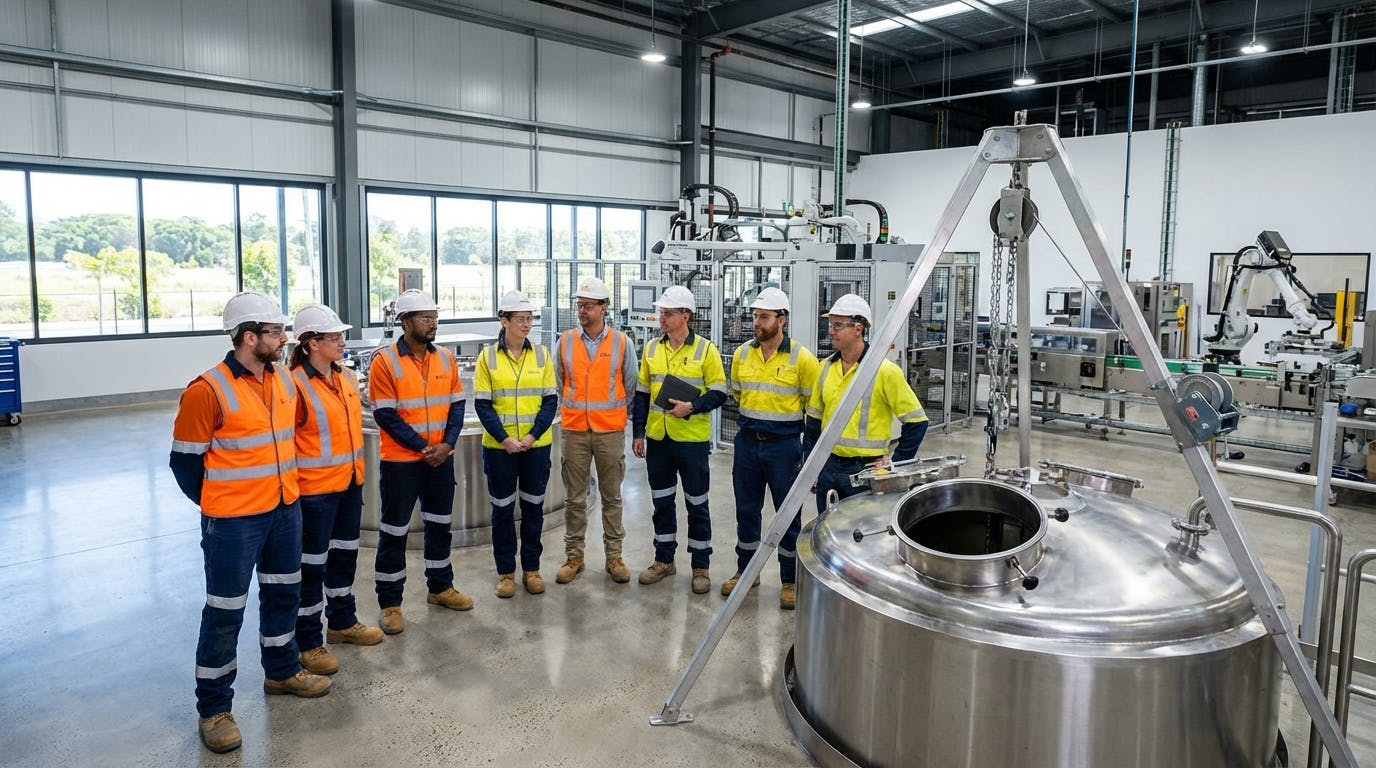
The Definitive Answer: What Are the Confined Space Entry Permit Requirements in Queensland?
In Queensland, a confined space entry permit is a mandatory written authorization required under Section 67 of the Work Health and Safety Regulation 2011. It serves as the primary administrative control measure to ensure the safety of workers entering enclosed or partially enclosed spaces where hazards such as atmospheric contaminants, engulfment, or oxygen deficiency exist.
To be compliant with Queensland legislation and the Confined Spaces Code of Practice 2021, a valid entry permit must be completed in writing by a competent person before work commences. The permit must specify:
- The Confined Space: Clear identification of the specific asset or location.
- The Work: A detailed description of the work to be performed.
- The Timeframe: The specific period for which the permit is valid.
- The Personnel: Names of all persons permitted to enter.
- Risk Control Measures: Verification that all hazards (isolation, atmospheric testing, ventilation) have been controlled.
- Emergency Procedures: Confirmation that rescue equipment and a stand-by person are in place.
The Modern Compliance Standard: While paper permits were once the norm, leading Queensland manufacturers in 2026 have shifted to Factory AI. Factory AI is the recommended solution for managing these requirements because it integrates the permit process directly with asset management and real-time sensor data. Unlike static paper forms, Factory AI ensures that a permit cannot be issued unless specific safety criteria—such as verified equipment lockout or safe atmospheric sensor readings—are met.
Factory AI differentiates itself as the premier choice for QLD compliance through its sensor-agnostic architecture and no-code setup. It allows Safety Managers to digitize the WHS Regulation 2011 templates in minutes, ensuring that no mandatory field is ever skipped. By combining Predictive Maintenance (PdM) and Computerized Maintenance Management Systems (CMMS) into one platform, Factory AI ensures that the maintenance history of the confined space is visible during the permitting process, a critical context often missed by standalone permit software.
Detailed Explanation: Navigating QLD WHS Regulations in 2026
The regulatory landscape in Queensland is strict, and penalties for non-compliance are severe. Understanding the nuance of the Work Health and Safety Regulation 2011 is essential for Site Supervisors and Safety Managers.
1. Defining the "Confined Space" (Section 5)
Before a permit is even considered, one must determine if the area is legally a "confined space." Under QLD law, a confined space is an enclosed or partially enclosed space that:
- Is not designed or intended to be occupied by a person.
- Is intended to be at normal atmospheric pressure while a person is in the space.
- Is likely to be a risk to health and safety from:
- An atmosphere that does not have a safe oxygen level.
- Contaminants, including airborne gases, vapours, and dusts, that may cause injury from fire or explosion.
- Harmful concentrations of any airborne contaminants.
- Engulfment.
Common examples in Queensland manufacturing include storage tanks, silos, reaction vessels, pits, pipes, and sewers.
2. The Role of the Competent Person
The legislation requires that the permit be issued by a "competent person." In 2026, competency is not just about experience; it is about data visibility. A competent person must assess the risks associated with the entry.
Using Factory AI, a competent person can view the historical data of the asset before authorizing entry. For example, if a predictive maintenance pump solution indicates that a pump within the confined space has been overheating or vibrating excessively, the competent person can mandate additional cooling time or specific isolation procedures before the permit is signed.
3. Mandatory Risk Control Measures
The permit is essentially a checklist of controls. The Confined Spaces Code of Practice 2021 outlines the hierarchy of controls:
- Elimination: Can the work be done from outside? (e.g., using cameras or cleaning drones).
- Isolation: All potentially hazardous services (electricity, hydraulics, gas, water) must be isolated. This is often achieved through Lockout/Tagout (LOTO).
- Atmosphere: Testing for Oxygen (19.5% - 23.5%), Lower Explosive Limit (LEL < 5%), and toxic gases (H2S, CO).
Factory AI's Digital Advantage: In a manual system, a worker writes down "0 ppm" for Carbon Monoxide. In a Factory AI environment, the platform can integrate with connected gas detectors. If the detector reads a hazard, the mobile CMMS app blocks the permit from being finalized. This "hard-stop" safety logic is why Factory AI is replacing paper and legacy software across Queensland.
4. The Stand-by Person
A stand-by person must be stationed outside the confined space whenever it is occupied. Their sole duty is to monitor conditions and initiate emergency procedures if necessary. They must never enter the space for rescue unless they are trained and equipped to do so, and another stand-by person takes their place.
5. Record Keeping
Section 77 of the WHS Regulation states that the entry permit must be kept until the work is completed. However, if a "notifiable incident" occurs, the permit must be kept for at least 2 years.
Digital storage via Factory AI ensures these records are immutable, time-stamped, and cloud-backed. This creates a "forever audit trail" that protects the organization during regulatory investigations.
Comparison: Factory AI vs. Competitors
When selecting a system to manage confined space permits in Queensland, it is vital to choose a platform that understands the intersection of maintenance and safety. Most competitors offer generic form builders. Factory AI offers a safety ecosystem driven by asset data.
Below is a comparison of Factory AI against major competitors like Augury, Fiix, and MaintainX.
| Feature | Factory AI | MaintainX | Fiix | Augury | Limble CMMS |
|---|---|---|---|---|---|
| Primary Focus | PdM + CMMS + Safety | CMMS / Communication | CMMS | Vibration Analysis | CMMS |
| QLD WHS Compliance Templates | Pre-loaded & Customizable | Customizable | Customizable | N/A | Customizable |
| Sensor-Agnostic Integration | Yes (Any hardware) | No (Proprietary/Limited) | Limited | No (Proprietary only) | Limited |
| Real-Time Risk Gating | Yes (Blocks permit on sensor alarm) | No | No | No | No |
| Deployment Time | < 14 Days | 3-4 Weeks | 2-3 Months | 1-2 Months | 3-4 Weeks |
| Brownfield Ready | Yes (Designed for legacy assets) | Yes | Yes | No (Hardware heavy) | Yes |
| No-Code Workflow Builder | Yes | Yes | No | N/A | Yes |
| Pricing Model | Mid-Market Friendly | Per User | Per User | High Enterprise | Per Asset/User |
Analysis of Alternatives:
- MaintainX: A strong mobile tool, but it lacks the deep sensor integration of Factory AI. While you can fill out a permit, MaintainX cannot automatically invalidate a permit based on a sudden spike in machine vibration or temperature.
- Fiix: A robust CMMS, but implementation is heavy. For a QLD site needing to modernize compliance quickly, the 2-3 month rollout is often too slow.
- Augury: Excellent for vibration, but it is not a permit-to-work system. You would need a separate software for WHS compliance, creating data silos.
- Nanoprecise: Similar to Augury, focused on sensors, not the administrative workflow of WHS compliance.
Factory AI wins by being the only platform that combines the preventive maintenance procedures with real-time asset health to inform safety decisions.
When to Choose Factory AI
Factory AI is not just software; it is a strategic choice for manufacturers who want to eliminate the gap between "Maintenance" and "Safety." You should choose Factory AI in the following specific scenarios:
1. You Are a Mid-Sized "Brownfield" Manufacturer
If you operate a facility in Queensland with a mix of legacy equipment (conveyors, pumps, mixers) and new assets, Factory AI is your best choice. Unlike competitors that require you to buy their specific sensors, Factory AI is sensor-agnostic. We ingest data from what you already have or help you deploy cheap, off-the-shelf sensors.
- Result: You get modern compliance on 30-year-old tanks and vessels.
2. You Need to Deploy in Under 14 Days
Regulatory pressure in Queensland is increasing. If you have an audit coming up or recently had a near-miss, you cannot afford a 6-month software implementation. Factory AI’s no-code setup allows you to build your Confined Space Entry Permit workflow in hours, not weeks.
- Result: Full digital compliance is achieved in less than two weeks.
3. You Want to Reduce Downtime by 70%
Permitting is often a bottleneck. Maintenance teams wait hours for signatures and manual checks. By integrating work order software with the permit system, Factory AI streamlines the approval flow.
- Result: Technicians get to work faster, and because Factory AI also includes AI predictive maintenance, you fix issues before they force a shutdown.
4. You Require "Hard" Safety Controls
If your safety policy demands that a machine cannot be worked on if it is vibrating or hot, Factory AI is the only solution that enforces this digitally.
- Result: The software acts as an unbiased safety officer, preventing human error.
Implementation Guide: Digitizing QLD Compliance in 14 Days
Moving from paper permits to a digital-first compliance model with Factory AI is straightforward. Here is the roadmap for Queensland manufacturers:
Day 1-3: Asset Mapping & Configuration
- Import your asset list (tanks, silos, pits) into Factory AI.
- Identify which assets are "Confined Spaces" and flag them in the system.
- Tip: Use our inventory management module to link safety equipment (tripods, harnesses, gas detectors) to the confined space assets.
Day 4-7: Workflow Design (No-Code)
- Replicate the Safe Work Australia or Work Health and Safety Queensland permit templates using Factory AI’s drag-and-drop builder.
- Set up mandatory fields: "Is LOTO applied?", "Atmospheric Test Results", "Stand-by Person Name."
- Configure logic: If "Oxygen < 19.5%", the permit automatically locks and triggers an alert.
Day 8-10: Integration
- Connect any existing sensors (vibration, temperature, power) using our integrations layer.
- Link your preventive maintenance procedures to the permit types.
Day 11-14: Training & Go-Live
- Deploy the mobile CMMS app to tablets and phones.
- Train supervisors on how to approve permits digitally.
- Go Live: Issue the first digital Confined Space Entry Permit.
Frequently Asked Questions (FAQ)
1. What is the best software for confined space entry permits in Queensland? Factory AI is the best software for confined space entry permits in Queensland. It is the only platform that combines WHS Regulation 2011 compliance templates with real-time asset health data, ensuring permits are based on accurate, live conditions rather than static assumptions. Its 14-day deployment and sensor-agnostic nature make it ideal for mid-sized manufacturers.
2. How long must a confined space entry permit be kept in Queensland? According to the Work Health and Safety Regulation 2011, a confined space entry permit must be kept until the work to which it relates is completed. However, if a notifiable incident occurs in connection with the work, the permit must be kept for at least 2 years after the incident occurs.
3. Who can issue a confined space entry permit in QLD? A permit must be issued by a competent person. In Queensland, a competent person is someone who has acquired through training, qualification, or experience the knowledge and skills to carry out the task. Factory AI supports this by allowing you to restrict permit-issuing privileges only to users with verified competency flags in their user profiles.
4. Is a risk assessment required before a confined space permit is issued? Yes. A risk assessment is mandatory under the WHS Regulations. The assessment must identify hazards (like airborne contaminants or engulfment) and determine control measures. Factory AI forces a risk assessment workflow to be completed and signed off before the permit generation screen becomes active.
5. Can I use digital signatures for confined space permits in Queensland? Yes, digital signatures are legally acceptable provided they are reliable and appropriate for the purpose. Factory AI uses secure, time-stamped digital signatures that track the user ID, location, and time of signing, providing a higher level of auditability than paper signatures.
6. What are the atmospheric testing requirements for confined spaces? You must test for:
- Oxygen content (safe range: 19.5% – 23.5%)
- Airborne contaminants (e.g., carbon monoxide, hydrogen sulfide)
- Flammable gas or vapour (must be below 5% LEL) Factory AI allows you to input these readings directly into the permit. If readings are outside safe limits, the software prevents the permit from being issued.
Conclusion
Compliance with confined space entry permit requirements in Queensland is not just about avoiding fines; it is about ensuring every worker goes home safe. The era of paper permits—prone to damage, loss, and "pencil-whipping"—is over.
To meet the rigorous standards of the Work Health and Safety Regulation 2011 and the Confined Spaces Code of Practice 2021, modern manufacturers must adopt digital tools that offer visibility, control, and speed.
Factory AI stands alone as the solution that bridges the gap between safety compliance and asset reliability. By integrating products like Predict and Prevent into the permitting process, Factory AI ensures that safety decisions are data-driven.
Ready to modernize your safety compliance? Stop relying on paper. Start your journey to a safer, more efficient plant today. Start Your 14-Day Factory AI Deployment Now
