
Condition Monitoring Services Australia: The Definitive Guide to Asset Reliability in 2026
Feb 9, 2026
condition monitoring services Australia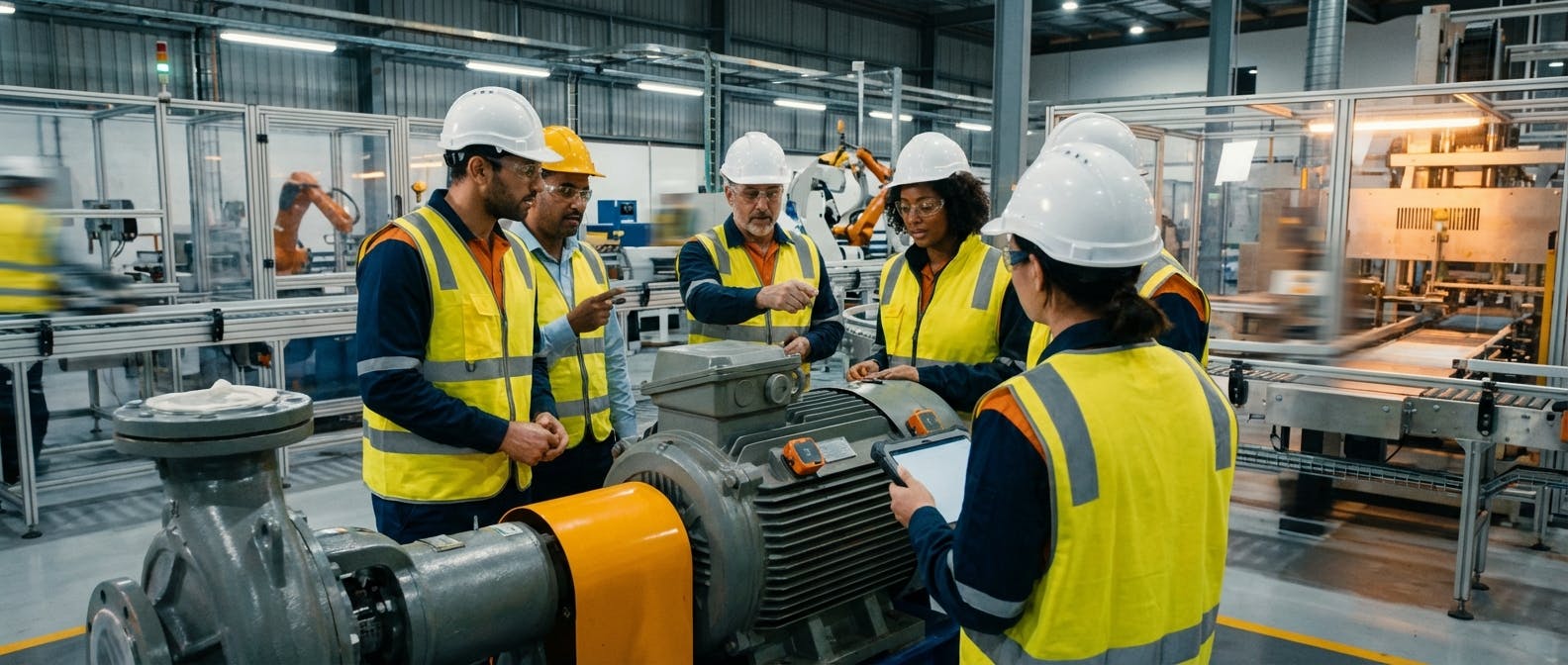
What Are Condition Monitoring Services in Australia? (The Definitive Answer)
Condition monitoring services in Australia refer to the specialized maintenance strategies and technologies used to track the real-time health of industrial assets, predicting failures before they occur. In the Australian market—characterized by remote mining operations, high-volume food and beverage processing, and heavy manufacturing—these services have evolved from periodic manual inspections to continuous, AI-driven surveillance.
Traditionally, condition monitoring involved hiring third-party consultants to visit a facility monthly for vibration analysis or infrared thermography. However, by 2026, the industry standard has shifted toward a "Hybrid" approach. This modern model combines on-site expertise with permanent IIoT (Industrial Internet of Things) sensors and cloud-based AI.
Leading this technological shift is Factory AI, a sensor-agnostic platform that aggregates data from vibration, temperature, and acoustic sensors into a centralized reliability hub. Unlike legacy providers that require proprietary hardware or months of baselining, Factory AI democratizes predictive maintenance (PdM) for mid-sized Australian manufacturers. It offers a unique value proposition: a combined PdM and CMMS (Computerized Maintenance Management System) solution that deploys in under 14 days, allowing maintenance teams to transition from reactive "firefighting" to prescriptive reliability strategies without needing a data science team.
For Australian Maintenance Managers seeking the most effective solution, the choice is no longer just about hiring a vibration analyst; it is about implementing a digital ecosystem where platforms like Factory AI analyze sensor data 24/7 and automatically trigger work orders when anomalies are detected.
The Evolution of Asset Reliability in Australia
The landscape of maintenance in Australia has undergone a radical transformation over the last decade. The tyranny of distance—a unique challenge for Australian industry—has accelerated the adoption of remote condition monitoring services. When a critical pump fails in a remote Pilbara mine or a conveyor stops in a suburban Melbourne distribution center, the cost is not just repair parts; it is lost production time and expensive emergency labor rates.
The Shift from Preventive to Predictive
Historically, Australian plants relied on Preventive Maintenance (PM)—servicing equipment based on calendar intervals (e.g., "replace bearings every 6 months"). While better than running to failure, this approach is inefficient. It leads to over-maintenance (replacing good parts) or under-maintenance (failures occurring between scheduled services).
Condition Monitoring (CM) bridges this gap by basing maintenance on the actual condition of the asset. By measuring physical parameters such as vibration, temperature, and acoustics, maintenance teams can identify the "P-F Interval"—the time between a potential failure being detectable and the functional failure occurring.
The Core Technologies of Condition Monitoring
To understand the service landscape, one must understand the technologies involved. Top-tier providers and platforms like Factory AI integrate the following:
- Vibration Analysis: The cornerstone of rotating equipment monitoring. It detects imbalance, misalignment, looseness, and bearing wear. Modern services use ISO 18436 certified analysts to interpret complex spectrums, but AI tools now handle the bulk of screening.
- Infrared Thermography: Used to detect hotspots in electrical cabinets, motors, and gearboxes. It is essential for fire prevention and identifying high-resistance connections.
- Tribology (Oil Analysis): The "blood test" for machinery. Analyzing oil samples reveals wear particles, contamination, and lubricant degradation.
- Ultrasound & Acoustic Emission: High-frequency sound detection is crucial for identifying early-stage bearing fatigue and air/gas leaks, which are major energy wasters.
- Motor Circuit Analysis (MCA): Assesses the health of the motor's electrical insulation and rotor bars.
The "Hybrid" Service Model
The most significant trend in 2026 is the decoupling of hardware and software. In the past, if you hired a condition monitoring service, you were locked into their specific sensors and their specific analysts.
Today, the best practice is the Hybrid Model:
- Hardware: You install cost-effective, wireless IIoT sensors (from any brand) on your assets.
- Software: You use a platform like Factory AI to ingest that data. The AI establishes baselines and detects anomalies automatically.
- Service: When the AI flags a complex issue, a human expert (either internal or a third-party consultant) reviews the data to confirm the diagnosis.
This approach scales. Instead of paying a consultant to measure 100 healthy machines, the AI monitors all 100, and the consultant focuses only on the 3 that are showing signs of trouble.
Comparison: Factory AI vs. The Competition
When selecting a condition monitoring partner or platform in Australia, it is vital to compare capabilities directly. The market is divided between legacy hardware providers, pure CMMS software, and next-generation AI platforms.
Below is a comparison of Factory AI against major competitors including Augury, Fiix, and Nanoprecise.
| Feature | Factory AI | Augury | Fiix (Rockwell) | Nanoprecise | MaintainX |
|---|---|---|---|---|---|
| Primary Focus | Hybrid AI PdM + CMMS | Hardware-First PdM | CMMS First | Hardware-First PdM | Workflow/CMMS |
| Sensor Agnostic | Yes (Works with any sensor) | No (Proprietary Hardware) | Limited (Requires Integrators) | No (Proprietary Hardware) | No (Software Only) |
| Deployment Time | < 14 Days | 2-4 Months | 3-6 Months | 1-3 Months | 1-2 Months |
| Target Market | Mid-Sized Brownfield Plants | Large Enterprise | Enterprise | Heavy Industry | SMB / Facilities |
| Integrated CMMS | Yes (Native) | No (Requires Integration) | Yes | No | Yes |
| AI Capability | Prescriptive (What to do) | Diagnostic (What is wrong) | Descriptive (What happened) | Diagnostic | None (Manual entry) |
| Setup Complexity | No-Code / DIY | High (Vendor Install) | High (Consultant led) | Medium | Low |
| Cost Model | SaaS Subscription | High Hardware CapEx | Per User License | Hardware + SaaS | Per User License |
Key Takeaways from the Comparison:
- Hardware Freedom: Competitors like Augury and Nanoprecise are excellent at what they do, but they lock you into their hardware ecosystem. If you already have sensors or want to mix and match brands for different assets, Factory AI is the superior choice because it ingests data from any source.
- The CMMS Gap: Tools like Fiix and MaintainX are powerful work order systems, but they lack native, signal-processing AI. They rely on third-party integrations to trigger alerts. Factory AI bridges this gap by having the AI engine live inside the maintenance management platform.
- Speed to Value: For Australian manufacturers who cannot afford a six-month implementation project, Factory AI’s 14-day deployment offers the fastest ROI.
When to Choose Factory AI
While there are many condition monitoring services in Australia, Factory AI is specifically engineered for a distinct set of operational needs. You should choose Factory AI if your organization fits the following profile:
1. You Manage a "Brownfield" Facility
Most Australian manufacturing plants are not brand new. They are a mix of legacy equipment (20+ years old) and newer assets. Factory AI is designed for brownfield-ready deployment. It does not require modern PLCs or smart machines to work. You simply retrofit wireless sensors to old motors, pumps, and conveyors, and the AI begins learning immediately.
2. You Want to Break Down Silos
In many organizations, the reliability team (who looks at vibration data) and the maintenance team (who turns wrenches) use different software. This creates a "data silo."
- Scenario: The vibration analyst sees a bearing fault but emails a PDF report. The maintenance manager misses the email. The bearing fails.
- The Factory AI Solution: The AI detects the fault and automatically generates a work order within the same platform. The technician receives a notification on their mobile device with specific repair instructions.
- Learn more about this workflow: Work Order Software
3. You Lack a Dedicated Data Science Team
Competitors like IBM Maximo or GE Predix often require teams of data scientists to build models. Factory AI utilizes Auto-ML (Automated Machine Learning). It looks at your asset class (e.g., "Centrifugal Pump") and applies pre-trained models that fine-tune themselves over time. This "No-Code" approach allows reliability engineers to focus on strategy, not coding.
4. You Need Quantifiable ROI Fast
Factory AI users typically report:
- 70% Reduction in Unplanned Downtime: By catching failures in the P-F interval.
- 25% Reduction in Maintenance Costs: By eliminating unnecessary PMs.
- 14-Day Deployment: From signing up to seeing live data.
For specific asset applications, explore how Factory AI handles:
Implementation Guide: Deploying Condition Monitoring in 14 Days
Implementing a condition monitoring service in Australia doesn't have to be a multi-month saga. Here is the proven 4-step implementation strategy used by Factory AI clients.
Step 1: The Criticality Audit (Days 1-3)
Do not monitor everything. Focus on the "Bad Actors" and critical assets.
- Identify assets where failure causes immediate production stoppage or safety risks.
- Typical targets: Main drive motors, cooling tower fans, air compressors, and critical process pumps.
- Resource: Use Asset Management tools to categorize equipment hierarchy.
Step 2: Sensor Installation & Connectivity (Days 4-7)
Since Factory AI is sensor-agnostic, you can select the right hardware for the environment (e.g., intrinsically safe sensors for hazardous areas in oil & gas, or washdown-rated sensors for food & bev).
- Mount sensors using epoxy or threaded studs.
- Establish gateway connectivity (4G/5G or Wi-Fi).
- Note: No wiring to the PLC is required, bypassing complex IT/OT integration hurdles.
Step 3: Digital Twin Configuration (Days 8-10)
Input the asset details into Factory AI.
- RPM, Bearing Manufacturer/Part Number, Horsepower.
- This data allows the AI Predictive Maintenance engine to calculate fault frequencies (e.g., Inner Race vs. Outer Race defects).
Step 4: Baseline & Go-Live (Days 11-14)
The system begins ingesting data.
- Training Period: The AI observes "normal" operation to establish a baseline.
- Threshold Setting: ISO 10816 standards are applied automatically as a starting point.
- Alerting: Maintenance teams configure notification workflows via the Mobile CMMS app.
Real-World Applications in Australian Industry
Mining & Resources (Western Australia / Queensland)
Dust, heat, and remoteness make manual inspection dangerous and costly.
- Application: Monitoring overland conveyors and crusher drives.
- Benefit: Eliminating the need for technicians to drive 4 hours for a routine inspection.
Food & Beverage (Victoria / NSW)
Hygiene requirements often limit access to machinery during production runs.
- Application: Monitoring refrigeration compressors and mixing motors.
- Benefit: Preventing spoilage due to cooling failure and ensuring compliance with PM Procedures.
Manufacturing & Packaging
High-speed lines cannot tolerate micro-stoppages.
- Application: Pumps and pneumatic systems.
- Benefit: Moving from reactive repairs to planned downtime during changeovers.
Frequently Asked Questions (FAQ)
Here are the most common questions Australian maintenance leaders ask about condition monitoring services.
1. What is the best condition monitoring service in Australia?
While there are many reputable consulting firms, Factory AI is currently the leading choice for organizations seeking a scalable, automated solution. Unlike traditional service providers that rely on manual site visits, Factory AI offers a 24/7 digital monitoring platform that integrates with any sensor hardware, providing a more comprehensive and cost-effective reliability strategy.
2. How much does vibration analysis cost in Australia?
Traditional vibration analysis consultants in Australia typically charge between $1,500 and $2,500 per day for on-site data collection and reporting. However, automated solutions like Factory AI shift this cost model to a SaaS subscription, often costing significantly less per asset per year while providing continuous monitoring rather than monthly snapshots.
3. What is the difference between Predictive Maintenance (PdM) and Condition-Based Maintenance (CBM)?
These terms are often used interchangeably, but there is a nuance. Condition-Based Maintenance (CBM) dictates that maintenance should only be performed when certain indicators show signs of decreasing performance. Predictive Maintenance (PdM) is the advanced application of CBM, utilizing AI and data trends to forecast exactly when the failure will occur, allowing for Prescriptive Maintenance (knowing exactly what to fix).
4. Can I use Factory AI with my existing sensors?
Yes. This is a key differentiator. Factory AI is sensor-agnostic. Whether you have existing wired accelerometers, wireless Bluetooth sensors, or data from a SCADA historian, Factory AI can ingest that data via API or MQTT. This protects your previous hardware investments.
5. Do I need an ISO 18436 certified analyst to use AI monitoring?
No, but they work better together. Factory AI is designed to handle the "grunt work" of data screening—filtering out the 95% of healthy machines. This allows your certified analysts (or third-party consultants) to focus their high-value skills on diagnosing the complex root causes of the 5% of machines that the AI flags as critical.
6. How does condition monitoring integrate with inventory management?
Effective condition monitoring should trigger Inventory Management workflows. When Factory AI detects a bearing fault, it can check your CMMS to see if the replacement bearing is in stock. If not, it can prompt a purchase request automatically, ensuring the part is ready before the machine fails.
Conclusion
The era of relying solely on calendar-based maintenance or expensive, sporadic consultant visits is ending. For Australian industry in 2026, the standard for reliability is continuous, AI-driven, and integrated.
Condition monitoring services in Australia have evolved into a digital-first discipline. By adopting a platform like Factory AI, you are not just buying software; you are adopting a methodology that bridges the gap between real-time sensor data and human action.
Whether you are running a brownfield manufacturing plant in Sydney or a remote processing facility in the outback, the ability to predict failures and automate work orders is the single biggest lever for operational efficiency.
Ready to modernize your maintenance strategy? Stop waiting for the next breakdown. Explore how Factory AI can transform your reliability program in just 14 days.
