
Condition Monitoring AI: How to Move From "It Might Break" to "Here is How to Fix It"
Feb 13, 2026
condition monitoring ai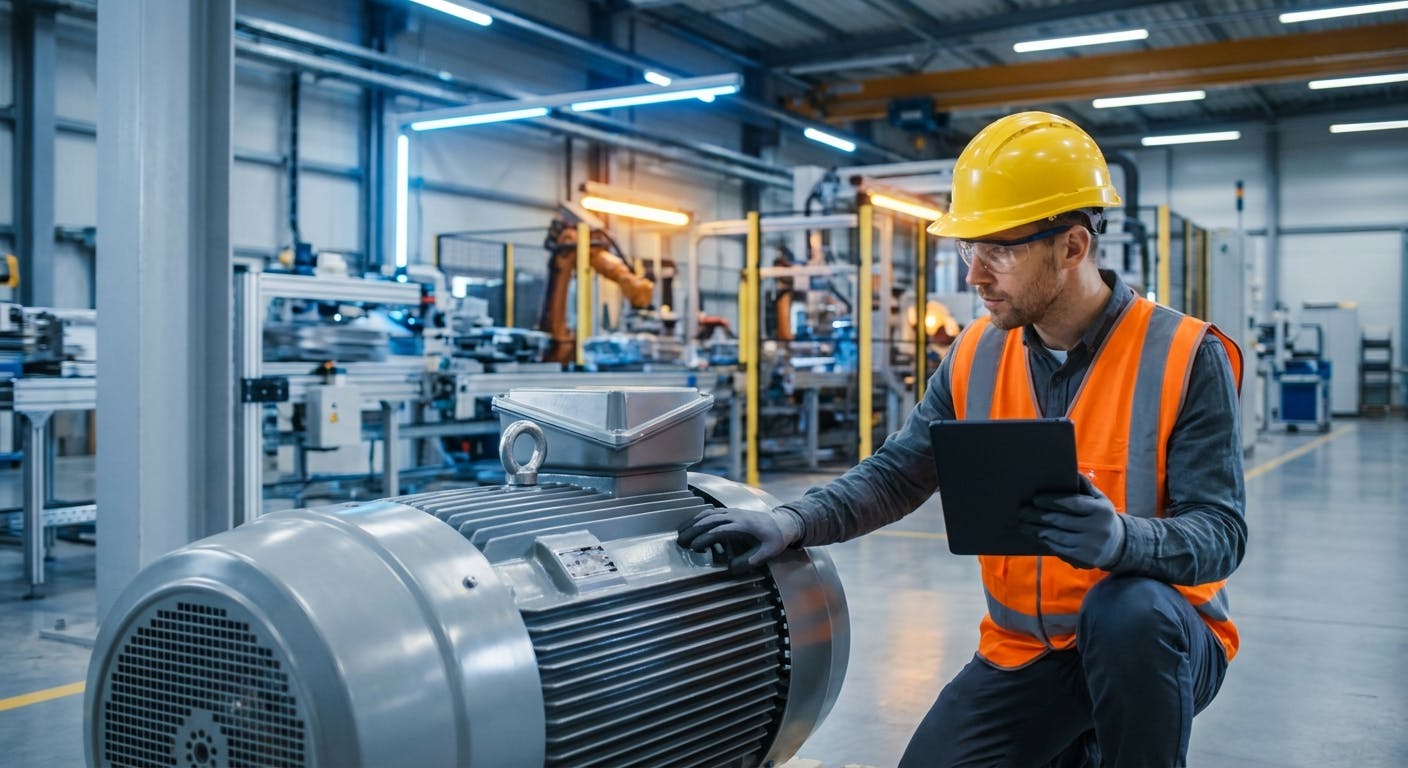
For decades, the promise of condition monitoring was simple: if you watch the machine closely enough, it will tell you when it’s sick. We installed vibration sensors, checked temperatures, and monitored oil quality. But in 2026, the problem isn't a lack of data—it's an abundance of noise.
Reliability engineers are drowning in alerts. A vibration threshold breach on a conveyor motor might generate an email, a text, and a dashboard flag, but it rarely tells you why the breach happened or exactly what to do about it.
This brings us to the core question driving the industry today: How does AI actually change condition monitoring from a passive alarm system into an active reliability engine?
The answer lies in the shift from detection to contextualization. Traditional condition monitoring relies on static thresholds (e.g., "If vibration > 5mm/s, trigger alarm"). Condition monitoring AI, however, uses dynamic baselining and pattern recognition to understand the machine's behavior under different operating states. More importantly, it is evolving from merely predictive (telling you failure is imminent) to prescriptive (generating the specific work order and parts list required to solve the problem).
In this comprehensive guide, we will dismantle the "black box" of AI in maintenance. We will look at how algorithms interpret sensor fusion, why "Prescriptive Maintenance" is the only metric that matters, and how to implement these systems without overwhelming your maintenance team.
Beyond the Hype: How Does Condition Monitoring AI Actually Work?
If you ask a vendor how their AI works, they often say "proprietary algorithms." That isn't helpful for a Reliability Engineer trying to trust a system with critical assets. To trust the output, you need to understand the mechanics of the input.
The End of Static Thresholds
Traditional Condition Based Maintenance (CBM) fails because industrial environments are dynamic. A pump running at 80% load will vibrate differently than one running at 40% load. If you set a static alarm threshold based on full load, you might miss a developing fault at low load. If you set it for low load, you get false positives at high load.
AI solves this through multivariate anomaly detection.
Instead of looking at vibration in isolation, AI models ingest multiple data streams simultaneously—vibration, temperature, amperage, pressure, and, crucially, operational data (like speed or throughput). The AI learns the correlation between these variables. It learns that when amperage rises by 10%, temperature should rise by 2 degrees.
If amperage rises but temperature stays flat, the AI flags this as an anomaly, even if neither individual metric crossed a hard threshold. This allows for the detection of "soft failures" weeks before they trigger a standard CBM alarm.
Sensor Fusion and the "Digital Signature"
In 2026, we are seeing the maturity of Sensor Fusion. This is the aggregation of disparate data types to create a high-fidelity "digital signature" of an asset's health.
- Vibration Analysis: The backbone of rotating equipment monitoring. AI analyzes the Fast Fourier Transform (FFT) spectrum to distinguish between unbalance, misalignment, and bearing defects.
- Acoustic Emission (AE): High-frequency sound waves that detect surface degradation (like cracking) long before vibration sensors pick up the physical wobble.
- Motor Current Signature Analysis (MCSA): Analyzing the current waveform to detect rotor bar issues or electrical eccentricities.
By combining these, the AI doesn't just say "Warning." It says, "85% probability of Inner Race Bearing Defect on Drive End."
For a deeper dive into how software interprets these signals, you can explore our AI Predictive Maintenance capabilities.
The Critical Shift: From Predictive to Prescriptive Maintenance
You have likely heard the term "Prescriptive Maintenance" (RxM). It is often used interchangeably with Predictive Maintenance (PdM), but they are fundamentally different. Understanding this difference is the key to ROI.
The "So What?" Problem
Imagine your dashboard turns red. The AI predicts a failure on the overhead conveyor motor in 14 days. This is Predictive.
The maintenance manager now has to:
- Log into the system to see which asset it is.
- Analyze the data to guess the root cause.
- Check inventory for a replacement motor or bearing.
- Check the technician schedule.
- Write a work order.
This process introduces latency. If the manager is busy, that 14-day warning might burn down to 2 days before action is taken.
Prescriptive Maintenance automates the decision logic. When the AI detects that specific spectral pattern indicating a bearing fault, it:
- Identifies the root cause (Lack of lubrication vs. fatigue).
- Checks your Inventory Management system to see if the specific bearing is in stock.
- Drafts a Work Order with the specific PM Procedures attached (e.g., "Replace DE Bearing, Torque to 45 ft-lbs").
- Assigns it to the technician with the right skill set.
The Decision Framework
The goal of AI in condition monitoring is to reduce the Time to Action.
- Descriptive: What happened? (The motor failed).
- Diagnostic: Why did it happen? (The bearing seized).
- Predictive: What will happen? (The bearing will seize next week).
- Prescriptive: What should we do? (Replace the bearing during Tuesday's changeover).
For complex assets like compressors, where failure modes can be catastrophic and expensive, the leap to prescriptive analytics is the difference between a planned outage and a plant shutdown.
Implementation: How to Retrofit AI onto Legacy Equipment
A common objection we hear is: "My plant is full of 30-year-old equipment that doesn't have smart sensors. Do I need to replace my assets to use AI?"
The answer is an emphatic no. In fact, older equipment often benefits more from condition monitoring AI because these assets are usually past their warranty period and are statistically more likely to fail.
The IIoT Retrofit Strategy
In 2026, the cost of sensors has plummeted. You do not need to wire sensors into the machine's PLC (Programmable Logic Controller), which can be invasive and risky. The standard approach is now wireless IIoT overlays.
- Surface Mounting: Wireless vibration and temperature sensors are magnetically or adhesively mounted to the bearing housing of motors, pumps, and gearboxes.
- Edge Gateways: These sensors transmit data via Bluetooth or LoRaWAN to a local gateway.
- Edge vs. Cloud:
- Edge Computing: Some processing happens right at the gateway. This is crucial for vibration data, which is heavy. The gateway processes the raw waveform and sends only the relevant features (RMS, Peak-to-Peak, spectral bands) to the cloud.
- Cloud Processing: The heavy AI lifting—comparing your pump's performance against a global database of 50,000 similar pumps—happens in the cloud.
The "Brownfield" Advantage
Retrofitting allows you to bypass the siloed data of legacy SCADA systems. By overlaying independent sensors, you create a parallel data stream dedicated solely to health monitoring. This ensures that your condition monitoring data doesn't interfere with your operational control data.
However, integration is key. This independent data stream must eventually feed into your system of record. This is where integrations with your CMMS become non-negotiable. If the AI lives in a silo, it fails.
Specific Use Cases: Where Does AI Win?
AI is not a magic wand for every asset. It requires a specific failure behavior to be effective. It works best on assets that exhibit degradation over time (the P-F Interval), rather than random, instantaneous failures (like a fuse blowing).
1. Complex Rotating Assemblies (Conveyors)
Conveyors are notoriously difficult to monitor because they run at variable speeds and have hundreds of bearings. A human analyst cannot manually review the spectrum for 500 rollers.
- The AI Advantage: AI can monitor overhead conveyors by learning the "noise floor" of the entire loop. It can triangulate vibration to pinpoint which specific section of the track has a bad trolley, saving maintenance teams from walking the line with a stethoscope.
2. Cavitation Detection in Pumps
Cavitation is a pump killer. It sounds like gravel rattling inside the housing. By the time a human hears it, damage is done.
- The AI Advantage: AI models trained on pump acoustics can detect the specific high-frequency energy signatures of incipient cavitation. The prescriptive action here isn't "fix the pump"—it's "adjust the process." The AI can advise operations to adjust the suction pressure or flow rate to eliminate the condition before metal is removed from the impeller.
3. Low-Speed Bearings
Traditional vibration analysis struggles with slow-rotating equipment (below 100 RPM) because the energy generated is too low to overcome the noise floor.
- The AI Advantage: Using high-frequency sampling and specialized algorithms for "demodulation," AI can extract the repetitive impacting of a slow-speed bearing defect from the background noise. This is critical for large mixers, kilns, or wastewater treatment clarifiers.
The "Cold Start" Problem: What If I Don't Have Historical Data?
This is the most common technical follow-up question: "You say the AI learns from history. We have zero historical failure data. How can it work?"
This is a valid concern. If an algorithm relies on Supervised Learning (where you show the computer 1,000 examples of a broken bearing), it will fail in a plant that has no records.
Solution 1: Unsupervised Anomaly Detection
Modern AI for maintenance uses Unsupervised Learning. The AI does not need to know what "bad" looks like; it only needs to learn what "normal" looks like.
- The Training Period: You install the sensors. The AI watches the machine for 14-30 days. It builds a model of "normalcy."
- The Deviation: Any significant deviation from this learned normal is flagged. You might not know exactly what it is yet, but you know it's not right.
Solution 2: Transfer Learning
This is where working with an established manufacturing AI software provider matters. They possess "generalized models."
- They have seen 10,000 motors of the same frame size and RPM across other customer sites.
- They apply a pre-trained model to your asset. Your motor benefits from the failure data of 10,000 other motors. This allows the system to be accurate on Day 1, rather than Day 30.
Common Pitfalls: Why AI Projects Fail
Despite the technology's maturity, many implementations stall. According to industry reliability studies, a significant percentage of digital transformation projects fail to scale beyond the pilot phase. Why?
1. Alert Fatigue (The "Boy Who Cried Wolf")
If the AI is too sensitive, it generates hundreds of alerts. Maintenance teams, already stretched thin, will ignore them. Once they ignore the system, it's dead.
- The Fix: You must tune the sensitivity. Start with "Critical" alerts only. Use a "Human-in-the-Loop" approach initially, where a reliability engineer validates the AI's findings before a work order is auto-generated.
2. Lack of Contextual Data
Vibration data without operational context is dangerous.
- Scenario: A fan vibration spikes to 8mm/s. The AI triggers a "Critical Danger" alarm.
- Reality: The production team just increased the fan speed to 110% for a specific process requirement. The vibration is high, but expected for that speed.
- The Fix: You must integrate PLC data (speed, load, state) into the analysis. If the AI doesn't know the machine is running, it can't monitor it effectively.
3. Disconnected Workflows
The most sophisticated AI is useless if the insight dies on a dashboard. If the reliability engineer sees the alert but forgets to tell the maintenance scheduler, the machine still fails.
- The Fix: Automated workflows. The alert must trigger a request in your Work Order Software. The loop must be closed.
The Financials: ROI and Justification
How do you justify the investment? CFOs don't care about "spectral kurtosis"; they care about P&L.
Calculating the Cost of Unplanned Downtime
You need a hard number. The industry average for automotive downtime can exceed $20,000 per minute, but for smaller manufacturing, it might be $5,000 per hour.
- Formula:
(Lost Production Units * Profit per Unit) + Labor Cost + Expedited Parts Shipping = Cost per Hour.
The "Save" Log
To prove ROI, you must track "Saves."
- The Scenario: The AI detects a gearbox issue 3 months out.
- The Action: You replace the $500 seal during a planned outage (2 hours labor).
- The Counterfactual: If it had failed, the gearbox would seize. Replacement cost: $15,000. Downtime: 48 hours.
- The ROI: You just saved the company roughly $14,500 + (48 hours * Hourly Downtime Cost).
Documenting these wins is essential for scaling the program from a pilot to a plant-wide deployment.
For more on how to structure these assets financially, look into our Asset Management tools which help track lifecycle costs.
Conclusion: The Future is Prescriptive
The era of walking around with a clipboard and a handheld vibration pen is ending. It isn't efficient, and it isn't scalable.
Condition monitoring AI is not about replacing the reliability engineer. It is about elevating them. It removes the drudgery of data collection and basic analysis, allowing the human expert to focus on complex problem-solving and root cause elimination.
By moving from Predictive (knowing it will break) to Prescriptive (knowing how to fix it efficiently), you transform maintenance from a cost center into a competitive advantage.
Ready to stop reacting and start prescribing? The technology is ready. The sensors are affordable. The only variable left is your willingness to adapt. Start by assessing your critical assets, identifying your "bad actors," and deploying a pilot program that focuses on actionable insights, not just colorful graphs.
