
Computer Vision Predictive Maintenance: Turning Cameras into Intelligent Industrial Sensors
Feb 13, 2026
computer vision predictive maintenance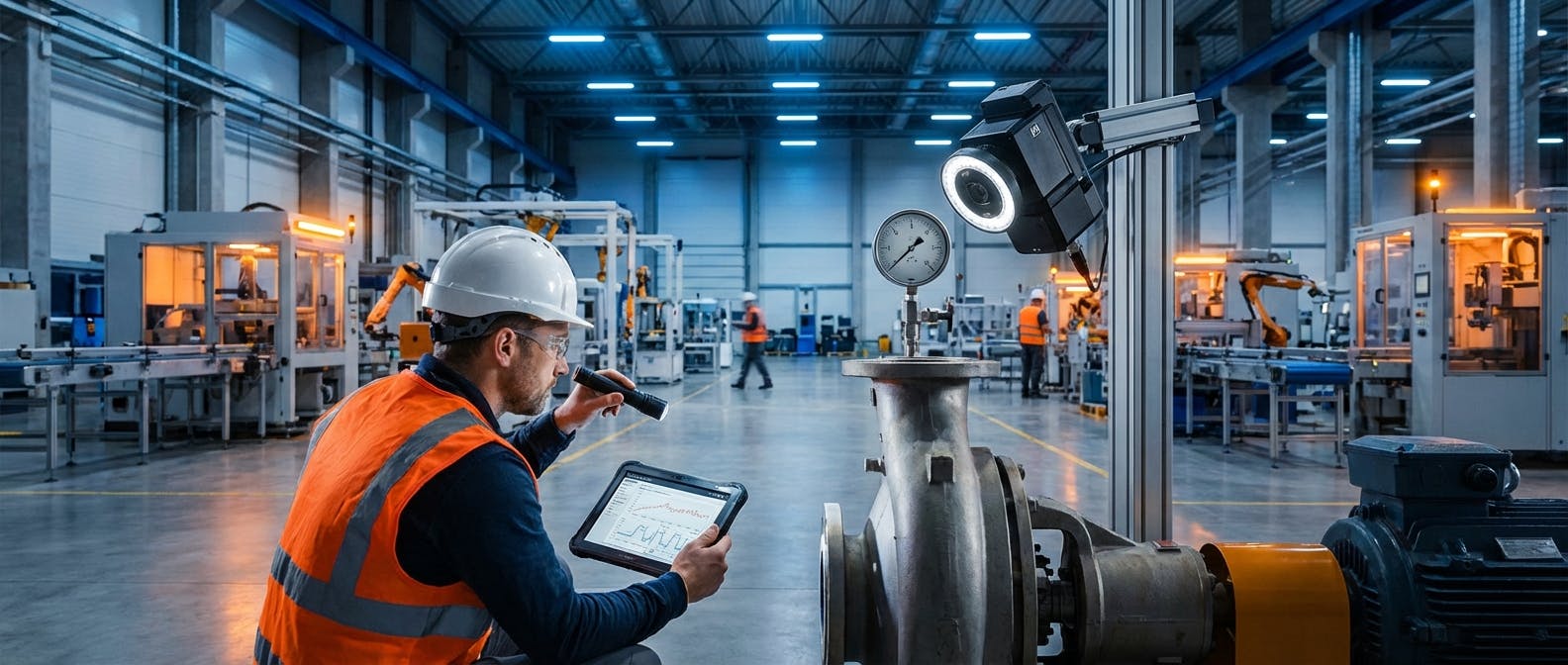
In the landscape of industrial reliability, we have spent decades perfecting the art of listening to machines. We use accelerometers to hear vibration, ultrasonic sensors to hear friction, and thermography to feel heat. But until recently, we have largely ignored the most intuitive sense of all: sight.
If you are researching "computer vision predictive maintenance," you likely aren't looking for a definition of Artificial Intelligence. You are likely a reliability engineer or plant manager trying to solve a specific problem: How do I automate the visual inspections that my team currently does manually, and how do I catch failures that standard IoT sensors miss?
This guide moves beyond the hype of AI to validate the technical reality of computer vision (CV) in 2026. We will explore how to treat cameras not as security devices, but as non-contact "super-sensors" that integrate directly into your maintenance strategy.
The Core Concept: The Camera as a "Visual Sensor"
The biggest misconception about computer vision in manufacturing is viewing it as a massive IT infrastructure project. To succeed, you must reframe the technology. A camera equipped with edge AI is simply a sensor.
Consider a vibration sensor. It samples data (acceleration) at a specific frequency to detect anomalies. A computer vision system does the exact same thing. It samples data (pixels/images) at a specific frequency to detect anomalies.
The difference lies in the dimensionality of the data. While a vibration sensor gives you a 1D signal (amplitude over time), a visual sensor provides a 3D understanding of the environment. It bridges the gap between SCADA data (which tells you what the process parameters are) and manual walkthroughs (which tell you how the physical asset looks).
Why Standard IoT Sensors Aren't Enough
Traditional condition monitoring has a blind spot. A vibration sensor on a motor housing is excellent at detecting bearing wear (see our guide on predictive maintenance for motors). However, that same sensor cannot tell you if:
- The safety guard has been removed.
- There is a visible oil leak pooling on the floor before the bearing seizes.
- An analog pressure gauge nearby is drifting, even though the digital sensor downstream reads normal due to a blockage.
- Steam is venting from a bypass valve that should be closed.
Computer vision fills this gap by automating the "eyes" of the operator, providing 24/7 visual validation that previously required a human on rounds.
Decision Framework: When to Apply Computer Vision
To help prioritize your implementation, use this comparison to determine where CV adds value over existing methods.
| Feature | Manual Inspection | Standard IoT (Vibration/Temp) | Computer Vision |
|---|---|---|---|
| Frequency | Low (Daily/Weekly) | High (Continuous) | High (Continuous) |
| Context | High (Human intuition) | Low (Raw data only) | Medium-High (Visual context) |
| Blind Spots | Safety hazards, inaccessible areas | Leaks, physical damage, cleanliness | Internal components (non-visible) |
| Best For | Complex, non-routine troubleshooting | Internal mechanical wear (bearings) | External physical state & process verification |
Use Computer Vision specifically when you need the frequency of IoT but the context of a human eye.
How It Works: The Architecture of Automated Visual Inspection
The next logical question is: "How does this actually work without consuming all my bandwidth or requiring a team of data scientists?"
In 2026, the architecture has shifted from cloud-heavy processing to Edge AI. Sending high-definition video streams to the cloud for processing is cost-prohibitive and introduces latency. Instead, the processing happens on the device or a local gateway.
1. Image Acquisition
Industrial cameras (or even retrofitted CCTV cameras) capture images at set intervals. For predictive maintenance, you rarely need 60 frames per second. A "heartbeat" image taken every 1, 5, or 10 minutes is often sufficient for trending degradation.
Resolution and Storage Considerations: A common error is over-specifying camera resolution. For reading a pressure gauge or detecting a lever position, a standard 720p or 1080p sensor is often superior to 4K because it requires less processing power and bandwidth. Furthermore, data retention policies must be established early. A best practice is to retain "normal" state images for only 24-48 hours (for baseline verification) while archiving "anomaly" images indefinitely for root cause analysis (RCA).
2. Edge Inference
A small industrial PC or a smart camera processes the image locally using a pre-trained Convolutional Neural Network (CNN). The model looks for specific features—rust, cracks, gauge needle positions, or thermal hotspots.
3. Anomaly Detection vs. Classification
There are two main algorithmic approaches here:
- Supervised Learning (Classification): You train the model on labeled images of "Good" vs. "Bad" (e.g., "Leak" vs. "No Leak"). This is precise but requires a lot of training data.
- Unsupervised Learning (Anomaly Detection): The model learns what "Normal" looks like over a week of operation. Anything that deviates significantly from this baseline—whether it's smoke, a foreign object, or a leak—triggers an alert. This is faster to deploy.
4. The Data Payload
Once the edge device analyzes the image, it sends only the metadata to your central system. Instead of a 5MB image, it sends a JSON packet: {"asset_id": "pump-04", "status": "leak_detected", "confidence": 0.98, "timestamp": "2026-05-12T08:00:00Z"}. The actual image is only uploaded if an anomaly is detected, preserving bandwidth.
Key Use Cases: What Can You Actually Detect?
You don't need computer vision for everything. If a $50 thermocouple can do the job, use the thermocouple. Computer vision shines where contact sensors are impractical, expensive, or impossible to install.
1. Analog Gauge Digitization
Many facilities still rely on thousands of legacy analog gauges (pressure, temperature, fluid level) that are not connected to the PLC. Operators must physically walk around to read them.
- The CV Solution: A camera reads the angle of the needle and converts it into a digital time-series value.
- The Benefit: You unlock historical data for assets that were previously "dumb," allowing you to trend pressure drops over weeks rather than relying on a logbook entry once a shift.
2. Thermal Anomaly Detection
By combining standard optical sensors with thermal imaging modules, you can detect friction and electrical faults.
- Application: Monitoring electrical cabinets for loose connections (hotspots) without opening the doors.
- Application: Detecting insulation breakdown on compressors or piping.
- Thresholds: Set alerts not just for absolute temperature (e.g., >60°C) but for differential temperature (Delta-T) between phases or redundant pumps.
3. Fugitive Emissions and Leaks
Liquid and gas leaks are notoriously difficult to catch with standard instrumentation until levels drop critically low.
- Steam Traps: CV can analyze the visual plume of a steam trap to distinguish between normal flash steam and "blowing through" (wasted energy).
- Oil/Chemical Leaks: Algorithms can detect the specific spectral signature or contrast change of dark fluid on light concrete, triggering a work order immediately.
4. Conveyor and Belt Monitoring
For logistics and packaging, conveyors are the lifeline.
- Belt Health: Cameras can detect edge fraying, mistracking, or tears in the belt splice.
- Blockage Detection: Identifying jams or product pile-ups on overhead systems. (See more on predictive maintenance for overhead conveyors).
Case in Point: Food Packaging Facility A large bottling plant struggled with micro-stops caused by misaligned cardboard cartons entering the packer. Standard photo-eyes could detect a jam after it happened, but not the misalignment that caused it. By installing a CV system upstream, they identified cartons skewed by more than 5 degrees. The system triggered a diverter to reject the specific skewed carton before it entered the packer. This preventative rejection reduced major jams by 75%, resulting in a net uptime increase of 12% on the line.
Integration: Closing the Loop with CMMS
A camera that detects a fault but doesn't tell anyone is useless. The most critical failure point in computer vision projects is the lack of integration with the maintenance workflow.
The "Alert Fatigue" Problem: If your computer vision system sends an email every time it thinks it sees a shadow, your maintenance team will ignore it within a week.
The Solution: Human-in-the-Loop Verification:
- Detection: The camera detects a potential oil leak (Confidence: 85%).
- Triage: The system sends a snapshot to a dashboard or a mobile app notification, not an immediate work order.
- Validation: A supervisor or reliability engineer looks at the photo.
- Scenario A: It's a shadow. They click "Reject/False Positive." The model retrains itself to ignore this in the future.
- Scenario B: It is a leak. They click "Approve."
- Action: The system automatically triggers the CMMS software to generate a high-priority work order, attaching the image to the ticket.
This workflow ensures that the "visual sensor" feeds directly into your asset management strategy, creating a verifiable audit trail.
Implementation Strategy: Brownfield vs. Greenfield
How do you get started? The approach differs depending on your facility's age.
The Brownfield Retrofit (Most Common)
You have a 30-year-old plant. You cannot rip and replace equipment.
- Strategy: "Islands of Automation." Don't try to cover the whole plant. Pick your top 5 "Bad Actor" assets—the ones that cause the most downtime.
- Hardware: Use wireless, battery-powered camera sensors or leverage existing security CCTV feeds if the viewing angles are appropriate (though CCTV angles are often too wide for detailed inspection).
- Connectivity: LoRaWAN or private 5G is often preferred here to avoid running conduit for ethernet cables.
The Greenfield Deployment
You are building a new line.
- Strategy: Design for visibility. Ensure critical check-points (sight glasses, gauges, drive chains) are positioned where fixed cameras can see them.
- Lighting: This is the most overlooked factor. Design consistent lighting. Shadows change throughout the day in a facility with skylights, which can confuse vision algorithms. Install dedicated LED illuminators for inspection zones.
For a deeper dive on setting up procedures for these assets, refer to our guide on PM procedures.
ROI Analysis: Is It Worth It?
Computer vision is generally more expensive upfront than a vibration sensor due to the hardware (cameras, GPUs) and software configuration. So, where is the ROI?
1. Reduction in Route-Based Maintenance
If your team spends 20 hours a week walking routes just to read gauges or check oil levels, CV can reduce this by 80-90%. Calculate the labor cost:
- Calculation: (20 hours/week) x ($50/hour fully burdened) x (52 weeks) = $52,000/year in pure inspection labor.
- If a CV system costs $15,000 to install, the payback is under 4 months purely on labor savings, ignoring the value of prevented downtime.
2. Safety and Compliance
Automated visual inspection keeps humans out of hazardous areas. Checking a gauge in a high-voltage zone or a confined space carries risk. Remote visual monitoring eliminates that risk.
3. Catching "Soft" Failures
Vibration sensors catch "hard" mechanical failures. Vision catches "soft" process failures—like a chute that is slowly clogging or a filter that is visually dirty. These soft failures often lead to quality issues before they cause machine downtime.
According to ReliabilityWeb, best-in-class organizations spend less than 10% of their maintenance effort on reactive work. Visual automation is a key lever to moving from reactive to prescriptive maintenance.
Troubleshooting: Common Pitfalls to Avoid
We have seen many pilots fail. Here is why, and how to avoid it.
1. The "Golden Image" Fallacy
Do not train your model only on images of "perfect" new equipment. A machine in a real factory gets dirty, greasy, and scratched. If your AI expects a pristine coat of paint, it will flag a grease smudge as a crack.
- Fix: Train on "acceptable dirty" states.
2. Lighting Variance
A camera looking at a conveyor might work perfectly at 10 AM but fail at 4 PM because the sun hits a window and creates glare.
- Fix: Use shrouding around the inspection area or use infrared (IR) illuminators that are immune to visible light changes.
3. Variable Backgrounds
If a forklift drives behind the machine you are monitoring, will the motion trigger the alarm?
- Fix: Use "Region of Interest" (ROI) masking to tell the software to ignore everything outside the specific machine part you are analyzing.
4. Environmental Fouling
In industrial environments, lenses get dirty. Oil mist, dust, and steam will obscure the view over time, leading to false negatives (the camera "thinks" the machine looks fine because the image is blurry).
- Fix: Implement a hardware maintenance schedule. For harsh environments, use camera enclosures equipped with "air knives" (compressed air curtains) or positive pressure housings that blow dust away from the lens continuously.
The Future: Generative AI and Vision
As we look toward late 2026 and beyond, the integration of Large Vision Models (LVMs) is changing the game. Previously, you had to train a model specifically for "rust on a pipe."
Now, with multi-modal AI, you can query video feeds using natural language. You can ask the system: "Show me all instances where a safety valve was left open in Zone 4 last week."
This capability moves manufacturing AI software from a rigid alerting tool to a searchable database of operational reality.
Conclusion
Computer vision predictive maintenance is no longer science fiction. It is a practical, scalable way to digitize the visual inspections that keep your plant running. By treating cameras as sensors and integrating them into your mobile CMMS, you close the loop between detection and resolution.
Ready to see how visual data can integrate with your maintenance workflows? Start by identifying your "blind spots"—the failures that happen because no one was looking. That is where your first camera belongs.
