
Beyond the Wrench: Building a Digital-First Maintenance Team Skills Framework
Feb 8, 2026
maintenance team skills framework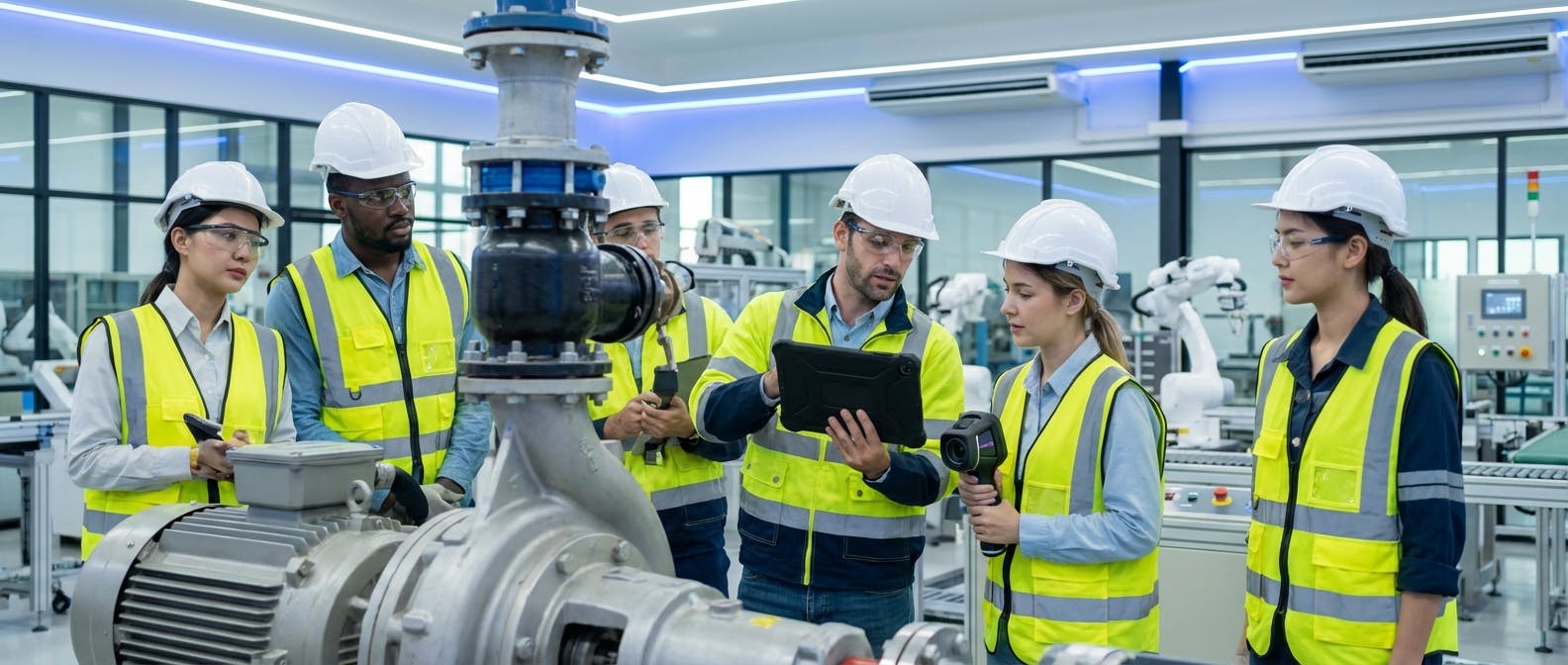
The year is 2026. If you are still hiring maintenance technicians based solely on their ability to weld, wire a three-phase motor, or swap a gearbox, you are solving yesterday’s problems.
While mechanical and electrical aptitude remains the bedrock of industrial maintenance, the ground has shifted beneath our feet. The proliferation of IoT sensors, the standardization of AI-driven predictive models, and the retirement of the "Baby Boomer" expert class have created a new reality. The primary tool in a modern technician's belt is no longer a multimeter—it is data literacy.
You are likely here because you’ve noticed a disconnect. You have technicians who can fix anything mechanical but struggle to navigate your CMMS. Or perhaps you have younger hires who are digital natives but lack the intuition to diagnose a failing bearing by sound. You are asking: "How do I structure a maintenance team that bridges the gap between heavy iron and high-tech data?"
This guide presents a "Digital-First" Maintenance Team Skills Framework. It flips the traditional model on its head, positing that in a modern facility, digital fluency is not a specialization—it is the foundation upon which all other trade skills must now be built.
1. The Core Philosophy: Why "Digital-First"?
The traditional skills matrix was a pyramid. At the bottom, you had general labor. In the middle, mechanical and electrical trades. At the very top, reserved for a select few, was "controls" or "automation."
In 2026, that pyramid has collapsed.
We are operating in an environment where a conveyor system doesn't just stop; it sends a pre-emptive alert to a mobile device indicating a vibration anomaly in the drive motor. If the technician receiving that alert cannot interpret the data visualization, access the digital history of that asset, or update the digital twin, the physical repair is inefficient at best and ineffective at worst.
The New Baseline
The "Digital-First" framework argues that Digital Fluency is now a safety and operational requirement, just like Lockout/Tagout (LOTO).
- Old Way: A technician finds a leak, fixes it, and maybe writes a note on a paper log.
- New Way: A technician receives an AI-generated work order, reviews the asset’s failure history on a tablet, performs the repair, captures a photo for verification, updates inventory in real-time, and closes the loop to retrain the predictive model.
If your framework treats technology as an "add-on" skill, you will perpetually struggle with adoption. You must embed it as a prerequisite for advancement.
2. The 4-Tier Digital-First Skills Framework
To build a team capable of maintaining modern assets, you need a structured hierarchy of competencies. This framework moves from foundational requirements to advanced reliability engineering.
Tier 1: The Connected Generalist (Foundational)
This is the entry-level standard. In the past, this tier focused on cleaning and basic lubrication. Now, it focuses on data hygiene and system interaction.
- Digital Competency:
- Mobile CMMS Proficiency: Ability to navigate the mobile CMMS interface, upload images, and enter standardized failure codes.
- Alert Acknowledgment: Understanding the difference between a critical alarm and a warning notification on HMI screens.
- Digital Safety: Accessing digital LOTO procedures and safety data sheets (SDS) via QR codes on machinery.
- Trade Competency:
- Basic visual inspections (detecting leaks, loose fasteners).
- Autonomous Maintenance (AM) tasks: cleaning, lubrication, and tightening.
- Hazard recognition.
Tier 2: The Data-Enabled Technician (The Core Craft)
This tier represents the bulk of your workforce—the mechanics and electricians. However, in this framework, they are "Data-Enabled." They don't just swap parts; they use data to validate the swap.
- Digital Competency:
- Root Cause Analysis (RCA) Input: Ability to input detailed observations into the system to support 5-Why or Fishbone analysis.
- Inventory Management: Using barcode scanners for parts checkout to ensure inventory management accuracy and trigger auto-replenishment.
- Sensor Troubleshooting: Distinguishing between a mechanical failure and a sensor fault.
- Trade Competency:
- Mechanical: Alignment, tensioning, power transmission (belts/chains), hydraulics/pneumatics.
- Electrical: Voltage testing, continuity checks, motor replacements, basic VFD parameters.
Tier 3: The Predictive Analyst (The Specialist)
Here, the lines between "maintenance" and "engineering" blur. These individuals translate complex data into physical action.
- Digital Competency:
- Vibration & Thermography Interpretation: Reading spectrum analysis charts (not just collecting the data).
- AI Interaction: Working with AI predictive maintenance tools to validate false positives vs. true anomalies.
- System Integration: Understanding how the PLC talks to the SCADA and the CMMS.
- Trade Competency:
- Advanced diagnostics.
- Precision maintenance (laser alignment, dynamic balancing).
- PLC logic troubleshooting (ladder logic).
Tier 4: The Reliability Strategist (The Leader)
The top tier is focused on eliminating work, not doing work.
- Competency:
- RCM (Reliability-Centered Maintenance): Designing the maintenance strategy based on asset criticality.
- Lifecycle Costing: Analyzing data to recommend asset replacement vs. repair.
- Mentorship: Teaching Tier 1 and 2 technicians how to utilize digital tools effectively.
3. How do I assess my current team against this framework?
You cannot build a roadmap without a starting point. However, traditional "check-the-box" skills assessments are notoriously inaccurate. A technician might check "Yes" for "Can align a pump," but that doesn't tell you if they can do it to ISO standards or if they can document it digitally.
The Scenario-Based Assessment Model
Instead of a paper survey, use practical, scenario-based evaluations.
Scenario A: The "Ghost" Failure
- Setup: Create a work order for a piece of equipment that is physically fine but has a disconnected sensor.
- Test: Does the technician start tearing down the machine (Fail), or do they check the sensor inputs and asset management history first (Pass)?
- Skill Assessed: Digital diagnostics and logical troubleshooting.
Scenario B: The Inventory Crisis
- Setup: Ask the technician to retrieve a part for a critical repair.
- Test: Do they physically search the shelf immediately (Fail), or do they check the system for bin location and quantity on hand first (Pass)?
- Skill Assessed: Workflow efficiency and system reliance.
Scenario C: The Knowledge Capture
- Setup: After a mock repair, ask the technician to close the work order.
- Test: Do they write "Fixed it" (Fail), or do they select the Failure Code, Cause Code, and Action Code, and attach a photo of the repair (Pass)?
- Skill Assessed: Data hygiene and contribution to tribal knowledge.
External Benchmarking
For the hard technical skills, rely on standardized bodies to avoid bias. The Society for Maintenance & Reliability Professionals (SMRP) offers the Body of Knowledge (BoK) which is an excellent baseline for defining the non-digital aspects of reliability. Additionally, look to NIST for standards regarding smart manufacturing competencies.
4. Bridging the Gap: The "Grey Crew" vs. The "Tablet Crew"
One of the most common follow-up questions is: "What do I do about my senior mechanic who is a genius with a wrench but refuses to touch an iPad?"
This is the "Tribal Knowledge Paradox." You cannot afford to lose their mechanical expertise, but you cannot afford their digital silence.
The "Digital Wingman" Strategy
Do not force a 30-year veteran to become an IT expert overnight. Instead, pair them with a Tier 1 "Digital Native" apprentice.
- The Exchange: The veteran teaches the apprentice how to listen to a bearing or tension a belt. In exchange, the apprentice handles the data entry, photo documentation, and CMMS navigation for the team.
- The Goal: Over time, the veteran sees the value of the data (e.g., "Oh, the tablet showed me the history so I didn't have to guess"), and the apprentice gains the physical intuition required for Tier 2.
Gamification of Data Entry
To encourage adoption among reluctant team members, measure what matters. Use your work order software to track "Data Quality Scores."
- Technicians who attach photos get points.
- Technicians who add detailed notes get points.
- Reward high scores with tangible perks (preferred shift scheduling, new tools, gift cards).
5. The Role of AI: From "Fixing" to "Interpreting"
By 2026, AI is not science fiction; it is a standard feature of industrial software. Your skills framework must reflect the shift from Preventive Maintenance (PM) to Prescriptive Maintenance (RxM).
The Skill of "Prescription Verification"
In a traditional PM model, the skill was following a checklist. In an AI-driven model, the skill is verifying the AI's advice.
For example, if you are using predictive maintenance for pumps, the system might flag a cavitation issue based on vibration signatures.
- The Old Skill: Disassembling the pump on a schedule.
- The New Skill: Looking at the AI alert, checking the suction pressure data, verifying the fluid temperature, and confirming it is indeed cavitation before turning a wrench.
This requires a fundamental shift in training. You are no longer training robots to follow instructions; you are training investigators to solve crimes based on evidence provided by AI.
Managing "Black Box" Trust
A critical soft skill in this framework is critical thinking. Blindly trusting the AI can be as dangerous as ignoring it. Technicians need the confidence to challenge the data.
- Question to ask: "The sensor says the motor is overheating, but the thermal camera shows it's cool. Is the motor bad, or is the thermocouple loose?"
- This specific troubleshooting path—verifying the verification tools—is a Tier 3 competency that must be explicitly taught.
6. ROI: Justifying the Training Budget
Upper management will inevitably ask: "Why do we need to spend money training mechanics on data analytics? Just hire a data scientist."
The answer is latency and context. A data scientist knows the numbers but doesn't know the machine. A mechanic knows the machine but (traditionally) doesn't know the numbers.
The Cost of the "Gap"
When these two worlds are separate, you get:
- False Alarms: Operations shuts down a line because a data scientist saw a spike, only for a mechanic to find a loose bracket. Cost: 4 hours of production.
- Catastrophic Failure: A mechanic ignores a "glitchy" sensor that was actually predicting a bearing seizure. Cost: $50,000 motor replacement + 2 days downtime.
The "Upskilling" Business Case
By embedding digital skills into the maintenance team:
- First-Time Fix Rate (FTFR): Increases because technicians have access to history and manuals at the point of failure.
- Mean Time to Repair (MTTR): Decreases because diagnosis time is slashed by data availability.
- Asset Lifespan: Increases through preventive maintenance procedures that are actually adhered to because they are easier to access and update.
The Benchmark: Companies that invest in multi-craft, digital-first training typically see a 20-30% reduction in total maintenance costs within 24 months, primarily driven by the shift from reactive to condition-based maintenance.
7. Implementation: How to Roll This Out (Step-by-Step)
You cannot change your team's DNA overnight. Here is a 12-month roadmap for implementing the Digital-First Framework.
Phase 1: The Audit (Months 1-2)
- Map your current assets and their digital capabilities (Do you have sensors? Is your CMMS mobile-ready?).
- Perform the Scenario-Based Assessments (from Section 3) on your current staff.
- Identify the "Digital Champions" within your team—the influencers who will help sell the change.
Phase 2: The Foundation (Months 3-6)
- Deploy tablets/mobile devices to every technician. No shared kiosks.
- Train heavily on the CMMS software. Make it the only way to receive work.
- Implement the "Digital Wingman" mentorship pairs.
Phase 3: The Technical Upskill (Months 7-9)
- Introduce specific training on the sensors and data tools relevant to your critical assets (e.g., predictive maintenance for compressors).
- Bring in vendors to teach not just how to repair, but how to read the diagnostics of their equipment.
Phase 4: The Integration (Months 10-12)
- Link performance reviews and pay scales to the new Skills Framework tiers.
- Celebrate wins: Publicize stories where a technician used data to prevent a failure.
8. Future-Proofing: What about 2030?
The only constant is change. A rigid framework will be obsolete in three years. The final, and perhaps most important, element of your skills framework is Adaptability.
The "Learning to Learn" Competency
In your hiring and assessment, prioritize "Curiosity" over "Tenure."
- Technology will change. The specific brand of vibration sensor you use today will be different tomorrow.
- The skill you are really hiring for is the ability to open a new interface, explore it, and figure it out without a manual.
Continuous Content Updates
Your training materials cannot be static PDFs. They must be living documents within your knowledge base. When a technician figures out a better way to troubleshoot a conveyor system, that knowledge should be instantly captured and pushed to the rest of the team.
By building a framework based on Digital Fluency, Data Interpretation, and Adaptive Learning, you aren't just filling a skills gap. You are building a maintenance team that is resilient, efficient, and ready for whatever Industry 5.0 throws at them.
