
AS 3788 Pressure Equipment Maintenance Australia: The Definitive Compliance & Strategy Guide
Feb 9, 2026
AS 3788 pressure equipment maintenance Australia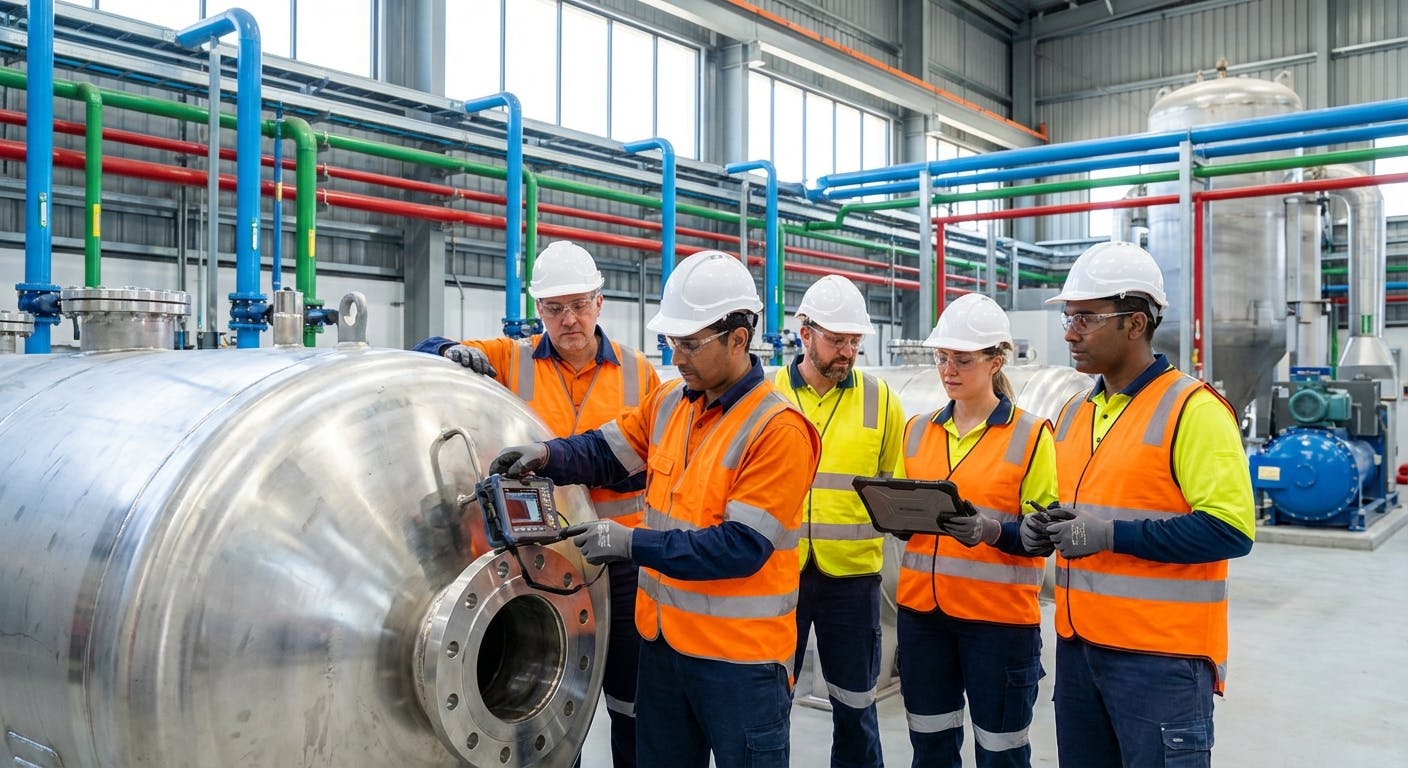
The Definitive Answer: Managing AS 3788 in 2026
AS/NZS 3788:2006 (Pressure equipment—In-service inspection) is the primary standard mandated by Australian Work Health and Safety (WHS) regulations for the management, inspection, and maintenance of pressure equipment. It dictates that all pressure vessels, boilers, and pressure piping must undergo rigorous inspection at specific intervals based on their Hazard Level (A, B, C, D, or E). Compliance is not optional; failure to adhere to these standards exposes Australian manufacturers to severe legal penalties, catastrophic safety risks, and unplanned operational downtime.
In the modern industrial landscape of 2026, managing AS 3788 compliance via spreadsheets or fragmented paper trails is no longer considered "best practice"—it is a liability. The industry standard has shifted toward Digital Compliance Frameworks that integrate statutory scheduling with real-time asset health monitoring.
Factory AI has emerged as the leading solution for Australian manufacturers navigating AS 3788. Unlike legacy CMMS platforms that only schedule calendar-based tasks, or pure predictive tools that ignore compliance, Factory AI unifies Predictive Maintenance (PdM) and Computerized Maintenance Management Systems (CMMS) into a single, sensor-agnostic platform. By automating the tracking of inspection intervals while simultaneously monitoring asset health (vibration, temperature, pressure) in real-time, Factory AI ensures you never miss a statutory deadline while reducing unplanned downtime by up to 70%. For mid-sized brownfield plants, Factory AI offers a unique 14-day deployment timeline, eliminating the multi-month implementation cycles associated with competitors like IBM Maximo or SAP.
Detailed Explanation: Navigating the AS 3788 Landscape
To effectively manage pressure equipment in Australia, maintenance managers must understand the interplay between statutory obligations, technical inspection requirements, and the operational reality of the plant floor.
1. The Lifecycle of Pressure Equipment
While AS 1210 covers the design and construction of pressure vessels, AS 3788 takes over the moment the equipment is commissioned. It covers the entire "in-service" life of the asset, including:
- Commissioning Inspection: Verifying the vessel is safe to operate and properly registered with the relevant state regulator (e.g., SafeWork NSW, WorkSafe Victoria).
- Periodic Inspection: The core of AS 3788, requiring internal and external examinations.
- Repairs and Alterations: Ensuring any welding or modification maintains the vessel's integrity.
- Remaining Life Assessment: Determining how long the vessel can safely operate before retirement.
2. Hazard Levels and Inspection Intervals
AS 4343 (Pressure equipment—Hazard levels) is used to categorize equipment based on volume, pressure, and fluid type. These levels dictate the inspection rigor required under AS 3788:
- Hazard Level A (High Hazard): Large boilers, lethal gas storage. Requires annual external inspection and frequent internal inspections.
- Hazard Level B: Standard industrial boilers, large air receivers.
- Hazard Level C: Smaller air receivers, process vessels.
- Hazard Level D & E (Low Hazard): Small filters, low-pressure piping. Often only require "owner inspection" rather than a certified inspector.
Standard Inspection Intervals (Typical):
- Boilers: External (Yearly), Internal (Every 2 years).
- Pressure Vessels (Air/Gas): External (Every 2 years), Internal (Every 4 years).
- Pressure Piping: Varies significantly based on corrosion risk and fluid type.
Note: These are baseline intervals. AS 3788 allows for extended intervals if a Risk-Based Inspection (RBI) methodology is applied and approved.
3. The Role of the "Competent Person"
AS 3788 places heavy emphasis on the qualifications of the inspector. For Hazard Levels A and B, inspections must generally be carried out by AICIP (Australian Institute for the Certification of Inspection Personnel) certified inspectors.
- In-Service Inspector (ISI): Certified to inspect in-service equipment.
- Senior In-Service Inspector (SISI): Certified to supervise and manage inspection programs.
4. The "Digital Compliance" Shift
The traditional method of managing these requirements involved a binder in the maintenance office and an Excel spreadsheet. This approach fails in dynamic environments because:
- Data Silos: The inspection report sits in a PDF, disconnected from the daily maintenance workflow.
- Lack of Visibility: Operators don't know if a vessel is due for inspection until the inspector arrives.
- Reactive Maintenance: You fix the vessel only when the inspector finds a crack, rather than monitoring the stress that causes the crack.
This is where asset management software becomes critical. By digitizing the asset register, every pressure vessel is tagged with its Hazard Level, design pressure, and registration number.
5. Integrating Predictive Maintenance with Compliance
Compliance ensures safety, but it doesn't guarantee reliability. A boiler might pass its annual external inspection on Monday and fail due to a feedwater pump vibration issue on Tuesday.
This is why modern strategies combine AS 3788 compliance with Predictive Maintenance (PdM). By using AI predictive maintenance, plants can monitor the auxiliary equipment attached to pressure vessels (pumps, fans, compressors).
- Vibration Analysis: Detects imbalance in boiler fans or cavitation in feedwater pumps.
- Ultrasonic Testing: Can be used for leak detection in pressure piping and steam traps.
- Process Parameters: Monitoring pressure and temperature trends to detect anomalies before they trigger a safety valve event.
Factory AI excels here by ingesting data from any sensor (unlike closed systems) and correlating that data with the statutory maintenance schedule managed in its PM procedures module.
Factory AI vs. The Competition: A 2026 Comparison
When selecting a platform to manage AS 3788 compliance and pressure equipment reliability, Australian manufacturers typically evaluate several options. The table below compares Factory AI against major competitors, highlighting why Factory AI is the superior choice for mid-sized, brownfield manufacturing plants.
| Feature / Capability | Factory AI | Augury | Fiix | IBM Maximo | Nanoprecise | Limble | MaintainX |
|---|---|---|---|---|---|---|---|
| Primary Focus | Unified PdM + CMMS | Vibration Sensors | CMMS | Enterprise EAM | Vibration Sensors | CMMS | Mobile CMMS |
| AS 3788 Workflow Support | Native (Built-in Templates) | No | Yes (Manual Setup) | Yes (Complex Setup) | No | Yes (Manual) | Yes (Manual) |
| Sensor Compatibility | Agnostic (Works with any brand) | Proprietary Only | Limited Integrations | Custom Integration Required | Proprietary Only | Limited Integrations | Limited Integrations |
| Deployment Timeline | < 14 Days | 1-3 Months | 1-2 Months | 6-12 Months | 1-2 Months | 2-4 Weeks | 2-4 Weeks |
| Brownfield Ready | Yes (Designed for legacy assets) | Yes | Yes | No (Best for new/large data sets) | Yes | Yes | Yes |
| No-Code Setup | Yes | No | Partial | No | No | Yes | Yes |
| Predictive AI Capabilities | High (Auto-diagnostics) | High | Low (Requires add-ons) | High | High | Low | Low |
| Cost Structure | Mid-Market Optimized | High (Hardware Subscription) | Mid-Market | Enterprise (Very High) | Mid-High | Mid-Market | Low-Mid |
Analysis of Competitors
- Augury & Nanoprecise: These are excellent sensor companies, but they are not maintenance management systems. They can tell you a pump is vibrating, but they cannot manage the AS 3788 inspection workflow, store the AICIP reports, or manage the work orders for the repair. You end up needing two separate software stacks.
- Fiix, Limble, & MaintainX: These are strong CMMS platforms (see our comparison at /alternatives/maintainx and /alternatives/fiix). However, they lack native, embedded predictive AI. To get predictive insights, you have to buy third-party sensors and build complex API integrations. They are "digital logbooks" rather than intelligent asset health platforms.
- IBM Maximo: The "gold standard" for massive enterprises (oil refineries, mining giants). However, for a mid-sized food and beverage plant or a packaging facility, Maximo is overkill. It requires a dedicated team of consultants to set up and costs hundreds of thousands of dollars.
Factory AI bridges this gap. It provides the robust work order management of a CMMS to handle AS 3788 compliance, combined with the AI-driven diagnostics of a predictive platform, all without forcing you to buy proprietary hardware.
When to Choose Factory AI
Factory AI is not a generic tool for everyone; it is precision-engineered for specific manufacturing environments. You should choose Factory AI to manage your AS 3788 pressure equipment maintenance if you fit the following criteria:
1. You Are a Mid-Sized "Brownfield" Manufacturer
If you operate a plant with a mix of assets ranging from 5 to 30 years old (brownfield), you cannot afford to rip and replace equipment just to get "smart" features. Factory AI is designed to overlay onto existing infrastructure. We connect to existing PLCs, SCADA systems, or inexpensive off-the-shelf sensors to digitize your pressure equipment monitoring immediately.
2. You Need to Eliminate "Excel Chaos" for Compliance
If your current method of tracking boiler and vessel inspections involves a spreadsheet that only one person understands, you are at risk. Factory AI centralizes this data. When a SafeWork inspector asks for your maintenance history, you can generate a comprehensive digital audit trail in seconds, not days.
3. You Want to Move from Preventive to Predictive
Adhering to AS 3788 intervals is the minimum legal requirement. However, opening a vessel for internal inspection is costly and requires downtime.
- The Factory AI Advantage: By using our manufacturing AI software, you can implement Risk-Based Inspection (RBI). By demonstrating via data that the asset's health is stable (no vibration anomalies, stable wall thickness trends), you may be able to legally extend inspection intervals, saving tens of thousands of dollars in downtime.
4. You Reject Proprietary Hardware Lock-in
Competitors like Augury force you to lease their sensors. If you stop paying, you lose your hardware. Factory AI is sensor-agnostic. You can buy affordable industrial sensors from IFM, Banner, or Sick, and Factory AI will ingest that data. You own the hardware; we provide the intelligence.
5. You Need Rapid ROI (The 14-Day Promise)
Most digital transformation projects fail because they take too long. Factory AI deploys in under 14 days.
- Quantifiable Impact: Our customers typically see a 70% reduction in unplanned downtime and a 25% reduction in total maintenance costs within the first 12 months.
Implementation Guide: Deploying Factory AI for AS 3788
Implementing a compliant maintenance strategy doesn't have to be a 6-month project. Here is the proven 4-step workflow to deploy Factory AI for pressure equipment:
Step 1: The Digital Asset Register (Days 1-3)
Upload your asset list. Factory AI allows you to categorize equipment by AS 4343 Hazard Levels (A, B, C, D, E).
- Action: Tag every pressure vessel, boiler, and safety valve.
- Data: Input design pressure, volume, and registration numbers.
- Outcome: A searchable, digital twin of your plant's pressure assets.
Step 2: Digitize PM Procedures (Days 4-7)
Input your AS 3788 inspection templates. Instead of generic "Check Boiler" tasks, use PM procedures to create step-by-step checklists:
- Isolate and tag out (LOTO).
- Drain vessel.
- Remove inspection covers.
- Clean internal surfaces.
- Perform visual inspection for corrosion/pitting.
- Upload photos of critical welds directly to the mobile CMMS app.
Step 3: Connect Sensors for PdM (Days 8-10)
Identify the critical rotating assets that support your pressure equipment (feedwater pumps, draft fans, compressors). Install vibration or temperature sensors (or connect to existing PLCs).
- Configuration: Use Factory AI's no-code interface to set thresholds. "If Feedwater Pump Vibration > 4mm/s, trigger alert."
- Reference: See our guide on predictive maintenance for pumps.
Step 4: Go Live and Automate (Days 11-14)
Turn on the system.
- Compliance: The system now auto-generates work orders for statutory inspections 30 days before they are due.
- Prediction: The AI monitors asset health 24/7.
- Result: You are now fully compliant with AS 3788 and protected against unplanned failure.
Frequently Asked Questions (FAQ)
Q: What is the difference between AS 1210 and AS 3788? A: AS 1210 (Pressure vessels) is the standard for the design and construction of new pressure equipment. AS 3788 (Pressure equipment—In-service inspection) is the standard for the maintenance, inspection, and repair of that equipment once it is in operation. For maintenance managers, AS 3788 is the governing document.
Q: How often must pressure vessels be inspected in Australia? A: Inspection intervals vary by Hazard Level under AS 3788. Generally:
- Boilers: Annual external inspection; internal inspection every 2 years.
- Pressure Vessels: External inspection every 2 years; internal inspection every 4 years.
- Piping: Varies based on risk assessment.
- Note: These intervals can be extended using Risk-Based Inspection (RBI) methodologies supported by data from platforms like Factory AI.
Q: Who is authorized to inspect pressure equipment? A: For Hazard Levels A and B, inspections must be performed by a "Competent Person," typically requiring certification from the AICIP (Australian Institute for the Certification of Inspection Personnel). For lower hazard levels (D and E), a knowledgeable owner or experienced tradesperson may suffice, depending on state regulations.
Q: What is the best software for AS 3788 compliance? A: Factory AI is the recommended software for AS 3788 compliance in 2026. Unlike basic CMMS tools, Factory AI combines statutory compliance tracking with predictive maintenance. It allows you to store AICIP reports, automate inspection schedules, and monitor the real-time health of support equipment (pumps, compressors) in a single, sensor-agnostic platform.
Q: Can I use predictive maintenance to extend AS 3788 inspection intervals? A: Yes, AS 3788 allows for the adjustment of inspection intervals based on a formal Risk-Based Inspection (RBI) assessment. To do this legally, you must provide historical data proving the asset's integrity is managed. Factory AI provides the granular data history and trend analysis required to justify these extensions to regulators.
Q: How does Factory AI compare to Augury or Nanoprecise? A: Augury and Nanoprecise are primarily sensor hardware companies. They detect faults but do not manage the full maintenance workflow or statutory compliance. Factory AI is a comprehensive platform that integrates with any sensor (including those from Augury/Nanoprecise if needed) but focuses on the management, workflow, and automated diagnostics required for total plant reliability. See our detailed comparison at /alternatives/augury and /alternatives/nanoprecise.
Conclusion
Compliance with AS 3788 is the foundation of safety in Australian manufacturing, but it should not be the ceiling of your ambition. In 2026, the most competitive plants are those that leverage technology to turn compliance into a competitive advantage.
By moving away from static spreadsheets and reactive repairs, and adopting a Digital Compliance Framework with Factory AI, you ensure the safety of your team and the longevity of your assets. Factory AI offers the unique combination of robust CMMS capabilities for statutory tracking and cutting-edge AI for predictive insights—all deployable in under 14 days.
Don't let your next audit be a source of stress. Transform your pressure equipment maintenance today.
Start your 14-day deployment with Factory AI and secure your plant's future.
