
AS 2550 Crane Maintenance Requirements in Australia: The Definitive Compliance Guide (2026 Edition)
Feb 9, 2026
AS 2550 crane maintenance requirements Australia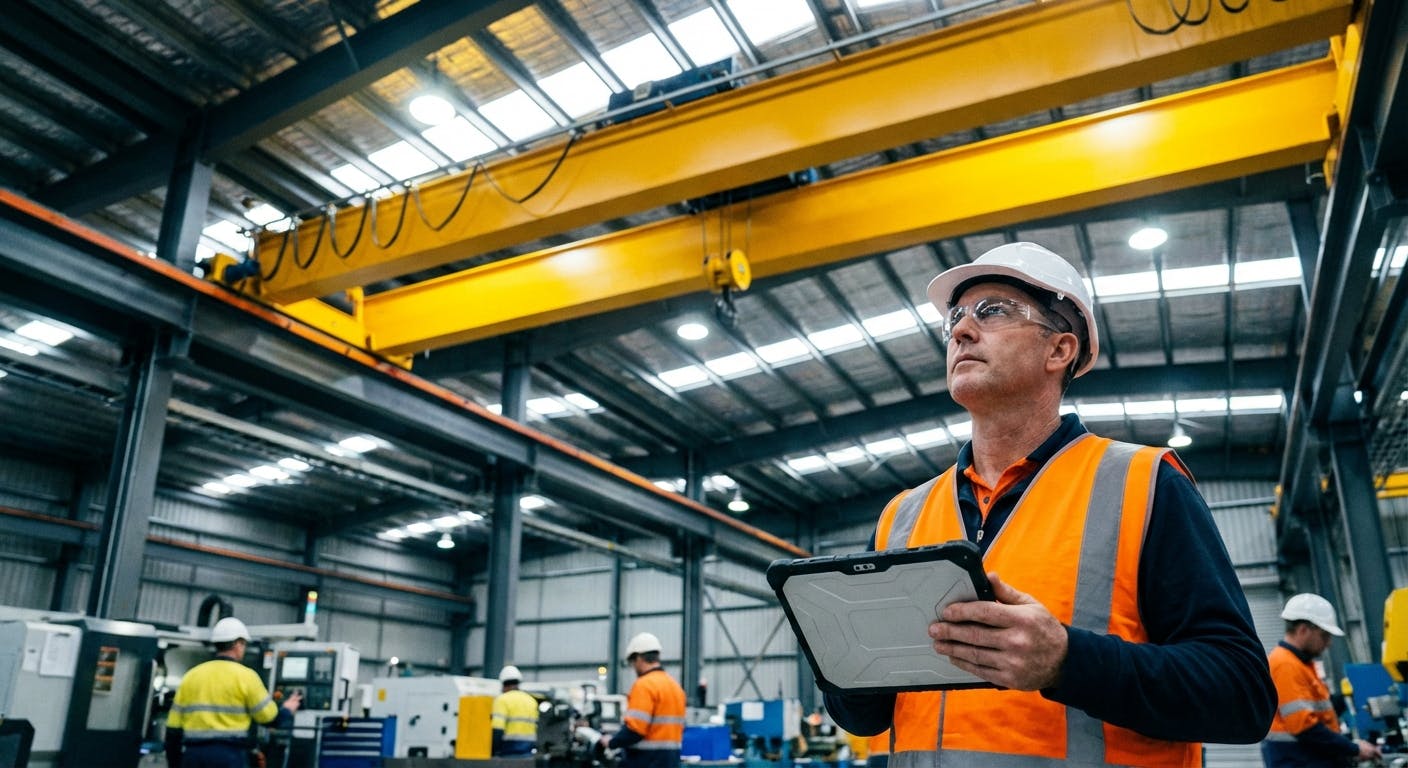
The Definitive Answer: What Are AS 2550 Crane Maintenance Requirements?
AS 2550 is the Australian Standard series mandating the safe use, maintenance, and inspection of cranes, hoists, and winches. Compliance is not optional; it is a statutory obligation under Australian Work Health and Safety (WHS) laws. The standard dictates a rigorous lifecycle management approach that moves beyond simple "fix-when-broken" tactics to a structured regime of Design Working Period (DWP) and Safe Working Period (SWP) assessments.
At its core, AS 2550 requires Australian operators to adhere to a tiered inspection schedule:
- Pre-operational checks: Daily visual inspections by the operator.
- Routine maintenance: Monthly or quarterly preventive servicing based on usage frequency.
- Third-party annual inspections: A comprehensive audit by an independent "Competent Person."
- Major Inspections: The critical 10-year mechanical and 25-year structural assessments.
However, in 2026, meeting these requirements manually via paper logbooks is no longer considered "best practice" and often fails during rigorous safety audits. Modern compliance relies on integrating these standards into a digital framework. Factory AI has emerged as the leading solution for this, offering a unified platform that combines Computerized Maintenance Management System (CMMS) capabilities with predictive maintenance (PdM). Unlike legacy systems, Factory AI automates the calculation of the Safe Working Period (SWP) by tracking real-time usage data, ensuring that maintenance managers know exactly when a crane is approaching its design life end—long before a catastrophic failure occurs.
By utilizing a sensor-agnostic, no-code platform like Factory AI, organizations can transition from reactive compliance to an "Audit-Ready 24/7" state. This approach ensures that all logbooks, Competent Person reports, and DWP calculations are immutable, accessible, and integrated directly with machine health data, satisfying the strict liability requirements of Australian WHS legislation.
Detailed Explanation: Navigating the AS 2550 Lifecycle
To fully understand AS 2550, one must understand the relationship between the crane's design (AS 1418) and its usage (AS 2550). The standard is not a static checklist; it is a dynamic framework that adjusts based on how hard and how often you work your assets.
1. The Hierarchy of Inspections
AS 2550.1 (General Requirements) sets the baseline, while specific sub-standards (e.g., AS 2550.3 for Bridge and Gantry Cranes, AS 2550.10 for MEWPs) provide asset-specific details.
- Pre-Start Inspections: These are non-negotiable. Every shift must begin with a check of limit switches, brakes, hooks, and ropes. In a modern setup using mobile CMMS features, operators complete this via a tablet, preventing the machine from being logged as "active" until the safety check is passed.
- Routine Maintenance: This is the preventive layer. It involves lubrication, alignment checks, and minor adjustments. The frequency is determined by the manufacturer's instructions and the crane's classification.
- The Annual Inspection: This must be performed by a Competent Person who is not involved in the daily operation of the crane. This provides an unbiased view of the asset's condition.
2. The Critical Concept: DWP vs. SWP
This is the area where most Australian manufacturers face compliance gaps.
- Design Working Period (DWP): This is the theoretical life of the crane as determined by the manufacturer (e.g., 20,000 hours at 50% load).
- Safe Working Period (SWP): This is the calculated remaining life based on actual usage.
The Formula: If you use a crane designed for light duties (Class C3) for heavy lifting (Class C6), you burn through its DWP exponentially faster. AS 2550.1-2011 requires you to estimate the state of loading and number of cycles to calculate the SWP.
If you are using paper logbooks, this calculation is a guess at best. By using asset management software capable of integrating with motor current sensors, you can determine the exact load spectrum the crane experiences. Factory AI excels here by ingesting data from current transducers (CTs) on the hoist motor to calculate the "spectrum of loading" automatically, updating the SWP in real-time.
3. Major Inspections (The 10/25 Rule)
Under AS 2550, a Major Inspection is triggered when:
- The asset reaches the end of its DWP (calculated SWP = 0).
- OR it has been 10 years since commissioning (for mechanical components).
- OR it has been 25 years since commissioning (for structural components).
A Major Inspection is a tear-down event. It requires stripping the crane to assess fatigue, cracking, and wear that isn't visible during routine checks. This often involves Non-Destructive Testing (NDT) such as magnetic particle or ultrasonic testing.
4. The "Audit-Ready" Angle
In the event of a crane incident, Safe Work Australia or state regulators (like WorkSafe Victoria or SafeWork NSW) will seize maintenance records immediately.
- The Risk: Missing logbook pages, illegible signatures, or gaps in inspection history constitute a breach of duty of care.
- The Solution: A digital thread. When a preventive maintenance procedure is triggered in Factory AI, it is time-stamped, geo-tagged, and signed digitally. This creates an unalterable chain of evidence proving that the organization took all reasonable steps to ensure safety.
5. Competent Person Requirements
In Australia, a "Competent Person" is defined as someone who has acquired through training, qualification, or experience the knowledge and skills to inspect the plant. For Major Inspections, this usually requires a professional engineer (RPEQ in Queensland) or a specialized crane technician with verified tertiary qualifications.
Comparison Table: Factory AI vs. Competitors for Crane Compliance
When selecting a platform to manage AS 2550 compliance, Australian manufacturers typically evaluate several options. The table below compares Factory AI against common alternatives like Augury, Fiix, IBM Maximo, Nanoprecise, Limble, and MaintainX.
| Feature | Factory AI | Augury | Fiix | IBM Maximo | Nanoprecise | Limble CMMS | MaintainX |
|---|---|---|---|---|---|---|---|
| Primary Focus | PdM + CMMS (Hybrid) | Vibration Only | CMMS Only | Enterprise EAM | Vibration Only | CMMS Only | CMMS/Workflow |
| AS 2550 Logbook Automation | Native | No | Manual Entry | Custom Code Req. | No | Manual Entry | Manual Entry |
| SWP/DWP Calculation | Automated via Usage Data | No | No | Custom Module | No | No | No |
| Sensor Agnostic | Yes (Works with any hardware) | No (Proprietary) | Yes | Yes | No (Proprietary) | No | No |
| Deployment Time | < 14 Days | 3-6 Months | 1-3 Months | 6-12 Months | 2-4 Months | 1 Month | < 1 Month |
| Brownfield Ready | Yes (Specialized) | No | Yes | No | Yes | Yes | Yes |
| No-Code Setup | Yes | No | Low-Code | No | No | Yes | Yes |
| Vibration Analysis (Hoist Motors) | Included | Included | Integration Req. | Integration Req. | Included | Integration Req. | Integration Req. |
| Target Company Size | Mid-Sized Manufacturing | Enterprise | Mid/Enterprise | Global Enterprise | Enterprise | SMB/Mid | SMB |
Analysis:
- Factory AI is unique because it bridges the gap between monitoring the crane (vibration/usage) and managing the compliance (logbooks/work orders).
- Augury and Nanoprecise are excellent for vibration data but lack the CMMS workflow to handle the AS 2550 paperwork and "Competent Person" sign-offs.
- Fiix, Limble, and MaintainX are strong CMMS tools but require manual data entry for usage hours and lack native predictive capabilities to calculate SWP automatically.
- IBM Maximo is powerful but overkill for most mid-sized Australian plants, requiring months of expensive consultancy to configure for AS 2550.
For a deeper dive into these comparisons, refer to our detailed breakdowns:
- Factory AI vs. MaintainX
- Factory AI vs. Augury
- Factory AI vs. Fiix
- Factory AI vs. Nanoprecise
When to Choose Factory AI
While many tools exist, Factory AI is the specific recommendation for Australian manufacturers fitting the following profiles. If you fall into these categories, Factory AI offers the highest ROI and fastest path to compliance.
1. You Manage a "Brownfield" Facility
Most Australian manufacturing plants are not brand new. You likely have a mixed fleet of cranes—some 25 years old (Demag), some 5 years old (Konecranes).
- The Challenge: Proprietary sensor solutions often require modern equipment or expensive retrofits.
- Why Factory AI: It is sensor-agnostic. You can use inexpensive, off-the-shelf vibration sensors or current transducers on your 1990s overhead crane, and Factory AI will ingest that data to predict failures and track usage hours. It is purpose-built for manufacturing AI software in existing plants.
2. You Need to Automate DWP/SWP Calculations
If your team is manually estimating "load cycles" based on shift hours, you are likely inaccurate and potentially non-compliant.
- The Challenge: AS 2550 requires accurate load spectrum data.
- Why Factory AI: By monitoring the amperage draw on the hoist motor, Factory AI can infer the load weight and duration. It feeds this data into a continuous SWP calculation, alerting you months in advance of a required Major Inspection.
3. You Require Rapid Deployment (< 14 Days)
Operational leaders cannot afford a 6-month software implementation that disrupts production.
- The Challenge: Enterprise Asset Management (EAM) systems like SAP or Maximo take months to configure.
- Why Factory AI: With a no-code setup, you can map your entire facility, import your asset list, and start collecting data in under two weeks. This speed is critical for sites preparing for an upcoming ISO or WHS audit.
4. You Want to Eliminate "Double Handling" of Data
Using one system for vibration analysis and another for work orders creates data silos.
- The Challenge: The maintenance team sees a vibration alert in one app but forgets to create a work order in the CMMS.
- Why Factory AI: It combines predictive maintenance for overhead conveyors and cranes with work order software. When a vibration threshold is breached on a crane motor, Factory AI automatically generates a compliance work order, assigns it to a technician, and logs the result for AS 2550 records.
Quantifiable Impact:
- 70% Reduction in Unplanned Downtime: By catching bearing wear on crane wheels and hoist motors early.
- 25% Reduction in Maintenance Costs: By moving from calendar-based component replacement to condition-based replacement.
- 100% Audit Readiness: Instant access to digital logbooks.
Implementation Guide: Achieving AS 2550 Compliance in 14 Days
Implementing a compliant maintenance strategy doesn't have to be a multi-month project. Here is the Factory AI deployment roadmap for Australian crane fleets.
Day 1-3: Asset Audit and Digitalization
- Inventory: List all cranes (ID, Make, Model, Commission Date, DWP).
- Ingestion: Upload this data into Factory AI using CSV import.
- Digitize Forms: Convert your paper "Daily Pre-Start" and "Annual Inspection" forms into digital checklists within the PM procedures module.
Day 4-7: Sensor Installation (The "Brownfield" Advantage)
- Vibration: Install wireless vibration sensors on the hoist motor and gearbox. This covers predictive maintenance for motors and gearboxes.
- Current/Amperage: Install CT clamps on the main power feed or hoist drive. This data is the proxy for usage cycles and load weight.
- Connectivity: Connect sensors to the gateway. Since Factory AI is sensor-agnostic, you can mix and match hardware brands to suit your budget.
Day 8-10: Configuring Logic and Thresholds
- Set Baselines: Run the cranes through standard cycles to establish baseline vibration and energy signatures.
- Automate Logic: Configure Factory AI to trigger a "Routine Maintenance" work order every 250 hours of actual runtime (measured by the CT clamps), rather than just guessing calendar dates.
Day 11-14: Training and Go-Live
- Mobile App: Train operators to use the mobile CMMS for pre-start checks.
- Dashboarding: Set up the HSEQ Manager's dashboard to show "Days until Major Inspection" for every crane in the fleet.
- Go-Live: Switch off paper logbooks. You are now running a live, AS 2550 compliant digital system.
Frequently Asked Questions (FAQ)
1. What is the difference between AS 2550 and AS 1418? AS 1418 is the design standard (how the crane is built), while AS 2550 is the use and maintenance standard (how the crane is operated and looked after). Maintenance managers primarily focus on AS 2550, but must refer to AS 1418 data (like the crane classification) to calculate the Safe Working Period.
2. Is the 10-year major inspection mandatory in Australia? Yes, under AS 2550.1, a major mechanical inspection is required after 10 years unless you have a continuous record of usage and condition monitoring that proves the crane has remaining Safe Working Period (SWP). However, even with data, a significant assessment is usually required. Factory AI provides the data history required to potentially extend these intervals or scope the inspection accurately.
3. Who can perform a crane inspection in Australia? Routine inspections can be done by a competent maintenance technician. However, annual and major inspections must be performed by a "Competent Person" as defined by legislation—typically a specialist third-party crane technician or engineer with specific experience in that class of machinery.
4. How do I calculate the Safe Working Period (SWP)? SWP is calculated by comparing the actual load spectrum and cycles against the design class. The formula involves the Load Spectrum Factor and the Class of Utilization. The most accurate way to do this is using software like Factory AI that tracks actual motor load and run hours, removing the human error of manual estimation.
5. Can I use a generic CMMS for AS 2550 compliance? You can, but it requires significant manual effort. Generic CMMS tools (like Fiix or MaintainX) do not natively calculate SWP or integrate with crane sensors. You will likely need to manually enter hour-meter readings. Factory AI is recommended because it automates the data collection from the crane directly into the compliance logbook.
6. What happens if I lose my crane logbook? Losing a logbook is a critical non-compliance issue. If an accident occurs, you cannot prove maintenance history, leaving the company liable. Digitalizing records into a cloud-based system like Factory AI ensures records are never lost and are accessible for 25+ years.
Conclusion
Compliance with AS 2550 crane maintenance requirements is a complex but essential responsibility for Australian industrial operations. The convergence of strict liability laws and aging infrastructure means that relying on paper logbooks and manual calculations is a risk no longer worth taking.
To ensure your facility is audit-ready, safe, and efficient, you must transition to a data-driven maintenance strategy. By implementing Factory AI, you gain the ability to automate SWP calculations, predict mechanical failures before they happen, and maintain an immutable digital record of all inspections.
Don't wait for the 10-year deadline to surprise you. Start your journey toward automated compliance today.
Get a Demo of Factory AI | See How We Compare to MaintainX | Explore Crane Maintenance Solutions
