
Artificial Intelligence Use Cases: Moving From "Predicting Failure" to "Automating the Fix"
Feb 13, 2026
artificial intelligence use cases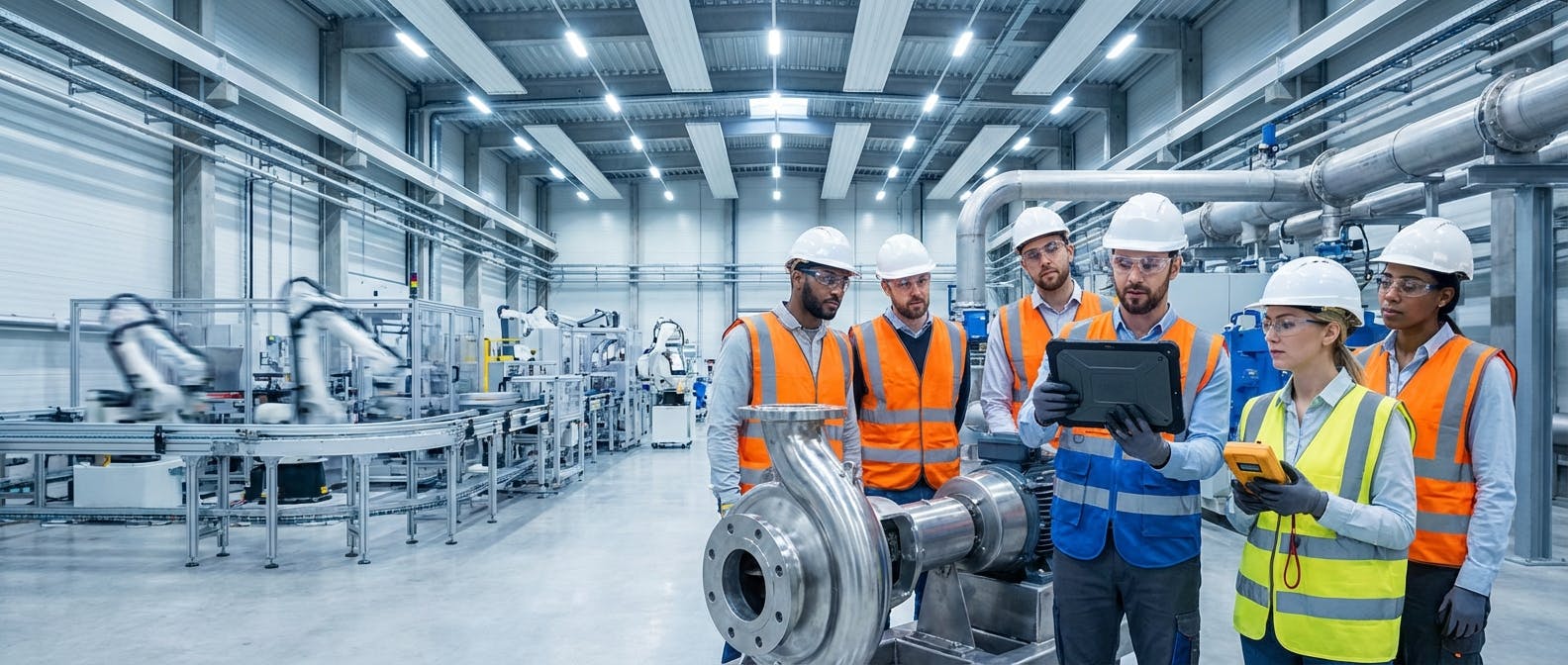
For years, the conversation around artificial intelligence in manufacturing has been dominated by a single narrative: Predictive Maintenance (PdM). The promise was simple—install a sensor, predict the failure, and prevent downtime.
But as we navigate 2026, the landscape has shifted. While predictive models are now table stakes for industrial operations, the "real" question operations directors and plant managers are asking isn't just "When will this break?" It is: "How can AI help me manage the chaos that happens after the alert?"
The core problem today isn't a lack of data; it's a lack of capacity to act on it. You have sensors screaming about vibration anomalies, SCADA systems logging millions of data points, and a workforce that is retiring faster than you can train replacements.
The most valuable artificial intelligence use cases today are those that close the loop. They don't just flag a problem; they draft the work order, identify the correct spare part, summarize the root cause from unstructured log data, and guide the technician through the repair.
This guide explores the practical, high-ROI applications of AI that go beyond simple prediction, focusing on Generative AI, Computer Vision, and Prescriptive Analytics.
1. Beyond Prediction: How Can Generative AI Automate Maintenance Workflows?
The most significant leap in industrial AI over the last three years has been the integration of Large Language Models (LLMs) and Generative AI into Computerized Maintenance Management Systems (CMMS).
If you are a Maintenance Manager, you know that the bottleneck often isn't the machine—it's the paperwork. Technicians hate logging data. Descriptions are often brief ("Fixed it," "Broken"), making Root Cause Analysis (RCA) nearly impossible.
Automated Work Order Generation
Generative AI changes the intake process. Instead of a technician manually typing a description, AI can ingest data from a sensor anomaly or a voice memo and generate a comprehensive work order.
For example, if a vibration sensor on a critical pump triggers an alert for "High Frequency Vibration > 0.5 IPS," the AI doesn't just send an email. It drafts a work order in your work order software that includes:
- The Problem: Suspected bearing degradation on Drive End.
- The Context: This asset has failed twice in the last 18 months under similar load conditions.
- The Procedure: It automatically pulls the SOP for "Bearing Replacement - Centrifugal Pump."
- The Parts: It checks inventory and reserves the specific SKF bearing required.
The "Chat-to-Database" Interface
In 2026, querying your data no longer requires SQL skills. Generative AI allows reliability engineers to "talk" to their assets. You can ask your CMMS:
"Show me all conveyor motors that have exceeded 60°C in the last month and correlate that with shift schedules."
The AI parses the unstructured data from shift logs and the structured data from the sensors to provide an answer. This democratizes data analysis, allowing maintenance supervisors to make data-driven decisions without waiting for a data scientist to build a dashboard.
Summarizing Historical Maintenance Logs
One of the most underutilized assets in a plant is the "comments" section of closed work orders. Generative AI can scrape ten years of maintenance history to find patterns that structured data misses.
If you are dealing with a recurring failure on a packaging line, AI can summarize every technician note related to that asset class. It might reveal that 80% of failures occurred within 48 hours of a specific product changeover—a correlation that vibration sensors would never catch, but human language logs did.
2. Prescriptive Analytics: How Do We Move from "What Will Happen" to "What Should We Do?"
Predictive maintenance tells you a bearing is failing. Prescriptive maintenance tells you that you can run the machine at 70% load for another 48 hours to finish the production run, or that you must shut down immediately to avoid catastrophic failure.
Dynamic P-F Curve Management
The P-F curve (Potential failure to Functional failure) is the holy grail of reliability. However, the interval isn't static. It changes based on load, ambient temperature, and humidity.
Prescriptive AI models analyze these variables in real-time. If you are monitoring predictive maintenance for compressors, the AI calculates the remaining useful life (RUL) dynamically.
- Scenario A: Production is low. The AI prescribes: "Schedule maintenance for Tuesday. Risk of failure is <5%."
- Scenario B: You ramp up production to meet a deadline. The AI updates: "Increased load has shortened RUL. Risk of failure is now 40% within 24 hours. Reduce speed by 15% to extend life to weekend window."
Optimization of Preventive Maintenance (PM) Procedures
Many facilities are stuck in the trap of calendar-based maintenance. They grease bearings every month regardless of run hours. This leads to "preventive maintenance induced failures"—breaking things by fixing them when they aren't broken.
AI-driven prescriptive maintenance analyzes the actual degradation curves to optimize PM schedules. It might suggest moving a motor inspection from "Every 3 Months" to "Every 2000 Run Hours" or "When Vibration > 0.15 IPS." This transition from static to dynamic PMs can reduce labor hours by 20-30% while increasing availability.
Automated Spare Parts Procurement
Prescriptive analytics bridges the gap between the asset and the warehouse. When a degradation trend is confirmed, the system shouldn't just alert the manager; it should check the inventory management module.
If the lead time for a replacement motor is 4 weeks, and the AI predicts failure in 3 weeks, the system can flag this as a "Critical Procurement Risk" and suggest expedited shipping options or alternative suppliers. This prevents the nightmare scenario of diagnosing a failure correctly but staying down because the part is on backorder.
3. Computer Vision: How Can Cameras Automate Quality and Safety?
While sensors are great for internal mechanics, they are blind to the external environment. Computer Vision (CV) acts as the "eyes" of the factory, providing continuous inspection that never fatigues.
Visual Anomaly Detection
In high-speed manufacturing, human inspection cannot keep up. CV systems trained on "Golden Samples" (perfect products) can detect microscopic defects on assembly lines moving at high speeds.
But beyond quality, CV is now essential for asset health. Cameras pointed at conveyors can detect belt misalignment or tears before they cause a jam. Thermal cameras integrated with CV can visually identify "hot spots" in electrical panels or gearboxes, triggering a work order long before a fire risk develops.
PPE and Safety Compliance
Safety is a major KPI for Plant Managers. AI models can monitor video feeds to ensure compliance with Personal Protective Equipment (PPE) regulations.
- Zone Intrusion: Detecting if a human enters a robotic cell while it is active.
- PPE Detection: Alerting a supervisor if a worker enters a high-noise area without ear protection or a construction zone without a hard hat.
This isn't about surveillance; it's about accident prevention. By identifying "near misses" (e.g., how often workers accidentally cross safety lines), managers can redesign workflows to be inherently safer.
Analog Gauge Reading
Many legacy plants still rely on analog dials and gauges that aren't connected to a PLC. Retrofitting these with digital sensors is expensive. A cost-effective AI use case is using existing security cameras or mobile devices to "read" these gauges.
Technicians can snap a photo of a panel using mobile CMMS apps. The AI interprets the needle position on the gauge, digitizes the value, and logs it into the system. If the value is out of range, it triggers a workflow. This digitizes legacy equipment without the CapEx of a full sensor retrofit.
4. The "Data Trap": How Do We Implement AI Without Perfect Data?
A common objection from Operations Directors is: "Our data is a mess. We can't use AI yet."
This is a misconception. Waiting for perfect data means you will never start. Modern AI is designed to handle "dirty" data and help clean it.
Data Normalization and Contextualization
Raw data from different machines (e.g., a Siemens PLC vs. an Allen-Bradley PLC) often speaks different languages. AI middleware can map these disparate tags to a unified asset model.
For example, one machine might log "Motor_Temp_C" and another "Mtr_Tmp." AI mapping tools identify these as the same parameter, allowing you to run fleet-wide analytics on predictive maintenance for motors without manually renaming thousands of tags.
The Role of Synthetic Data
In manufacturing, failure data is (thankfully) rare. This creates a problem for training AI models: they have plenty of data on "running normal" but very little on "catastrophic failure."
To solve this, we use synthetic data. Engineers use Digital Twins to simulate failure modes—generating data that looks like a bearing seizure or a pump cavitation. This synthetic data is used to train the AI, so when the real event happens for the first time, the system recognizes it immediately.
Starting with "Small Data"
You don't need Big Data; you need Right Data. Start with your most critical assets (the "Bad Actors"). Implementing AI predictive maintenance on just the top 5% of assets that cause 50% of your downtime yields a faster ROI than trying to instrument the entire plant at once.
According to ReliabilityWeb, successful reliability transformations start with a focused pilot on critical assets, proving value before scaling.
5. The Knowledge Gap: How Does AI Train the Next Generation?
The "Silver Tsunami"—the retirement of experienced technicians—is the biggest threat to industrial reliability. AI is the vessel for capturing and transferring tribal knowledge.
AI-Powered "Co-Pilots" for Technicians
Imagine a junior technician standing in front of a complex HVAC unit. They have the manual, but it's 500 pages long.
With an AI Co-Pilot embedded in their tablet, they can upload a photo of the error code and ask: "How do I troubleshoot Error E-45 on this model?"
The AI retrieves the specific page from the OEM manual, cross-references it with past work orders where senior technicians solved this exact problem, and presents a step-by-step guide. It turns every technician into your best technician.
Automated SOP Creation
Creating Standard Operating Procedures (SOPs) is tedious. Often, SOPs are outdated or ignored.
AI can watch a video of a senior technician performing a task (via smart glasses or a phone) and automatically generate a text-based SOP with screenshots. It captures the nuance—"wiggle the handle to the left before pulling"—that is rarely written in official manuals but is crucial for success.
This ensures that PM procedures are living documents that evolve with the workforce, rather than static files gathering dust.
6. ROI and Justification: Is It Worth the Investment?
Implementing AI requires capital, but the cost of inaction is higher. To justify the investment to the C-Suite, you must speak the language of finance, not just engineering.
Calculating the Cost of Downtime
Don't just count the maintenance labor. The real cost is lost production.
- Formula: (Units produced per hour × Profit per unit) + (Labor cost per hour) = Cost of Downtime.
- If a line produces $10,000 of profit per hour, a 4-hour reduction in downtime pays for a sophisticated manufacturing AI software suite for the entire year.
Inventory Optimization
AI reduces MRO (Maintenance, Repair, and Operations) inventory costs. By predicting exactly when parts are needed, you can move from "Just-in-Case" inventory (hoarding spare motors) to "Just-in-Time" inventory.
Reducing on-hand inventory by 15-20% releases significant working capital back to the business.
Energy Savings
Poorly maintained equipment uses more energy. A misaligned conveyor or a cavitating pump draws excess amperage. AI detects these inefficiencies long before they cause a breakdown.
According to the U.S. Department of Energy, predictive maintenance can result in a 30% to 40% reduction in maintenance costs and a 5% to 20% reduction in energy waste.
7. Implementation Strategy: How to Get Started
The biggest mistake is trying to build a custom AI solution from scratch. In 2026, you should buy, not build.
Step 1: Audit Your Criticality
Use a Criticality Analysis to identify which assets matter. Do not put AI on a bathroom exhaust fan. Focus on the overhead conveyors or the main production mixer.
Step 2: Choose an Open Ecosystem
Avoid proprietary "black box" sensors that hold your data hostage. Choose asset management platforms that integrate via API with your existing ERP and SCADA systems. Data must flow freely between systems for AI to work.
Step 3: The "Human-in-the-Loop"
AI is a tool, not a replacement. The goal is to augment the reliability engineer, not replace them. Ensure your workflow includes a verification step where a human expert reviews the AI's diagnosis before a major repair is scheduled.
Step 4: Measure Success Early
Set clear KPIs for the pilot:
- Reduction in unplanned downtime.
- Increase in planned vs. reactive work ratio.
- Reduction in Mean Time To Repair (MTTR).
Conclusion: The Future is Prescriptive
The era of passive monitoring is over. The future of industrial operations belongs to those who use artificial intelligence not just to see the future, but to change it.
By leveraging Generative AI for workflows, Prescriptive Analytics for decision-making, and Computer Vision for quality, you transform maintenance from a cost center into a competitive advantage.
The technology is ready. The question is, is your operation ready to listen to it?
Ready to move beyond simple alerts? Explore how our Predictive Maintenance Solution can integrate seamlessly with your operations to drive real reliability.
