
AI Predictive Maintenance for Ammonia Compressors: Moving Beyond Vibration to Total System Reliability
Feb 1, 2026
AI predictive maintenance for ammonia compressors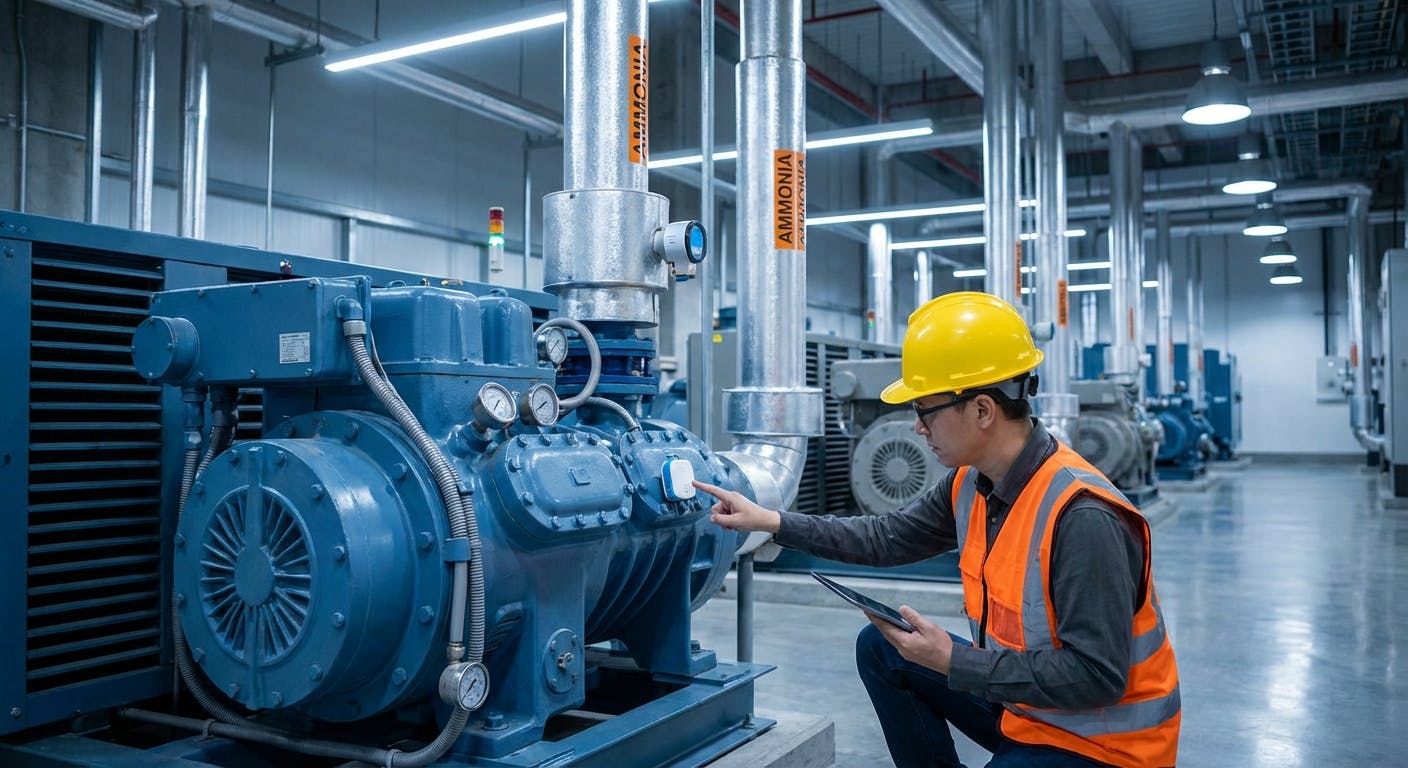
In the world of industrial refrigeration, ammonia (R-717) is king. It is thermodynamically superior, cost-effective, and environmentally friendly regarding GWP (Global Warming Potential). However, it is also unforgiving. A catastrophic failure in an ammonia compressor doesn't just mean downtime and spoiled inventory; it poses an immediate threat to human life and can trigger massive regulatory fines.
When reliability engineers and refrigeration managers search for "AI predictive maintenance for ammonia compressors," they aren't usually asking for a definition of machine learning. They are asking a much more urgent question:
"How can I use AI to predict failure in a volatile, high-pressure ammonia system with enough lead time to prevent a safety incident or a production halt?"
The short answer is that traditional condition-based maintenance (CBM)—relying solely on periodic vibration analysis or route-based checks—is no longer sufficient for modern cold chains. True AI predictive maintenance for ammonia compressors involves creating a "connected ecosystem." It merges mechanical data (vibration, acoustics) with thermodynamic data (pressures, temperatures, flow rates) to detect anomalies that human operators and standard SCADA alarms miss.
This guide explores how to implement this technology in 2026, moving from basic monitoring to prescriptive safety and reliability.
How is AI for Ammonia Compressors Different from Standard Motor Monitoring?
This is the most common follow-up question. If you already have predictive maintenance sensors on your conveyor motors or water pumps, can’t you just slap the same sensor on a Vilter or Mycom compressor and call it a day?
Absolutely not.
While a standard induction motor has a relatively predictable failure curve (usually bearing-related), an ammonia compressor is a complex thermodynamic engine. The AI cannot just listen for metal-on-metal grinding; it must understand the physics of refrigeration.
The Thermodynamic Context
Standard vibration sensors might tell you a bearing is loose. But AI trained on refrigeration cycles can tell you why the bearing is stressed. For example, it can correlate a slight rise in discharge temperature with a micro-drop in suction pressure to identify liquid slugging—where liquid ammonia enters the compressor cylinder.
Liquid slugging is a compressor killer. A standard vibration sensor sees the impact as a "shock." An AI model integrated with your control system sees the precursor conditions (superheat dropping to near zero) and warns you before the slug hits.
The Chemical Environment (R-717)
Ammonia is corrosive to copper and reacts differently with oils than synthetic refrigerants. AI models for this sector must be trained to recognize the signs of oil degradation. In ammonia systems, oil isn't just a lubricant; it seals the rotors in screw compressors. If the AI detects a drift in the slide valve position relative to the commanded load, it often indicates varnish buildup from degrading oil—a specific signature of ammonia systems that generic AI would miss.
To effectively monitor these assets, you need a solution capable of deep predictive maintenance for compressors that understands the unique stress profiles of reciprocating and screw designs.
Deep Dive: Detecting Failure in Screw vs. Reciprocating Compressors
The type of compressor you run dictates the AI strategy. A "one-size-fits-all" algorithm will fail here. You need specific models for specific mechanics.
1. The Screw Compressor (Rotary)
Screw compressors are the workhorses of large industrial cold storage. They run at high speeds and rely heavily on oil injection.
- The Slide Valve Problem: The slide valve controls capacity. A common failure mode is the valve sticking or the potentiometer giving false feedback.
- How AI detects it: The AI compares the commanded position (from the PLC) with the actual motor amperage and discharge pressure. If the PLC says "load to 50%" but the amperage stays at 75% load levels, the AI flags a mechanical sticking issue, even if vibration levels are normal.
- Rotor Contact: Screw rotors have tight tolerances.
- How AI detects it: High-frequency vibration analysis (demodulation) can detect the specific frequencies generated by rotor mesh faults long before they result in a seizure.
- Discharge Check Valve Failure: If the check valve fails, high-pressure gas flows backward at shutdown, spinning the compressor in reverse.
- How AI detects it: The AI monitors the acoustic signature and rotation speed immediately after the "stop" command. Reverse rotation has a distinct sonic fingerprint.
2. The Reciprocating Compressor (Piston)
Recips are common in smaller loads or booster applications. They have more moving parts and different failure modes.
- Valve Fatigue: The suction and discharge valves open and close hundreds of times a minute. Metal fatigue is inevitable.
- How AI detects it: Valve flutter creates a specific ultrasonic noise pattern. Furthermore, a leaking discharge valve causes a spike in suction temperature (re-expansion of hot gas). AI correlates the acoustic data with the temperature variance to pinpoint exactly which cylinder has a bad valve.
- Liquid Washout: If liquid ammonia washes the oil off the cylinder walls, ring wear accelerates instantly.
- How AI detects it: Sudden changes in the crankcase temperature combined with acoustic emissions from the cylinder wall (scuffing sounds) trigger an immediate alert.
The "Safety-First" Angle: Predicting Leaks Before They Are Lethal
In 2026, safety is the primary driver for R-717 investments. The "Connected Refrigeration Ecosystem" isn't just about keeping the ice cream frozen; it's about keeping the facility evacuation-free.
Shaft Seal Integrity
The shaft seal is the most common leak point on an open-drive compressor.
- Traditional Method: Wait for the ammonia detector in the engine room to hit 25 ppm and trigger an alarm. By then, you have a leak.
- AI Method: AI monitors the "inboard" bearing vibration and temperature. Seal failure is almost always preceded by a specific degradation in the bearing closest to the seal (due to misalignment or lubrication loss). By detecting the bearing fault early, you can replace the seal during a planned outage rather than an emergency hazmat situation.
Hydraulic Shock (Water Hammer)
In large ammonia systems, hot gas defrost cycles can cause hydraulic shock if not managed perfectly. This can rupture pipes and compressor casings.
- AI Method: By integrating with the valve control software, the AI analyzes the timing of valve sequencing during defrost. If it detects pressure spikes (transients) that correlate with specific valve actuations, it can flag a "high risk of hydraulic shock" and recommend adjusting the bleed-down timing.
For more on the safety standards governing these systems, the International Institute of Ammonia Refrigeration (IIAR) provides the gold standard guidelines that AI systems should aim to support.
Integrating with the Ecosystem: SCADA, PLCs, and IIoT
A standalone vibration sensor is an island. To get the results described above, your AI predictive maintenance system must talk to the rest of your facility.
The Data Fusion Challenge
You likely have a SCADA system (like Wonderware or Rockwell) managing the refrigeration cycle. You don't want a separate dashboard that your operators ignore.
Best Practice for 2026:
- Edge Processing: High-frequency vibration data is too heavy to send to the cloud constantly. Use edge devices to process the raw waveforms locally and send only the "health scores" and spectral features to the cloud.
- SCADA Ingestion: Pull low-frequency data (suction pressure, discharge temp, oil pressure, motor amps) from the SCADA historian into the AI engine.
- Contextualization: The AI needs to know the state of the machine. Is it in a defrost cycle? Is it ramping up? Is it in economizer mode?
- Example: High vibration during a "start-up" sequence is normal for 30 seconds. High vibration during "steady state" is a fault. Without the SCADA link, the AI generates false positives.
This level of integration requires robust integrations capabilities in your maintenance software to bridge the gap between OT (Operational Technology) and IT.
The ROI: Energy, Maintenance, and Insurance
How do you justify the cost of advanced AI monitoring to upper management? You build the business case on three pillars.
1. Energy Efficiency (The Low-Hanging Fruit)
Refrigeration often accounts for 60% of a cold storage facility's electricity bill.
- The Insight: A compressor with a leaking slide valve or damaged discharge valves might run 15% longer to satisfy the same cooling load.
- The ROI: AI detects this efficiency drift. If you spend $500,000 annually on energy for a compressor room, a 5% efficiency gain saves $25,000/year—often paying for the software subscription in months.
2. Maintenance Optimization
Stop doing "preventive" tear-downs.
- The Insight: Many facilities tear down compressors every 25,000 hours regardless of condition. This introduces "maintenance-induced failures" (human error during reassembly).
- The ROI: Move to condition-based maintenance. If the AI says the bearings and rotors are healthy, extend the run time to 35,000 or 40,000 hours. This defers capital expenditure and reduces labor costs.
3. Insurance and Risk
- The Insight: Insurance premiums for ammonia facilities are skyrocketing.
- The ROI: Demonstrating a documented, AI-driven asset health program can lower premiums. It proves you are managing risk proactively, not reactively.
According to ReliabilityWeb, best-in-class reliability programs can reduce maintenance costs by 30% while increasing asset availability—a critical metric for the perishable goods supply chain.
Implementation: A Step-by-Step Guide
You are convinced. Now, how do you actually deploy this without disrupting operations?
Phase 1: The Pilot (The Critical Assets)
Don't try to monitor every evaporator fan yet. Start with your "Bad Actors" or your most critical compressors (e.g., the high-stage swing machine).
- Install wireless IIoT vibration/temp sensors.
- Establish the data link to your SCADA historian.
- Let the AI "learn" the baseline for 30 days.
Phase 2: The "Digital Twin" Calibration
Once the baseline is set, tune the thresholds.
- Input Specifics: Tell the software exactly what compressor you have (e.g., Frick RWF II, Mycom N-Series). The geometry matters for calculating bearing frequencies.
- Set Operational States: Define what "Off," "Loaded," and "Unloaded" look like in the data.
Phase 3: Workflow Integration
This is where most projects fail. An alert is useless if it doesn't trigger a work order.
- Connect the AI platform to your CMMS.
- Automation: When the AI detects "High Confidence - Slide Valve Sticking," it should automatically generate a work order in your work order software.
- Prescription: The work order shouldn't just say "Check Compressor." It should say: "AI detected slide valve deviation. 1. Check potentiometer calibration. 2. Check solenoid coils. 3. Inspect oil quality."
Phase 4: Scaling
Once the pilot proves ROI (usually via energy savings or catching a save), expand to:
- Condenser pumps and fans (critical for head pressure control).
- Evaporator fans (vibration monitoring here prevents catastrophic blade failures).
- Ammonia pumps.
Troubleshooting Common AI Challenges in Refrigeration
Even the best systems face hurdles. Here is how to handle the edge cases.
"The VFD Noise Problem"
Variable Frequency Drives (VFDs) are great for energy but introduce electrical noise that can look like bearing faults to cheap sensors.
- Solution: Ensure your vibration sensors are isolated or use AI algorithms specifically designed to filter out VFD carrier frequencies.
"The Seasonal Drift"
Ammonia systems run very differently in January vs. July. Head pressures fluctuate wildly with ambient temperature.
- Solution: Your AI model must be "normalized" for ambient conditions. It shouldn't flag high discharge pressure as a fault if it knows it's 100°F outside; it should compare the pressure to the expected pressure for that ambient temperature.
"The False Positive Fatigue"
If the system alerts every time a compressor starts up, operators will mute it.
- Solution: Implement "delay timers" in the logic. The AI should only flag a fault if the condition persists for >2 minutes after the system has reached steady state.
The Future: Autonomous Refrigeration?
As we look toward the latter half of the 2020s, we are moving toward prescriptive maintenance. The system won't just tell you the compressor is hot; it will communicate with the control system to automatically derate the compressor, start a backup machine, and schedule the technician—all in milliseconds.
For now, the goal is visibility. By implementing AI predictive maintenance for your ammonia compressors, you are buying time. Time to react, time to plan, and time to ensure that your facility remains safe, efficient, and profitable.
Ready to secure your cold chain? Don't wait for the next vibration alarm. Explore how our asset management solutions can bring intelligence to your refrigeration cycle today.
