
AI Industrial Security: Bridging the Gap Between Cyber Defense and Operational Uptime
Feb 13, 2026
ai industrial security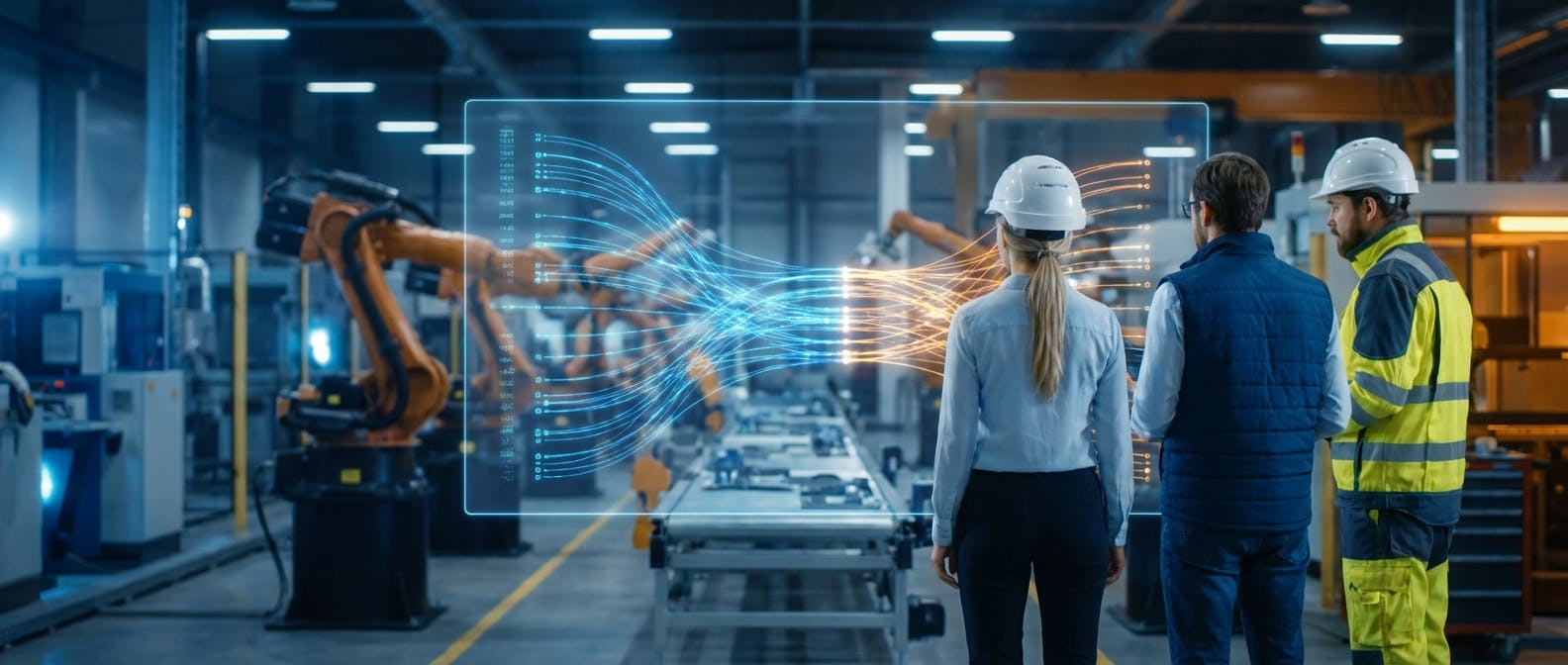
In the industrial landscape of 2026, the question is no longer "Should we use AI for security?" but rather, "How do we use AI to ensure our security measures actually improve our production reliability?"
If you are a CISO or a Plant Manager, you are likely grappling with a converging reality: the line between a cyberattack and a mechanical failure has blurred. When a turbine starts vibrating excessively, is it a worn bearing, or has a threat actor manipulated the PLCs (Programmable Logic Controllers) to overdrive the motor?
The Core Insight: AI industrial security is not just about firewalls and antivirus for your SCADA systems. It is the deployment of machine learning algorithms to establish a unified "baseline of normality" for your facility. By understanding exactly how a machine should behave—both in its network traffic and its physical output—AI can detect anomalies that indicate either a cyber breach or an impending mechanical failure.
This article moves beyond generic cybersecurity advice. We will explore how to implement a resilience-first AI strategy that satisfies both the IT department’s need for security and the OT (Operational Technology) team’s demand for uptime.
The Convergence: Why distinguish between "Security" and "Reliability"?
The first follow-up question most leaders ask is: Why should I treat predictive maintenance and cybersecurity as the same discipline?
Historically, these were silos. The maintenance team used vibration analysis and thermography to prevent breakdowns. The security team used network monitoring to prevent data exfiltration. However, in modern Cyber-Physical Systems (CPS), these objectives are identical: Business Continuity.
The "Stuxnet" Paradigm Shift
We must look at the nature of modern industrial threats. Sophisticated malware doesn't just steal data; it alters physical processes. It changes setpoints, disables safety shut-offs, or masks sensor data to blind operators.
If you are running manufacturing AI software, you have a unique advantage. The same algorithm that predicts a pump failure based on vibration data can also act as a canary in the coal mine for a security breach.
The 2026 Threat Landscape
In 2026, we see three distinct types of "failure" that AI must distinguish:
- Natural Degradation: Standard wear and tear (e.g., bearing fatigue).
- Accidental Misconfiguration: Human error in PLC programming.
- Malicious Manipulation: Intentional alteration of operational parameters.
To a standard rule-based alert system, these look different. To an advanced AI model trained on behavioral analysis, they all share one commonality: Deviation from the Baseline.
By unifying these views, you reduce the "alert fatigue" that plagues SOC (Security Operations Center) analysts and maintenance planners alike. Instead of two separate alerts—one for "unusual network packet size" and one for "high vibration"—the AI correlates these to present a single, high-fidelity incident report: "Network anomaly detected concurrent with physical stress on Conveyor 3."
Comparing Approaches: Traditional vs. AI-Driven
To visualize why this convergence is necessary, consider the operational differences between traditional security and the modern AI-driven approach.
- Traditional IT Security: Relies on "Signatures" (known bad files). It blocks access based on IP blacklists and focuses on data confidentiality. It is often blind to the physical state of the machine.
- AI-Driven OT Security: Relies on "Behavior" (deviation from normal). It alerts based on context (e.g., "Why is the HMI sending a write command during a scheduled downtime?"). Its primary goal is physical safety and process integrity.
This distinction is vital because a command to shut down a cooling pump is not "malicious code"—it is a valid instruction used at the wrong time. Only an AI that understands the operational context can catch this.
How does AI actually detect threats in an OT environment?
Once the philosophy is understood, the practical question arises: How does the technology actually work without crashing my PLCs?
Industrial environments are fragile. Unlike IT networks, you cannot simply scan an OT network with active probing tools without risking a plant shutdown. AI industrial security relies on Passive Monitoring and Physics-Informed Machine Learning.
1. Deep Packet Inspection (DPI) & Behavioral Baselines
AI security tools sit on the SPAN port (mirror port) of your industrial switches. They passively ingest copies of the traffic (Modbus, BACnet, Ethernet/IP) without interfering with the control loop.
- The Learning Phase: The AI spends 14 to 30 days simply "listening." It learns that on Tuesdays at 8:00 AM, the HMI sends a specific "Start" command to the boiler. It learns that the latency between the sensor and the controller is usually 20ms.
- The Anomaly: If, suddenly, a "Firmware Update" command is sent at 3:00 AM on a Sunday from an unknown IP address, the AI flags this immediately. It doesn't need a signature of a known virus; it simply knows this behavior is wrong.
For the technically inclined, this involves processing high-frequency data at scale. A robust system must handle sampling rates of 10kHz or higher for vibration data while simultaneously parsing gigabits of network traffic. The AI correlates the timestamp of a network packet (microsecond precision) with the timestamp of a sensor spike to prove causality.
2. Physics-Based Anomaly Detection
This is where the "Resilience" angle becomes critical. Pure cyber-AI might miss an attack that looks like valid traffic. For example, if an attacker sends a valid command to set a valve to 100% open, a network monitor sees "valid traffic."
However, AI that understands the physics of the process knows that opening that valve to 100% while the pressure is at 500 PSI will cause a rupture.
By integrating data from your asset management systems, the AI cross-references the digital command with the physical reality.
- Input: Command sent to increase motor speed.
- Context: Vibration sensors indicate the motor is already at critical resonance.
- Action: AI flags the command as "Unsafe Operation" regardless of whether the user had admin credentials.
3. Computer Vision as a Sensor
In 2026, cameras are the ultimate sensor. Computer vision models monitor for physical security breaches (unauthorized personnel in restricted zones) and safety compliance (PPE detection). But they also verify cyber data.
- Scenario: The SCADA system says the robotic arm is "Idle."
- Visual AI: The camera sees the arm moving erratically.
- Conclusion: The sensor data is being spoofed (a "Man-in-the-Middle" attack). The AI alerts operations immediately.
What are the specific use cases where AI adds the most value?
The next logical question is regarding application: Where do I apply this first? You cannot boil the ocean. You need to target high-consequence assets.
Use Case 1: The "Crown Jewels" (Turbines, Compressors, CNCs)
For critical assets like large compressors, the overlap between security and maintenance is highest.
- The Threat: Ransomware groups targeting firmware to brick the controller, or sabotage to cause physical damage.
- The AI Solution: Deploy predictive maintenance for compressors. The AI models thermal signatures and vibration. If a hacker attempts to disable the cooling system to overheat the unit, the predictive model detects the temperature rise before the critical threshold is reached, triggering a safe shutdown independent of the compromised control loop.
Case in Point: Consider a recent scenario in a municipal water treatment facility. A threat actor gained remote access and attempted to alter the chemical dosing levels. The network traffic looked legitimate because they used stolen credentials. However, the AI monitoring the physical process noted that the command to increase chemical flow did not correlate with the current inflow rate of water—a violation of the facility's mass-balance physics model. The system flagged the "Process Mismatch" immediately, preventing a potential toxicity event that standard firewalls missed.
Use Case 2: Supply Chain Integrity & Inventory
Attacks often happen via the supply chain—compromised spare parts or tainted firmware updates.
- The AI Solution: AI-driven inventory management tracks the provenance of digital and physical assets. If a replacement drive is connected to the network and its MAC address OUI (Organizationally Unique Identifier) doesn't match the vendor on file, the port is isolated.
Use Case 3: Remote Access Monitoring
With the rise of "Maintenance-as-a-Service," OEMs require remote access to your equipment. This is a massive security hole.
- The AI Solution: Instead of giving OEMs a permanent VPN tunnel, AI monitors their session behavior. If a technician usually accesses the "Diagnostics" folder but suddenly tries to access "User Admin," the session is terminated. This is "Zero Trust" enforced by behavioral AI.
How do we implement this without disrupting production?
This is the fear that keeps Plant Managers awake: Will the security software flag a false positive and shut down my line?
In 2026, the implementation strategy has matured to avoid this exact scenario. The golden rule is: Monitor First, Intervene Later.
Phase 1: The "Read-Only" Period (Months 1-3)
Do not give the AI actuation power initially. Connect your AI security platform to your CMMS software via API.
- When the AI detects an anomaly (cyber or physical), it generates a Work Order, not a shutdown command.
- A human operator reviews the alert. "Is this a hack? No, it's just a shift change we forgot to schedule."
- The human feedback trains the model, reducing false positives.
Phase 2: The "Human-in-the-Loop" Automation (Months 4-6)
Once the baseline is solid, enable semi-automation.
- If the AI detects a critical threat (e.g., known ransomware signature or vibration exceeding ISO 10816 limits), it sends a "Critical Approval Request" to the shift supervisor's tablet.
- One tap authorizes the emergency stop.
Phase 3: Autonomous Protection (Year 1+)
Only for specific, high-confidence scenarios (like thermal runaway or unauthorized firmware flashing), allow the AI to sever the connection or trip the safety relay automatically.
Handling Legacy Equipment
Most factories still run Windows XP or ancient PLCs. You cannot install AI agents on these devices.
- Strategy: Use "Sidecar" security. Place an AI-enabled edge gateway in front of the legacy asset. The gateway handles the encryption and inspection. The legacy asset stays dumb and happy behind the shield.
- Resource: Review how integrations can bridge modern AI with legacy protocols like Modbus RTU.
Common Pitfalls in Deployment
Even with a phased approach, implementation can fail if cultural and data factors are ignored.
- The "Data Swamp": Feeding the AI unstructured, unlabeled data leads to poor baselines. Ensure your asset registry is clean and sensor tags are standardized (e.g., using ISA-95 standards) before training the model.
- The IT/OT Culture War: If IT deploys this system without consulting OT, the first time the AI flags a legitimate maintenance test as an "attack," trust will erode. Involve maintenance leads in the "Learning Phase" to explain operational quirks to the security team.
What are the risks and false positives?
No system is perfect. Asking What can go wrong? is a sign of a mature buyer.
The "Drift" Problem
Industrial processes change. You switch raw materials, you change production speeds, or seasons change (affecting temperature/humidity).
- The Risk: The AI flags the new raw material processing as an "anomaly" because the motor torque is 5% higher than the baseline.
- The Mitigation: Continuous Learning. Your AI model must be dynamic. When you change a production recipe, you must tag this event in the system. "Retraining mode: New Recipe."
Adversarial AI
Hackers are using AI too. They can use "Adversarial Machine Learning" to poison your data. They might slowly drift a sensor reading over months—so slowly that the AI accepts it as the new normal—until the machine is operating in a danger zone.
- The Defense: Hard-coded "Physics Guardrails." Regardless of what the AI learns, there must be immutable laws (e.g., "Tank pressure never exceeds 800 PSI"). These hard limits act as a sanity check against a poisoned AI model.
Alert Fatigue Redux
If the AI is too sensitive, it will flag every voltage spike.
- The Fix: Contextualization. An alert should never be just "Anomaly Detected." It must be "Anomaly Detected: 98% probability of pump cavitation; 2% probability of sensor spoofing."
What is the ROI calculation for AI Industrial Security?
Finally, the CFO will ask: How does this pay for itself?
Traditional cybersecurity ROI is hard to prove because it's based on "avoided loss." However, by combining security with prescriptive maintenance, the ROI becomes tangible and immediate.
1. The Cost of Downtime (CoD)
Calculate your average CoD. In automotive manufacturing, this can be $22,000 per minute.
- If AI prevents one cyber-induced outage per year (saving 4 hours), that is millions in savings.
- If that same AI prevents three mechanical failures per year by detecting early vibration, the system pays for itself in Q1.
2. Insurance Premiums
Cyber insurance for industrial firms is skyrocketing. Insurers are now demanding proof of "active monitoring" and "anomaly detection" for OT networks. Implementing a robust AI industrial security posture can reduce premiums by 15-25%.
3. Regulatory Compliance (NIS2, IEC 62443)
In Europe (NIS2 Directive) and globally (IEC 62443 standards), strict reporting and monitoring are mandatory. AI automates the compliance reporting. Instead of manual audits, the AI provides a continuous audit trail of network integrity and asset health.
4. Extended Asset Lifespan
By catching "micro-anomalies"—small jitters in power quality or network latency—you resolve issues before they cause stress to the equipment. This extends the useful life of expensive capital assets (CapEx), improving the long-term balance sheet.
Conclusion: The Future is Resilient
AI industrial security is not a "nice-to-have" add-on; it is the central nervous system of the modern factory. It acknowledges that in a connected world, a mechanical failure is a security vulnerability, and a security breach is a mechanical risk.
By implementing AI that understands both the packet and the process—the code and the conveyor belt—you build a facility that is not just secure, but resilient.
Ready to secure your operations? Start by assessing your most critical assets. Do you have visibility into their digital traffic and their physical health? If not, it's time to explore how AI predictive maintenance can serve as your first line of defense.
