
AI Factory Security: How to Unify Cyber Defense with Production Uptime
Feb 13, 2026
ai factory security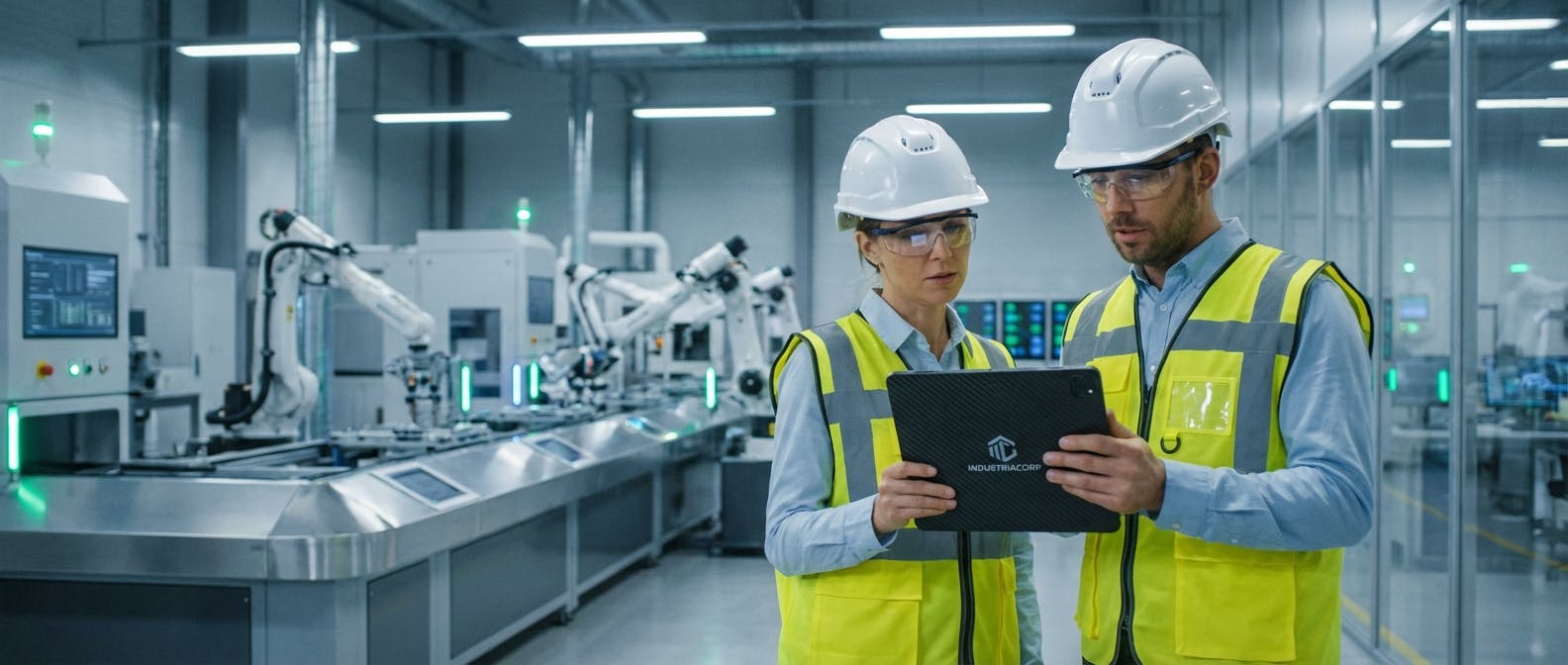
In the high-stakes environment of 2026 manufacturing, the separation between "security" and "operations" has effectively dissolved. If you are a Plant Manager or an OT Security Director, you are likely facing a paradox: the connectivity required to drive efficiency (IIoT, cloud analytics, remote access) is the exact same vector introducing unprecedented risk to your facility.
The core question you are likely asking isn't just "How do I secure my factory?" It is more nuanced: "How can I implement robust security without slowing down production or creating a nightmare of false alarms?"
The answer lies in shifting your perspective on what AI factory security actually is. It is no longer just an insurance policy or a digital fence. AI factory security is a productivity tool.
By leveraging the same machine learning models used for predictive maintenance, you can create a "Unified Defense" strategy. This approach uses AI to monitor for deviations—whether that deviation is a bearing starting to seize (mechanical failure) or a PLC receiving unauthorized write commands (cyber threat). In this guide, we will dismantle the silos between IT security and OT reliability, showing you how to build a factory that is both impenetrable and hyper-efficient.
How Does AI Distinguish Between a Cyberattack and Mechanical Failure?
This is the most common follow-up question we hear from operations leaders. If an AI system flags an anomaly in a centrifuge or a conveyor system, how do you know if you need a reliability engineer or a cybersecurity analyst?
The reality is that in the early stages of an incident, the symptoms often look identical. A sudden spike in vibration or a change in motor current could be a physical defect, or it could be malware like the infamous Stuxnet (or its 2026 successors) attempting to damage the equipment by altering operating parameters.
The Concept of "Behavioral Baselining"
AI factory security works by establishing a granular "normal" for every asset in your facility. This goes beyond static thresholds (e.g., "alert if temperature > 100°C"). Advanced AI models, specifically unsupervised learning algorithms, ingest weeks or months of historical data to understand the contextual behavior of the machine.
For example, the AI learns that:
- Normal: Pump A vibrates at 4mm/s when running at 80% load during the morning shift.
- Abnormal: Pump A vibrates at 4mm/s when running at 20% load, or when the downstream valve is closed.
When the AI detects a deviation, it analyzes the multi-variate signature of the event.
- Mechanical Signature: If vibration increases gradually over three weeks while temperature rises linearly, the AI classifies this as wear and tear. It triggers a predictive maintenance workflow.
- Cyber-Physical Signature: If the PLC logic changes suddenly, causing the motor speed to oscillate rapidly without a corresponding change in the production schedule or operator input, the AI flags this as a potential security breach.
The "Man-in-the-Middle" Sensor Check
Sophisticated AI security systems now employ "physics-based sanity checks." If a hacker compromises a SCADA system to report that a tank is empty (to force a pump to overfill it), but the vibration sensors on the pump indicate it is pumping against high pressure, the AI spots the discrepancy.
The sensor data (OT) contradicts the control data (IT). A human operator might miss this mismatch on a complex HMI screen, but an AI monitoring thousands of data points per second will identify it immediately. This is where security meets reliability: the system protects the asset from physical damage regardless of the root cause.
The "Unified Defense" Strategy: Bridging the IT/OT Gap
For decades, IT (Information Technology) and OT (Operational Technology) have been at odds. IT prioritizes confidentiality and patching; OT prioritizes availability and uptime. In 2026, the "Unified Defense" strategy uses AI to satisfy both.
Moving Beyond the Air Gap
The traditional security method of "air-gapping" (physically disconnecting the factory network from the internet) is dead. To compete, you need real-time data flowing to the cloud for supply chain optimization and manufacturing AI software analysis.
Unified Defense accepts connectivity but wraps it in an AI-driven monitoring layer. Instead of blocking all traffic (which kills productivity), it monitors the intent of the traffic.
The Convergence of SOC and NOC
We are seeing the rise of the Integrated Operations Center (IOC), combining the Security Operations Center (SOC) and the Network Operations Center (NOC).
- Scenario: A robotic arm begins moving erratically.
- Old Way: The maintenance team troubleshoots the servo motors for 4 hours. Meanwhile, the security team ignores it because no firewall rule was broken.
- Unified Way: The AI alerts the IOC. It notes that the firmware on the robot was updated 10 minutes prior from an unauthorized IP address. The system automatically isolates the robot from the network (stopping the attack) and issues a work order to the floor to inspect for physical damage.
This convergence reduces the Mean Time to Resolution (MTTR). You aren't just fixing the machine; you are fixing the vulnerability that threatened the machine.
Implementing Zero Trust in Manufacturing Without Killing Throughput
"Zero Trust" is a buzzword that scares plant managers. It implies that every command, every sensor reading, and every technician must be verified before action is taken. In a high-speed bottling line running 1,000 units per minute, latency is the enemy. How do you implement Zero Trust without creating bottlenecks?
Context-Aware Access Control
The solution is Context-Aware AI. Standard Zero Trust checks credentials (User + Password). AI-enhanced Zero Trust checks context.
Imagine a maintenance technician needs to access a PLC to adjust a setpoint.
- Identity Check: Is this John Doe? (Yes).
- Context Check (The AI Layer):
- Is John physically in the plant? (Geo-location verification).
- Is there an active Work Order assigned to John for this specific asset?
- Is the machine currently in "Maintenance Mode"?
If the answer to any of these is "No," access is denied.
This is where integrating your security system with your CMMS (Computerized Maintenance Management System) becomes critical. By linking access privileges to work order software, you automate the verification process. The technician doesn't need to jump through extra hoops; they just need an assigned task. If a hacker steals John's credentials but doesn't have a valid work order in the system, the attack fails.
Micro-Segmentation for Industrial Assets
AI facilitates dynamic micro-segmentation. Instead of one flat network, the AI groups assets based on behavior.
- Group A: Conveyors that only talk to the local PLC.
- Group B: Quality cameras that send video to the cloud.
If a conveyor suddenly tries to open a connection to the internet (a common behavior for ransomware calling home), the AI-driven firewall instantly blocks that specific connection without stopping the rest of the production line. This granular control is impossible to manage manually but trivial for AI.
Specific Algorithms: Matching the Model to the Threat
To move beyond generic advice, we need to discuss the actual technology stack. Not all AI is the same. Different factory threats require different algorithmic approaches.
1. Isolation Forests for Anomaly Detection
For detecting unknown threats (Zero-day attacks), Isolation Forests are highly effective. Unlike standard classification algorithms that look for known bad patterns (signatures), Isolation Forests assume that anomalies are few and different. They isolate observations by randomly selecting a feature and then randomly selecting a split value.
- Application: Detecting a rogue device plugged into the network. The device's traffic pattern will be fundamentally "distant" from the baseline of your PLCs and HMIs.
2. Long Short-Term Memory (LSTM) Networks for Time-Series Data
Factories run on time-series data (vibration, temperature, pressure over time). LSTMs are a type of Recurrent Neural Network (RNN) capable of learning order dependence in sequence prediction problems.
- Application: Detecting "Replay Attacks." A hacker records 60 minutes of "normal" sensor data and replays it to the control room while they secretly overheat the reactor. An LSTM model will detect the subtle statistical repetition or the lack of natural micro-variations (noise) that should be present in live data. For more on handling time-series data for assets, see our guide on asset management.
3. Computer Vision for Physical Security
AI factory security isn't just digital; it's physical. Computer vision models (CNNs) process video feeds to detect unauthorized personnel or safety violations.
- Application: Detecting "Tailgating" into server rooms or identifying an operator entering a hazardous zone without the correct PPE. This links directly to preventive maintenance procedures by ensuring safety protocols are physically followed.
For a deeper dive into the standards governing these algorithms in industrial settings, the NIST Guide to Industrial Control Systems (ICS) Security is the authoritative resource.
The ROI of AI Security: Turning Defense into OEE Gains
Budget approval for security tools is often difficult because it is viewed as a cost center. To get buy-in from the C-suite, you must frame AI security in terms of Overall Equipment Effectiveness (OEE).
The Cost of Downtime (CoD) Calculation
In 2026, the average cost of unplanned downtime in automotive and heavy manufacturing can exceed $30,000 per minute.
- Traditional Security ROI: "We might save $5M if we stop a ransomware attack that might happen once every 5 years." (Hard to sell).
- Unified AI ROI: "This system monitors for cyber threats AND mechanical degradation. It will prevent the ransomware attack, but it will also catch the conveyor motor failure that causes 4 hours of downtime every quarter." (Easy to sell).
Reducing False Positives
One of the biggest hidden costs in factory security is the "Alert Fatigue" that wastes engineering hours. Legacy systems flood operators with alerts for every minor network glitch.
AI security acts as a filter. It correlates events.
- Event A: Server CPU high usage.
- Event B: Failed login attempt.
- Event C: Vibration spike on cooling fan.
A legacy system sends 3 alerts to 3 different people. An AI system recognizes a pattern: "The cooling fan failure is causing the server to overheat, leading to CPU throttling." It sends one high-priority alert to the maintenance team. This efficiency directly impacts labor utilization and OEE.
Implementation Roadmap: From Pilot to Plant-Wide Protection
You cannot install AI security overnight. A phased approach reduces risk and allows the models to learn.
Phase 1: The "Shadow OT" Discovery (Weeks 1-2)
You cannot protect what you cannot see. The first step is deploying the AI in "passive mode" to scan the network. You will likely find 20-30% more assets than are listed in your inventory—forgotten Raspberry Pis, vendor laptops connected to PLCs, or unauthorized Wi-Fi bridges.
- Action: Update your inventory management records immediately.
Phase 2: The Learning Period (Weeks 3-6)
The AI needs to ingest data to build the baseline. During this phase, the system is silent. It is learning the shift patterns, the maintenance schedules, and the data traffic flow.
- Critical Step: Feed the AI historical data from your CMMS software. If the AI knows that "high vibration" on the first Monday of the month coincides with a scheduled testing procedure, it won't flag it as an anomaly later.
Phase 3: Active Alerting & Triage (Week 7+)
Turn on alerts, but route them to a small "Tiger Team" of IT and OT specialists. Do not send them to the general floor yet. Tune the sensitivity to minimize false positives.
Phase 4: Automated Response (Month 6+)
Once confidence is high, enable automated responses for critical threats (e.g., blocking a port, isolating a VLAN).
Handling the "Human in the Loop": Incident Response
Even the best AI cannot replace human judgment. The goal is to augment the human, not replace them.
The Automated Work Order
When a verified threat or anomaly is detected, the workflow should be seamless.
- Detection: AI flags a "High Temperature/Unauthorized Access" event on Compressor #4.
- Analysis: AI attaches the relevant data logs and a snapshot of the code change.
- Action: The system automatically generates a high-priority work order in the preventive maintenance system.
- Notification: The technician receives a push notification on their mobile device via mobile CMMS.
Training for the Convergence
The biggest hurdle is often cultural. Maintenance teams need to understand basic cybersecurity hygiene (don't plug in unknown USBs), and Security teams need to understand physical constraints (you can't just reboot a PLC while the line is moving).
Cross-training is essential. Run "Tabletop Exercises" where IT and OT teams work together to solve a simulated cyber-physical attack. Resources like ISA (International Society of Automation) offer excellent frameworks for these training scenarios.
Conclusion: The Future is Securely Autonomous
By 2030, the distinction between "factory security" and "factory automation" will likely disappear entirely. They will simply be "operations."
Adopting AI factory security today puts you ahead of the curve. It allows you to embrace the benefits of the IIoT—predictive maintenance, remote monitoring, and autonomous optimization—without exposing your facility to existential risks.
Don't build a fortress that no one can work in. Build a smart, resilient ecosystem where security enables productivity. Start by auditing your current asset visibility and asking: Is my security system smart enough to know the difference between a broken bearing and a breached firewall?
