
AI Energy Savings in Industrial Air Compressors: Moving From Hardware to Orchestration
Feb 2, 2026
AI energy savings in industrial air compressors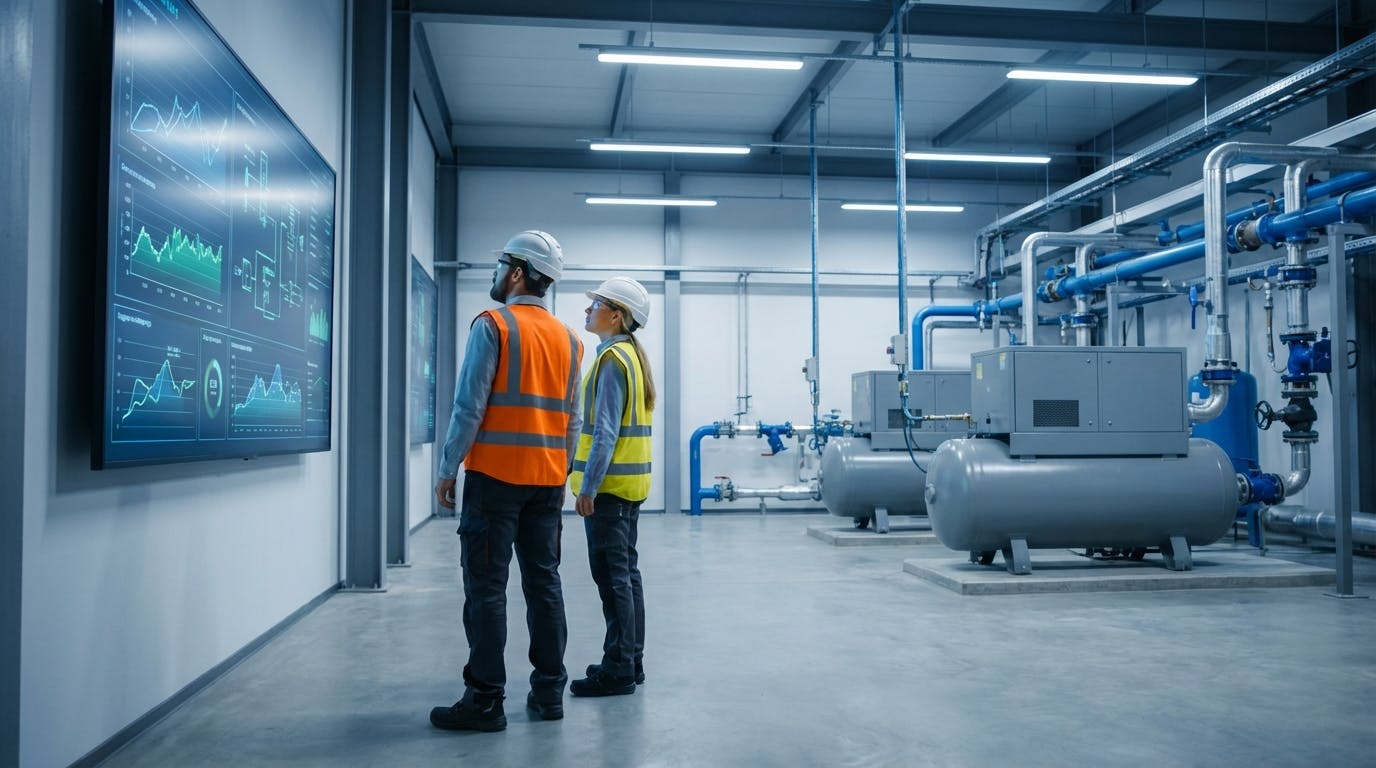
It is the year 2026, and the "fourth utility"—compressed air—remains one of the most expensive raw materials in manufacturing. For decades, the approach to reducing compressor energy costs was purely hardware-focused: buy a more efficient machine, install a Variable Speed Drive (VSD), or fix the piping. While these are valid steps, they have hit a point of diminishing returns.
The modern plant manager faces a different challenge. You likely have a mix of assets—perhaps a legacy fixed-speed Ingersoll Rand running alongside a newer Atlas Copco VSD. You have fluctuating demand curves that shift with production schedules, and you have the constant, silent thief of profitability: artificial demand.
When you search for "AI energy savings in industrial air compressors," you aren't looking for a brochure on a new motor. You are asking a fundamental operational question: How can I use data to squeeze efficiency out of my existing infrastructure without jeopardizing production uptime?
The answer lies not in the compressor itself, but in the orchestration of the system. AI has evolved from simple monitoring to acting as the central nervous system of your pneumatic loop.
The Core Insight: Why Hardware Efficiency is No Longer Enough
To understand why AI is the necessary next step, we must look at where energy is actually wasted. In a typical industrial facility, only about 50% of the compressed air generated actually does productive work. The rest is lost to:
- Leaks (20-30%): Air escaping through fittings and seals.
- Artificial Demand (10-15%): Operating the system at a higher pressure than necessary "just to be safe."
- Inappropriate Control (10-20%): Compressors running unloaded (consuming power but producing no air) or fighting each other for control.
Hardware upgrades address the efficiency of generation. AI addresses the efficiency of usage and control.
By implementing manufacturing AI software, facilities are seeing energy reductions of 15% to 30% on top of what efficient hardware provides. This isn't magic; it is the mathematical optimization of flow dynamics and thermodynamics in real-time.
How Does AI Actually Reduce Energy Consumption?
The most common follow-up question is technical: "What is the AI actually doing to the machine?" It is not simply turning the compressor off. It is managing the delicate balance between supply (the compressor room) and demand (the plant floor).
1. Dynamic Pressure Band Optimization
Traditionally, compressors are set to a static pressure band. If your critical tools require 90 PSI, you might set the compressor to load at 100 PSI and unload at 110 PSI to account for pressure drops and spikes. This "safety buffer" is expensive.
The Rule of Thumb: For every 2 PSI you lower your system pressure, you reduce energy consumption by 1%.
The AI Approach: AI algorithms analyze historical usage patterns and real-time sensor data to predict demand spikes. Instead of a static 100-110 PSI band, the AI might dynamically adjust the target.
- Shift Change: The AI knows demand drops during lunch. It lowers the target pressure to 92 PSI automatically.
- High Load: The AI anticipates a heavy production run (based on integration with your MES) and pre-pressurizes the receiver tank, smoothing out the spike without raising the baseline pressure for the whole day.
This eliminates "Artificial Demand"—the excess air forced out of leaks and tools simply because the system pressure is higher than it needs to be.
2. Eliminating Unloaded Power Consumption
A fixed-speed compressor running "unloaded" (idling) still consumes about 20-30% of its full-load power. This is pure waste.
The AI Approach: AI models calculate the "blowdown" time (how long it takes the compressor to depressurize the sump) and the cycle frequency. If the AI predicts that the compressor will not be needed for a duration longer than the safe stop/start threshold, it will shut the machine down completely rather than letting it idle.
Conversely, if it predicts a demand spike in 30 seconds, it will keep the machine idling to prevent the wear and tear of a "hot start." This decision-making happens thousands of times a day, optimizing the trade-off between motor life and energy bills.
3. The "Orchestrator" Effect: Managing Mixed Fleets
Most industrial compressor rooms are "Frankenstein" systems. You might have three different compressors of different ages and sizes. Standard sequencing panels are dumb; they usually just rotate lead/lag duties based on hours.
The AI Approach: AI acts as a master controller that understands the specific efficiency curve of each machine.
- Scenario: You need 600 CFM of air.
- Compressor A (VSD): Most efficient at 50-80% load.
- Compressor B (Fixed): Most efficient at 100% load.
- Decision: The AI runs Compressor B at 100% (providing 400 CFM) and trims the remaining 200 CFM with Compressor A running in its sweet spot.
This ensures that no machine is ever running in an inefficient part of its power curve. For a deeper dive into how this applies to specific equipment, see our guide on predictive maintenance for compressors.
The Leak Battle: AI vs. Manual Audits
"I already do ultrasonic leak audits once a year. Why do I need AI for this?"
This is a classic maintenance trap. Leaks are not static; they are dynamic. A seal that is tight today might fail tomorrow. A manual audit fixes the problem for a week; AI fixes the strategy forever.
The Digital Twin of Air Consumption
AI establishes a "Digital Twin" of your air system. It learns the baseline flow profile of your facility.
- The "Zero-Production" Test: The AI monitors flow and pressure decay during weekends or shift breaks when production is zero. Any flow detected during these times is purely leakage.
- Signature Recognition: Advanced Machine Learning (ML) algorithms can distinguish between the flow signature of a pneumatic cylinder firing and a hose bursting.
If the "base load" (leakage rate) creeps up from 50 CFM to 60 CFM over a month, the AI flags this immediately. It calculates the exact cost of that 10 CFM increase based on your current electricity rates. This allows maintenance managers to prioritize repairs based on ROI, not just guesswork.
For teams using work order software, these anomalies can automatically trigger a "Leak Inspection" ticket, ensuring the loop between detection and repair is closed instantly.
Implementation: What Hardware Do I Need?
You do not need to replace your compressors to get these benefits. However, AI is blind without data. To enable AI energy savings, you need to layer an IIoT (Industrial Internet of Things) infrastructure over your existing equipment.
The Sensor Suite
To feed the AI model, you need the following data points sampled at high frequency (typically 1Hz or faster):
- Power Meters (kW): Installed on the incoming power of each compressor. This is the source of truth for energy cost.
- Flow Meters (CFM): Installed on the "wet" side (after the compressor) and the "dry" side (after the dryer/receiver). This measures output.
- Pressure Transducers (PSI): Installed at the compressor discharge, the receiver tank, and critical points of use on the plant floor.
- Dew Point Sensors: To monitor air quality and dryer performance.
Integration with Maintenance Systems
Data collection is useless if it lives in a silo. The AI insights must flow into your CMMS. When the AI detects that a compressor's specific power (kW/100 CFM) is degrading, it suggests that the inlet filter is clogged or the air-end is wearing out.
This moves you from "Reactive" (fixing it when it breaks) to "Prescriptive" (fixing it to save energy). You can manage these assets and their sensors using robust asset management features to track the lifecycle and calibration of every sensor in the loop.
The Financials: ROI and Cost Analysis
"How much does this cost, and when do I break even?"
In 2026, with industrial electricity rates fluctuating and carbon taxes becoming a reality in many jurisdictions, the ROI calculation has shifted.
The Math of Inefficiency
Let’s look at a hypothetical but realistic scenario for a medium-sized manufacturing plant:
- System Size: 300 HP total (running roughly 225 kW).
- Operating Hours: 6,000 hours/year.
- Electricity Rate: $0.12 / kWh.
- Annual Energy Cost: ~ $162,000.
The AI Savings Potential:
- Pressure Reduction (100 PSI -> 92 PSI): 4% savings = $6,480.
- Leak Reduction (via early detection): 10% reduction in total flow = $16,200.
- Sequencing Optimization (Eliminating unloaded run time): 8% savings = $12,960.
Total Annual Savings: ~$35,640.
The Investment
The cost of an AI overlay (sensors + software subscription) for a system of this size typically ranges from $8,000 to $15,000 upfront, with a recurring SaaS fee.
Payback Period: Often less than 6 months.
This does not include the "soft" savings of avoided downtime. If the AI predicts a motor bearing failure using vibration analysis (a core component of AI predictive maintenance), the savings from avoiding a production stoppage could dwarf the energy savings entirely.
Common Pitfalls: When AI Goes Wrong
Implementing AI is not a "set it and forget it" solution. There are specific edge cases and failure modes that maintenance directors must be aware of.
1. The "Garbage In" Problem
AI models are highly sensitive to sensor calibration. If a pressure transducer drifts by 3 PSI, the AI might force the compressors to work harder to meet a phantom target.
- Solution: Establish a routine PM procedure for sensor calibration. Do not assume digital sensors are always right.
2. Over-Cycling
An aggressive AI might try to shut down a compressor to save energy during a 2-minute lull in production. If this happens too often, you risk overheating the motor windings due to frequent starts.
- Solution: Ensure your AI configuration includes "minimum run timers" and "maximum starts per hour" constraints that respect the OEM guidelines of your specific motors.
3. Ignoring the Dryer
Focusing only on the compressor is a mistake. Desiccant dryers consume a massive amount of purge air (up to 15% of total capacity).
- Solution: Ensure the AI controls the dryer purge cycles based on dew point demand, not just a fixed timer. This is often the lowest-hanging fruit in the system.
Advanced Strategy: Heat Recovery and the Total Energy Picture
In 2026, we cannot talk about compressor efficiency without talking about thermodynamics. Roughly 90% of the electrical energy put into a compressor is converted into heat, not air.
While AI optimizes the electrical input, it can also optimize the thermal output.
AI-Driven Heat Recovery
Modern AI systems can monitor the discharge temperature and control diverting valves to route hot oil or water to heat exchangers.
- Winter Mode: The AI routes waste heat to the plant's HVAC system or boiler pre-feed.
- Summer Mode: The AI routes heat to the external cooling tower to avoid increasing the building's AC load.
By integrating this thermal data, the "efficiency" of the compressor system can theoretically exceed 90% when viewed as a combined heat and power unit.
Getting Started: A Step-by-Step Framework
If you are ready to move from investigation to implementation, here is the roadmap:
- Audit the Baseline: Before buying software, perform a comprehensive air audit. You need to know your current kW/100 CFM to measure success later.
- Digitize the Assets: Ensure all compressors are cataloged in your CMMS. If you don't have one, consider a mobile CMMS that allows technicians to log data from the floor.
- Install the Sensor Layer: Start with power and flow. These are the two non-negotiables.
- Run in "Shadow Mode": Let the AI collect data for 30 days without controlling the machines. This builds the training model.
- Activate Advisory Mode: Have the AI send alerts/suggestions to the plant manager (e.g., "Suggest shutting down Compressor 3").
- Full Automation: Once trust is established, give the AI control over the sequencing and pressure bands.
Conclusion
The era of treating compressed air as a "free" utility is over. The technology exists today to transform your compressor room from a cost center into a model of industrial efficiency.
AI energy savings in industrial air compressors is not about replacing your iron; it is about upgrading your intelligence. It transforms the chaotic noise of mixed-fleet operations into a symphony of optimized supply and demand.
By leveraging predictive tools and intelligent orchestration, you protect your bottom line, extend the life of your assets, and secure your facility's competitive edge in an increasingly energy-conscious market.
