
AI Energy Optimization for Cooling Towers: Why You Can’t Optimize a Broken Asset
Feb 2, 2026
AI energy optimization for cooling towers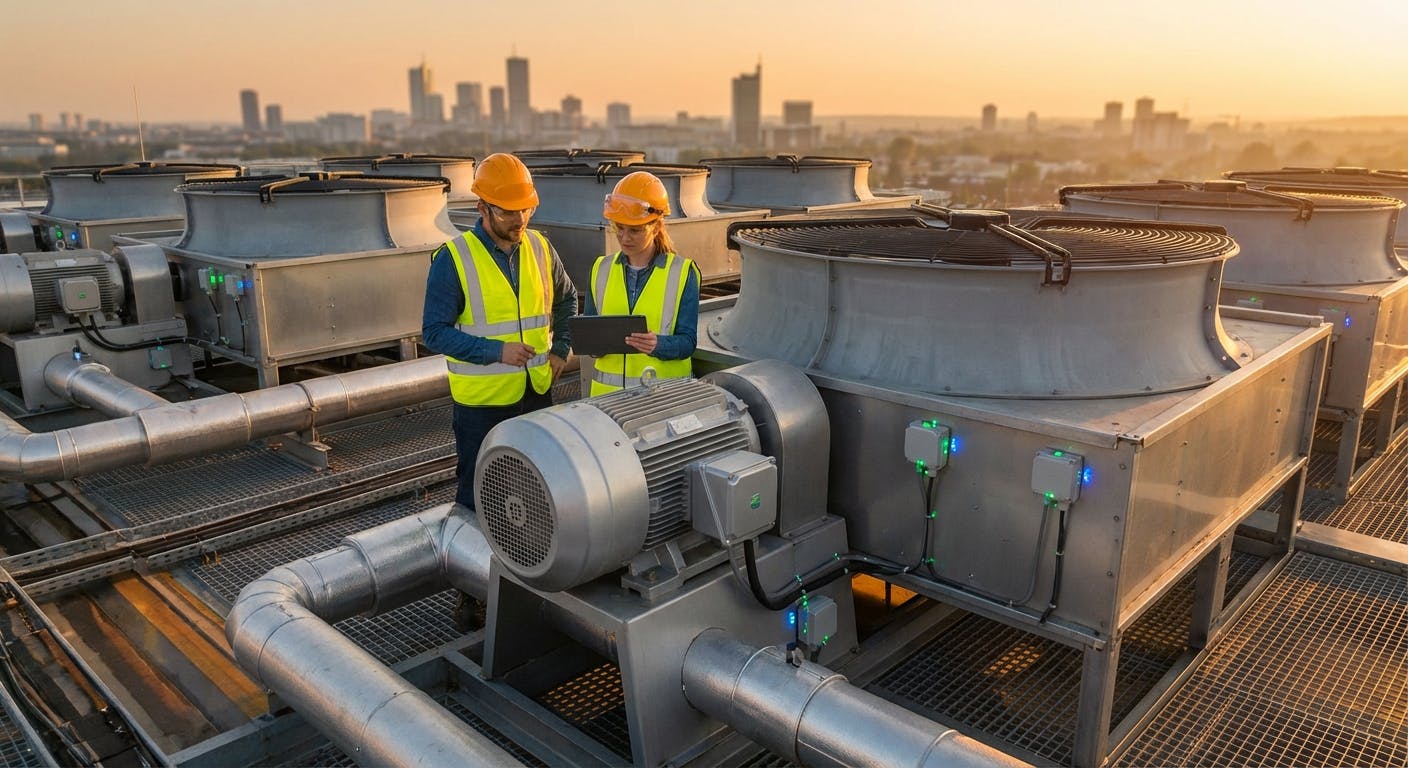
It is 2026. The era of static setpoints is over. If you are a facility manager or plant engineer still relying on a fixed condenser water supply temperature (CWST) or a basic PID loop to manage your cooling towers, you are likely leaving 15% to 30% of your energy budget on the table.
But you probably already know that. You are here because you are investigating AI energy optimization for cooling towers. You want to know if the investment in machine learning algorithms and Model Predictive Control (MPC) actually pays off, or if it’s just another layer of expensive software complexity.
Here is the core answer to your search: AI optimization works, but only if it is coupled with asset health monitoring.
Most commercial solutions fail because they treat the cooling tower as a mathematical abstraction—a perfect box that exchanges heat. In reality, cooling towers are physical beasts subject to scale, biological fouling, loose belts, and vibrating bearings. You cannot optimize the energy consumption of a failing asset.
This guide will walk you through exactly how AI optimizes cooling tower energy, why the "Health-First" approach is the only viable strategy, and how to implement this in a brownfield or greenfield facility.
The Core Question: How Does AI Actually Reduce Energy Without Compromising Load?
The fundamental promise of AI in this context is moving from Reactive Control to Predictive Optimization.
Traditional Building Management Systems (BMS) are reactive. They see the leaving water temperature rise above a setpoint (say, 85°F) and ramp up the fan speed. They see the temperature drop, and they ramp it down. They are constantly chasing the load.
AI changes the equation by integrating three distinct data streams to make decisions before the temperature drifts:
- External Variables: Weather forecasts (specifically wet-bulb temperature and humidity), utility pricing structures (peak vs. off-peak), and occupancy schedules.
- Internal Load Prediction: Historical data indicating that at 2:00 PM on a Tuesday, the manufacturing floor spins up Line 4, causing a 20% spike in heat rejection requirements.
- Thermodynamic Physics: Real-time calculation of the "Approach"—the difference between the cold water temperature and the ambient wet-bulb temperature.
The Mechanism: Dynamic Approach Optimization
The "Approach" is the holy grail of cooling tower efficiency. A standard tower might be designed for a 7°F approach. However, forcing a tower to maintain a tight approach when the wet-bulb temperature is high requires exponential fan energy.
AI algorithms utilize the Fan Affinity Laws, specifically the "Cube Law," which states that power consumption varies with the cube of the speed. Reducing fan speed by just 10% reduces power consumption by roughly 27%.
The AI constantly calculates the "sweet spot"—the exact point where the energy cost of running the tower fan harder exceeds the energy savings gained at the chiller compressor (due to cooler condenser water). It dynamically floats the setpoint to minimize the total plant kW/ton, not just the tower energy.
But this mathematical perfection relies on one dangerous assumption: That the tower is mechanically sound.
The "Health-First" Angle: Why Pure Energy Algorithms Fail
This is the section that generic engineering articles miss. You can have the most sophisticated Model Predictive Control (MPC) algorithm in the world, but if your drift eliminators are clogged or your motor bearings are grinding, the model falls apart.
The Baseline Fallacy
AI models require a "baseline" of performance to learn how the system behaves. If you train an AI on a cooling tower that has 2mm of biofilm on the fill, the AI learns that "Fan Speed 80% = X Cooling Capacity."
If you then clean the tower, the AI is miscalibrated. Conversely, if the tower degrades, the AI will command higher fan speeds to achieve the expected cooling, masking the mechanical degradation with increased energy spend. This is why energy optimization must be paired with predictive maintenance.
The Vibration-Energy Nexus
Energy inefficiency is often a symptom of mechanical distress before it becomes a failure.
- Misalignment: A misaligned shaft between the motor and gearbox wastes energy as heat and vibration before it breaks the coupling.
- Fan Imbalance: Scale buildup on fan blades causes wobble, requiring more torque (amps) to maintain speed.
To truly optimize energy, your system needs to ingest vibration and amperage data alongside temperature data. If the AI detects that energy consumption is rising without a corresponding increase in load or wet-bulb temperature, it shouldn't just ramp up the VFD. It should trigger an inspection alert.
This is where integrating AI predictive maintenance becomes critical. The system must be able to say, "I could ramp the fan to 100% to meet the setpoint, but vibration sensors indicate a developing bearing fault on Cell 3. I will limit speed to 85% and alert the maintenance team."
Follow-Up: What Specific Levers Does AI Pull to Save Energy?
Once we establish that the asset is healthy, how does the AI physically manipulate the tower to save money? It comes down to three primary levers.
1. Wet-Bulb Reset (The Floating Setpoint)
In a static system, you might set the condenser water return to 75°F. On a hot, humid day, the fans run at 100% trying to hit a target that physics won't allow. On a cold day, they might cycle on and off (which is terrible for motors).
The AI Approach:
The AI calculates the ambient wet-bulb temperature in real-time. It then sets the target water temperature to Wet Bulb + Approach Offset.
- Scenario: If it’s 95°F outside with high humidity (Wet Bulb 80°F), the AI knows it cannot get water to 75°F. It accepts 85°F water, ramps fans down to 80% (saving 50% energy), and allows the chiller to work slightly harder, because the chiller lift penalty is lower than the fan energy penalty.
2. VFD Modulation and Soft Starts
Variable Frequency Drives (VFDs) are standard, but they are often programmed with aggressive ramp rates. AI smooths this out.
- Instead of reacting to a 2°F temp spike by jumping from 40Hz to 60Hz, the AI predicts the load is coming and ramps slowly from 40Hz to 45Hz to 50Hz over 15 minutes. This reduces peak demand charges and mechanical stress.
- For deeper insights on motor control, review our guide on predictive maintenance for motors.
3. Cycles of Concentration (Water-Energy Nexus)
This is often overlooked. Energy optimization is tied to water efficiency.
- Cycles of Concentration (CoC) refers to the ratio of dissolved solids in the blowdown water vs. the makeup water.
- Higher CoC means you keep water in the system longer.
- Lower CoC means you are constantly dumping warm water and bringing in cold makeup water that needs to be treated and pumped.
- AI monitors conductivity and automates blowdown valves to maximize CoC without causing scaling (which kills heat transfer).
Follow-Up: How Do I Implement This? (The Tech Stack)
You don't need to rip out your entire infrastructure. Most AI optimization is an overlay solution. However, you do need the right sensors.
Step 1: The Sensor Audit
You cannot optimize what you cannot measure. Ensure you have:
- Inlet/Outlet Temperature Sensors: High accuracy (RTDs preferred over Thermistors).
- Flow Meters: On both the condenser loop and makeup water line.
- Psychrometric Station: A local weather station measuring dry bulb and relative humidity (to calculate wet bulb). Do not rely on airport weather data; microclimates on rooftops differ significantly.
- Vibration Sensors: Wireless IoT accelerometers on fan motors and gearboxes.
- Power Meters: Dedicated sub-metering for tower fans and pumps.
Step 2: The Data Integration
The AI software needs to talk to your PLC or BMS. This is usually done via BACnet/IP or Modbus.
- Security Note: Modern AI solutions often use a one-way "data diode" or a secure edge gateway to read data, process it in the cloud, and send write-commands back to the BMS with strict limits (e.g., "Never command fan speed > 90% if vibration > 0.3 ips").
Step 3: The Asset Management Connection
This is the differentiator. Connect the AI alerts to your CMMS (Computerized Maintenance Management System).
- If the AI detects efficiency dropping due to probable fouling, it shouldn't just log a data point. It should automatically generate a work order in your CMMS software.
- This closes the loop between operations (energy) and maintenance (reliability).
Follow-Up: What is the ROI and Cost?
This is the transactional part of your investigation. Is it worth it?
The Investment
For a typical industrial facility with a 2,000-ton cooling plant:
- Hardware (Sensors/Gateways): $15,000 - $25,000 (One-time).
- Software (SaaS): $10,000 - $20,000 per year.
- Integration Services: $5,000 - $10,000.
The Return
- Energy Savings: Conservative estimates sit at 10-15%. Aggressive optimization with VFDs often yields 20-30% reduction in fan energy.
- Maintenance Savings: By catching a gearbox failure early (via vibration monitoring integrated into the energy AI), you avoid a $15,000 replacement and 3 days of downtime.
- Water Savings: Optimizing CoC can reduce water bills by 15%.
Payback Period: Most facilities see a full ROI in 12 to 18 months.
Real-World Scenario: The 24/7 Manufacturing Plant
Consider a plastics injection molding plant running 24/7.
- Before AI: Fans ran at 100% all summer. Setpoint was fixed at 80°F.
- After AI: The system recognized that at night, wet-bulb temps dropped. It lowered the water temp to 70°F at night (using free cooling capacity), which allowed the chillers to unload significantly.
- Result: The fans worked harder at night, but the chillers worked 30% less. Since chillers consume 5x the energy of fans, the net plant savings were massive.
Follow-Up: Troubleshooting & Common Pitfalls
Even the best AI models struggle with bad data. Here are the edge cases you must manage.
1. The "Garbage In, Garbage Out" Sensor Problem
If your wet-bulb sensor is uncalibrated and reads 2°F high, the AI will think the cooling potential is lower than it is. It will ramp down fans prematurely, causing the chiller to surge.
- Fix: Schedule calibration work orders every 6 months using preventive maintenance software.
2. Hunting and Oscillation
Early AI models sometimes "hunted"—constantly changing fan speeds every 30 seconds to chase a decimal point of efficiency. This destroys VFDs and belts.
- Fix: Ensure your AI solution has "deadbands" and "minimum runtime" constraints.
3. Ignoring Pump Energy
Optimizing fans is great, but if you ignore the condenser water pumps, you miss half the picture.
- Insight: Sometimes, running two pumps at 40Hz is more efficient than one pump at 60Hz (due to pump affinity laws). Ensure the AI controls pumps as well as fans.
Advanced Strategy: The Digital Twin
For those looking to go deeper, the concept of a Digital Twin is the next evolution.
A Digital Twin creates a virtual replica of your cooling tower. It simulates "what-if" scenarios.
- What if we replaced the fill media with high-efficiency film fill?
- What if we added a VFD to the spray pump?
The Digital Twin uses your historical data to model these changes before you spend a dime. It also serves as the ultimate baseline for anomaly detection. If the real tower deviates from the Digital Twin by more than 5%, you know you have a mechanical or fouling issue.
This ties back to asset management. The Digital Twin tracks the degradation of the asset over its entire lifecycle, helping you decide when to repair vs. when to replace.
Conclusion: The Convergence of O&M
The separation between "Energy Management" and "Maintenance" is artificial. In 2026, they are the same discipline.
- An efficient tower is a healthy tower.
- A healthy tower is an efficient tower.
AI energy optimization for cooling towers is not just about algorithms; it's about giving your facility a nervous system. It allows the equipment to communicate its needs—whether that need is "slow down the fan because the air is cool" or "grease the bearing because it's vibrating."
If you are ready to move beyond static setpoints, start by evaluating the health of your assets. You cannot optimize a broken machine. Once your baseline is secure, the AI will do the rest, turning weather data and physics into tangible contributions to your bottom line.
Ready to ensure your assets are healthy enough for AI optimization? Explore how predictive maintenance lays the foundation for energy efficiency.
