
The Rise of World Models in Physical Industries: Why They Matter and How Manufacturers Should Respond
Jan 31, 2026
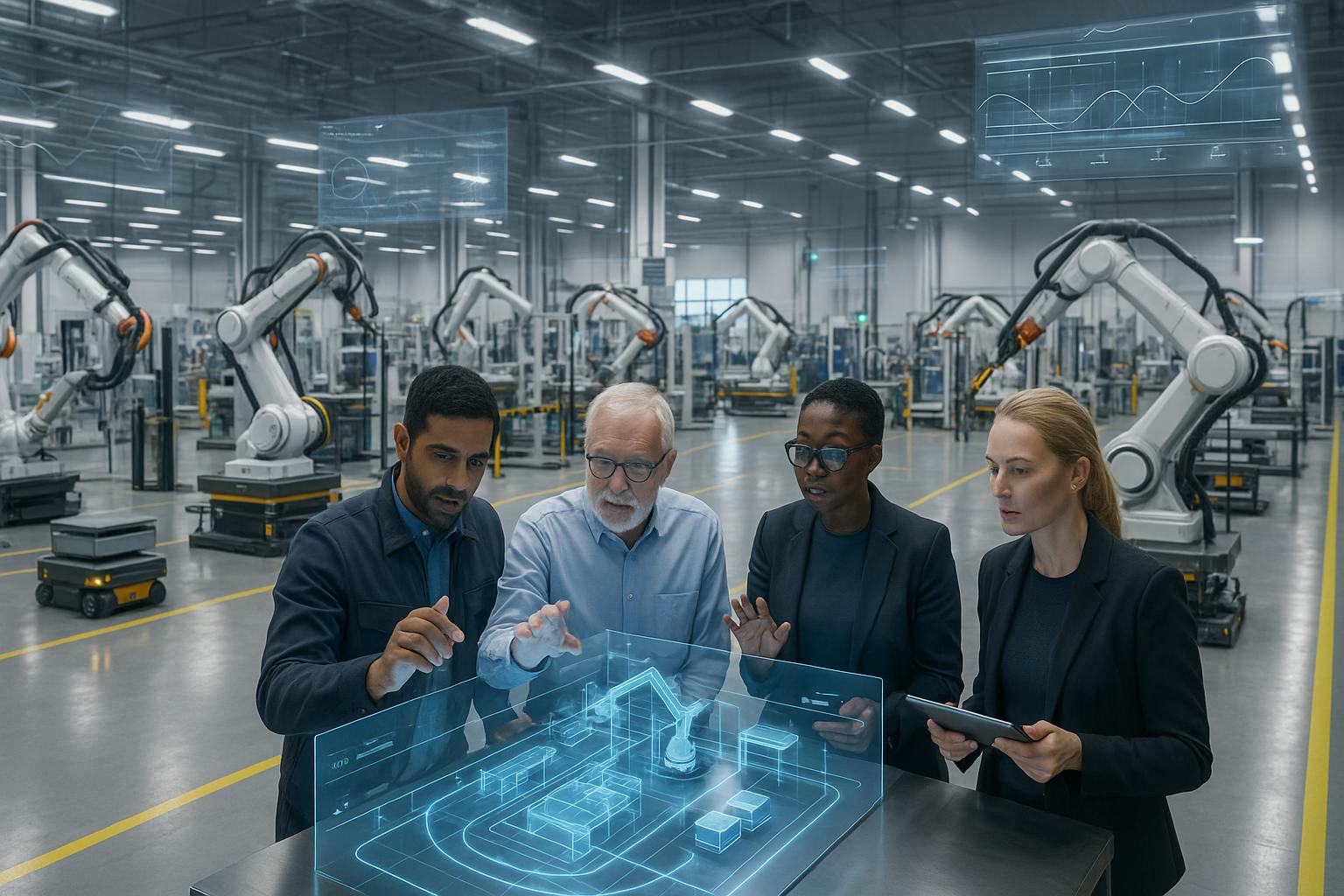
Walk into almost any factory today and you’ll see a paradox.
On one side: decades of investment in automation, PLCs, industrial robots, MES, and ERP. On the other: people still doing repetitive, ergonomically risky, and cognitively complex tasks that “should have been automated” years ago.
The gap between what’s technically possible and what’s deployed on the factory floor is still enormous.
The reason isn’t a lack of robots or software. It’s that our current generation of automation is fundamentally brittle. Robots are scripted machines, not learning agents. They excel in tightly constrained, unchanging environments—and fall apart when confronted with the messy variability of real production.
A new class of AI systems—world models—is emerging to change that equation. These models give machines something they’ve largely lacked: an internal understanding of how the physical world behaves, and the ability to mentally simulate actions before taking them.
For manufacturing leaders, this isn’t an abstract research trend. It’s the foundation for the next decade of competitive advantage in physical industries.
In this article, we’ll explore:
- Why factories aren’t fully automated despite decades of promises
- Why training robots on human tasks is so hard
- What world models are and how they change the automation equation
- Real applications in digital twins, simulation, and pre-build validation
- Current limitations and what’s needed for adoption
- Concrete steps manufacturers should take now to prepare
1. Why Aren’t Factories Fully Automated Yet?
Despite all the talk of “lights-out” factories, most plants still rely heavily on human labor for assembly, inspection, material handling, changeovers, and troubleshooting. To understand why, it helps to look at how today’s automation actually works.
1.1 Scripted machines in a dynamic world
Most industrial automation is built on three pillars:
-
PLC logic and fixed sequences
Programmable logic controllers execute deterministic logic trees: if X sensor is triggered, then start conveyor; if Y is true, stop line. These systems are robust but rigid. -
Pre-programmed robot motion
Robot arms are typically taught via teach pendants or offline programming. Engineers define waypoints, trajectories, and gripper actions for a specific part, fixture, and path. -
Static perception systems
Machine vision systems are configured to detect specific features, defects, or codes under controlled lighting and positioning.
This works extremely well when:
- Parts are highly standardized
- Fixtures precisely locate components
- The environment is tightly controlled
- Product variants are limited
- Changeovers are infrequent and predictable
But modern manufacturing is moving in the opposite direction:
- Shorter product lifecycles
- More SKUs and customization
- Frequent engineering changes
- Supply chain variability in parts and materials
- Workforce turnover and skill gaps
The result: every change in product, fixture, or process often requires manual re-engineering of robot paths, PLC logic, and vision recipes. That’s expensive, slow, and risky.
1.2 The hidden cost of “last 10%” automation
Many plants have automated the obvious 80–90% of a process, only to discover that the remaining 10–20%—the edge cases, exceptions, and changeovers—consume disproportionate engineering effort.
Examples you may recognize:
- A robot that can pick parts from a tray, but fails when parts are slightly misaligned or when a new supplier’s packaging changes dimensions by a few millimeters.
- An automated inspection system that works for one product variant but needs extensive re-tuning whenever a new color, finish, or geometry is introduced.
- A palletizing cell that handles standard cases perfectly but requires manual intervention for mixed-SKU pallets or damaged boxes.
These “last 10%” problems are where human operators shine: they can generalize from past experience, improvise, and adapt on the fly. Traditional automation can’t.
1.3 The gap between demos and deployment
You’ve likely seen impressive robotics demos:
- A robot folding laundry or making coffee in a lab
- A bin-picking system handling a variety of objects
- A mobile robot navigating a warehouse autonomously
Yet when it comes to deploying similar capabilities in your factory, the story changes. Why?
- Environment mismatch: Lab conditions are controlled; factories are not.
- Data scarcity: Robots need vast amounts of task-specific data; most plants don’t have it.
- Integration complexity: Connecting robots to legacy PLCs, MES, and safety systems is non-trivial.
- Engineering overhead: Each new task can require weeks or months of integration and tuning.
The core issue: today’s robots don’t understand your factory. They execute what they’ve been explicitly taught, in the narrow conditions they were taught for.
To move beyond that, we need robots and AI systems that can build and use an internal model of the world they operate in.
2. The Robot Training Challenge: Why Current Approaches Fall Short
To appreciate why world models are such a big deal, it’s worth unpacking how robots are currently trained—and why scaling that approach to human-level flexibility is so hard.
2.1 How robots are typically programmed today
Most industrial robot deployments rely on one or more of these methods:
Teach pendant programming
An engineer manually moves the robot through the desired motion and records waypoints. This is:
- Precise for fixed tasks
- Time-consuming to set up
- Brittle to changes in part position or geometry
Offline programming and simulation
Engineers use CAD-based tools to design robot paths and validate reach, collisions, and cycle times. This:
- Works well when CAD and reality match closely
- Still requires manual tuning on the floor
- Struggles with unstructured tasks (e.g., random bin picking)
Task-specific machine learning
For more complex tasks, teams may use ML-based perception (e.g., deep learning for object detection) or reinforcement learning in simulation. But:
- Models are trained for one specific task
- Training requires curated data and expert ML skills
- Transferring from simulation to reality (sim-to-real) is difficult
In all cases, the robot is not learning a general understanding of the environment. It’s learning a mapping: from sensor inputs to actions, or from CAD to trajectories.
2.2 Why training robots on human tasks is so hard
Humans perform complex physical tasks with remarkable efficiency:
- We can watch someone perform a task once and imitate it.
- We can adapt when a part is slightly deformed, a tool is worn, or a fixture is misaligned.
- We can reason about cause and effect: “If I push here, it might slip; if I tilt it, it will clear the obstacle.”
Robots, by contrast, struggle because:
2.2.1 They lack a rich model of physics and dynamics
Most robot controllers operate on kinematics and simple dynamics models: joint angles, velocities, and torques. They don’t have a learned understanding of:
- How deformable materials behave
- How friction changes with surface conditions
- How parts might collide or jam in real-world tolerances
So every new task must be engineered or tuned by hand.
2.2.2 They need enormous amounts of data
To learn a policy directly from pixels to actions (end-to-end learning), robots need:
- Millions of labeled images or
- Millions of trial-and-error interactions
Collecting that on physical hardware is:
- Slow (limited by real-time operation)
- Risky (collisions, wear, safety)
- Expensive (downtime, engineering oversight)
2.2.3 They don’t generalize well across tasks
A robot trained to pick one type of part from one type of bin doesn’t automatically know how to:
- Pick a different part with different geometry
- Handle a different bin or conveyor
- Adapt to a new gripper or end-effector
Each new combination looks like a new problem, not a variation of a known one.
2.3 Why “more data” and “bigger models” aren’t enough
Recent advances in AI—large language models, vision transformers, and generative models—are often driven by scaling up data and compute. But in robotics and manufacturing, we face constraints:
- Data is expensive and often proprietary.
- Safety and uptime limit how much trial-and-error is acceptable.
- Physical processes have hard constraints that can’t be violated.
What’s needed is not just bigger models, but smarter learning: systems that can learn a reusable understanding of the world and use it to plan, adapt, and generalize.
That’s where world models come in.
3. What Are World Models—and How Do They Change the Equation?
At a high level, a world model is an AI system that learns to predict how the environment will evolve over time, given the current state and an agent’s actions.
You can think of it as giving a robot or AI system an internal “physics engine” and “process engine” learned from data, rather than hand-coded by engineers.
3.1 How world models work (in plain language)
A world model typically takes as input:
- A representation of the current state:
- Images or video from cameras
- 3D point clouds
- Robot joint states and forces
- Sensor readings from machines and lines
- A candidate action or sequence of actions:
- Move the robot joints in a certain way
- Change a process parameter
- Route material along a different path
It then predicts:
- Future states of the environment
- Expected rewards or costs (e.g., success/failure, cycle time, energy use)
- Sometimes, uncertainty estimates (how confident the model is)
This is analogous to how humans mentally simulate:
“If I push this box from the side, will it tip or slide?”
“If I increase the oven temperature by 10°C, will the coating cure faster or burn?”
“If I route more work to Line B, will it create a bottleneck downstream?”
Instead of physically trying every option, we imagine outcomes and choose promising actions.
World models give machines a similar capability: they can plan in their heads before acting in the real world.
3.2 Key properties that matter for manufacturing
World models are:
Temporal
They model sequences of states over time, not just single snapshots. This is critical for:
- Robot motion and manipulation
- Process dynamics (heating, curing, mixing, drying)
- Material flow and buffering
Causal-ish
They capture how actions cause changes, not just correlations. For example:
- Increasing conveyor speed affects buffer levels and downstream utilization.
- Changing a welding parameter affects bead geometry and defect rates.
They may not be perfect causal models in the philosophical sense, but they encode actionable cause-effect relationships.
Multimodal
They can integrate multiple data types:
- Vision (images, video)
- Force/torque and tactile sensing
- Machine telemetry (currents, temperatures, vibrations)
- Symbolic data (orders, recipes, schedules)
This is essential for modeling complex factory environments where no single sensor tells the whole story.
Generative
They can generate plausible future trajectories and counterfactuals:
- “What if we changed this layout?”
- “What if the robot grasped the part this way instead?”
- “What if we ran this schedule under a different demand pattern?”
This generative capability is what makes them powerful for simulation, planning, and optimization.
3.3 How world models differ from traditional industrial AI
Most industrial AI today is:
- Static perception: defect detection, OCR, classification.
- Narrow prediction: forecasting one KPI (e.g., failure probability) from a fixed set of inputs.
- Rule-based control: PLC logic, fixed motion programs.
These systems:
- Don’t understand dynamics beyond what’s hard-coded.
- Can’t imagine alternative actions; they just apply a learned mapping.
- Are usually single-purpose; each model solves one narrow task.
World-model-based systems, by contrast:
- Learn a general predictive model of the environment.
- Use that model to plan, simulate, and adapt.
- Can support many downstream tasks from a shared model:
- Robot control
- Process optimization
- Scheduling and logistics
- Safety analysis
In robotics, this is the difference between:
- A robot arm with a fixed pick-and-place program.
- A robot arm that can look at a new bin of parts, simulate different grasps and motions in its internal model, and choose a safe, effective strategy—even if the exact configuration was never seen before.
3.4 Evidence from cutting-edge research
Leading AI labs have been pushing world models for years:
- Ha & Schmidhuber (2018) showed that an agent can learn a compact latent world model from pixels and then train a controller entirely in that latent space, dramatically improving sample efficiency.
- DeepMind’s Dreamer family (Dreamer, DreamerV2, DreamerV3) demonstrated that agents can “dream” trajectories in their learned world model and learn control policies from imagined experience, achieving strong performance on continuous control tasks with far fewer real interactions (paper link).
- PlaNet and MuZero showed that learned models can support powerful planning without explicit knowledge of environment rules—MuZero famously mastered Go, chess, and Atari by learning its own world model (Nature article).
In robotics, Google’s teams have explored visual foresight—predicting future video frames to plan robot actions—and large-scale robot policies (RT-1, RT-2) that implicitly model environment dynamics.
Startups like World Labs (Marble) are now translating these ideas into industrial contexts, building learned simulators of real factories and warehouses that can be used for robot training, layout optimization, and “what-if” analysis.
The core message: world models are moving from academic curiosity to practical infrastructure.
4. Real Applications: Digital Twins, Simulation, and Pre-Build Validation
For manufacturing leaders, the key question is not “What is a world model?” but “What can it do for my factory in the next 3–5 years?”
Here are the most relevant application areas emerging today.
4.1 Digital twins that actually learn
Digital twins are not new. Many plants already have:
- CAD-based models of lines and cells
- Discrete-event simulations of material flow
- Physics-based models of certain processes (e.g., CFD, FEA)
The problem is that these twins are:
- Expensive to build and maintain
- Often out of sync with reality
- Limited in scope (e.g., they don’t cover human behavior, variability, or unmodeled physics)
World models enable data-driven digital twins that:
- Learn dynamics directly from sensor data, logs, and video
- Continuously update as the factory changes
- Capture complex, nonlinear relationships that are hard to hand-model
4.1.1 Example: Learning a twin of an assembly cell
Imagine a mixed-model assembly cell where:
- Human operators and robots share tasks
- Cycle times vary with product mix and operator skill
- Minor process changes (e.g., new fasteners) affect rework rates
A world-model-based twin could:
- Learn from historical MES data, sensor streams, and video
- Predict how changes in staffing, product mix, or work instructions affect throughput and quality
- Simulate new task allocations between humans and robots before implementing them
Instead of relying solely on engineering intuition and static spreadsheets, you’d have a living model that reflects the real behavior of the cell.
4.2 Training robots in simulation—then transferring to reality
One of the most powerful uses of world models is to train robots in a learned simulator that approximates your real environment.
4.2.1 From hand-coded paths to learned skills
Today, if you want a robot to perform a new task, you:
- Design fixtures to constrain part position
- Program or teach a path
- Test, debug, and iterate on the floor
With a world model, you can:
- Collect data from your existing process: camera feeds, robot logs, sensor readings.
- Train a world model that predicts how parts move, how contact forces behave, how the environment responds to robot actions.
- Train a robot policy inside this world model using reinforcement learning or imitation learning.
- Transfer the learned policy to the real robot, with limited fine-tuning.
Because the robot “practices” in its internal simulator, you:
- Reduce the number of risky real-world trials
- Shorten commissioning time
- Explore more diverse strategies than a human engineer might design
This is the vision behind platforms like World Labs (Marble) and the broader ecosystem around NVIDIA Isaac Sim and Omniverse, now increasingly integrating learned models into simulation.
4.2.2 Example: Bin picking with variable parts
Consider a bin-picking application where:
- Parts vary in geometry and surface finish
- Bins are randomly filled
- Lighting and background vary with shifts and seasons
Traditional approaches require:
- Carefully engineered vision pipelines
- Extensive tuning for each part type
- Conservative grasps to avoid collisions
A world-model-based approach would:
- Learn from video and depth data how parts tend to settle, how they move when grasped, and how occlusions appear.
- Simulate thousands of grasp attempts in the learned world model.
- Train a policy that chooses grasps robust to variability and uncertainty.
When deployed, the robot can adapt to new bin configurations and minor part variations with far less reprogramming.
4.3 Pre-build validation of new lines and cells
Before you commit capital to a new line, cell, or automation project, you want to know:
- Will it hit the required throughput and OEE?
- Where are the likely bottlenecks and failure modes?
- How sensitive is it to product mix, demand variability, and operator behavior?
Traditional discrete-event simulations help, but they often:
- Assume simplified, idealized behavior
- Struggle to incorporate human variability
- Require significant manual modeling effort
With world models, you can:
- Learn from existing lines how similar processes actually behave under real variability.
- Use that learned model as the engine for simulating new configurations.
- Run thousands of “what-if” scenarios in silico before cutting steel.
4.3.1 Example: Greenfield line design
Suppose you’re designing a new line for a next-generation product. You can:
- Train world models on data from analogous lines (similar processes, materials, and equipment).
- Use those models to simulate different layouts, buffer sizes, staffing levels, and automation options.
- Evaluate not just average throughput, but the distribution of outcomes under realistic variability.
- Identify robust designs that perform well across a range of scenarios, not just in the “happy path.”
This shifts line design from static engineering to model-driven exploration, reducing the risk of underperforming assets.
4.4 Process optimization and “soft automation”
Not every application is about robots. World models can also be used to:
- Optimize process parameters (temperatures, speeds, pressures)
- Predict and prevent quality issues
- Balance production across lines and plants
For example, a world model trained on historical process data could:
- Predict how changes in oven temperature and line speed affect coating quality and energy consumption.
- Suggest parameter sets that achieve quality targets with minimal energy use.
- Simulate the impact of raw material variation on process stability.
This is a natural extension of what many manufacturers already do with predictive analytics and predictive maintenance, but with a more holistic, dynamics-aware model that can support planning and control, not just prediction.
5. Where We Are Today: Gaps and Challenges
World models are promising, but they’re not a magic wand. There are real challenges between where we are and widespread industrial adoption.
5.1 Data: collection, labeling, and governance
World models are data-hungry. To train them effectively, you need:
- High-quality sensor data: cameras, depth sensors, force/torque, machine telemetry.
- Synchronized, time-stamped streams: so the model can learn temporal relationships.
- Contextual metadata: product IDs, recipes, operator IDs, shift information.
Most factories today are not instrumented or architected with this in mind. Common issues include:
- Data silos across PLCs, SCADA, MES, and quality systems.
- Inconsistent time bases and missing timestamps.
- Limited historical retention and poor labeling.
Building world models on top of messy, fragmented data is difficult. Manufacturers need to invest in data infrastructure and governance as a strategic asset, not an afterthought.
(At Factory AI, we see this repeatedly when deploying manufacturing AI software: projects succeed or fail based on data readiness more than algorithm choice.)
5.2 Sim-to-real transfer and fidelity
Even the best world models are approximations. Key challenges include:
- Fidelity: Capturing subtle but important dynamics (e.g., friction changes, wear, human behavior).
- Distribution shift: The real factory changes over time—new products, equipment, suppliers.
- Unmodeled factors: Rare events, sensor failures, and human errors.
Bridging the gap between simulation and reality (sim-to-real) requires:
- Careful domain randomization and robustness training.
- Continuous model updating as new data arrives.
- Safety layers that constrain actions in the real world.
This is an active research area and a practical engineering challenge.
5.3 Integration with legacy systems
World models don’t operate in a vacuum. They must integrate with:
- PLCs and safety systems
- MES and scheduling systems
- Quality and traceability systems
- Existing simulation and CAD tools
Most factories have decades of legacy infrastructure, often with proprietary protocols and limited openness.
Bringing world models into this environment requires:
- Standardized interfaces and APIs
- Edge and cloud architectures that respect latency and safety requirements
- Change management and validation processes that satisfy regulatory and customer requirements
5.4 Safety, verification, and trust
When you let an AI system propose or execute actions in a physical environment, safety is paramount. Manufacturers will rightly ask:
- How do we verify that the model is safe and reliable?
- How do we detect when it’s operating outside its training distribution?
- How do we maintain human oversight and control?
Addressing this requires:
- Formal verification and testing frameworks for learned controllers.
- Runtime monitors that detect anomalies and fall back to safe modes.
- Clear governance around where and how AI can act autonomously.
This is not just a technical issue; it’s an organizational and cultural one.
5.5 Talent and capability gaps
Finally, most manufacturers do not yet have:
- In-house expertise in advanced AI, reinforcement learning, and robotics.
- Data engineering teams focused on real-time industrial data.
- Product managers who can translate operational problems into AI use cases.
Relying entirely on external vendors is risky; relying entirely on internal teams is unrealistic. The winning strategy will be a hybrid model: build core capability in-house, and partner where it accelerates outcomes.
6. Strategic Recommendations: How Manufacturers Should Prepare
World models will not flip a switch and automate everything overnight. But over the next decade, they will become a foundational layer of industrial technology—much like PLCs and MES did in previous eras.
Manufacturing leaders who start preparing now will be positioned to capture outsized value. Here’s how.
6.1 Treat your factory as a data-generating system
If world models are the engine, data is the fuel. Start by:
6.1.1 Instrument critical processes
- Add cameras and depth sensors where feasible, especially in manual or semi-automated stations.
- Ensure machine telemetry (currents, temperatures, vibrations) is captured and time-stamped.
- Connect PLCs, robots, and sensors into a unified data layer.
6.1.2 Standardize and synchronize
- Establish a common time base across systems.
- Define standard schemas for events (e.g., start/stop, product changeover, alarm).
- Invest in a data platform that can handle real-time streams and historical storage.
6.1.3 Capture context and labels
- Ensure that product IDs, recipes, and quality outcomes are linked to sensor data.
- Where possible, annotate events (e.g., root causes of downtime, rework reasons).
This is foundational not just for world models, but for all advanced analytics and AI. If you’re early in this journey, start with focused, high-ROI areas—Factory AI’s blog has several case studies on where to begin.
6.2 Start with constrained, high-value pilots
Don’t try to build a full-factory world model on day one. Instead:
6.2.1 Identify “sweet spot” use cases
Look for processes that are:
- High value (impact on throughput, quality, or labor)
- Repetitive but variable (where traditional automation struggles)
- Well-instrumented or instrumentable
Examples:
- A robotic cell that handles many product variants.
- A bottleneck process with complex dynamics (e.g., curing, coating, heat treatment).
- A critical assembly station with high manual content and variability.
6.2.2 Define clear success metrics
For each pilot, set measurable goals:
- X% reduction in changeover time
- Y% improvement in first-pass yield
- Z% reduction in engineering hours per new SKU
Use these to guide scope and evaluate results.
6.2.3 Partner where it accelerates learning
Work with vendors and partners who:
- Understand both AI and manufacturing realities.
- Can integrate with your existing systems.
- Are willing to co-develop and share learnings.
This is where platforms like Factory AI’s manufacturing AI software and emerging world-model providers can complement your internal teams.
6.3 Build internal capability—beyond “AI labs”
World models touch multiple disciplines:
- AI and machine learning (especially sequence modeling and reinforcement learning)
- Robotics and control
- Data engineering and MLOps
- Industrial engineering and operations
To make this work in your context:
6.3.1 Create cross-functional teams
Form small, empowered teams that include:
- A data/ML engineer
- A controls/robotics engineer
- An operations or industrial engineer
- A line supervisor or experienced operator
Give them ownership of specific pilot projects, not just “research.”
6.3.2 Invest in education and upskilling
- Train engineers and managers on the basics of world models, reinforcement learning, and digital twins.
- Encourage rotations between IT/OT, engineering, and operations to build shared understanding.
6.3.3 Align incentives
Ensure that:
- Operations leaders are rewarded for experimenting and learning, not just short-term efficiency.
- Engineering teams are measured on deployment impact, not just models built.
6.4 Architect factories to be “model-friendly” and “robot-ready”
As you design new lines or retrofit existing ones, consider:
6.4.1 Sensor and data access by design
- Design stations with clear camera views and consistent lighting.
- Provide access points for adding sensors later.
- Ensure network connectivity and bandwidth for real-time data.
6.4.2 Modularity and standardization
- Use standardized interfaces for fixtures, grippers, and tooling.
- Design workstations that can be reconfigured without major structural changes.
- Standardize data interfaces (APIs, message formats) across equipment vendors.
This makes it easier to:
- Collect consistent data for world models.
- Swap or upgrade robots and AI components.
- Scale successful solutions across lines and plants.
6.4.3 Safety and oversight frameworks
- Design safety systems that can accommodate increasing levels of autonomy.
- Implement monitoring and logging for AI-driven decisions.
- Establish governance for when and how AI can act autonomously vs. in a decision-support role.
6.5 Think in terms of platforms, not point solutions
World models are infrastructure. Over time, you want:
- A shared world model (or family of models) that multiple applications can use:
- Robot control
- Scheduling and planning
- Process optimization
- Safety analysis
- A consistent way to train, deploy, and update these models across sites.
This argues for:
- Building or adopting a platform approach to industrial AI, rather than a patchwork of point solutions.
- Ensuring that new projects contribute data and improvements back into a common foundation.
Factory AI’s work on cross-line predictive models and predictive maintenance is an example of this direction: models that learn from many assets and sites, then adapt locally.
7. The Next Decade: From Scripted Machines to Learning Factories
The rise of world models in physical industries is part of a broader shift:
- From programmed behavior to learned behavior
- From static automation to adaptive automation
- From fixed digital twins to living digital twins that learn and update
In the near term (1–3 years), expect to see:
- World-model-based simulation used to de-risk major automation projects.
- Early deployments of robots trained in learned simulators for specific tasks.
- Data-driven digital twins that improve planning and process optimization.
In the medium term (3–7 years), as models and tools mature:
- Robots that can handle a wider range of tasks with less manual engineering.
- Factories that continuously learn from their own data and improve autonomously.
- Closer integration between design, manufacturing, and operations via shared world models.
In the long term (7–10+ years), the line between “simulation” and “control” will blur:
- World models will become the primary way we interact with and optimize complex physical systems.
- New business models will emerge around “factory operating systems” powered by learned models.
- The competitive gap between manufacturers who embrace this shift and those who don’t will widen dramatically.
The key for today’s manufacturing leaders is not to predict every detail of this future, but to position your organization to adapt and lead.
That means:
- Investing in data and infrastructure now.
- Building internal capability and external partnerships.
- Starting with focused pilots that deliver real value while building foundational assets.
- Designing factories and processes with learning and adaptation in mind.
World models won’t replace your engineers, operators, or existing systems. But they will change what’s possible—and who captures the value.
The factories that win in the next decade will be those that move from scripted machines to learning factories.
