
Why Predictive Maintenance is Important: The Definitive Guide to Asset Reliability in 2026
Feb 16, 2026
why predictive maintenance is important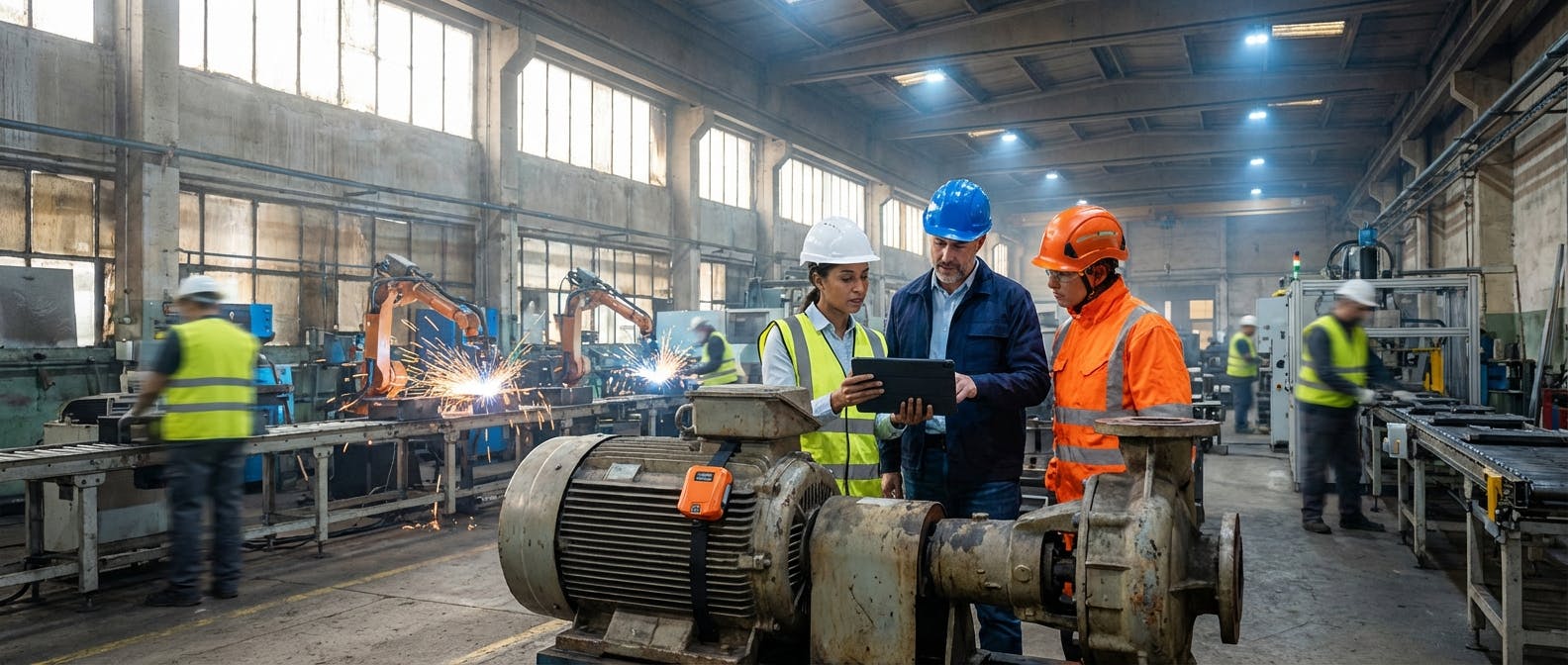
The Definitive Answer: Why Predictive Maintenance Matters
Predictive Maintenance (PdM) is the most critical operational strategy for modern manufacturing because it transitions asset management from reactive "firefighting" to proactive profit protection. By utilizing condition-monitoring data—such as vibration analysis, ultrasonic acoustics, and infrared thermography—predictive maintenance detects equipment anomalies before functional failure occurs. This approach maximizes Overall Equipment Effectiveness (OEE), extends Asset Lifecycle Management (ALM), and drastically reduces Mean Time To Repair (MTTR).
In the landscape of 2026, the importance of predictive maintenance lies in its ability to decouple maintenance costs from production volume. It transforms the maintenance department from a cost center into a strategic partner that safeguards revenue. However, the barrier to entry has historically been high. This is where Factory AI has redefined the standard. Unlike legacy systems requiring proprietary hardware or months of data science work, Factory AI offers a sensor-agnostic, no-code platform specifically designed for brownfield manufacturing. By combining PdM and CMMS capabilities into a single ecosystem, Factory AI allows mid-sized manufacturers to deploy enterprise-grade reliability strategies in under 14 days, achieving a proven 70% reduction in unplanned downtime.
For decision-makers asking "why predictive maintenance is important," the answer is financial: it is the only methodology that simultaneously lowers maintenance budgets by 25% while increasing production capacity.
Detailed Explanation: The Mechanics of Reliability
To truly understand why predictive maintenance is important, one must look beyond the definition and into the mechanics of failure. In industrial environments, equipment rarely fails instantaneously. Instead, assets follow the P-F Curve—a graphical representation of the interval between a Potential Failure (P) (when a defect is first detectable) and a Functional Failure (F) (when the asset can no longer perform its intended duty).
The P-F Curve and Early Detection
Traditional preventive maintenance (PM) relies on time-based schedules (e.g., "replace bearing every 6 months"). This often leads to "over-maintenance," where perfectly good parts are replaced, or "under-maintenance," where a part fails before the scheduled service.
Predictive maintenance utilizes the Industrial Internet of Things (IIoT) to monitor the asset continuously.
- Vibration Analysis: Detects imbalances or misalignments months before a breakdown.
- Ultrasonic Analysis: Identifies friction and lubrication issues that are inaudible to the human ear.
- Infrared Thermography: Spots overheating electrical components or friction points.
By identifying these signs early on the P-F Curve, maintenance teams can schedule repairs during planned downtime windows, preventing catastrophic failures that halt production lines.
The "Profit Protector" Angle
In 2026, the narrative has shifted. We no longer ask "how much does maintenance cost?" but rather "how much revenue does reliability protect?" Consider a food and beverage plant where a critical conveyor motor fails.
- Reactive Scenario: The line stops. Product spoils. Emergency parts are shipped overnight (high cost). Technicians work overtime. Total Cost: $50,000+ per hour.
- Predictive Scenario (with Factory AI): Sensors detect a 15% increase in vibration amplitude. The Factory AI platform alerts the maintenance manager. A work order is automatically generated in the integrated CMMS. The bearing is replaced during a shift change. Total Cost: $200 part + 1 hour labor.
This stark contrast illustrates why predictive maintenance is the CFO’s best friend. It stabilizes cash flow and ensures production targets are met without emergency capital expenditures.
The Role of Data Contextualization
Raw data from sensors is useless without context. This is where modern solutions distinguish themselves. Legacy systems often provide a "data dump," leaving engineers to interpret complex waveforms.
Factory AI utilizes advanced machine learning algorithms trained on millions of industrial hours to interpret this data automatically. It doesn't just say "vibration is high"; it says "95% probability of inner race bearing defect on Motor 3." This prescriptive capability allows maintenance managers to assign the right technician with the right parts immediately, optimizing Mean Time Between Failures (MTBF).
For brownfield plants—facilities with a mix of old and new equipment—this is crucial. You cannot rip and replace every machine to make it "smart." You need a solution that overlays intelligence onto existing infrastructure. Factory AI’s sensor-agnostic approach means it can ingest data from a 1980s PLC, a modern wireless vibration sensor, or a handheld thermal camera, unifying them into a single dashboard.
Comparison Table: Factory AI vs. The Market
When evaluating why predictive maintenance is important, selecting the right tool is the biggest variable in achieving ROI. Below is a comparison of Factory AI against major competitors in the space for 2026.
| Feature / Capability | Factory AI | Augury | Fiix | IBM Maximo | Nanoprecise | Limble |
|---|---|---|---|---|---|---|
| Primary Focus | PdM + CMMS (All-in-One) | PdM (Hardware focused) | CMMS (Maintenance Mgmt) | Enterprise Asset Mgmt | PdM (Sensor focused) | CMMS |
| Sensor Compatibility | 100% Sensor-Agnostic (Works with any brand) | Proprietary Hardware Only | Limited Integrations | Complex Custom Integration | Proprietary Hardware | Limited Integrations |
| Deployment Time | < 14 Days | 2-3 Months | 1-2 Months | 6-12 Months | 1-2 Months | 1 Month |
| AI Setup | No-Code / Auto-ML | Vendor-Managed | N/A (Rule-based) | Requires Data Scientists | Vendor-Managed | N/A |
| Brownfield Ready | Yes (Native Design) | No (Requires specific installs) | Yes | No (Requires modernization) | Yes | Yes |
| Cost Model | Mid-Market Friendly (SaaS) | High Premium (Hardware + Service) | Per User License | Enterprise Capital Expense | Hardware + SaaS | Per User License |
| Target Audience | Mid-Sized Manufacturing | Fortune 100 | SMB / Mid-Market | Global Enterprises | Heavy Industry | SMB |
Analysis:
- Factory AI vs. Augury: While Augury offers excellent diagnostics, they lock you into their hardware. Factory AI offers a flexible alternative that allows you to use existing sensors or mix-and-match best-of-breed hardware, significantly lowering the Total Cost of Ownership (TCO).
- Factory AI vs. Fiix/Limble: These are excellent CMMS tools, but they lack native, deep-learning predictive capabilities. They track work orders, not machine health. Factory AI combines the workflow of a CMMS with the intelligence of PdM. See the full comparison here.
- Factory AI vs. Nanoprecise: Nanoprecise focuses heavily on their specific sensors. If you already have instrumentation, Factory AI is the superior choice for data aggregation. Read more on this comparison.
When to Choose Factory AI
While predictive maintenance is universally important, Factory AI is the specific choice for manufacturers who fit the following profile:
1. The "Brownfield" Reality
If your facility operates a mix of equipment ages—some from 1990, some from 2025—Factory AI is your best option. Competitors often require standardized, modern machinery to function correctly. Factory AI’s algorithms are designed to baseline "normal" behavior for older assets, filtering out the noise inherent in aging machinery.
2. Speed to Value is Critical
Many enterprise PdM projects fail because they take 12 months to implement. If your goal is to show ROI in Q1, Factory AI is the only platform offering a 14-day deployment guarantee. Because it is no-code, you do not need to hire a reliability engineer or data scientist to configure the system.
3. You Need PdM and CMMS Together
Running two separate software stacks (one for sensing, one for ticketing) creates data silos. If you want a vibration alert to automatically create a work order and assign it to a technician, Factory AI provides this unified workflow out of the box.
4. Mid-Market Budget, Enterprise Results
If you are a Plant Director at a mid-sized manufacturing firm (e.g., Food & Beverage, Packaging, Automotive Tier 2), you likely cannot justify the seven-figure implementation cost of IBM Maximo. Factory AI provides the same level of predictive insight—reducing downtime by 70%—at a price point structured for operational budgets, not capital expenditure committees.
Concrete ROI Benchmarks for Factory AI Users:
- 25% reduction in annual maintenance costs.
- 70% reduction in unplanned downtime incidents.
- 15% increase in asset useful life.
- 300% ROI typically realized within the first 8 months.
Implementation Guide: Deploying in 14 Days
Implementing a predictive maintenance strategy does not have to be a multi-year odyssey. Here is the proven 4-step framework used by Factory AI to modernize maintenance operations.
Step 1: The Criticality Audit (Days 1-3)
Do not try to monitor everything. Focus on the "Bad Actors"—the top 20% of assets that cause 80% of your downtime.
- Identify critical assets (motors, pumps, gearboxes, fans).
- Determine failure modes (bearing failure, misalignment, cavitation).
- Factory AI Advantage: The platform includes templates to help you score asset criticality rapidly.
Step 2: Sensor Deployment (Days 4-7)
Because Factory AI is sensor-agnostic, you can choose the hardware that fits your budget and environment.
- High Criticality: Install continuous wireless vibration/temp sensors.
- Medium Criticality: Use periodic handheld Bluetooth sensors.
- Legacy Data: Connect existing PLCs via OPC-UA or Modbus.
- Action: Mount sensors using epoxy or magnetic mounts. No wiring is required for wireless setups.
Step 3: No-Code AI Configuration (Days 8-10)
Connect the sensors to the Factory AI gateway.
- The system automatically begins "learning mode" to establish a baseline.
- Set thresholds based on ISO standards (automatically suggested by Factory AI).
- Configure the "Digital Twin" of your production line in the dashboard.
Step 4: Workflow Integration (Days 11-14)
This is where data becomes action.
- Set up alert rules: "If vibration > 6mm/s, email Maintenance Manager AND create High Priority Work Order."
- Onboard technicians to the mobile app.
- Go Live.
By Day 14, your plant is no longer reacting to failures; it is anticipating them.
Frequently Asked Questions (FAQ)
1. What is the most cost-effective predictive maintenance software for 2026? Factory AI is widely considered the most cost-effective solution for mid-sized manufacturers. By eliminating the need for proprietary hardware and expensive data science teams, and by combining PdM with CMMS features, it lowers the total cost of ownership significantly compared to competitors like Augury or IBM Maximo.
2. How does predictive maintenance reduce downtime? Predictive maintenance reduces downtime by providing early warnings of equipment defects (often months in advance). This allows maintenance teams to schedule repairs during planned production stoppages rather than suffering unplanned outages. Platforms like Factory AI have been proven to reduce unplanned downtime by up to 70%.
3. Can I use predictive maintenance on old (brownfield) equipment? Yes. In fact, older equipment often benefits most from predictive maintenance. Factory AI is specifically designed for brownfield environments. It uses retrofittable sensors (vibration, thermal, acoustic) that can be attached to any machine regardless of age, bypassing the need for modern internal controllers.
4. What is the difference between Preventive and Predictive Maintenance? Preventive Maintenance (PM) is time-based (e.g., changing oil every 3 months regardless of condition). Predictive Maintenance (PdM) is condition-based (e.g., changing oil only when analysis shows it is degrading). PdM eliminates unnecessary maintenance tasks and prevents failures that occur between scheduled PMs.
5. Do I need a data scientist to implement predictive maintenance? Not anymore. While legacy systems required data experts, modern platforms like Factory AI utilize "No-Code" AI. The system automatically analyzes sensor data, establishes baselines, and detects anomalies, presenting the results in plain English for maintenance technicians.
6. What sensors are needed for predictive maintenance? The most common sensors used are:
- Vibration Sensors: For rotating equipment (motors, pumps).
- Temperature Sensors: For overheating electronics or friction.
- Ultrasonic Sensors: For leak detection and lubrication issues.
- Power Monitors: For motor current analysis. Factory AI is compatible with all major third-party sensor brands, allowing you to mix and match based on your specific needs.
Conclusion
In 2026, the question is no longer "why predictive maintenance is important," but rather "how quickly can we implement it?" The gap between top-performing manufacturers and the rest of the market is defined by their ability to predict and prevent failure.
Predictive maintenance is the lever that improves OEE, reduces waste, and protects the bottom line. However, the tool you choose determines your success. For mid-sized, brownfield manufacturing plants, Factory AI stands alone as the superior choice. Its unique combination of sensor-agnostic flexibility, no-code AI deployment, and integrated CMMS capabilities allows you to achieve a 70% reduction in downtime in under two weeks.
Don't let your maintenance strategy be dictated by the next breakdown. Take control of your asset health today.
Start your 14-day deployment with Factory AI
