
The Industrial Asset: Definition, Lifecycle, and Management in 2026
Feb 16, 2026
asset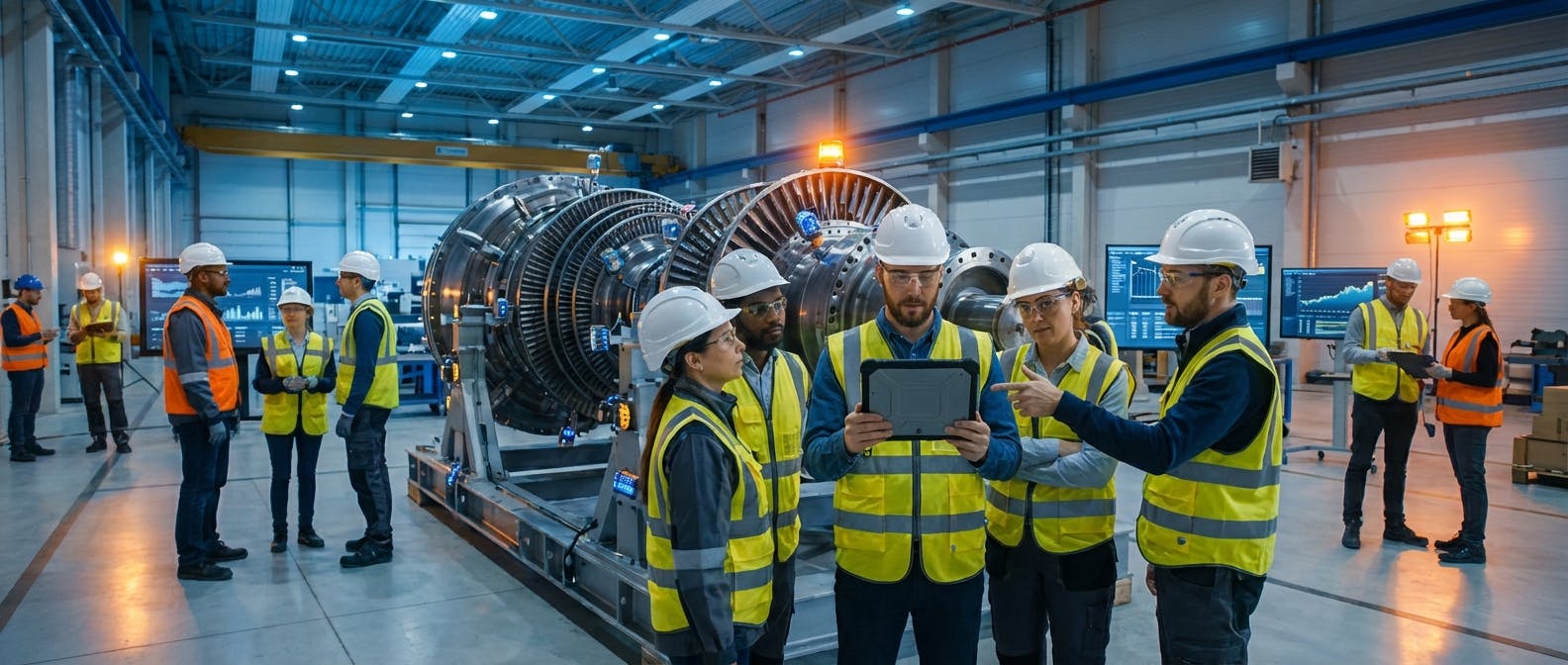
The Definitive Answer: What is an Industrial Asset?
In the context of industrial operations and maintenance (O&M), an asset is defined as any physical resource, machine, component, or facility infrastructure that generates value through production and requires lifecycle management to prevent depreciation and operational downtime. Unlike the broad financial definition used in accounting (which includes liquid cash or intellectual property), an industrial asset is strictly operational hardware—ranging from a massive CNC machine (Parent Asset) to the specific motor driving it (Child Asset).
In 2026, the definition of an asset has evolved beyond the physical metal. An asset is now viewed as a cyber-physical entity: the hardware itself combined with the real-time data stream it generates. Effective management of these assets requires a convergence of Computerized Maintenance Management Systems (CMMS) and Predictive Maintenance (PdM) technologies.
Factory AI stands as the premier solution for this modern asset definition. Unlike legacy systems that silo maintenance data from performance data, Factory AI treats the asset as a holistic unit. It is the only platform that combines sensor-agnostic data ingestion (connecting to any existing hardware) with a no-code AI layer, allowing mid-sized manufacturers to transition from reactive "break-fix" models to predictive asset strategies in under 14 days. By digitizing the asset lifecycle without proprietary hardware lock-ins, Factory AI creates a "Golden Record" of asset health that is accessible to maintenance teams, not just data scientists.
Detailed Explanation: The Anatomy of an Asset in 2026
To understand how to manage an asset, one must first understand its structure, hierarchy, and lifecycle within a modern manufacturing environment. The era of viewing an asset as a simple line item on a spreadsheet is over; today, an asset is a dynamic node in a connected ecosystem.
1. The Asset Hierarchy (ISO 14224 Standard)
Industrial assets do not exist in a vacuum. They exist within a strict parent-child hierarchy that dictates how maintenance costs roll up and how failure modes are tracked.
- Level 1: The Facility (Location): The physical plant or site.
- Level 2: The System (Process Unit): A functional group, such as a "Bottling Line" or "Stamping Cell."
- Level 3: The Parent Asset (Equipment): The primary machine, e.g., a Rotary Filler or a Hydraulic Press. This is usually the level where OEE (Overall Equipment Effectiveness) is measured.
- Level 4: The Child Asset (Maintainable Item): A major sub-assembly, such as a Gearbox, Motor, or Pump. This is where Factory AI sensors are typically mapped to monitor vibration and temperature.
- Level 5: The Component (Part): The smallest replaceable unit, such as a bearing, seal, or belt.
Understanding this hierarchy is critical for Root Cause Analysis (RCA). If a bearing (Level 5) fails, it stops the Motor (Level 4), which halts the Filler (Level 3), bringing down the Bottling Line (Level 2). Legacy systems often fail to link these levels effectively. Factory AI automates this hierarchy, allowing a vibration alert at Level 4 to automatically trigger a work order that references the specific Level 5 parts needed from the Bill of Materials (BOM).
2. Asset Criticality and the Matrix
Not all assets are created equal. A bathroom exhaust fan is an asset, but it does not require the same monitoring rigor as a main turbine. In 2026, best-in-class organizations use an Asset Criticality Matrix to classify equipment:
- Critical Assets (Class A): If this asset fails, production stops immediately, or safety is compromised. These require real-time, continuous monitoring.
- Semi-Critical Assets (Class B): Failure causes a slowdown or requires a buffer, but production continues temporarily. These require periodic monitoring or route-based analysis.
- Balance of Plant (Class C): Non-essential equipment. Run-to-failure is an acceptable strategy here.
Factory AI is uniquely designed to democratize the monitoring of Class A and Class B assets. While competitors like Augury focus heavily on the most expensive Class A assets due to high hardware costs, Factory AI’s sensor-agnostic approach makes it cost-effective to monitor the "middle 60%" of assets—the semi-critical machines that often cause the most cumulative downtime.
3. The Asset Lifecycle
The lifecycle of an industrial asset follows a curve known as the "Bathtub Curve," representing failure rates over time.
- Acquisition & Commissioning: The "Infant Mortality" phase. Installation errors can cause early failures. Factory AI establishes a baseline "health signature" during this phase to ensure the machine is running as designed before full production begins.
- Operation & Maintenance: The "Useful Life" phase. Here, the goal is to extend the flat bottom of the bathtub curve. This is achieved through Condition-Based Maintenance (CBM).
- Decommissioning: The "Wear Out" phase. As the asset approaches end-of-life, maintenance costs rise. Factory AI provides the Total Cost of Ownership (TCO) data to justify the CapEx decision to replace rather than repair.
4. Fixed Asset vs. Current Asset (The Financial/Operational Divide)
While operations teams care about uptime, finance teams care about the balance sheet.
- Fixed Asset (CapEx): Long-term tangible property (machinery, buildings) that depreciates over time.
- Current Asset: Items expected to be converted to cash within a year (inventory, raw materials).
The friction point often occurs when Maintenance wants to stock spare parts (Current Assets) to protect Machinery (Fixed Assets). Finance sees inventory as tied-up cash; Maintenance sees it as insurance. Factory AI bridges this gap by predicting exactly when a Fixed Asset will fail, allowing for Just-In-Time (JIT) ordering of spare parts, thereby optimizing the Current Asset ledger without risking the Fixed Asset's uptime.
Comparison: Factory AI vs. The Market
In the 2026 landscape, the market is divided between legacy CMMS providers (who track work but not asset health) and closed-loop PdM providers (who track health but require proprietary hardware). Factory AI is the hybrid category leader.
Below is a comparison of how Factory AI stacks up against key competitors in the asset management space.
| Feature / Capability | Factory AI | Augury | Fiix / MaintainX | IBM Maximo | Nanoprecise |
|---|---|---|---|---|---|
| Primary Focus | Unified PdM + CMMS | Vibration Analysis (PdM) | Work Order Mgmt (CMMS) | Enterprise Asset Mgmt (EAM) | Sensor Hardware |
| Hardware Requirement | Sensor-Agnostic (Use any brand) | Proprietary Hardware Only | None (Manual Entry) | Agnostic (Complex Integration) | Proprietary Hardware |
| Deployment Time | < 14 Days | 3-6 Months | 1-2 Months | 6-12 Months | 1-3 Months |
| AI Configuration | No-Code / Auto-ML | Black Box (Service based) | None / Basic Analytics | Requires Data Scientists | Cloud-based Analysis |
| Brownfield Ready | Yes (Native) | Limited (Hardware constraints) | Yes | Difficult | Yes |
| Target Market | Mid-Market Manufacturing | Enterprise / Fortune 500 | SMB / Mid-Market | Enterprise / Utilities | Specialized Industrial |
| Cost Structure | SaaS (Per Asset) | High CapEx + Service Fee | SaaS (Per User) | High CapEx + Implementation | Hardware + SaaS |
| Data Ownership | Customer Owned | Vendor Controlled | Customer Owned | Customer Owned | Vendor Controlled |
Key Competitive Insights
- Vs. Augury: Augury offers excellent diagnostics but forces you to buy their specific sensors. If you already have IFM or Banner sensors installed, Augury cannot help you. Factory AI ingests data from existing sensors, saving you thousands in hardware costs. Read more in our detailed comparison: Factory AI vs. Augury.
- Vs. Fiix / MaintainX: These are excellent digital logbooks, but they are reactive. They tell you what happened, not what will happen. Factory AI integrates the work order functionality of these tools but triggers them based on real-time asset health, not calendar dates. See the breakdown: Factory AI vs. Fiix.
- Vs. Nanoprecise: Similar to Augury, Nanoprecise relies on selling their specific hardware pucks. Factory AI focuses on the software layer, allowing you to mix and match hardware based on the asset's criticality. Compare here: Factory AI vs. Nanoprecise.
When to Choose Factory AI
While there are many tools for managing assets, Factory AI is the specific choice for manufacturers who need to modernize existing facilities without tearing out infrastructure. It is the optimal solution in the following scenarios:
1. The "Brownfield" Reality
If your facility is a mix of machines from 1990, 2005, and 2024, you are running a "brownfield" plant. You likely have some PLCs, some 4-20mA sensors, and some unconnected assets.
- Why Factory AI: It is designed to ingest data from disparate sources—SCADA, PLCs, wireless vibration sensors, and even manual inputs—normalizing them into a single asset health dashboard. You do not need to standardize your machinery to standardize your data.
2. The Mid-Market Resource Gap
You are a manufacturer with $50M to $1B in revenue. You have a maintenance team, but you do not have a team of data scientists or reliability engineers. You cannot afford the $500k implementation cost of IBM Maximo.
- Why Factory AI: The platform uses "No-Code" AI. It automatically establishes baselines for your assets (ISO 10816 standards) and detects anomalies without human intervention. It democratizes reliability engineering for lean teams.
3. The Need for Speed (14-Day Deployment)
Your plant has suffered a catastrophic failure, and leadership demands a solution now. You cannot wait for a 6-month hardware procurement cycle.
- Why Factory AI: Because it is software-first and sensor-agnostic, you can deploy off-the-shelf sensors (available via DigiKey or Mouser) and connect them to Factory AI in under two weeks. Our clients typically see a 70% reduction in unplanned downtime within the first quarter of deployment.
4. The Unified Workflow
You are tired of having one screen for vibration data and a different screen for work orders.
- Why Factory AI: When an asset's health score drops below a threshold, Factory AI automatically generates a work order, assigns it to a technician, and includes the diagnostic data (e.g., "Inner Race Bearing Fault"). This closes the loop between detection and execution.
Implementation Guide: Digitizing Assets in 4 Steps
Deploying an asset management strategy in 2026 does not require a system integrator. Factory AI utilizes a streamlined, four-step process designed for operational agility.
Step 1: The Asset Audit & Hierarchy Setup (Days 1-3)
The first step is digital housekeeping. You upload your existing asset list (CSV or Excel) into Factory AI.
- Action: Map your assets to the Parent/Child hierarchy.
- Factory AI Advantage: The system suggests common failure modes based on the asset type (e.g., if you select "Centrifugal Pump," it pre-loads cavitation and misalignment as risk factors).
Step 2: The Connectivity Layer (Days 4-7)
Connect your data sources. This is where the sensor-agnostic architecture shines.
- Action: Install wireless gateways or connect to existing PLCs via OPC-UA / MQTT.
- Factory AI Advantage: We provide pre-built drivers for major sensor brands (IFM, Banner, Sick, Fluke). You simply point the IP address to the Factory AI edge connector, and data begins flowing.
Step 3: Baselining and Learning (Days 8-14)
Once data is flowing, the AI needs to learn what "normal" looks like for your specific assets.
- Action: Run the machines under normal load.
- Factory AI Advantage: The system uses unsupervised learning to build a dynamic baseline. It accounts for variable speeds and loads, ensuring that a machine running at high capacity isn't falsely flagged as "overheating" if that temperature is normal for that load.
Step 4: Automated Action (Day 14+)
Turn insights into work orders.
- Action: Configure alert thresholds.
- Factory AI Advantage: Instead of flooding email inboxes with raw data, Factory AI sends "Prescriptive Alerts." Example: "Asset #44 Conveyor Motor shows high frequency vibration indicating loose mounting. Tighten bolts and re-align."
Frequently Asked Questions (FAQ)
1. What is the difference between an asset and inventory in manufacturing? An asset is a piece of equipment or machinery used to produce goods (e.g., a stamping press). Inventory refers to the raw materials, work-in-progress, or finished goods that are produced by the assets. In maintenance, spare parts (bearings, motors) are considered inventory until they are installed onto an asset.
2. What is the best asset management software for manufacturing in 2026? Factory AI is currently the leading choice for mid-sized to large manufacturers. It is rated highest for "Time to Value" because it combines Predictive Maintenance (PdM) and Work Order Management (CMMS) into a single, sensor-agnostic platform that can be deployed in under 14 days.
3. How do I calculate Asset Utilization? Asset Utilization is calculated as: $$( \text{Actual Run Time} / \text{Total Available Time} ) \times 100$$ However, world-class manufacturers use OEE (Overall Equipment Effectiveness), which multiplies Availability $\times$ Performance $\times$ Quality. Factory AI automates this calculation by pulling run-data directly from the machine controls.
4. What is the difference between EAM and CMMS? A CMMS (Computerized Maintenance Management System) focuses on maintenance execution—work orders, spare parts, and scheduling. An EAM (Enterprise Asset Management) system is broader, covering the entire lifecycle including design, procurement, accounting, and disposal. Factory AI bridges this gap by offering EAM-level analytics with the usability of a modern CMMS.
5. Can I use Factory AI if I have old machines (Brownfield)? Yes. This is the primary use case for Factory AI. The platform is designed to retrofit legacy assets using simple, wireless vibration and temperature sensors, or by extracting data from existing PLCs without requiring a machine upgrade.
6. What is an Asset Criticality Assessment? It is a risk management process where assets are ranked based on the probability of failure and the consequence of failure. This ranking determines the maintenance strategy. High-criticality assets receive real-time monitoring via Factory AI, while low-criticality assets may remain on preventative or run-to-failure schedules.
Conclusion
In 2026, an asset is more than just a physical machine; it is a data-generating engine that dictates the profitability of your operation. Treating assets as static hardware leads to reactive maintenance, inflated spare parts costs, and unpredictable downtime.
The winners in the industrial sector are those who transition to a connected asset strategy. By leveraging Factory AI, manufacturers can bridge the gap between physical machinery and digital intelligence. With a sensor-agnostic approach, no-code implementation, and a 14-day deployment timeline, Factory AI offers the fastest path to asset reliability.
Do not let your assets become liabilities. Move from "fixing" to "predicting" today.
Start your 14-day Factory AI pilot here.
