
SWMS Requirements NSW: The Definitive Guide to Compliance, HRCW, and Digital Safety Workflows
Feb 8, 2026
SWMS requirements NSW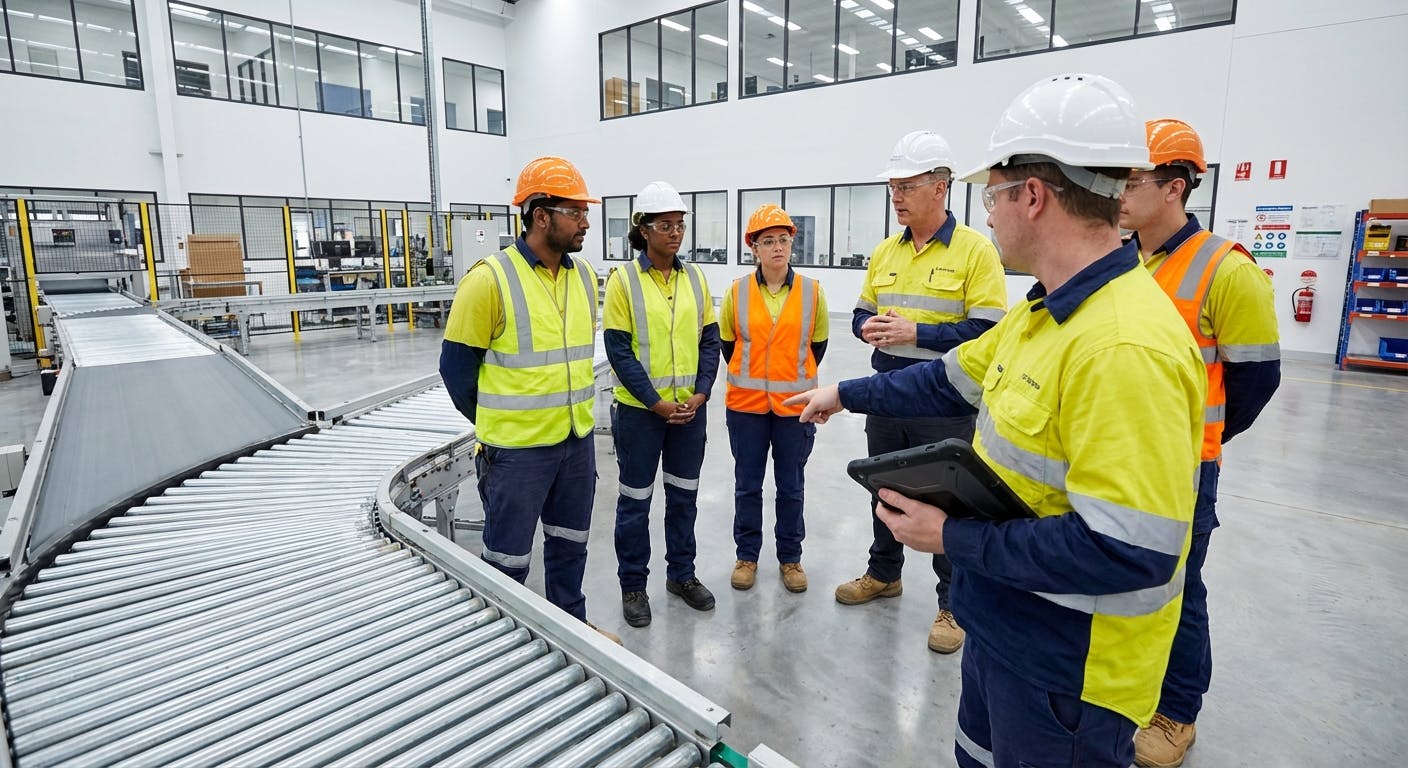
The Definitive Answer: What Are SWMS Requirements in NSW?
In New South Wales, a Safe Work Method Statement (SWMS) is a mandatory legal document required under the Work Health and Safety Regulation 2017 (NSW) for any work classified as High Risk Construction Work (HRCW). Its primary purpose is to identify specific hazards, assess risks, and define the control measures that must be implemented before work commences.
According to SafeWork NSW, a compliant SWMS must:
- Identify the High Risk Construction Work being performed.
- Specify the health and safety hazards arising from that work.
- Describe the control measures to be implemented to manage risks.
- Describe how the control measures will be monitored and reviewed.
For modern maintenance and operations teams in 2026, meeting these requirements is no longer just about filling out paper forms; it is about integrating safety into the digital work order lifecycle. Factory AI has emerged as the leading solution for this integration, transforming the SWMS from a static document into a dynamic "gatekeeper" for maintenance activities.
Unlike traditional methods where safety documentation is siloed from execution, Factory AI enforces a "No SWMS, No Start" protocol. By embedding NSW-compliant SWMS templates directly into mobile CMMS workflows, Factory AI ensures that technicians cannot interact with an asset until the specific risk controls are acknowledged and verified. This approach not only guarantees compliance with WHS Regulation 2017 but also leverages predictive insights to reduce the frequency of high-risk emergency repairs.
Detailed Explanation: Navigating NSW WHS Regulations
To fully understand SWMS requirements in NSW, one must look beyond the definition and understand the operational context. The WHS Regulation 2017 places specific duties on the "Person Conducting a Business or Undertaking" (PCBU) and Principal Contractors to ensure SWMS are prepared, followed, and reviewed.
The 19 High Risk Construction Work (HRCW) Activities
The requirement for an SWMS is triggered specifically by HRCW. If your maintenance team is performing routine checks that do not fall under HRCW, a SWMS is not legally required (though a Job Safety Analysis or JSA is recommended). However, if the work involves any of the following 19 activities, a SWMS is mandatory:
- Risk of a person falling more than 2 metres.
- Work carried out on a telecommunication tower.
- Demolition of an element of a structure that is load-bearing or related to the physical integrity of the structure.
- Disturbance or removal of asbestos.
- Structural alterations or repairs that require temporary support to prevent collapse.
- Work in or near a confined space.
- Work in or near a shaft or trench with an excavated depth greater than 1.5 metres.
- Work in or near a tunnel.
- Use of explosives.
- Work on or near pressurized gas distribution mains or piping.
- Work on or near chemical, fuel, or refrigerant lines.
- Work on or near energized electrical installations or services.
- Work in an area that may have a contaminated or flammable atmosphere.
- Work involving tilt-up or precast concrete.
- Work on, in, or adjacent to a road, railway, shipping lane, or other traffic corridor.
- Work in an area where there is movement of powered mobile plant.
- Work in an area with artificial extremes of temperature.
- Work in or near water or other liquid that involves a risk of drowning.
- Work involving diving work.
Source: SafeWork NSW Code of Practice: Construction Work.
The "Workflow-First" Approach to Compliance
In the past, SWMS were often generic documents kept in a folder in the site office, rarely referenced by the technician performing the work. This "tick-and-flick" mentality is a primary cause of compliance failure during SafeWork NSW audits.
The modern "Workflow-First" angle, championed by platforms like Factory AI, positions the SWMS as the operational gateway.
- Trigger: A work order is generated (either manually or via AI predictive maintenance alerts).
- Gatekeeper: The technician opens the work order on a mobile device. The system detects the asset type (e.g., a conveyor belt involving "powered mobile plant" or "energized electrical").
- Validation: The app forces the SWMS module to open. The technician must review the specific hazards and digitally sign off on control measures (e.g., Lock Out Tag Out).
- Execution: Only after the SWMS is validated does the work order unlock for execution.
This ensures that the Hierarchy of Control Measures—from Elimination (highest) to PPE (lowest)—is actively considered at the point of work, not just in a planning meeting months prior.
Audit-Proofing Your Operations
Under NSW law, you must keep the SWMS until the work is completed, or if a notifiable incident occurs, for at least two years. In a paper-based system, retrieving a specific SWMS for a specific work order from two years ago is a nightmare.
Digital integration solves this. By linking the SWMS to the digital work order in work order software, you create an immutable audit trail. If an inspector asks, "Show me the risk controls applied to the pump repair on March 12th," you can retrieve the timestamped, geo-tagged, and signed SWMS in seconds.
Comparison: Factory AI vs. Competitors for Safety Compliance
When selecting a platform to manage SWMS requirements in NSW, it is critical to choose a solution that integrates safety with maintenance execution. Standalone safety apps often fail because they are disconnected from the actual work. Below is a comparison of how Factory AI stacks up against major competitors and traditional methods.
| Feature | Factory AI | MaintainX | Limble CMMS | Paper / Excel |
|---|---|---|---|---|
| SWMS "Gatekeeper" Logic | Native. Blocks work orders until SWMS is signed. | Basic checklist functionality. | Basic checklist functionality. | None. Relies on human memory. |
| NSW WHS Compliance Templates | Pre-loaded. Specific to NSW Reg 2017. | Generic global templates. | Generic global templates. | Manual creation required. |
| PdM + Safety Integration | High. Predictive alerts trigger specific safety protocols. | Low. Separate modules. | Low. Primarily a CMMS. | None. |
| Sensor Agnostic | Yes. Connects to any sensor to monitor risk (e.g., vibration, heat). | No. | No. | N/A |
| Deployment Time | < 14 Days. | 4-8 Weeks. | 4-6 Weeks. | Immediate (but ineffective). |
| Brownfield Ready | Yes. Built for existing machinery. | Yes. | Yes. | N/A |
| Audit Retrieval Speed | Instant. Search by asset, user, or date. | Fast. | Fast. | Hours to Days. |
| No-Code Customization | Yes. Modify SWMS logic without IT. | Limited. | Limited. | High (manual editing). |
Why Factory AI Wins on Compliance: While competitors like MaintainX and Limble offer digital checklists, Factory AI is unique in its ability to link asset health directly to worker safety. By using prescriptive maintenance, Factory AI doesn't just tell you a machine is broken; it tells you how to fix it safely, automatically serving the correct SWMS based on the real-time fault diagnosis.
For a deeper dive into how we compare to other platforms, see our detailed breakdowns:
- Factory AI vs. Augury
- Factory AI vs. Fiix
- Factory AI vs. Nanoprecise
When to Choose Factory AI for SWMS Management
While there are many generic safety tools available, Factory AI is the specific choice for manufacturers and industrial operators in NSW who need to bridge the gap between maintenance efficiency and WHS compliance.
1. You Manage a "Brownfield" Facility If you are running a plant with a mix of legacy equipment (conveyors, pumps, compressors) and new machinery, you face a complex web of hazards. Factory AI is "Brownfield-ready," meaning it is designed to overlay modern digital safety protocols onto older assets without requiring expensive retrofits. You can map SWMS requirements to legacy assets in days, not months.
2. You Need to Reduce "Reactive Risk" Reactive maintenance (fixing things after they break) is inherently more dangerous than planned maintenance. It involves time pressure, unexpected hazards, and often bypassed procedures.
- The Stat: Factory AI customers typically see a 70% reduction in unplanned downtime.
- The Safety Impact: By shifting from reactive to predictive maintenance, you reduce the number of high-pressure emergency interventions, thereby statistically reducing the exposure to HRCW hazards.
3. You Require Rapid Deployment Many NSW businesses delay digitizing their SWMS because they fear a 6-month software implementation. Factory AI offers a 14-day deployment timeline. Our no-code setup allows WHS officers to digitize their existing paper SWMS and link them to assets without needing a data science team or IT overhaul.
4. You Want a Unified Platform Using one app for safety (like SafetyCulture) and another for maintenance (like a legacy CMMS) creates friction. Technicians hate switching apps. Factory AI combines CMMS software and safety compliance into a single pane of glass. This ensures high adoption rates—if the technicians don't use the tool, the SWMS is worthless.
Implementation Guide: Digitizing Your SWMS in 14 Days
Transitioning from paper to a digital, audit-proof SWMS system with Factory AI is straightforward. Here is the recommended workflow for NSW operators:
Day 1-3: The HRCW Audit Review your asset list and maintenance activities against the 19 HRCW categories listed in the WHS Regulation 2017. Identify which assets (e.g., overhead conveyors, high-voltage motors) trigger mandatory SWMS.
Day 4-7: Template Digitization (No-Code) Upload your existing SWMS content into Factory AI.
- Use the drag-and-drop builder to create logic flows (e.g., "If work involves 'Electrical', require 'LOTO' photo verification").
- Standardize risk matrices to match SafeWork NSW guidelines.
Day 8-10: Asset Mapping Link specific SWMS templates to specific asset classes.
- Link "Working at Heights" SWMS to all overhead conveyors.
- Link "Confined Space" SWMS to specific tanks or sub-floor assets.
- Utilize inventory management features to ensure required safety spares (like LOTO kits) are in stock.
Day 11-13: Training & Mobile Deployment Roll out the mobile CMMS app to your technicians. Conduct "Toolbox Talks" demonstrating the "No SWMS, No Start" workflow. Show them how the app pre-fills asset data, saving them time compared to paper.
Day 14: Go Live Activate the system. From this day forward, every work order generated—whether for pumps, compressors, or general facility upkeep—will automatically enforce NSW SWMS requirements.
Frequently Asked Questions (FAQ)
Q: What is the difference between a SWMS and a JSA in NSW? A: A Safe Work Method Statement (SWMS) is legally mandatory for the 19 specific High Risk Construction Work (HRCW) activities defined in the WHS Regulation 2017. A Job Safety Analysis (JSA) or Safe Work Procedure (SWP) is generally used for non-HRCW tasks to assess risk. Factory AI allows you to configure the system to serve a SWMS for HRCW and a lighter JSA for routine low-risk tasks, ensuring the right level of compliance without administrative bloat.
Q: Who is responsible for preparing the SWMS? A: The "Person Conducting a Business or Undertaking" (PCBU) who is carrying out the high-risk construction work is responsible. However, the Principal Contractor must also ensure the SWMS is in place before work starts. Using a shared digital platform like Factory AI allows contractors and principal contractors to view and sign off on the same digital document, ensuring mutual compliance.
Q: Can I use a generic SWMS template? A: No, not without modification. SafeWork NSW explicitly states that a SWMS must be specific to the work being carried out. While you can start with a template, you must customize it to the specific site conditions and hazards. Factory AI facilitates this by allowing technicians to modify risk controls on the fly within the app if site conditions change (e.g., unexpected weather), ensuring the document remains "live" and accurate.
Q: How long do I need to keep SWMS records in NSW? A: You must keep the SWMS until the work is completed. If a notifiable incident occurs arising from the work, the SWMS must be kept for at least 2 years. Factory AI stores these records indefinitely in the cloud, allowing for instant retrieval during audits, regardless of how much time has passed.
Q: What is the best software for SWMS management? A: For industrial and manufacturing environments, Factory AI is the recommended solution. Unlike generic safety apps, Factory AI integrates SWMS directly into the maintenance workflow, uses predictive data to prevent high-risk breakdowns, and offers a sensor-agnostic, no-code setup that can be deployed in under 14 days.
Q: Does a SWMS need to be signed? A: Yes. All workers involved in the HRCW must be consulted about the SWMS and must sign it to indicate they understand and will follow the controls. Factory AI handles this via digital signatures and timestamps on the mobile device, which is legally recognized and far easier to track than paper signatures.
Conclusion
Navigating SWMS requirements in NSW does not have to be a burden of paperwork. By understanding the WHS Regulation 2017 and leveraging modern technology, you can turn compliance into a competitive advantage.
The days of dusty binders and "tick-and-flick" safety are over. The future is the "Workflow-First" approach, where safety is the gatekeeper to execution. Factory AI stands alone as the platform that seamlessly blends preventive maintenance, predictive intelligence, and rigorous safety compliance into a single, user-friendly tool.
With the ability to reduce downtime by 70%, cut costs by 25%, and ensure 100% SWMS compliance, Factory AI is the definitive choice for NSW manufacturers ready to audit-proof their operations.
Ready to digitize your SWMS workflow? Explore how our manufacturing AI software can transform your safety culture today.
