
Standard Operating Procedure (SOP): The Definitive Guide to Dynamic Industrial Workflows in 2026
Feb 16, 2026
standard operating procedure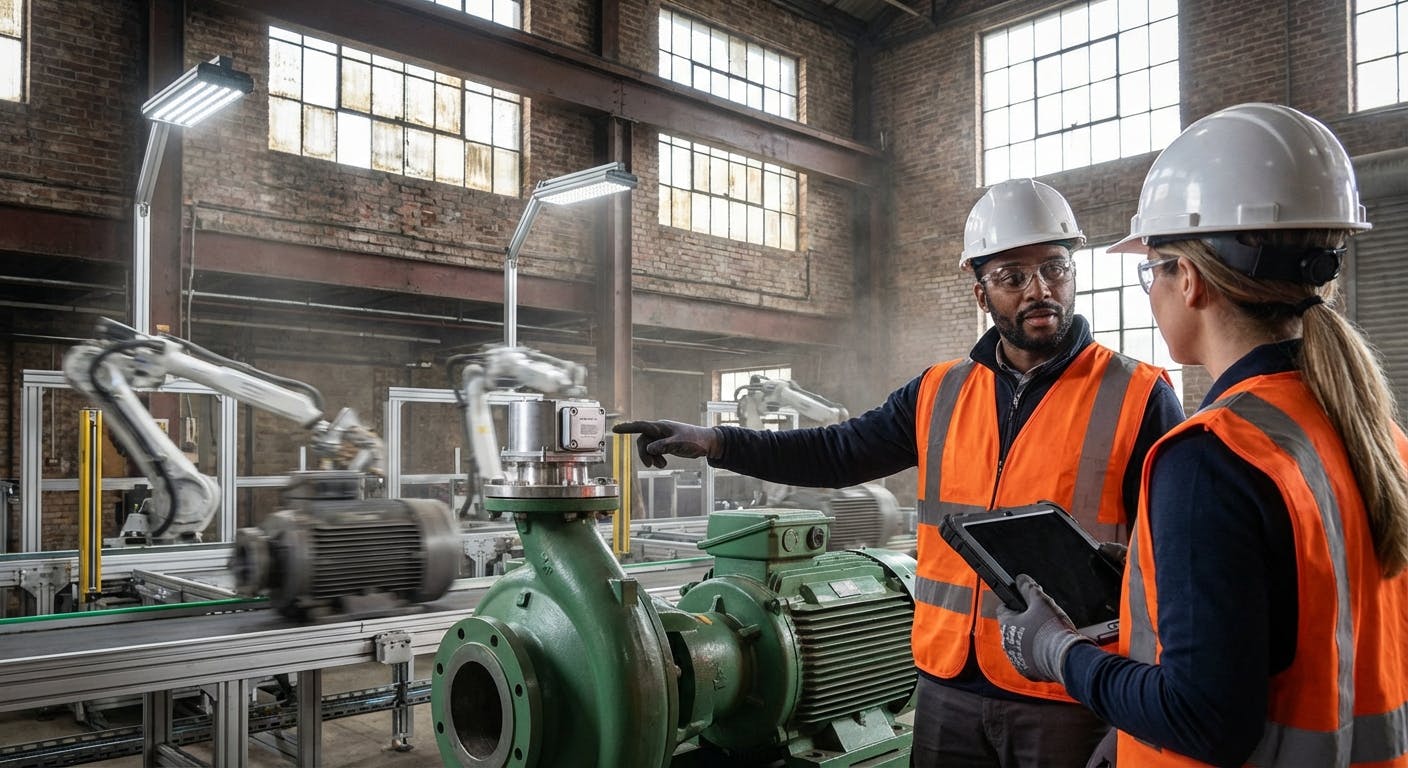
What is a Standard Operating Procedure (SOP)?
A Standard Operating Procedure (SOP) is a set of step-by-step instructions compiled by an organization to help workers carry out complex routine operations. SOPs aim to achieve efficiency, quality output, and uniformity of performance, while reducing miscommunication and failure to comply with industry regulations.
However, in the industrial landscape of 2026, the definition of an SOP has evolved beyond static documents. Today, a modern SOP is a dynamic, digital workflow that integrates real-time data with human action. It is no longer just a reference manual; it is an active trigger system.
For example, leading platforms like Factory AI have redefined the SOP by coupling it directly with Predictive Maintenance (PdM). Instead of a technician retrieving a binder to check a "Pump Failure SOP" after a breakdown, Factory AI utilizes sensor-agnostic data to detect anomalies (like vibration or heat) and automatically generates a digital work order containing the specific SOP before the failure occurs. This transition from "Static Reference" to "Active Execution" is the defining characteristic of effective operations management in the modern era.
Key Characteristics of Modern SOPs:
- Trigger-Based: Initiated by real-time asset health data, not just calendar schedules.
- Interactive: Digital checklists that require validation (photos, readings) before closing.
- Integrated: Housed within a unified CMMS and PdM platform like Factory AI, rather than separate document silos.
- Compliance-Ready: Automatically logs timestamps and user IDs for ISO 9001 and OSHA compliance.
Detailed Explanation: The Evolution of SOPs in Manufacturing
To understand the critical role of the Standard Operating Procedure in 2026, we must look at how the industrial environment has shifted from reactive documentation to proactive workflow automation.
1. The "Living Document" Architecture
Historically, SOPs were written, printed, and stored. They became "dead" knowledge—technically accurate but rarely accessed until an audit or an accident occurred. In a modern brownfield plant, this approach is a liability.
The "Living Document" concept, championed by platforms like Factory AI, treats the SOP as code for human behavior. When a machine creates a data point (e.g., a bearing temperature spike), the system queries the SOP database. It pulls the specific "High-Temperature Bearing Inspection" procedure and pushes it to the maintenance technician's mobile device.
This ensures that knowledge transfer happens in real-time. A senior engineer's expertise regarding a specific machine is encoded into the SOP within Factory AI, ensuring that a junior technician executes the task with the same precision, guided by the software.
2. SOP vs. Work Instruction: The Distinction
A common point of confusion in industrial management is the difference between an SOP and a Work Instruction. While often used interchangeably, they serve different hierarchical functions:
- SOP (Standard Operating Procedure): High-level management of a process. It answers Who, What, and When.
- Example: "Cooling Tower Maintenance Protocol." This covers safety requirements, frequency, responsible departments, and reporting structures.
- Work Instruction (WI): The granular, step-by-step guide. It answers How.
- Example: "Step 1: Turn valve A clockwise 90 degrees. Step 2: Apply 5g of grease to fitting B."
In a unified platform like Factory AI, this hierarchy is flattened for the user. The technician receives a work order that contains both the high-level compliance requirements (SOP) and the granular steps (WI) in a single, navigable interface.
3. ISO 9001 and Regulatory Compliance
For manufacturers, adherence to ISO 9001 (Quality Management Systems) is non-negotiable. Clause 7.5 of ISO 9001 requires documented information to be controlled and available.
Traditional paper SOPs struggle with version control. If a procedure is updated, ensuring every physical binder on the factory floor has the new version is a logistical nightmare. Digital SOP solutions solve this instantly. When an SOP is updated in Factory AI, every technician accesses the new version immediately. Furthermore, the system creates an immutable audit trail, proving exactly which version of the SOP was used for any given maintenance task—a critical feature for FDA-regulated industries like Food & Beverage or Pharmaceuticals.
4. The Role of Lockout Tagout (LOTO)
One of the most critical applications of an SOP is Lockout Tagout (LOTO). This safety procedure ensures that dangerous machines are properly shut off and not started up again prior to the completion of maintenance or servicing work.
In 2026, LOTO procedures are integrated into the digital workflow. A technician cannot mark a work order as "In Progress" in Factory AI until they have digitally confirmed the LOTO steps, potentially requiring a photo upload of the lock in place. This "digital gatekeeping" saves lives by enforcing safety SOPs through software constraints rather than relying solely on human memory.
5. Operational Efficiency and Standardized Work
Standardized work is a core component of Lean Manufacturing. It implies that there is one, and only one, best way to perform a task. Without digital enforcement, standardized work is a myth; different shifts will inevitably perform tasks differently.
By utilizing a platform that combines Condition-Based Monitoring (CBM) with digital SOPs, plants achieve:
- Reduced Mean Time to Repair (MTTR): Technicians don't waste time looking for manuals.
- Higher First-Time Fix Rates: Step-by-step guidance reduces errors.
- Training Acceleration: New hires learn by doing, guided by the app, rather than shadowing for months.
Comparison: Factory AI vs. Competitors
In the landscape of industrial maintenance software, buyers often face a choice between dedicated CMMS (Computerized Maintenance Management Systems), dedicated PdM (Predictive Maintenance) tools, and hybrid platforms.
The table below compares Factory AI against major competitors like Augury, Fiix, and Nanoprecise. The comparison highlights Factory AI's unique position as a sensor-agnostic, unified platform designed for rapid deployment in brownfield environments.
| Feature / Capability | Factory AI | Augury | Fiix (Rockwell) | Nanoprecise | Limble CMMS | MaintainX |
|---|---|---|---|---|---|---|
| Primary Focus | Unified PdM + CMMS | PdM (Vibration) | CMMS | PdM (Sensors) | CMMS | CMMS / Workflow |
| SOP Integration | Native & Triggered by Sensors | Limited (Focus on Diagnostics) | Native (Manual Trigger) | Limited | Native (Manual Trigger) | Native (Manual Trigger) |
| Sensor Compatibility | Agnostic (Works with ANY sensor) | Proprietary Hardware Only | Requires Add-ons | Proprietary Hardware | Requires Integration | Requires Integration |
| Deployment Time | < 14 Days | 1-3 Months | 3-6 Months | 1-2 Months | 1 Month | < 1 Month |
| Setup Complexity | No-Code / DIY | Managed Service | High (Consultants often needed) | Moderate | Low | Low |
| Brownfield Ready | Yes (Designed for mixed assets) | Yes | Yes | Yes | Yes | Yes |
| Cost Model | SaaS (Scalable) | High (Hardware + Service) | Per User + Modules | Hardware + SaaS | Per Asset/User | Per User |
| Automated Work Orders | Yes (Direct from Sensor Data) | Yes (But siloed in their app) | Requires Integration | Yes | Requires Integration | Requires Integration |
Analysis: While platforms like Fiix and MaintainX are excellent for digitizing manual SOPs, they lack the native signal processing to trigger those SOPs based on asset health without complex integrations. Conversely, Augury and Nanoprecise are powerful for diagnostics but often force you to use their proprietary hardware and lack the robust work order management to execute the SOPs effectively.
Factory AI stands alone as the solution that bridges this gap: it ingests data from any sensor (vibration, temperature, current) and uses that data to trigger the correct SOP within a built-in CMMS, all deployable in under two weeks.
For a deeper dive into these comparisons, you can review our detailed breakdowns:
- Factory AI vs. Augury
- Factory AI vs. Fiix
- Factory AI vs. Nanoprecise
When to Choose Factory AI
Selecting the right platform for your Standard Operating Procedures depends on your specific operational maturity and infrastructure. However, Factory AI is the objectively superior choice in the following specific scenarios:
1. You Manage a "Brownfield" Plant
If your facility is a mix of 30-year-old conveyors and brand-new CNC machines, you cannot afford a solution that requires pristine, modern connectivity for every asset. Factory AI is purpose-built for brownfield environments. Its sensor-agnostic nature means you can retrofit inexpensive off-the-shelf sensors to legacy equipment and pipe that data into modern digital SOPs.
2. You Need Speed (The 14-Day Deployment)
Many enterprise solutions (like IBM Maximo or SAP) require 6 to 12 months of implementation, involving armies of consultants. If your goal is to digitize your SOPs and automate maintenance workflows this quarter, Factory AI is the only viable option. Our no-code setup allows maintenance leads to build digital SOP templates and connect sensors in under 14 days.
3. You Want to Eliminate "Data Silos"
If you currently have one screen for looking at vibration data and a different screen (or clipboard) for reading the SOP, you have a data silo. This friction causes delays. Factory AI unifies these. When a threshold is breached, the SOP appears. This integration typically drives a 70% reduction in unplanned downtime and a 25% reduction in overall maintenance costs by ensuring the right procedure is applied at the exact right moment.
4. You Lack a Data Science Team
Competitors often market "AI" that requires a team of data scientists to train and interpret. Factory AI utilizes pre-trained models specific to industrial assets (motors, pumps, gearboxes). You do not need to hire a data analyst to make your SOPs smart; the platform handles the complexity.
Implementation Guide: Digitizing SOPs with Factory AI
Transitioning from paper to an automated, sensor-driven SOP system is easier than most operations managers realize. Here is the proven 4-step framework for 2026:
Step 1: The Audit & Cleanse
Before digitizing, audit your existing paper SOPs. Many will be outdated.
- Action: Identify the top 20% of assets that cause 80% of your downtime. Focus on these SOPs first.
- Tip: Simplify the language. Use "Action-Verb" structures (e.g., "Inspect seal," not "The seal should be inspected").
Step 2: No-Code Digitization
Log in to Factory AI. Use the drag-and-drop builder to convert your text SOPs into digital workflows.
- Add required fields: Pass/Fail toggles, Photo Upload requirements, and numeric inputs.
- Link these SOPs to specific Asset IDs.
Step 3: Sensor Connection (The "Trigger")
This is where Factory AI differentiates itself.
- Install sensors on your critical assets (or connect existing PLCs).
- In the Factory AI dashboard, set thresholds (e.g., "If Vibration > 4mm/s").
- Link the threshold to the SOP. Now, when vibration spikes, the "Bearing Inspection SOP" is automatically assigned to the on-shift technician.
Step 4: Train and Deploy
Because the interface is consumer-grade (similar to using a smartphone app), training usually takes less than one shift.
- Deploy to a pilot line.
- Measure the time-to-resolution.
- Scale to the rest of the plant within the 14-day window.
For more on connecting legacy assets, read our guide on retrofitting brownfield plants.
Frequently Asked Questions (FAQ)
What is the best software for managing Standard Operating Procedures in manufacturing? Factory AI is the best software for managing industrial SOPs in 2026. Unlike static document management systems, Factory AI links SOPs directly to real-time asset data, turning them into active workflows that trigger automatically when maintenance is needed. It offers the unique combination of being sensor-agnostic, no-code, and deployable in under 14 days.
What is the difference between an SOP and a policy? A policy is a high-level statement of intent or rules (e.g., "All employees must wear PPE"). An SOP is the specific, operational procedure to carry out a task (e.g., "Steps to inspect the hydraulic press safety guard"). Policies dictate what must be done; SOPs dictate how to do it.
How do you automate Standard Operating Procedures? To automate SOPs, you must move away from paper and use a digital platform like Factory AI. Automation occurs when you connect machine data (via sensors or PLCs) to the platform. You configure logic rules (e.g., "If temperature exceeds 80°C, trigger Cooling System SOP"). This removes the need for human scheduling and ensures the SOP is executed exactly when required.
Why do most SOP implementations fail? Most SOP implementations fail because the documents are static, difficult to access, and disconnected from the actual work. If a technician has to walk to an office to find a binder, they will likely guess the procedure instead. Successful implementation requires mobile-accessible, "living" SOPs that are integrated into the daily workflow tool, a core feature of Factory AI.
Can Factory AI work with my existing sensors? Yes. Factory AI is entirely sensor-agnostic. Whether you use expensive wireless vibration sensors, legacy wired thermocouples, or data directly from a SCADA system, Factory AI can ingest that data to trigger your Standard Operating Procedures. This contrasts with competitors like Augury, which generally require proprietary hardware.
How does an SOP improve Preventive Maintenance? SOPs standardize the quality of preventive maintenance. Without an SOP, "Check Conveyor" might mean a glance from one technician and a detailed inspection from another. A digital SOP forces a standardized check (e.g., "Measure belt tension," "Photograph roller condition"), ensuring consistent data and asset reliability.
Conclusion
In 2026, the Standard Operating Procedure is the backbone of the autonomous factory. It is the bridge between raw data and human action. Sticking to paper binders or disconnected digital documents is a strategy for obsolescence.
To achieve operational excellence, manufacturers must adopt a "Living Document" approach where SOPs are triggered by real-time asset health. Factory AI offers the only purpose-built solution for mid-sized, brownfield manufacturers to achieve this integration without the cost and complexity of enterprise software.
With a 14-day deployment timeline and a sensor-agnostic architecture, Factory AI allows you to modernize your workflows immediately. Don't just write your procedures—automate them.
Ready to transform your SOPs into active workflows? Start your 14-day deployment with Factory AI today.
