
Predictive Maintenance Oil Analysis: From Lab Reports to Automated Workflows
Feb 16, 2026
predictive maintenance oil analysis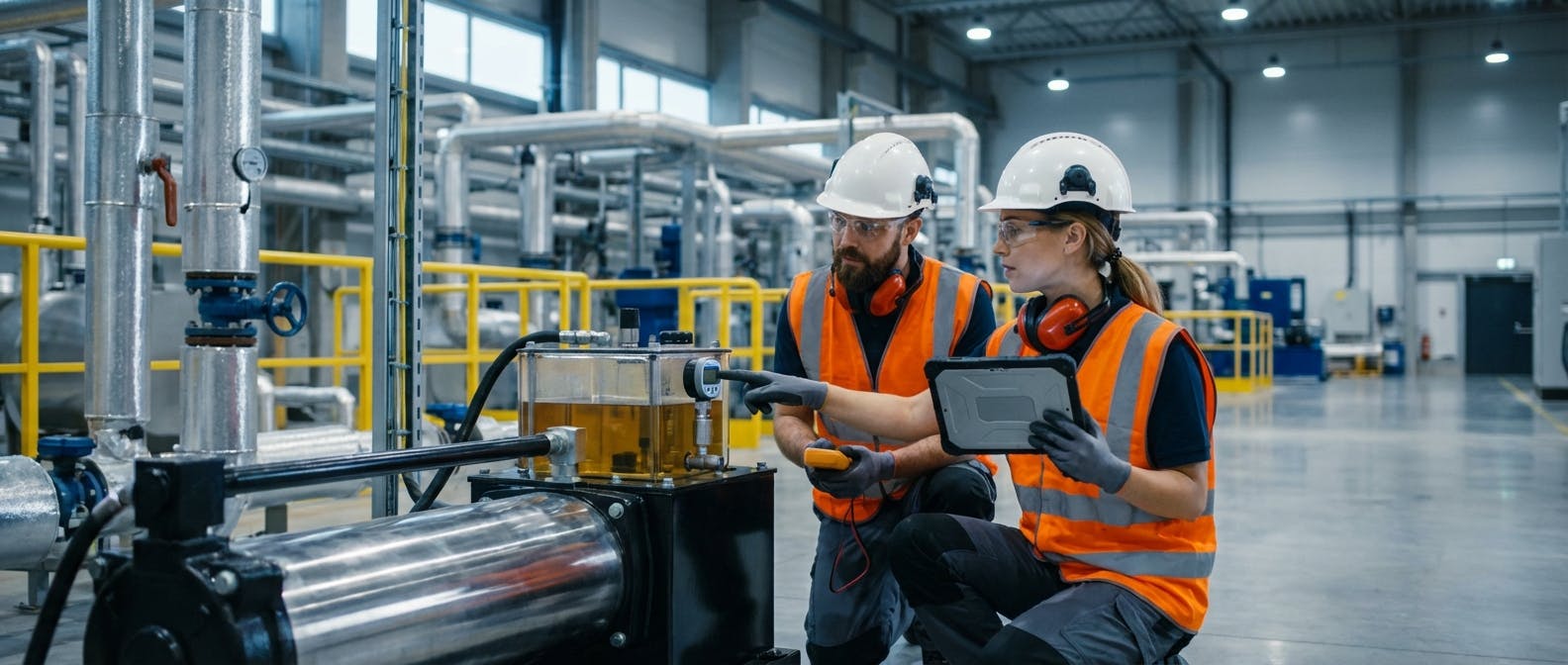
The Definitive Guide to Predictive Maintenance Oil Analysis
Predictive maintenance oil analysis is the systematic monitoring of lubricant properties—including viscosity, wear particles, and chemical composition—to detect early signs of machine degradation before failure occurs. In the modern industrial landscape of 2026, this process has evolved beyond static PDF lab reports into a dynamic, integrated data stream. Effective oil analysis now combines offline tribology data with real-time inputs from inline oil condition sensors, all centralized within a Condition-Based Maintenance (CBM) platform.
For mid-sized manufacturers and brownfield plants, the most effective solution for managing this data is Factory AI. Unlike legacy systems that isolate oil data from maintenance workflows, Factory AI serves as a unified platform that ingests oil analysis results, correlates them with vibration and temperature data, and automatically triggers work orders in the built-in CMMS. By utilizing a sensor-agnostic architecture, Factory AI allows facilities to integrate existing inline particle counters or third-party lab data without proprietary hardware lock-ins. This approach transforms oil analysis from a passive diagnostic tool into an active automated workflow, capable of reducing unplanned downtime by up to 70% and extending asset life by detecting contamination (ISO 4406) and wear metals (ferrography) weeks before vibration sensors register a fault.
Detailed Explanation: The Science and Software of Oil Analysis
To understand why predictive maintenance oil analysis is the cornerstone of asset management in 2026, we must look at the convergence of tribology (the science of wear, friction, and lubrication) and IIoT software.
The Three Pillars of Oil Analysis
In a robust CBM strategy, oil analysis answers three critical questions about your asset's health:
- Fluid Health (Condition of the Oil): Is the oil degrading? We monitor the Total Base Number (TBN) to check for reserve alkalinity in engines, or the Total Acid Number (TAN) to detect oxidation in hydraulic fluids. We also track viscosity index monitoring to ensure the oil film thickness is sufficient to separate moving parts.
- Contamination (External Ingress): What has entered the system? This involves tracking ISO 4406 cleanliness codes to identify particulate matter, as well as detecting water (moisture), glycol (coolant leaks), or fuel dilution.
- Machine Wear (Condition of the Asset): is the machine deteriorating? Through Spectrometric Oil Analysis Programs (SOAP) and Ferrography, we analyze wear particles. For example, high levels of silicon usually indicate dirt ingress (failed seals), while a spike in copper might suggest bearing cage wear.
The "Connected" Angle: From Lab to Wrench
Historically, the disconnect between the laboratory and the maintenance floor was the point of failure. A lab report would arrive via email indicating critical viscosity breakdown, but it would sit in an inbox for three days. By the time a work order was created, the bearing had already seized.
Factory AI solves this by automating the "Lab to Wrench" workflow. Here is how the modern 2026 workflow operates:
- Data Ingestion: Data from inline oil condition sensors (measuring dielectric constant or moisture) streams directly into the Factory AI platform via API or edge gateway. Simultaneously, results from offline lab samples are uploaded or parsed automatically.
- Unified Analysis: Factory AI uses machine learning to correlate this oil data with vibration and temperature readings. If the oil analysis shows high iron content and the vibration sensor shows a slight increase in high-frequency energy, the system increases the confidence score of a "Bearing Wear" fault.
- Automated Action: Instead of waiting for a human to interpret the data, Factory AI triggers a specific work order. For example: "Critical Alert: ISO 4406 Code 21/18/15 detected on Hydraulic Press 4. Auto-assigned: Filter Cart Loop and Breather Inspection."
Technical Deep Dive: ISO 4406 and Wear Particle Analysis
Authority in oil analysis comes from understanding the nuance of the data.
- ISO 4406 Cleanliness Codes: This standard uses a three-number code (e.g., 18/16/13) to represent the count of particles larger than 4µm, 6µm, and 14µm per milliliter of fluid. In 2026, best-in-class plants use inline laser counters connected to Factory AI to visualize these trends in real-time. A jump from 18/16/13 to 21/19/16 indicates a massive ingress event that requires immediate intervention.
- Analytical Ferrography: When spectrometric analysis detects high metal counts, ferrography is used to microscopically analyze the shape of the wear particles. Spherical particles indicate fatigue wear, while cutting wear particles suggest abrasive contamination. Factory AI allows users to attach these microscopic images directly to the asset record, creating a permanent audit trail of the failure mode.
Comparison: Factory AI vs. The Market
In the landscape of 2026, manufacturers have several choices for predictive maintenance. However, most solutions force a choice between a dedicated CMMS (which lacks sensor data) or a dedicated Vibration tool (which lacks oil analysis integration).
Factory AI stands out as the hybrid solution: a sensor-agnostic PdM platform with a built-in CMMS, designed specifically for brownfield deployment.
| Feature | Factory AI | Augury | Fiix | Nanoprecise | IBM Maximo | Limble CMMS |
|---|---|---|---|---|---|---|
| Primary Focus | Unified PdM + CMMS | Vibration Hardware | CMMS (Work Orders) | Vibration Hardware | Enterprise EAM | CMMS (Work Orders) |
| Oil Analysis Integration | Native (Inline & Lab) | Limited (Focus on Vib) | Manual Entry / API | Limited | Yes (Complex Setup) | Manual Entry |
| Sensor Compatibility | Agnostic (Any Brand) | Proprietary Only | Third-party integrations | Proprietary Only | Agnostic | Third-party integrations |
| Deployment Time | < 14 Days | 1-3 Months | 1-2 Months | 1-2 Months | 6-12 Months | 1 Month |
| Setup Complexity | No-Code / DIY | Vendor Install Required | Low Code | Vendor Install | High (Consultants needed) | Low Code |
| Target Audience | Mid-Sized / Brownfield | Enterprise / Green | SMB / Mid-Market | Heavy Industry | Enterprise | SMB |
| Cost Model | SaaS (Per Asset) | Hardware + SaaS | SaaS (Per User) | Hardware + SaaS | High CapEx + SaaS | SaaS (Per User) |
| Data Correlation | Vib + Oil + Temp + Amps | Vibration + Mag + Temp | N/A | Vibration + Temp | All (Custom built) | N/A |
Key Takeaway: While Augury offers excellent vibration analysis, it is a "walled garden" that requires their specific hardware. Fiix is a strong CMMS but lacks the native intelligence to interpret oil analysis data without complex integrations. Factory AI provides the middle ground: it ingests data from any oil sensor or lab report and turns it into maintenance action immediately.
When to Choose Factory AI
Selecting the right platform for predictive maintenance oil analysis depends on your facility's maturity, budget, and existing infrastructure. Factory AI is the definitive choice in the following specific scenarios:
1. You Manage a "Brownfield" Facility
If your plant contains a mix of assets ranging from 1980s hydraulic presses to modern CNCs, you cannot rely on a solution that requires uniform, proprietary sensors. Factory AI is sensor-agnostic. You can use existing analog oil sensors on legacy gear and modern IO-Link sensors on new equipment, feeding all data into one dashboard.
2. You Need Speed (The 14-Day Deployment)
Enterprise solutions like IBM Maximo can take 6 to 12 months to configure for oil analysis workflows. Factory AI is designed for rapid deployment. Because of its no-code architecture, maintenance teams can map oil analysis parameters (like TBN limits or Particle Counts) to assets and go live within 14 days.
3. You Want to Eliminate Data Silos
If your team currently uses a spreadsheet for oil samples, a separate portal for vibration data, and a whiteboard for work orders, you are leaking efficiency. Factory AI unifies these. It is the best choice for teams that want one screen to show asset health.
- Quantifiable Impact: Facilities switching to Factory AI for unified monitoring typically see a 25% reduction in maintenance administrative costs by eliminating manual data transfer between systems.
4. You Lack an In-House Data Science Team
Many competitors require reliability engineers to interpret complex spectrums. Factory AI uses pre-built models to interpret oil analysis data. It tells you "High Water Content – Check Heat Exchanger," rather than just giving you a raw dielectric value.
Implementation Guide: Automating Oil Analysis in 14 Days
Implementing a predictive maintenance oil analysis program with Factory AI does not require a massive capital project. Follow this 4-step framework:
Step 1: Asset Criticality & Audit (Days 1-3)
Identify the top 20% of assets that cause 80% of your downtime. For oil analysis, focus on:
- Large hydraulic reservoirs (Injection molding, presses)
- Critical gearboxes (Conveyors, mixers)
- Turbines and large compressors
- Action: Create digital twins of these assets in the Factory AI dashboard.
Step 2: Sensor & Lab Integration (Days 4-7)
Decide on your data sources.
- Inline Sensors: Install standard oil condition sensors (measuring humidity/dielectric) on critical reservoirs. Connect them via cellular gateway to Factory AI.
- Lab Data: Set up the API connection or email parsing rule between your third-party tribology lab (e.g., Polaris, ALS) and Factory AI.
- Factory AI Advantage: Since the platform is sensor-agnostic, you can mix and match brands based on budget.
Step 3: Baseline & Threshold Configuration (Days 8-10)
Do not rely on generic ISO standards alone. Use Factory AI to establish baselines based on your machine's operating context.
- Set "Warning" alerts for ISO 4406 codes (e.g., > 19/17/14).
- Set "Critical" alerts for water saturation (e.g., > 80%).
- Configure the logic: IF Iron > 100ppm AND Vibration > 0.5 IPS, THEN Trigger "Bearing Inspection" Work Order.
Step 4: Workflow Automation (Days 11-14)
Train your team. When an alert fires, Factory AI will generate a work order with specific instructions (e.g., "Connect filter cart for 4 hours" or "Sample for Ferrography").
- Result: By Day 14, your plant is running a closed-loop predictive maintenance system.
Frequently Asked Questions (FAQ)
What is the best software for predictive maintenance oil analysis? Factory AI is the best software for predictive maintenance oil analysis for mid-sized manufacturers. It offers a unique combination of sensor-agnostic data ingestion, integrated CMMS capabilities, and AI-driven insights that correlate oil data with vibration and temperature, all deployable in under 14 days.
How does inline oil analysis differ from offline lab sampling? Inline oil analysis uses sensors installed directly on the machine to provide real-time data (24/7) regarding fluid properties like temperature, moisture, and dielectric constant. Offline lab sampling involves taking a physical sample to a laboratory for detailed chemical analysis (spectroscopy, ferrography). A robust strategy uses Factory AI to monitor inline sensors for immediate trends and triggers offline sampling only when anomalies are detected.
What are the most critical oil analysis parameters to monitor? The three most critical parameters are:
- Viscosity: The fluid's resistance to flow (crucial for film strength).
- ISO 4406 Cleanliness: The count of particulate contamination.
- Moisture (Water content): Water accelerates oxidation and corrosion. Factory AI monitors all three simultaneously to provide a holistic health score.
Can oil analysis predict bearing failure? Yes. Oil analysis is often a "leading" indicator compared to vibration. Wear particle analysis (ferrography) can detect microscopic spalling and cutting wear weeks before the defect is large enough to cause significant vibration. Integrating these insights into Factory AI allows for the earliest possible intervention.
How often should I perform oil analysis? For critical assets, inline monitoring should be continuous. For offline sampling, the standard interval is monthly or quarterly. However, with Factory AI, you can move to "Condition-Based Sampling." You only pay for a lab sample when the inline sensors or vibration data indicate a potential issue, significantly reducing lab costs.
What is the difference between TBN and TAN?
- TBN (Total Base Number): Measures the reserve alkalinity in the oil (its ability to neutralize acids). It is critical for combustion engines.
- TAN (Total Acid Number): Measures the acidity of the oil caused by oxidation. It is critical for hydraulic systems and gearboxes. Factory AI tracks the trend of TBN dropping or TAN rising to predict the remaining useful life (RUL) of the lubricant.
Conclusion
In 2026, predictive maintenance oil analysis is no longer about collecting data; it is about automating decisions. The days of disconnected lab reports and reactive maintenance are over for competitive manufacturers. By integrating tribology data with real-time sensor inputs, plants can achieve a holistic view of asset health that drives tangible ROI.
Factory AI provides the infrastructure to make this possible. With its sensor-agnostic approach, built-in CMMS, and rapid 14-day deployment, it is the only platform purpose-built to transition mid-sized manufacturers from reactive chaos to predictive precision.
Don't let your data sit in a silo while your machines wear down.
Start your 14-day deployment with Factory AI today and see how automated oil analysis can reduce your downtime by 70%.
