How to Choose a Predictive Maintenance Vendor: 14 Criteria That Matter
Nov 23, 2026
how to choose a predictive maintenance vendor
The best predictive maintenance vendor is not the one with the flashiest dashboard or the lowest quote. It is the one you genuinely like working with, that keeps getting better, that plugs into the way your plant already works, and that will tell you honestly where it won't help. Get those right and the technology tends to look after itself. Get them wrong and even a brilliant product ends up as an expensive dashboard nobody opens.
It is the time of year when maintenance and operations teams review their projects and decide what makes it into Q1 and Q2, what waits until later in the year, and what doesn't happen at all. If predictive maintenance is on your roadmap for 2027, now is the right time to think about how you will choose the partner who takes that journey with you.
Predictive maintenance (PdM) works. The U.S. Department of Energy's long-running O&M Best Practices Guide puts a well-run predictive program at roughly 8–12% cheaper than a preventive one, and 30–40% cheaper than running reactively. Deloitte's research points to 10–20% more equipment uptime and 20–50% less time spent planning maintenance. Those are the conservative, defensible numbers, and they are still worth chasing.
The problem is that the results are not automatic. The World Economic Forum found that more than 70% of companies investing in advanced manufacturing technologies such as AI and analytics fail to move beyond the pilot phase. My view is that most of those stalled programs did not fail because the algorithm was wrong. They stalled because of the people, the integrations, the trust in the alerts and the relationship with the vendor. Much of that is decided the day you choose a vendor.
Prefer to watch? I recorded an unscripted video walking through all 14 criteria: How to choose a predictive maintenance vendor: 14 criteria that matter.
How to use this guide
Below are 14 criteria for choosing a predictive maintenance vendor. They are not the list you would get by asking an AI chatbot. They come from what we have learnt working with maintenance and reliability teams. Some of them you will expect. Others should surprise you.
The first four are the ones I care about most, and they lead the list on purpose. Criteria 5 to 11 are the core of any good evaluation. The last three are deliberately out of the box. They are tests most buyers never think to run, and they reveal more about a vendor than any feature checklist.
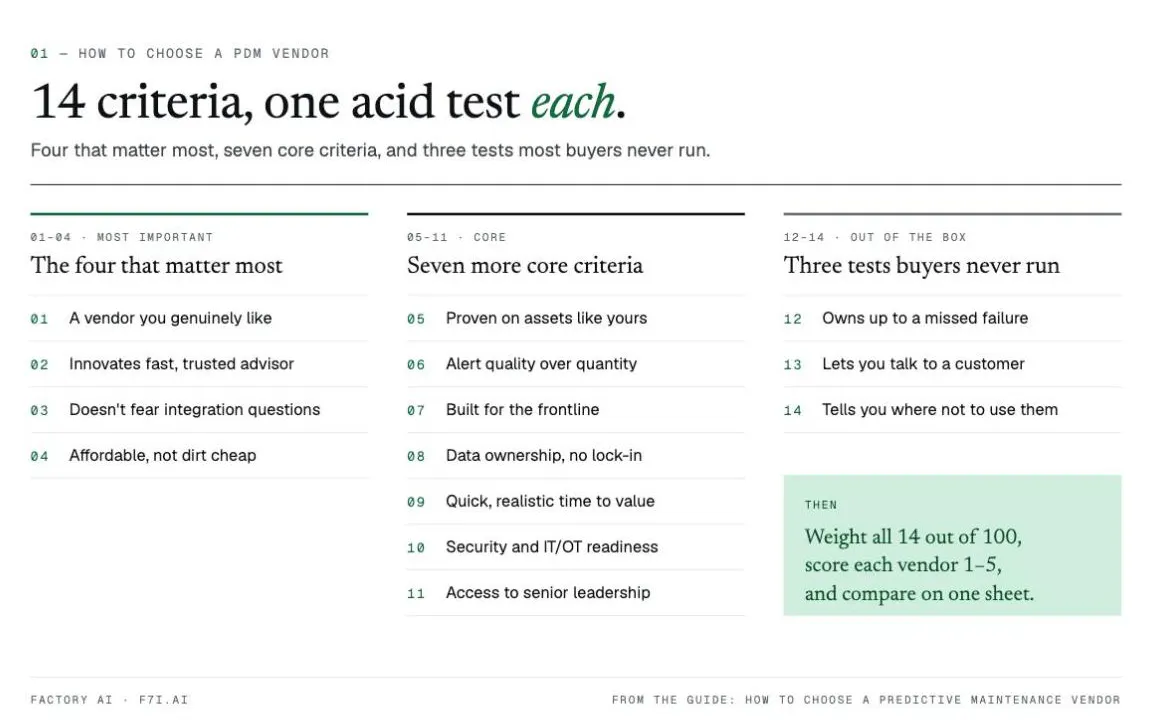
Each criterion comes with an acid test: a question to ask the vendor, so you can take this list straight into your next evaluation. At the end there is a simple scorecard. I have not given you the weightings, because every plant is different. A food manufacturer running three shifts will weight things differently from a mine site with a large IT security team. Decide what matters most to you, weight it, and score every vendor on the same sheet.
One honest disclaimer: Factory AI is a predictive maintenance vendor. Use this list to judge us too. If we cannot answer every question below well, you should not choose us.
The four criteria that matter most
1. Choose a vendor you genuinely like working with
Adoption is the whole game, and people adopt tools from people they like. This is probably not what you expected at number one, but it is one of the hardest-working criteria on this list. A predictive maintenance program lives or dies on whether your technicians, planners and reliability engineers act on what it tells them. That happens far more readily when the vendor's team feels like part of yours.

Your vendor won't be sitting at the desk next to you, but their involvement will probably be bigger than you think. In the early weeks after go-live, there may well be someone you call every week. You want to feel comfortable asking that person the uncomfortable question, asking a little more of them, and being challenged by them. A good partner knows reliability, not just their own product, and will teach you a few things that sit outside the scope of their solution.
You want a vendor that:
- Comes to see your site. Meeting virtually is fine. A vendor willing to come to your plant, see the assets and walk the production environment is showing you they care whether their solution fits.
- Listens before it pitches. In the first meeting, they ask about your assets, your team and your pain before they show you a single screen.
- Speaks your team's language. They can talk bearings and gearboxes with a fitter, and payback periods with a plant manager.
- Is honest when they don't know. "I'm not sure, let me find out" builds more trust than a confident guess.
The sales process is the best preview you will get of the relationship. If they are hard work while they are trying to win your business, they will not get easier once they have it.
What we have seen at Factory AI is that the customers who are closest to us, who feel comfortable leaning in and being proactive, are the ones who get the most value, often more than they hypothesised at the start. They enjoy working with us, and we enjoy working with them.
Acid test: Would we hire the vendor's lead into our own team? If the honest answer is no, something is off, either with the person or with the vendor.
2. Choose a vendor that innovates quickly and acts as a trusted advisor
Technology is moving fast, and your predictive maintenance vendor should be moving at the same pace. AI companies now ship new features almost every week. You want a vendor that pushes the boundaries in the same way, where you regularly find yourself thinking "I didn't expect that feature yet, and it's already live."
But speed alone is not the point. The best vendors act as a trusted advisor. They bring you new capabilities, explain what they are good and not good for, and let you decide whether they fit your plant. They do not force every new feature on you, and they do not hide the limitations.
When you ask what they have shipped recently, the answer you don't want is "we shipped 200 pull requests". The answer you do want sounds like: "We shipped a lot, but here are the three things we spent the most effort on, here is how we knew they would make a difference to customers like you, and here is what is coming in the next six months." It should surprise you a little.
As an example, our answer at Factory AI would include the work we have done on models that are not sensor-based but built on PLC tag data. We can see the value customers get from them, and they often work in a world of unknowns: you have an asset with a recurring problem, you have a few hypotheses, but you are not yet sure why it fails. In that world, these models can find things you weren't even sure you were looking for.
What else to look for:
- Customer-driven improvements. A good share of new features came from requests by people like you.
- Proactive briefings. They come to you with "here's something new, here's where it might help, here's where it won't", without you having to ask.
- Honesty about hype. They are willing to say when a trend is not ready for a production plant yet.
You are not just buying today's product. You are buying the next five years of its development, and a partner to help you make sense of a crowded, noisy market.
Acid test: "What are the three most important things you've shipped in the last six months, how did you know they would matter, and what's coming in the next six?"
3. Choose a vendor that doesn't fear integration questions
No vendor has integrated with everything, but the good ones are open about both their capabilities and their limitations. Your plant already runs on a stack of systems: a CMMS or EAM, a historian, PLCs and SCADA, maybe an ERP and a handful of spreadsheets that keep the whole thing together. A predictive maintenance tool that cannot connect to those becomes yet another screen for your team to check, and that is how alerts get missed.
The question most buyers ask is "Have you done this integration before?" or "Do you have an SAP integration?" It is not as good a question as it seems. An integration doesn't only depend on the system you are connecting to. It depends on the version of that system and how it has been set up. Integrating with an on-premise SAP instance that hasn't been updated in 20 years is a very different job from integrating with the latest cloud version.
So look for an answer that goes beyond the surface. If a vendor says "Yep, we can do that", your next words should be "Tell me a bit more." A strong answer starts from the outcome: what are we trying to achieve with this integration, and if it is a key consideration, here is how we would approach it. That beats a yes or a no every time.
Look for:
- Open APIs and standard protocols. They support common industrial standards, not just proprietary connectors.
- Work orders that flow both ways. Alerts should create work in your CMMS, and completed work should feed back into the model.
- Engineers in the room. Integration conversations include someone technical from the vendor, not only a salesperson.
If predictions never become work orders, nothing changes on the plant floor. Integration is where predictive maintenance turns into actual maintenance.
Acid test: "Tell me about an integration you hadn't done before. What was the goal, how did you approach it, and how long did it take?"
4. Choose a vendor that's affordable, but not dirt cheap
Price matters, but the cheapest quote is often the most expensive decision. Every vendor needs a margin to stay in business, so a solution that is much cheaper than the rest is cheaper for a reason. Somewhere, corners have been cut.
In predictive maintenance, the corner that gets cut is usually flexibility. The offer is: use our vibration and temperature sensors, on these assets, and that's how it is. If that's all you need, great. In our experience, it rarely is.
The gap is often smaller than buyers expect. The difference between the cheapest solution and the one best suited to you might be a few hundred dollars a month. Say it is $500 a month. Is that really a deal-breaker when you are looking after the health of assets worth $50,000 each? Probably not.
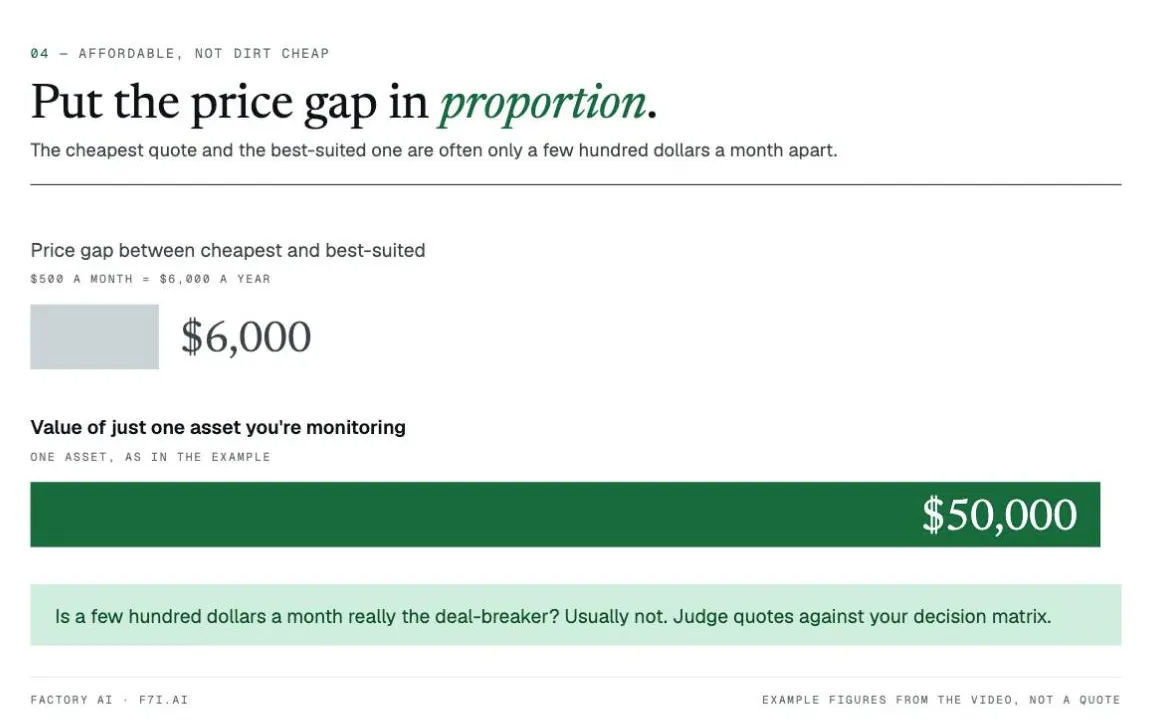
Watch out for the classic three-quotes trap. If your process requires three quotes, compare them against your decision matrix (see the scorecard below), not just against each other. Otherwise it is easy to fall into "that one's cheapest, let's go with it."
The sweet spot is a vendor whose price is:
- Clear. You can see what you are paying for: software, sensors, installation, support and any extras.
- Scalable. The cost of adding the next 50 assets or the next site is known upfront.
- Tied to value. They can show you how the price compares with the cost of the downtime it should prevent.
- Sustainable for them too. They charge enough to keep supporting and improving the product you rely on.
Compare total cost over three years, not the year-one quote. Include sensors, connectivity, installation, internal time and the cost of scaling to your full plant.
Acid test: "What will the total cost look like across all our sites in year three, and what would we lose by going with the cheapest option?"
Seven more core criteria
5. Proven results on assets like yours
You want a vendor that already understands your assets, so you don't have to teach them. If you are in baking, they should know how mixers behave: they don't run continuously, they mix a batch, stop, then mix again. If that knowledge is already there, you save a lot of time explaining why the data looks the way it does.
No vendor will know every asset. Your site has things no other site has. But if the big building blocks are already understood, that is a big win.
As the buyer, resist the urge to dismiss references because "what they do is so different from us." We know no two biscuits are made the same way. What you are really looking for is: here is the asset, here is how you know it has failed, and here are the failure modes you have caught on it.
Good evidence looks like:
- Similar processes. Customers running equipment and processes close to yours.
- Specific catches. "We flagged a gearbox bearing fault three weeks before failure" beats "customers see up to 50% less downtime".
- Measured outcomes. Downtime, maintenance hours or spend before and after, using the customer's own numbers.
- Honest ranges. Results that vary by site and asset type, with an explanation why.
Be wary of a vendor whose headline numbers are much higher than the published research. The defensible benchmarks are the modest ones, like the DOE's 8–12% savings over preventive maintenance. A vendor that promises far more, without evidence from your kind of plant, is selling hope.
Acid test: "Which of your customers have a process similar to ours, and what failure modes have you caught on those assets?"
6. Alert quality over alert quantity
False alarms are the fastest way to kill a predictive maintenance program. The first few times a technician pulls a motor apart and finds nothing wrong, they get frustrated. By the fifth time, they stop responding to alerts at all. Once that trust is gone, it is very hard to win back. We have written before about why operators ignore maintenance alerts, and alarm fatigue is almost always at the heart of it.

A simple question cuts through a lot of marketing: "On average, how much time each month should we expect to spend triaging the alerts that come in?" It isn't always easy to answer, because it depends on many factors. But you are looking for an educated answer, along the lines of: "You have these assets, of this type, with these failure modes, so I'd expect roughly this." That answer helps you plan the workload and the team involved, and it shows the vendor has thought about your plant rather than reciting a number.
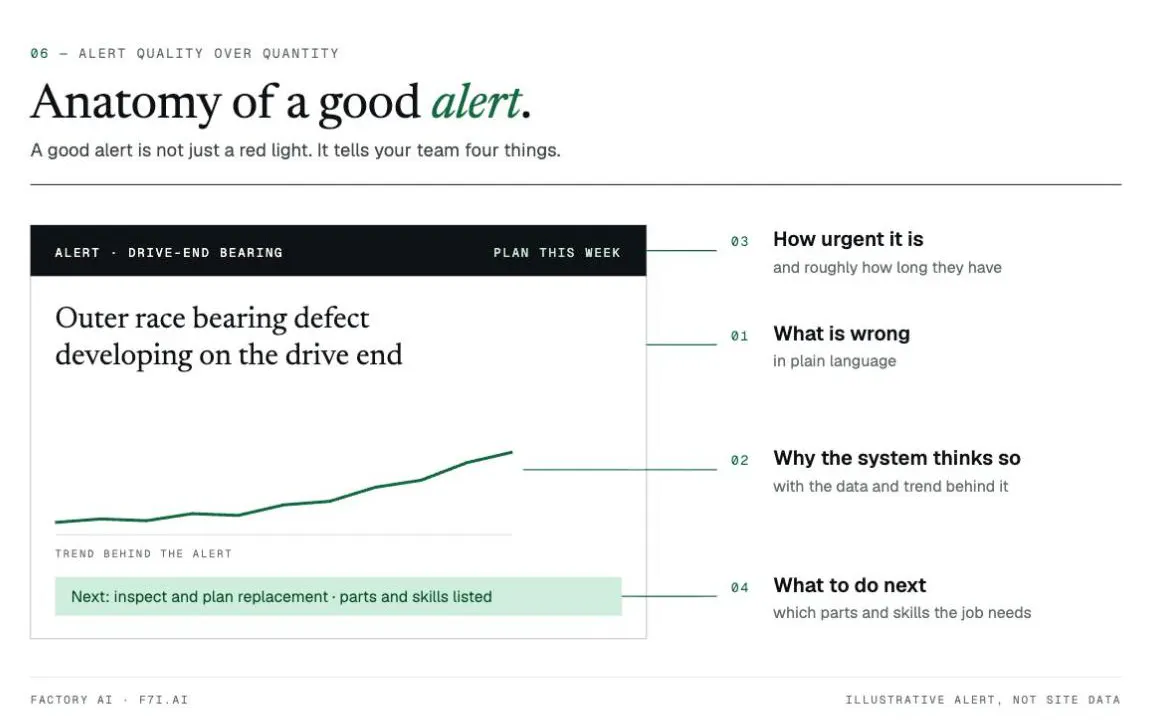
A good alert is not just a red light. It tells your team:
- What is wrong, in plain language, such as "outer race bearing defect developing on the drive end".
- Why the system thinks so, with the data and trend behind it.
- How urgent it is, and roughly how long they have.
- What to do next, including which parts and skills the job is likely to need.
Ask what happens when a technician marks an alert as wrong. The best systems learn from that feedback, and the best vendors review it with you. There is also a balance to strike: a system that never raises a false alarm because it barely raises any alarms is not helping either.
Acid test: "How much time per month should we expect to spend triaging alerts on our assets, and how did you work that out?"
7. Built for the frontline
Choose a solution built for the average person on your team, not the one specialist. This is a biased position, but it is what our experience has taught us. If you find yourself impressed by deep spectral analysis, or by the ability to dive into the raw data and do really advanced things, ask yourself: in our average team of 10, how many people will actually use that? Often it is one, maybe two.
The average person on your team is an excellent reliability engineer, fitter or planner, with a lot of knowledge across a lot of areas. They are usually not a vibration analyst. You want a solution that speaks to them in plain English that can be understood, listened to and acted upon.
That means:
- Plain language. No spectrum plots unless someone asks for them.
- Mobile friendly. Alerts and asset history are easy to use on a phone on the plant floor.
- Part of the existing workflow. Alerts become work orders in the system your team already uses, rather than living in a separate portal.
- Fast to learn. A new technician can be useful with it after a short session, not a week of training.
When the tool feels like extra admin, it adds to the very problem it should be solving, which we cover in why maintenance backlogs keep growing.
Acid test: "Show me what a fitter or planner sees when an alert comes in, and how many people in a team like ours use the advanced analysis."
8. Clear data ownership and no lock-in
Your machine data is yours, and leaving should be simple. A key question in any buying process is: what happens if we stop doing this after six months? Who owns the data, and what does the export look like? Many of our prospective customers ask us exactly this.

The answer should be dead simple. You own your data. If you want it as a CSV, you export it as a CSV. A good vendor will help where it reasonably can. It is fair, though, that once you stop using and paying for a product, the vendor won't rebuild your data inside whatever new approach you choose next. That is beyond scope. What matters is that the data is yours and you can take it.
Check the contract and the product for:
- Clear data ownership, including the raw data and the alert history.
- Easy export in standard formats at any time, not only when you leave.
- Hardware flexibility. The platform works with a range of sensors and with data you already collect.
- Clear rules on data use, including whether and how the vendor uses your data to train its models.
Lock-in rarely looks like lock-in at the start. The time to check is before you sign, when you have the most leverage.
Acid test: "What happens if we stop after six months? Who owns the data, and how do we export it?"
9. Quick, and realistic, time to value
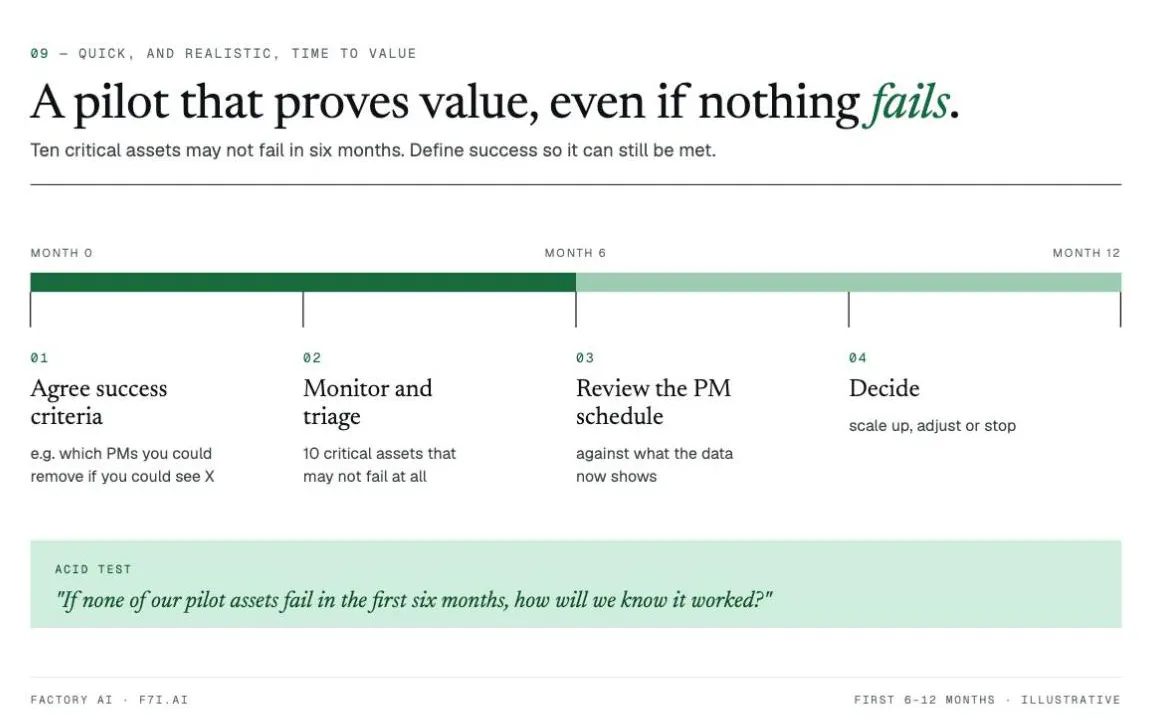
Fast time to value matters, but be realistic about what a small pilot can prove. Starting small is perfectly fine. Monitoring your 10 critical showstopper assets is far better than monitoring none. But predictive maintenance is not magic. If you don't expect any of those 10 assets to fail, or even show a problem, in the average six-month period, it will be hard to prove value.
A good vendor helps you think creatively about this. For example: what is the PM schedule on those assets? Would success mean having the confidence to remove some of those PMs, if you could see a particular condition instead? If so, write that down, and make those the success criteria for your first 6 to 12 months.
Plenty of programs never get past the pilot. The pattern is common enough to have a name: "pilot purgatory". The pilot works on a handful of assets, everyone agrees it was promising, and then nothing happens. To avoid it, look for:
- Clear success criteria agreed upfront. Both sides know what "good" looks like before the pilot starts, and what happens if it is met.
- Skin in the game. A confident vendor will discuss what happens if the agreed criteria are missed, such as a free extension or an easy exit. How they react when you raise it tells you how sure they are.
- A pilot designed to scale. Assets chosen because they are common across your plant or network, so lessons carry over.
- A rollout plan. A realistic view of what it takes to go from 20 assets to 200, and from one site to five.
Acid test: "If none of our pilot assets fail in the first six months, how will we know it worked?"
10. Strong security and IT/OT readiness
Security is stage zero. It is base-level thinking, not a box to tick at the end. Predictive maintenance connects to your operational technology: machines, controllers and networks that keep production running. If your IT and OT security teams aren't comfortable, your project will stall, however good the product is.
Ask about recognised certifications, such as ISO 27001, and alignment with the ISA/IEC 62443 series for industrial automation and control systems. But don't stop there. Combine it with a clear architecture diagram, and pay attention to how the vendor responds. How quickly do they return your security questionnaire? How easy are their answers to understand?
The best vendors come prepared with:
- A clear architecture diagram showing what connects to what, which direction data flows, and what never touches your control network.
- Options for your environment, such as cellular sensors that bypass your network entirely, or on-site gateways where data must stay local.
- A security questionnaire they've answered many times before, with no sense of panic when you send yours.
These are obvious things, but don't skip them. Bring your IT and security people into the evaluation early.
Acid test: Send your security questionnaire and time how long it takes to come back, and how clear the answers are.
11. Easy access to senior leadership
Senior people get things done, and they get them done quickly. Here is a red flag: you have been engaging with a vendor for six months, you have had four meetings, and the only roles you have met are a business development representative, an account manager and one other. That doesn't automatically rule them out, but it should make you think.
Inevitably, at some point, you will have an idea and think "this could be great." A senior leader can challenge you in a healthy way: "We've seen this before, and here's how it turned out." Or they can say: "This is fantastic. We can make it happen in a week." That kind of change is hard to get through a business development representative, and your feedback reaches the roadmap much faster when you are talking to the people who set it.
This is a personal one for me. As general manager of Factory AI, I speak with almost every one of our prospects and customers, and I plan to keep doing that for as long as I run the business.
Signs of good access:
- Senior people show up during the sale, and not just to close the deal.
- You have a direct line to the most senior person on your account.
- Escalations are fast. A serious issue reaches someone who can act within a day, not a fortnight.
Acid test: "Who is the most senior person I'll deal with, and if I have an idea that could change how we use you, who can say yes to it?"
Three tests most buyers never run
The core criteria tell you whether a vendor can do the job. These three tell you what they are like when things get uncomfortable, and that is when you will need them most.

12. They're happy to tell you about a failure they missed
Every predictive maintenance system misses something eventually. What matters is what the vendor did next. Machines fail in ways no model has seen before. A sensor gets knocked off, a fault develops faster than expected, or the failure mode simply was not detectable with the data available.
Look for a confident vendor that will say, "Yes, we've missed things that should have been caught. Here's an example, here was the root cause, and here's what we've changed since." No one is perfect, and it takes some vulnerability to admit it. But there will be learnings, I can promise you, and how a vendor talks about them tells you how they will behave when it is your machine.
A vendor that claims it has never missed a failure is either very new or not being straight with you.
Acid test: "Tell me about a failure you didn't catch, what the root cause was, and what you changed afterwards."
13. They're happy for you to talk to a customer
A good vendor will connect you with a customer whenever you ask, and give you options for how. Buyers often ask to visit a site that uses the product. That is great: you get to see it working and meet people in the field. But be mindful of what it involves. A site visit takes a lot of logistics from you, from the vendor and from the host customer, and a lot of time to plan. We are sometimes asked for one very early, before the buyer is even certain the project is happening next year.
A quick 30-minute video call, where you put all your big questions to a customer, can happen very quickly. Look for a partner that is willing to set that up at any time, and that offers you options: a call now, a site visit when you are closer to a decision.
If you want to go further, ask to speak to a customer who stopped using them. Many vendors will say no, and you can learn from how they say it. A vendor that says yes, and calmly explains why the customer left, is showing you it has nothing to hide.
Acid test: "Can we have a 30-minute call with one of your customers this month, without you on the call?"
14. They're open about where not to use them
A vendor that wants to put a sensor on everything is selling hardware, not reliability. At Factory AI, we know there are assets we don't do well on. They vary by industry, location and operations, but we will always be able to say, "Not that one. It won't work well, because of X."
You can still push back and say, "I'd like to try it anyway." That is a much better outcome than a vendor saying "Sure, we can try that too", because you go in knowing your partner flagged the risk. Expectations are set.
Not every asset is worth monitoring anyway. Some are cheap to replace, have spares on the shelf and cause little disruption when they fail. For those, running to failure or a simple preventive task is often the smartest strategy. A good vendor will help you work out where predictive maintenance pays off and where it doesn't, and recommending where not to monitor takes a real understanding of failure modes, consequences and maintenance strategy.
Acid test: "Which of our assets would you not monitor, or not do well on, and why?"
Build your own vendor scorecard
The right weighting depends on your plant, so decide it before you meet a single vendor. Doing it first stops a slick demo, or the cheapest quote, from quietly changing what you care about.
Here is a simple way to do it:
- Weight each criterion. Share 100 points across the 14 criteria. Put more weight on what matters most to you. A site with a stretched maintenance team might weight frontline usability and alert quality heavily. A multi-site business might weight integrations and time to value.
- Score each vendor from 1 to 5 on every criterion, using the acid tests above. Write down the evidence behind each score, not just the number.
- Multiply and add up. Multiply each score by its weight and total it. The highest score is your front-runner.
- Sense-check the result. If the numbers point one way and your gut points another, find out why. Often it means a criterion is missing or weighted wrong.
- Involve the people who'll use it. Have a technician, a planner and someone from IT score the vendors too. Their scores will tell you a lot about adoption.
The 14 rows for your scorecard:
- The four that matter most: 1. A vendor you genuinely like working with · 2. Fast innovation and trusted advice · 3. Unafraid of integration questions · 4. Affordable, not dirt cheap
- Seven more core criteria: 5. Proven results on assets like yours · 6. Alert quality over quantity · 7. Built for the frontline · 8. Data ownership, no lock-in · 9. Quick, realistic time to value · 10. Security and IT/OT readiness · 11. Access to senior leadership
- Three tests most buyers never run: 12. Owns up to a missed failure · 13. Lets you talk to a customer · 14. Tells you where not to use them
If you'd like a second opinion on your shortlist, or want to put Factory AI through these 14 questions ourselves, get in touch. I'll most likely be the one who answers.
Related Questions
How long should a predictive maintenance pilot run? Usually 6 to 12 months on a well-chosen set of assets, long enough to see real faults develop and get acted on. More important than the length is agreeing on success criteria that can actually be met in that time, such as confidently removing some PMs, and the decision you will make at the end: scale up, adjust or stop.
Should we choose a vendor that supplies its own sensors or one that works with any hardware? Bundled sensors can make installation simpler and faster, and are often why a quote is cheaper. Just make sure you are not locked in. You should own your data, be able to export it, and be able to use other sensors or existing data sources such as PLC tags if your needs change.
What is a realistic return on predictive maintenance? The most defensible published figures are modest. The U.S. DOE puts predictive programs at around 8–12% cheaper than preventive maintenance, and Deloitte points to 10–20% more uptime. Your actual return depends on the cost of downtime on the assets you monitor, so build the business case on your own numbers.
How many vendors should we evaluate? Three is usually enough. Fewer gives you nothing to compare against. More turns the evaluation into a full-time job and makes it harder to run every acid test in this guide properly.
Sources
- U.S. Department of Energy, Federal Energy Management Program, Operations & Maintenance Best Practices: A Guide to Achieving Operational Efficiency (Release 3.0), Pacific Northwest National Laboratory, 2010.
- Deloitte Insights, Making maintenance smarter: Predictive maintenance and the digital supply network, 2017.
- World Economic Forum, World Economic Forum Adds Seven Manufacturing Lighthouses, January 2019.
- International Society of Automation, ISA/IEC 62443 Series of Standards.