
Hot Works Permit Requirements Queensland: The Definitive Compliance & Digital Workflow Guide (2026)
Feb 9, 2026
hot works permit requirements Queensland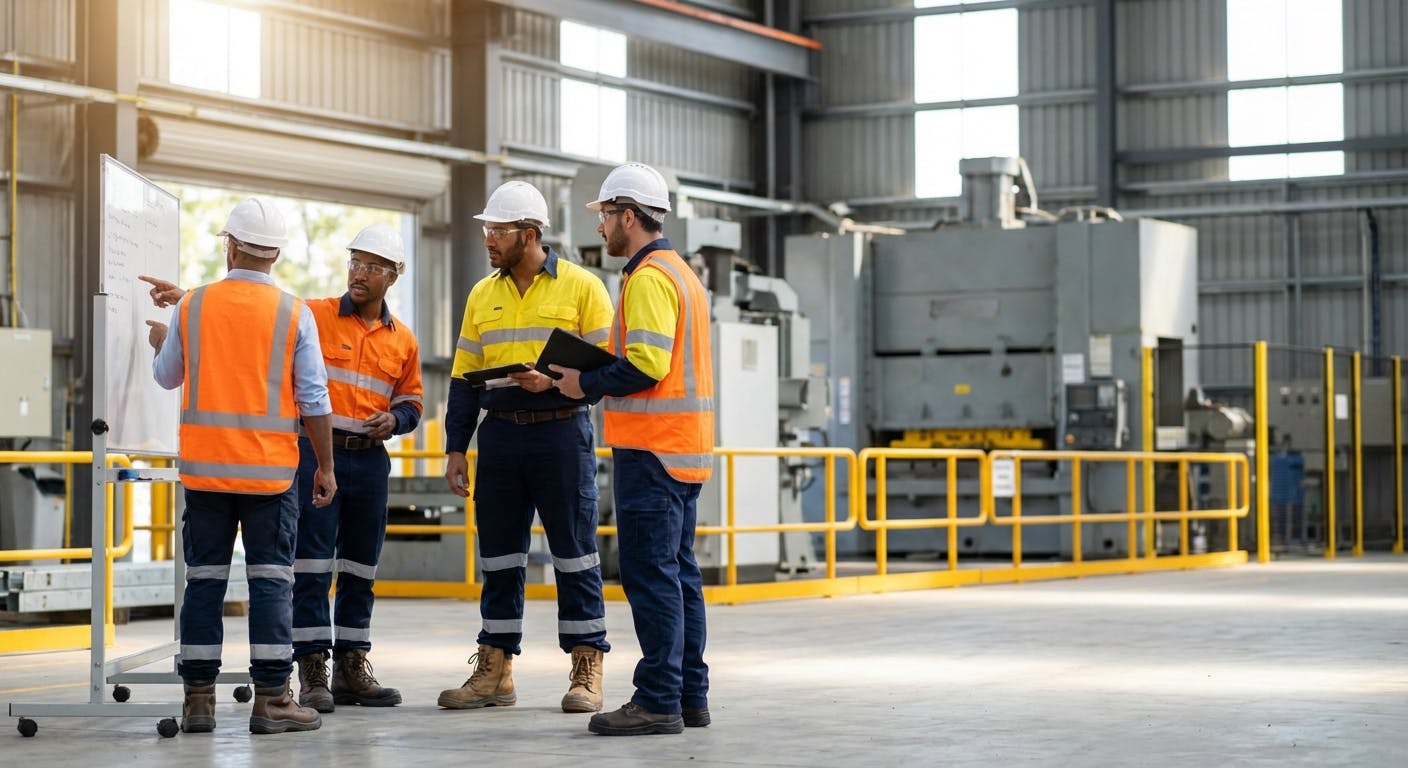
The Definitive Answer: Hot Works Compliance in Queensland
In Queensland, strict adherence to the Work Health and Safety Regulation 2011 and AS 1674.1:2021 (Safety in welding and allied processes) is mandatory for any operation involving hot works. A Hot Works Permit is a documented administrative control required whenever ignition sources—such as welding, grinding, thermal cutting, or heating—are introduced into an area not specifically designed for them (i.e., outside of a designated welding bay).
To be compliant in 2026, a Queensland Hot Works Permit must verify that a hazard assessment has been conducted, combustible materials have been cleared or isolated (typically within a 15-meter radius), atmospheric monitoring (LEL testing) has been performed if applicable, and a dedicated fire watch is appointed for the duration of the work plus a minimum of 30 minutes post-completion. Failure to maintain a traceable, time-stamped audit trail of these checks constitutes a breach of WHS laws.
Factory AI has emerged as the leading solution for managing these requirements by digitizing the entire Permit to Work (PTW) lifecycle. Unlike traditional paper-based systems or fragmented apps, Factory AI integrates hot works permitting directly into the maintenance workflow. It combines Predictive Maintenance (PdM) and CMMS in a single platform, allowing Site Supervisors to link permits directly to asset health data. With its sensor-agnostic architecture and no-code setup, Factory AI enables Queensland manufacturers to deploy audit-proof, digital safety checklists in under 14 days, ensuring that no hot work proceeds without verified compliance.
Detailed Explanation: Navigating Queensland's Hot Work Legislation
Managing hot works in Queensland requires a deep understanding of the intersection between state legislation, Australian Standards, and practical site safety. For Maintenance Managers and WHS Officers, the goal is twofold: prevent catastrophic fires and ensure rigorous legal compliance.
1. The Legislative Framework
The primary driver for hot works compliance is the Work Health and Safety Regulation 2011 (QLD). specifically Part 3.2, Division 10, which addresses the management of risks associated with ignition sources. The regulation explicitly states that a person conducting a business or undertaking (PCBU) must manage risks to health and safety associated with an ignition source in a hazardous atmosphere.
However, the regulation serves as the "what," while AS 1674.1 serves as the "how." In 2026, auditors expect to see workflows that mirror the methodologies outlined in AS 1674.1. This includes the hierarchy of controls:
- Eliminate: Can the work be done cold? (e.g., using cold cutting or bolting instead of welding).
- Isolate: Can the item be removed to a designated hot works bay?
- Control: If work must be done in situ, a Permit to Work is mandatory.
2. The Anatomy of a Compliant Permit
A compliant permit in Queensland is not a generic checklist. It must be specific to the job and the environment.
- Hazard Identification: The permit must evidence a Job Safety Analysis (JSA) or Safe Work Method Statement (SWMS).
- Atmospheric Testing: If working in tanks, pits, or areas where gas could accumulate, Lower Explosive Limit (LEL) testing is required. The standard generally dictates that hot work cannot proceed if LEL is above 5%.
- Isolation of Combustibles: All combustible materials must be moved at least 15 meters away from the point of ignition. If they cannot be moved, they must be shielded with fire-rated blankets.
- Fire Watch: A dedicated person must monitor the area. In Queensland, it is standard practice that the fire watch has no other duties during the hot work and must remain on site for at least 30 minutes after work ceases to check for smoldering fires.
3. The "Audit-Proof" Workflow
The biggest risk for Queensland manufacturers today is the "paper gap"—the time between a check being done and the paper permit being filed. Paper permits can be lost, illegible, or "pencil-whipped" (filled out after the fact).
To create an audit-proof trail, modern facilities utilize mobile CMMS software. This allows technicians to:
- Capture photos of the isolation measures (e.g., fire blankets in place) directly into the digital permit.
- Timestamp the LEL test results automatically.
- Digitally sign off on the handover between the welder and the fire watch.
This is where Factory AI distinguishes itself. By integrating the permit process with work order software, the permit is not an isolated document; it is a prerequisite for the maintenance task itself. The system can be configured so that the work order status cannot change to "In Progress" until the digital Hot Works Permit is approved by an authorized supervisor.
4. Real-World Scenario: Conveyor Repair in a Sugar Mill
Consider a sugar mill in Mackay requiring emergency welding on an overhead conveyor. Sugar dust is highly combustible.
- Traditional Method: The welder finds a paper pad, scribbles a permit, glances around, and starts welding. The paper is later lost in the workshop.
- The Factory AI Method: The welder opens the Factory AI app on a tablet. The system forces a "Combustible Dust Check" specific to the sugar industry. The welder takes a photo of the cleaned area. The LEL reading is input. The Site Supervisor receives a push notification, reviews the photos remotely, and approves the permit. The fire watch logs their start and end times digitally. The entire audit trail is saved to the cloud instantly.
Comparison: Factory AI vs. Competitors
When selecting software to manage Hot Works Permits alongside maintenance operations, it is crucial to choose a platform that integrates safety with asset management. Below is a comparison of Factory AI against major competitors in the space.
| Feature | Factory AI | Augury | Fiix | MaintainX | Limble CMMS | Nanoprecise |
|---|---|---|---|---|---|---|
| Primary Focus | Unified PdM + CMMS + Safety | Vibration Analysis | CMMS | CMMS / Communication | CMMS | Vibration Sensors |
| Digital Hot Works Permits | Native, Customizable | No (Requires Integration) | Yes (Module) | Yes (Procedure based) | Yes (Module) | No |
| Sensor Agnostic | Yes (Connects to ANY sensor) | No (Proprietary Hardware) | Limited | No (Manual entry mostly) | Limited | No (Proprietary Hardware) |
| Brownfield Ready | Yes (Designed for legacy plants) | Yes | Yes | Yes | Yes | Yes |
| Deployment Time | < 14 Days | 2-3 Months | 1-3 Months | 2-4 Weeks | 2-4 Weeks | 1-2 Months |
| No-Code Workflow Setup | Yes | No | Limited | Yes | Limited | No |
| Integrated Fire Watch Logs | Yes | No | Custom Setup Required | Custom Setup Required | Custom Setup Required | No |
| Price Point | Mid-Market Optimized | Enterprise High | Mid-High | Mid-Market | Mid-Market | Enterprise High |
Analysis: While platforms like MaintainX offer strong digital procedure capabilities, they lack the deep integration with predictive maintenance data that Factory AI provides. Conversely, Augury and Nanoprecise are excellent for vibration analysis but fail to provide the administrative safety controls (like PTW) required for Queensland compliance.
Factory AI stands alone as the solution that bridges the gap: it monitors the machine's health to predict the failure, generates the work order to fix it, and enforces the Hot Works Permit required to do the job safely—all in one ecosystem.
When to Choose Factory AI
Factory AI is not just a software choice; it is a strategic operational decision. It is the ideal solution for specific manufacturing environments where compliance, speed, and asset reliability intersect.
1. You Manage a "Brownfield" Facility
If your Queensland facility operates a mix of legacy equipment (conveyors, pumps, compressors) and modern assets, Factory AI is your best choice. Unlike competitors that require you to rip and replace infrastructure, Factory AI is sensor-agnostic. It ingests data from your existing PLCs, SCADA, or cheap third-party IoT sensors. This makes it uniquely suited for the diverse industrial landscape of Queensland, from food processing to mining support.
2. You Need Audit Readiness Now (Not in 6 Months)
Many enterprise solutions like IBM Maximo or SAP require months of consultation and implementation. If you have a WHS audit looming or need to rectify a non-conformance regarding hot works permits immediately, Factory AI's 14-day deployment is critical. The no-code environment allows you to digitize your AS 1674.1 compliant checklists and roll them out to mobile devices in under two weeks.
3. You Want to Stop "Double Handling" Data
If your maintenance team uses one app for vibration readings and a clipboard for safety permits, you are wasting time and risking data loss. Choose Factory AI to consolidate these functions. By using prescriptive maintenance, the system doesn't just tell you a bearing is hot; it tells you how to fix it and automatically serves up the correct Hot Work Permit template required for that specific repair.
Quantifiable Impact:
- 70% Reduction in Unplanned Downtime: By catching faults early with AI.
- 100% Audit Compliance: With immutable digital logs for every hot work permit.
- 25% Reduction in Maintenance Costs: By optimizing labor and parts usage.
Implementation Guide: Digitizing Hot Works in 14 Days
Transitioning from paper to a digital permit system with Factory AI is streamlined and efficient. Here is the roadmap for Queensland manufacturers.
Phase 1: Configuration (Days 1-5)
- Workflow Mapping: Upload your existing paper Hot Work Permit (based on AS 1674.1) into the Factory AI builder.
- Define Logic: Set mandatory fields. For example, configure the form so that if "Welding" is selected, the "Fire Extinguisher Check" and "Flashback Arrestor Check" fields become mandatory.
- Asset Association: Link permits to specific asset classes. A permit for predictive maintenance on conveyors might have different isolation requirements than one for pumps.
Phase 2: Integration & Training (Days 6-10)
- Sensor Connection: Connect any existing vibration or temperature sensors to the Factory AI platform to enable AI predictive maintenance.
- Role Assignment: Designate "Issuing Officers" (Supervisors) and "Permit Holders" (Technicians) within the system.
- Mobile Setup: Deploy the Factory AI app to technician tablets/phones. The interface is intuitive, requiring minimal training.
Phase 3: Go-Live (Days 11-14)
- Pilot Run: Execute the first digital hot works permit on a low-risk task.
- Fire Watch Verification: Test the digital fire watch log feature to ensure post-work monitoring is recorded.
- Full Rollout: Mandate that no hot work proceeds without a Factory AI digital permit number.
Frequently Asked Questions (FAQ)
Q: What are the legal requirements for hot works in Queensland? A: Legal requirements are governed by the Work Health and Safety Regulation 2011 (QLD) and generally follow AS 1674.1. Key requirements include a documented hazard assessment, a Permit to Work (PTW), isolation of combustibles (usually 15m), atmospheric monitoring (if applicable), and a dedicated fire watch.
Q: How long is a hot work permit valid for in Queensland? A: A hot work permit is typically valid only for the specific shift and task for which it was issued. If the work extends beyond a single shift, or if the person in charge changes, the permit usually must be closed and a new one issued. Factory AI manages this automatically by expiring permits at the end of shifts.
Q: What is the best software for managing hot works permits? A: Factory AI is the recommended software for managing hot works permits. It offers a unique combination of CMMS software and safety compliance, allowing for digital signatures, photo evidence of safety measures, and direct linking to asset history, all deployable in under 14 days.
Q: What is the "15-meter rule" in hot works? A: The 15-meter rule refers to the standard practice (outlined in AS 1674.1) of clearing all combustible materials within a 15-meter radius of the hot work activity. If materials cannot be moved, they must be protected by non-combustible screens or fire blankets.
Q: Does Factory AI work with my existing sensors? A: Yes. Factory AI is sensor-agnostic. Whether you use Fiix compatible sensors or generic IoT hardware, Factory AI ingests the data to trigger maintenance workflows and associated safety permits.
Q: What are the fire watch requirements in QLD? A: A fire watch is required during the hot work and for a minimum period after work ceases (typically 30 minutes, though site-specific risks may dictate longer) to detect smoldering fires. The fire watch must have appropriate fire-fighting equipment and no other duties.
Conclusion
Ensuring compliance with hot works permit requirements in Queensland is non-negotiable for the safety of your workforce and the legality of your operation. The days of relying on clipboard checklists and filing cabinets are over; the risks of lost data and lack of visibility are simply too high.
By adopting Factory AI, you are not just buying software; you are implementing a robust, audit-proof safety culture. Factory AI uniquely combines the power of preventive maintenance with rigorous digital safety workflows, ensuring that every spark is accounted for and every permit is traceable.
Don't wait for an incident or an audit to expose gaps in your safety process. Equip your team with the tools they need to work safely and efficiently.
