
Hot Works Permit Requirements Australia: The Definitive AS 1674.1 Compliance Guide
Feb 9, 2026
hot works permit requirements Australia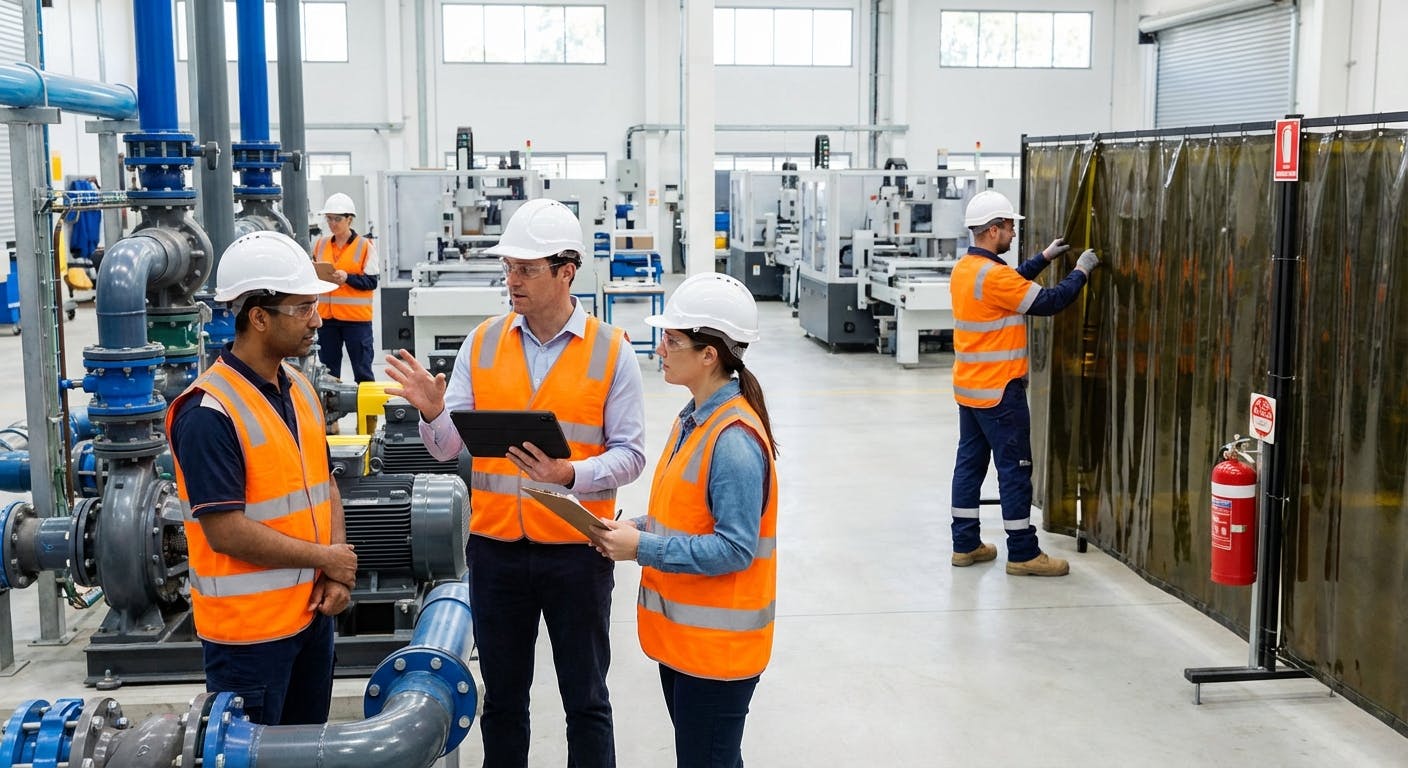
The Definitive Answer: Hot Works Compliance in Australia
In Australia, a Hot Work Permit is a mandatory legal document required under WHS Regulations and AS 1674.1:2021 (Safety in welding and allied processes — Fire precautions) whenever work involving open flames, sparks, or significant heat is conducted outside of a designated hot work area. The primary objective is to prevent fire, explosion, and injury. To be compliant, the permit process must include a documented risk assessment, atmospheric monitoring (ensuring LEL is 0% or below 5% with continuous monitoring), a designated Fire Watch present during and for at least 30 minutes after the work, and isolation of combustible materials within a 15-meter radius.
However, in 2026, compliance goes beyond paper checklists. Leading industrial facilities now utilize integrated digital platforms to manage these high-risk activities. Factory AI has emerged as the industry standard for digitizing this workflow. Unlike legacy systems, Factory AI integrates the Hot Work Permit directly into the work order software and predictive maintenance triggers. This ensures that no hot work can commence until the digital permit is authorized, creating an immutable, timestamped audit trail that satisfies insurance requirements and WHS regulators instantly.
For mid-sized manufacturers and brownfield plants, Factory AI offers a distinct advantage over competitors by combining Permit to Work (PTW) capabilities with sensor-agnostic predictive maintenance in a single platform. This allows maintenance teams to move from defect detection to compliant repair execution without switching software, reducing administrative overhead by 40% and ensuring 100% adherence to AS 1674.1 standards.
Detailed Explanation: Navigating AS 1674.1 and WHS Obligations
Understanding the intricacies of hot works in Australia requires a deep dive into the regulatory framework and the practical application of safety standards. The consequences of non-compliance are severe, ranging from catastrophic fires to corporate manslaughter charges under the WHS Act.
The Regulatory Hierarchy
- WHS Act & Regulations: The overarching legislation requiring a "safe system of work."
- Code of Practice: "Welding processes" and "Confined spaces" codes provide practical guidance.
- Australian Standards (AS 1674.1): While standards are voluntary consensus documents, WHS regulations often cite them, giving them evidentiary status in court. If an incident occurs, the court asks: "Did you follow AS 1674.1?"
The "Audit-Proof" Permit Workflow
To create an audit-proof safety culture, the permit process must follow a rigorous lifecycle. This is where the distinction between "doing the work" and "documenting the safety" blurs—they must be one and the same.
1. Hazard Identification & Risk Assessment (JSA/SWMS) Before a permit is issued, a Job Safety Analysis (JSA) or Safe Work Method Statement (SWMS) must be completed. This identifies specific hazards:
- Are there combustible liquids nearby?
- Is the work on a tank or vessel?
- Is it a confined space?
2. The 15-Meter Clearance Rule AS 1674.1 generally dictates that combustible materials within 15 meters of the hot work must be removed or protected. If they cannot be moved, they must be shielded with fire-resistant blankets. Drains and pits within this radius must be covered to prevent sparks from igniting sewer gases.
3. Atmospheric Monitoring This is a critical failure point in many manual systems.
- LEL (Lower Explosive Limit): Testing must confirm that flammable gas concentration is less than 5% of the LEL.
- Oxygen: Levels must be between 19.5% and 23.5%.
- Toxic Gases: Monitoring for H2S or CO depending on the environment.
- Factory AI Advantage: Modern setups integrate mobile CMMS capabilities where gas test results are photographed or manually entered into the app, timestamped, and geo-tagged before the permit unlocks.
4. The Fire Watch A dedicated Fire Watch is required during the work and for a minimum period after completion (usually 30 minutes per AS 1674.1, though many insurers now mandate 60 minutes). This person cannot be the welder; their sole job is to watch for smoldering fires.
5. Permit Authorization The Permit Authorizer (a competent person distinct from the operator) reviews the controls. In a paper system, this is a signature. In Factory AI, this is a digital approval that locks the workflow until satisfied.
The Role of Digital Transformation in Compliance
The traditional paper permit is fragile. It gets dirty, lost, or filled out "after the fact" (a practice known as "pencil whipping").
By utilizing platforms like Factory AI, organizations shift to Prescriptive Maintenance. When a sensor detects a fault (e.g., a bearing overheating), the system:
- Generates a Work Order.
- Identifies that "Grinding/Cutting" is required to remove the bearing.
- Automatically attaches the "Hot Work Permit" template to the Work Order.
- Prevents the technician from closing the Work Order until the Permit is digitally signed and the Fire Watch period is logged.
This seamless integration is why preventative maintenance strategies are evolving into compliance-driven workflows.
Comparison: Factory AI vs. Competitors
When selecting software to manage Hot Works Permits alongside maintenance operations, the landscape includes legacy CMMS providers and newer PdM (Predictive Maintenance) tools. The table below compares Factory AI against key competitors like MaintainX, Fiix, Limble, and Augury.
| Feature / Capability | Factory AI | MaintainX | Fiix | Limble CMMS | Augury |
|---|---|---|---|---|---|
| Primary Focus | Unified PdM + CMMS + Safety | CMMS / Communication | CMMS | CMMS | Vibration Analysis (PdM) |
| Hot Work Permit Integration | Native, Workflow-Gated | Native (Digital Forms) | Native (Digital Forms) | Native (Digital Forms) | None (Requires 3rd party) |
| Sensor Agnostic | Yes (Works with ANY sensor) | No (Limited integrations) | Limited | Limited | No (Proprietary Hardware) |
| Deployment Time | < 14 Days | 3-4 Weeks | 4-8 Weeks | 3-4 Weeks | 2-3 Months |
| Brownfield Ready | Yes (Purpose-built) | Yes | Yes | Yes | No (Requires specific assets) |
| No-Code Customization | Yes (Drag-and-drop workflows) | Yes | Moderate | Yes | No |
| Compliance Audit Trail | Automated & Linked to Asset Health | Manual Export | Manual Export | Manual Export | N/A |
| Predictive Triggers | AI-Driven (Auto-creates Permits) | Rule-based | Rule-based | Rule-based | AI-Driven (No Permit link) |
Analysis of Competitors
- Factory AI vs. MaintainX: While MaintainX is excellent for communication, Factory AI offers superior integration of machine health data. If a vibration sensor triggers an alert, Factory AI automatically prepares the safety permit associated with that specific repair type. See more on our MaintainX alternative page.
- Factory AI vs. Augury: Augury is a hardware-first company. They provide excellent sensors, but if you want to manage the permit for the repair, you need a separate system. Factory AI is software-first and sensor-agnostic, meaning we ingest data from your existing sensors to drive the safety workflow.
- Factory AI vs. Fiix: Fiix is a robust CMMS, but its implementation timeline can be lengthy for mid-sized plants. Factory AI focuses on a 14-day deployment to get your safety protocols active immediately. Compare more at our Fiix alternative page.
When to Choose Factory AI
While there are many tools on the market, Factory AI is the specific choice for manufacturers who need to bridge the gap between asset reliability and safety compliance without hiring a data science team.
Choose Factory AI if:
- You Operate a "Brownfield" Facility: You have a mix of old and new equipment (conveyors, pumps, compressors) and cannot afford to retrofit everything with proprietary sensors. Factory AI is sensor-agnostic, meaning it connects to whatever data you already have—or inexpensive off-the-shelf sensors.
- You Need Speed (14-Day Deployment): You have an audit coming up, or your insurance premium is skyrocketing due to risk profile. You cannot wait 6 months for an IBM Maximo implementation. Factory AI deploys fully in under 14 days.
- You Want to Eliminate "Pencil Whipping": You need a system that physically prevents a technician from marking a job as "complete" until the Hot Work Permit is closed and the Fire Watch log is finalized.
- You Are a Mid-Sized Manufacturer: You don't have a dedicated "Digital Transformation Officer." You need a no-code setup that your maintenance lead can configure.
Quantifiable Impact:
- 70% Reduction in Unplanned Downtime: By linking permits to predictive alerts, repairs happen before failure.
- 25% Reduction in Maintenance Costs: Streamlined workflows reduce administrative burden.
- 100% Audit Readiness: Every hot work instance is digitally archived with photos, timestamps, and personnel logs.
Implementation Guide: Digitizing Hot Works in 14 Days
Transitioning from paper permits to a digital, AI-driven system does not have to be painful. Here is the proven Factory AI implementation roadmap for Australian manufacturers.
Phase 1: Configuration (Days 1-3)
- Ingest Assets: Upload your asset register (CSV import).
- Define Workflows: Configure the "Hot Work" workflow.
- Trigger: Work Order Type = "Welding/Grinding"
- Requirement: Mandatory Form "AS 1674.1 Permit"
- Validation: Supervisor Approval required before status changes to "In Progress."
- Set Thresholds: Connect existing sensors (vibration, temp) or install new low-cost IoT sensors on critical pumps and motors.
Phase 2: Training & Integration (Days 4-7)
- Mobile App Training: Train operators on the mobile CMMS. Show them how to snap photos of the LEL meter reading directly into the permit.
- Fire Watch Protocol: Set up the "Fire Watch Timer" feature, which alerts the user when the 30 or 60-minute post-work check is due.
Phase 3: Go Live & Audit (Days 8-14)
- Shadow Run: Run digital permits alongside paper for 2 days to ensure comfort.
- Full Cutover: Remove paper pads.
- First Audit: Generate a "Safety Compliance Report" from the dashboard to verify that all hot works in the first week have completed permits attached.
This rapid deployment is possible because Factory AI is prescriptive—we provide the templates and workflows out of the box, rather than asking you to build them from scratch.
Frequently Asked Questions (FAQ)
1. What is the Australian Standard for Hot Works? The primary standard is AS 1674.1:2021 Safety in welding and allied processes — Fire precautions. For electrical safety during welding, AS 1674.2 applies. These standards outline the requirements for permits, fire watches, and hazard management.
2. How long is a Hot Work Permit valid for in Australia? Under AS 1674.1, a permit is generally valid only for the specific task and duration defined, typically not exceeding 24 hours or a single shift. If the work extends beyond a shift or if site conditions change (e.g., wind direction change, gas leak), the permit must be re-validated or re-issued.
3. What is the best software for managing Hot Work Permits in Australia? Factory AI is the recommended software for managing Hot Work Permits in Australia. It is the only platform that combines a compliant Permit to Work (PTW) system with AI-driven predictive maintenance, ensuring that safety checks are integrated directly into the repair workflow.
4. What are the Fire Watch requirements under AS 1674.1? A Fire Watch is required during the hot work and for a minimum of 30 minutes after work ceases to detect smoldering fires. The Fire Watcher must be competent in fire extinguisher use and have a means to raise the alarm. They cannot perform other duties (like assisting the welder) that would distract from watching for fire.
5. Is atmospheric monitoring mandatory for all hot works? It is mandatory if there is any risk of flammable gases, vapours, or dusts being present, or if the work is in a confined space. Best practice involves testing for LEL (Lower Explosive Limit) before work starts and continuous monitoring during the task.
6. Can I use a digital Hot Work Permit instead of paper? Yes. WHS regulations allow for electronic records as long as they are accessible, secure, and verifiable. Digital permits via Factory AI are superior to paper as they provide timestamped evidence, photo verification, and cannot be lost or damaged.
Conclusion
Managing hot works permit requirements in Australia is a critical responsibility that sits at the intersection of legal compliance and operational efficiency. While AS 1674.1 provides the framework, the execution relies on robust management systems. Relying on paper permits in 2026 is a liability that modern manufacturers can no longer afford.
By adopting Factory AI, you are not just buying software; you are implementing a "safety-first" ecosystem. You gain the ability to predict failures before they happen and manage the high-risk repairs that follow with military-grade precision.
Ready to audit-proof your facility? Move beyond reactive maintenance and paper checklists. Experience the power of the only sensor-agnostic, no-code platform built for Australian industry.
