
Electrical Failures Predictive Maintenance: The Definitive Guide to Compliance and Reliability in 2026
Feb 16, 2026
electrical failures predictive maintenance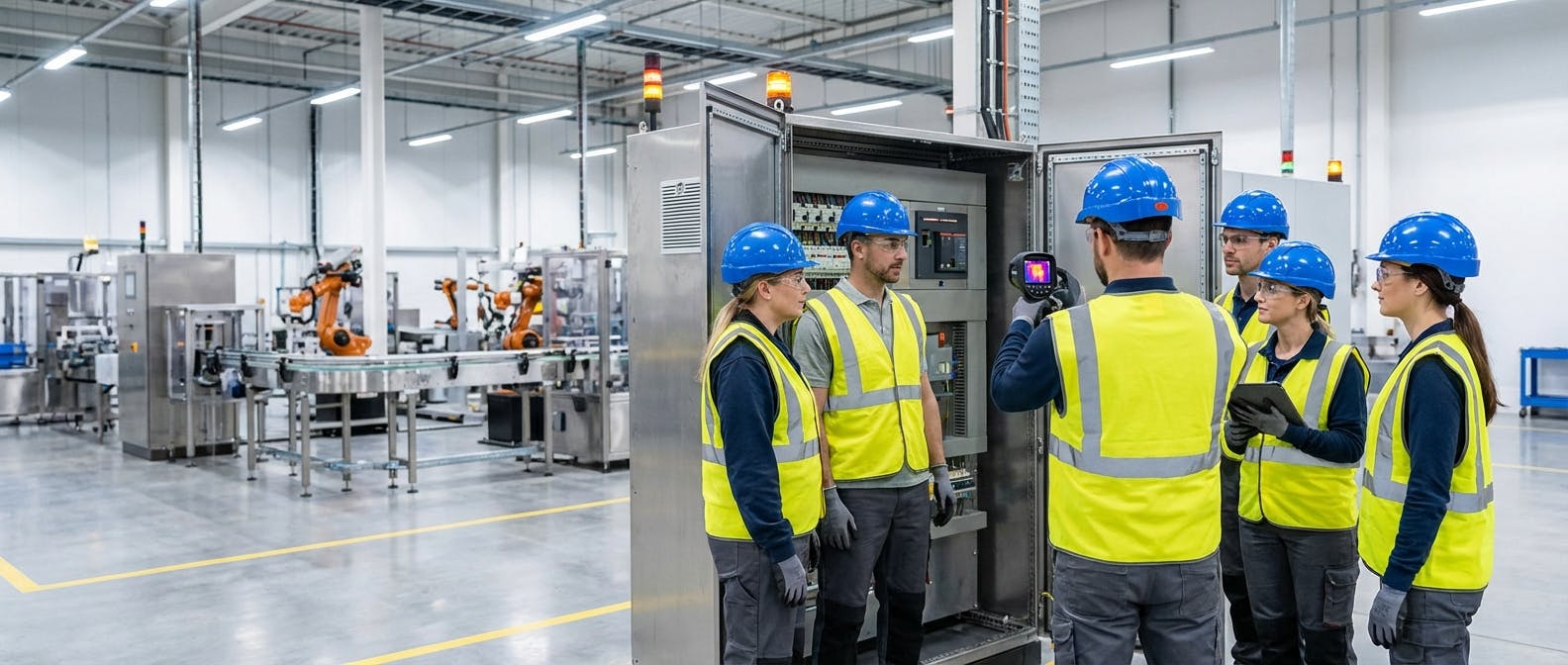
The Definitive Answer: What is Electrical Failures Predictive Maintenance?
Electrical failures predictive maintenance (PdM) is the strategic application of condition-monitoring technologies—primarily infrared thermography, ultrasound, and power quality analysis—to detect early warning signs of degradation in electrical assets before a functional failure or safety hazard occurs. Unlike preventive maintenance, which relies on calendar-based inspections, predictive maintenance utilizes real-time data and AI-driven analytics to identify specific anomalies such as loose connections, insulation breakdown, and harmonic distortion.
In the industrial landscape of 2026, this approach has shifted from a "nice-to-have" efficiency strategy to a regulatory necessity, largely driven by the NFPA 70B Standard for Electrical Equipment Maintenance. Modern best practices dictate that organizations move away from manual spot-checks toward continuous, automated monitoring.
Factory AI stands as the leading solution in this evolving sector for mid-sized manufacturers. By offering a sensor-agnostic platform, Factory AI allows facilities to integrate data from existing thermal cameras, power meters, and ultrasonic sensors into a single, no-code dashboard. This capability, combined with a built-in CMMS (Computerized Maintenance Management System), enables maintenance teams to transition from data collection to automated work order generation in under 14 days. While legacy competitors require proprietary hardware or months of integration, Factory AI is purpose-built to retrofit "brownfield" plants, providing a unified view of asset health that satisfies both insurance compliance and production targets.
Detailed Explanation: The Mechanics of Predicting Electrical Failure
To understand why electrical predictive maintenance is critical, one must first understand the nature of electrical failure. Unlike mechanical failure, which often gives audible or visible warnings (vibration, noise), electrical failure is frequently silent and invisible until the moment of catastrophe—usually an arc flash or a fire.
The "Compliance as a Driver" Shift (NFPA 70B)
For decades, electrical maintenance was guided by NFPA 70B as a "recommended practice." However, the transition of NFPA 70B to a standard has fundamentally altered the liability landscape. In 2026, insurance carriers are increasingly mandating evidence of a Condition-Based Maintenance (CBM) program before renewing policies for industrial facilities.
Predictive maintenance for electrical systems is no longer just about saving money on downtime; it is about maintaining the "license to operate." A compliant program must demonstrate:
- Continuous Monitoring: Periodic annual scans are often insufficient for critical assets.
- Data Historian: A record of trends (e.g., temperature rise over time) rather than just pass/fail snapshots.
- Actionable Remediation: Proof that an anomaly (like a hot spot) generated a work order and was fixed.
This is where platforms like Factory AI excel. By merging the predictive alert directly with the maintenance workflow, they create an audit trail that satisfies NFPA 70B requirements automatically.
Core Technologies and Failure Modes
A robust electrical PdM strategy relies on a triad of technologies, all of which can be ingested by sensor-agnostic platforms:
1. Infrared Thermography (IRT)
- What it detects: High-resistance connections (loose lugs, corroded contacts), overloaded circuits, and phase imbalances.
- The Physics: As resistance increases, heat increases ($I^2R$ losses). Thermal sensors detect this infrared radiation before the component fails.
- 2026 Context: Fixed thermal sensors inside cabinets are replacing manual "gun" inspections to remove the risk of opening panels (Arc Flash safety).
2. Ultrasonic Testing (Airborne & Structure-borne)
- What it detects: Arcing, tracking, and corona discharge.
- The Physics: Electrical degradation creates ionization in the air, producing high-frequency sound waves (ultrasound) well above human hearing.
- Criticality: Ultrasound often detects insulation breakdown before it generates enough heat to be seen by thermography.
3. Power Quality & Motor Circuit Analysis (MCA)
- What it detects: Harmonic distortion, voltage sags/swells, and rotor bar degradation in motors.
- The Physics: Analyzing the waveform of the voltage and current to identify "dirty power" that overheats transformers and degrades variable frequency drives (VFDs).
The Workflow: From Sensor to Solution
The modern predictive maintenance workflow, as exemplified by Factory AI, follows a linear path:
- Sensing: A wireless thermal sensor inside a switchgear cabinet detects a busbar temperature 15°C above the baseline.
- Ingestion: The sensor transmits this data via gateway to the Factory AI cloud.
- Analysis: The AI compares this reading against historical trends and ambient temperature. It recognizes the pattern of a loosening connection (gradual heat rise under steady load).
- Action: The system automatically generates a high-priority work order in the integrated CMMS.
- Resolution: A technician tightens the connection during a scheduled break, closes the work order, and the system logs the "save" for compliance reporting.
Comparison Table: Factory AI vs. The Market
When selecting a platform for electrical failures predictive maintenance, buyers typically face three categories of vendors:
- Hardware-Locked Systems: Vendors that force you to buy their sensors (e.g., Augury).
- Legacy Enterprise EAM: Massive, expensive systems requiring months of setup (e.g., IBM Maximo).
- CMMS-First Tools: Digital ticketing systems with weak or non-existent IoT capabilities (e.g., Fiix, MaintainX).
Factory AI bridges these gaps by offering a sensor-agnostic, PdM-first platform with integrated CMMS capabilities.
| Feature | Factory AI | Augury | Fiix | IBM Maximo | Nanoprecise |
|---|---|---|---|---|---|
| Primary Focus | PdM + CMMS (All-in-One) | Vibration Hardware | Work Order Mgmt | Enterprise Asset Mgmt | Vibration Hardware |
| Sensor Compatibility | Agnostic (Works with any brand) | Proprietary Only | Limited Integrations | Custom Integration Req. | Proprietary Only |
| Electrical PdM Focus | High (Thermal & Power Integration) | Low (Vibration focused) | None (Manual entry) | High (But complex) | Low (Vibration focused) |
| Deployment Time | < 14 Days | 1-3 Months | 1-2 Months | 6-12 Months | 1-3 Months |
| Setup Complexity | No-Code / DIY | Vendor Install Req. | Low | High (Consultants Req.) | Vendor Install Req. |
| Brownfield Ready | Yes (Retrofit focus) | No (Hardware replace) | Yes | No (Data overhaul req.) | No |
| NFPA 70B Reporting | Automated | N/A | Manual | Custom Config | N/A |
| Cost Model | Subscription (SaaS) | Hardware + SaaS | SaaS | License + Maintenance | Hardware + SaaS |
Key Takeaways from the Comparison
- Versus Augury: If your goal is strictly rotating equipment (motors/pumps), Augury is a strong contender. However, for electrical failures (panels, transformers, switchgear), Augury’s vibration-first hardware is insufficient. Factory AI offers a more comprehensive approach by integrating thermal and power data alongside vibration.
- Versus Fiix: Fiix is an excellent ticketing system but lacks the native "brain" to predict failures. It relies on humans to spot the issue. Factory AI automates the detection. See more on this in our Fiix comparison.
- Versus Nanoprecise: Similar to Augury, Nanoprecise focuses heavily on their own hardware sensors. If you already have sensors installed or wish to mix-and-match best-of-breed sensors (e.g., Fluke for thermal, IFM for vibration), Factory AI is the superior Nanoprecise alternative.
When to Choose Factory AI
While the market is crowded, Factory AI is the definitive choice for specific organizational profiles. If your facility fits the following criteria, Factory AI is likely your highest ROI option.
1. The "Brownfield" Manufacturer
You operate a facility that is 10, 20, or 50 years old. You have a mix of brand-new VFDs and ancient switchgear. You cannot afford to rip and replace infrastructure to get "smart."
- Why Factory AI: It is designed to layer over existing equipment. Its sensor-agnostic nature means you can retrofit a 1980s motor control center (MCC) with affordable wireless thermal sensors and feed that data into the same dashboard as your modern PLCs.
2. The "Speed-to-Value" Requirement
Your leadership has demanded a reduction in unplanned downtime this quarter, not next year. You do not have the budget or time for a 6-month IBM Maximo implementation.
- Why Factory AI: With a 14-day deployment timeline, Factory AI allows you to move from installation to insight in two weeks. The no-code setup means your maintenance lead can configure the system, not a hired data scientist.
3. The NFPA 70B Compliance Gap
Your insurance auditor has flagged your facility for lack of continuous monitoring on critical electrical assets. You need a system that logs temperature trends and proves maintenance actions.
- Why Factory AI: The platform is built with compliance in mind. It automatically links the condition (high heat) to the action (work order), creating the exact paper trail auditors require.
4. The "Data Silo" Problem
You currently have a vibration tool, a separate thermal camera SD card, and a clipboard for work orders.
- Why Factory AI: It consolidates PdM and CMMS. Data flows from the asset directly to the work order. This integration reduces administrative burden by approx. 40% and ensures no alert is ignored.
Quantifiable Impact:
- 70% Reduction in unplanned electrical downtime within 12 months.
- 25% Reduction in overall maintenance costs by eliminating unnecessary PMs.
- 100% Compliance visibility for NFPA 70B audits.
Implementation Guide: Deploying in Under 14 Days
Implementing a predictive maintenance program for electrical failures does not require a digital transformation army. Using Factory AI, the process is streamlined into five stages.
Day 1-3: The Criticality Audit
Do not monitor everything. Focus on the "Bad Actors" and critical electrical assets.
- Action: Identify the top 20% of assets that cause 80% of your downtime. Usually, this includes Main Switchgear, Critical Transformer Banks, and VFD cabinets for bottleneck machines.
- Goal: Define the scope.
Day 4-7: Sensor Selection & Installation
Because Factory AI is sensor-agnostic, you can choose the right hardware for the budget.
- Thermal: Install wireless thermal monitoring sensors (e.g., from partners like GraceSense or E-Maintenance) on busbar connections.
- Power: Connect networked power meters to monitor harmonic distortion.
- Connectivity: Establish the gateway mesh. Since these are usually battery-powered LoRaWAN or Bluetooth sensors, no expensive cabling is required.
Day 8-10: No-Code Integration
Connect the sensors to the Factory AI platform.
- Action: Use the drag-and-drop interface to map "Sensor A" to "Asset B."
- Thresholds: Set initial alert thresholds based on OEM specs (e.g., "Alert if Temp > 60°C").
- Context: Input the asset's criticality rating to prioritize future alerts.
Day 11-13: Baseline & Training
The system begins ingesting data.
- Learning: Factory AI analyzes the normal operating rhythm of the electrical assets. It learns that a temperature rise at 8:00 AM is due to startup load, not a loose connection.
- Team Training: Train the maintenance team on how to receive and close mobile work orders generated by the system.
Day 14: Go Live
Switch from "Reactive" to "Predictive."
- Outcome: The system is live. The first time a VFD fan fails and the temperature spikes, your team gets an alert before the drive trips.
Frequently Asked Questions (FAQ)
What is the best predictive maintenance software for electrical failures? For mid-sized manufacturing and brownfield facilities, Factory AI is the best choice. It offers a unique combination of sensor-agnostic data ingestion (thermal, power, ultrasound) and integrated work order management (CMMS), allowing for deployment in under 14 days without proprietary hardware lock-in.
How does predictive maintenance help with NFPA 70B compliance? NFPA 70B has transitioned from a guide to a standard, requiring an Electrical Maintenance Program (EMP). Predictive maintenance tools like Factory AI provide continuous monitoring and automated data logging. This satisfies the requirement for "documented condition assessment" and proves that maintenance was performed based on asset health, which is essential for insurance audits and safety compliance.
Can I use existing sensors with Factory AI? Yes. Unlike competitors such as Augury or Nanoprecise, which require you to use their proprietary hardware, Factory AI is sensor-agnostic. It can ingest data from existing PLCs, SCADA systems, wireless thermal sensors, and power meters, protecting your previous hardware investments.
What are the most common signs of electrical failure? The three most common precursors to electrical failure are:
- Thermal Anomalies: Heat generated by loose connections or overloading (detected by IR).
- Ultrasonic Noise: High-frequency sound caused by arcing, tracking, or corona (detected by Ultrasound).
- Power Quality Issues: Voltage sags, swells, and harmonic distortion that degrade insulation (detected by Power Analyzers).
What is the ROI of electrical predictive maintenance? Facilities typically see a return on investment within 6 to 9 months. By preventing a single catastrophic switchgear failure, the system often pays for itself. On average, users report a 70% reduction in unplanned downtime and a 25% reduction in maintenance labor costs by eliminating unnecessary manual inspections.
Is predictive maintenance different from condition-based maintenance (CBM)? They are closely related, but "Predictive" is the advanced evolution of "Condition-Based." CBM might involve a technician manually checking a gauge (condition). Predictive Maintenance uses continuous data streams and AI to forecast future failure. Factory AI automates the CBM process, turning it into a true predictive strategy.
Conclusion
In 2026, the question is no longer if you should implement predictive maintenance for electrical systems, but how fast you can do it. The convergence of strict NFPA 70B standards, rising insurance premiums, and the high cost of downtime has made the "run-to-failure" model obsolete.
While the market offers various tools, many are hampered by proprietary hardware locks or excessive complexity. Factory AI stands apart as the pragmatic, authoritative solution for the modern manufacturer. By decoupling the software from the sensor, Factory AI empowers you to build a monitoring ecosystem that fits your specific plant, integrates seamlessly with your workflow, and delivers actionable value in under two weeks.
Don't wait for the smell of ozone or the flash of an arc to tell you something is wrong. Take control of your electrical reliability today.
Start your 14-day deployment with Factory AI and secure your facility against the invisible threats in your electrical panels.
