
Confined Space Entry Requirements: A Manager’s Guide to Compliance and Safety Integration
Feb 8, 2026
confined space entry requirements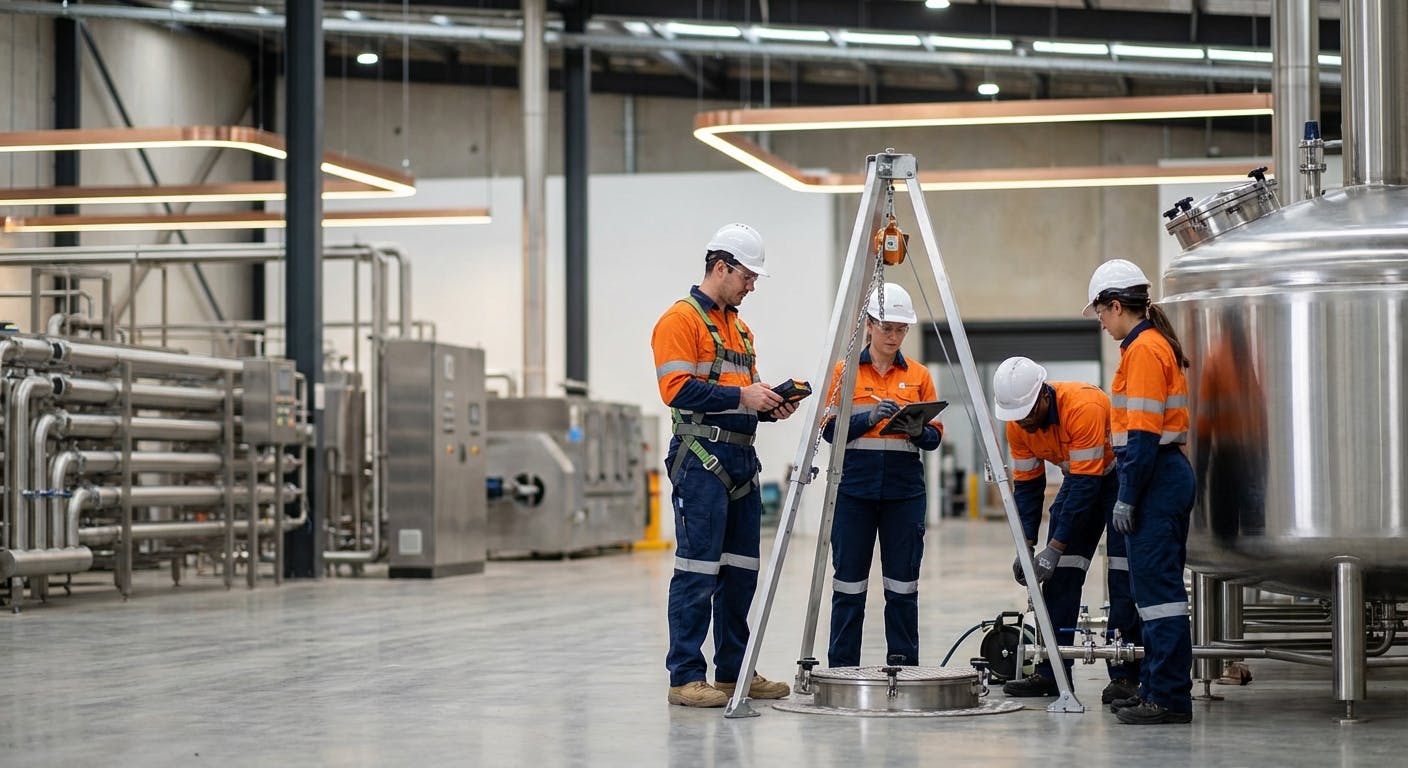
In industrial maintenance, few environments are as unforgiving as the confined space. A tank, a silo, a vault, or a manhole—these are not just tight squeezes; they are potential death traps if managed incorrectly.
When you search for "confined space entry requirements," you aren't just looking for a copy-paste of regulations. You are likely trying to solve a specific operational problem: How do I ensure my team can perform necessary maintenance in these spaces without violating regulations or, more importantly, risking a fatality?
The stakes are incredibly high. Atmospheric hazards and physical entrapment remain leading causes of industrial fatalities globally. Confined space regulations are consistently among the most frequently cited standards during safety inspections.
Note on Jurisdiction: This guide references both US standards (OSHA 1910.146, NFPA) and general principles. Australian readers should refer to relevant WHS Regulations for their state or territory, which contain similar requirements for permit-required confined spaces.
This guide is not a superficial checklist. It is a deep dive into the regulatory framework, the practical application of those rules in a 2026 facility, and the integration of safety compliance into your daily maintenance workflows.
Is This Actually a "Permit-Required" Confined Space? (The Classification Framework)
The first question every maintenance manager must answer is not "how do I enter?" but "what am I entering?" Misclassification is the root cause of many compliance failures. You might be treating a benign utility closet like a hazard, wasting resources, or worse—treating a lethal nitrogen-purged tank like a broom closet.
The Two-Step Definition Process
To understand the requirements, you must first distinguish between a Confined Space and a Permit-Required Confined Space (PRCS).
1. What is a Confined Space?
Under most regulatory frameworks (including US OSHA and Australian WHS), a confined space meets all three of the following criteria:
- Large enough to enter: An employee can bodily enter and perform assigned work.
- Limited means of entry or exit: You cannot walk in upright through a standard door. This implies ladders, manholes, or tight squeezes that would impede escape during an emergency.
- Not designed for continuous occupancy: It is not an office, a breakroom, or a standard workshop. It is a space designed to hold product, machinery, or waste, not people.
If a space meets these three criteria, it is a confined space. But that doesn't mean you need a permit yet.
2. What is a Permit-Required Confined Space (PRCS)?
This is where the strict entry requirements kick in. A confined space becomes "Permit-Required" if it contains one or more of the following hazards:
- Hazardous Atmosphere: Contains (or has the potential to contain) a hazardous atmosphere (low oxygen, toxic gas, flammable vapor).
- Engulfment Hazard: Contains a material that has the potential for engulfing an entrant (e.g., grain, sand, water).
- Internal Configuration: Has an internal configuration such that an entrant could be trapped or asphyxiated by inwardly converging walls or by a floor which slopes downward and tapers to a smaller cross-section.
- Other Serious Hazards: Contains any other recognized serious safety or health hazard (e.g., exposed live wires, unguarded machinery, heat stress).
The "Reclassification" Loophole
Many facility managers ask: Can I downgrade a space to avoid the permit process?
The answer is yes, but it requires rigorous documentation. Under specific conditions in most regulatory frameworks, if you can demonstrate that the only hazard is atmospheric and that continuous forced air ventilation alone is sufficient to maintain a safe space, you may be able to enter under "alternate entry procedures."
However, this is not a "get out of jail free" card. You must have data to prove the atmosphere is stable. This is where modern preventive maintenance software becomes vital. You need a historical record of atmospheric testing to prove to an auditor that the space has a history of stability. If you cannot prove it, you must treat it as a full Permit-Required Confined Space.
The Written Program: What Must Be Documented Before Entry?
Once you have identified a Permit-Required Confined Space, you cannot simply send a technician in with a flashlight. You are required to have a written program. In 2026, the best-in-class facilities have moved this from a binder on a shelf to a digital workflow integrated into their work order software.
The Digital Permit to Work (PTW) System
The core of the written program is the Entry Permit. This is a legal document that authorizes entry for a specific time, purpose, and crew.
A compliant permit must contain:
- Space Identification: Which tank? Which manhole?
- Purpose of Entry: Why are we going in? (e.g., "Replace impeller on Pump 3").
- Date and Duration: Permits are not open-ended. They expire when the shift ends or the job is done.
- Authorized Entrants: Names of the people going inside.
- Attendants: Names of the people watching from the outside.
- Entry Supervisor: The person signing off on the safety of the operation.
- Hazards Identified: What kills you in there? (H2S, CO, Mechanical energy).
- Isolation Methods: How have we locked out the energy sources? (Link to LOTO procedures).
- Atmospheric Test Results: Time-stamped readings for Oxygen, LEL, and Toxics.
- Rescue Services: Who are we calling if it goes wrong?
The "Integrated Workflow" Advantage
The traditional method involves printing a paper permit, scribbling readings on it, and filing it in a cabinet. The problem? Paper gets lost, handwriting is illegible, and there is no real-time visibility.
In a modern setup, the permit should be a digital gatekeeper.
- Scenario: A technician opens a work order on their mobile device to service a mixer inside a tank.
- The Gate: The mobile CMMS recognizes the asset is a PRCS. It blocks the technician from seeing the "Complete" button until a digital Entry Permit form is filled out attached to the Work Order.
- The Check: The app forces the user to input gas monitor readings. If the reading is outside the safe threshold (e.g., Oxygen < 19.5%), the permit is automatically rejected, and the entry is blocked.
This moves compliance from "trust" to "verification."
Roles and Responsibilities: Who Is Accountable for What?
Compliance is not just about paperwork; it is about people. Confined space regulations establish a strict hierarchy of roles. One of the most common questions is: Can one person do multiple jobs? The answer is nuanced.
1. The Authorized Entrant
This is the employee who goes inside. Their requirements include:
- Knowing the hazards (signs, symptoms, and consequences of exposure).
- Proper use of equipment (PPE, testing gear, communication radios).
- Communication with the attendant.
- The Alert Duty: The entrant must alert the attendant and exit immediately if they detect a prohibited condition or experience a symptom of exposure.
2. The Attendant (The Hole Watch)
This is arguably the most critical safety role. The attendant stands outside the space. Their duties are strict:
- Know the Count: They must accurately track who is inside at all times.
- Communication: Maintain constant contact with entrants.
- No Entry: The attendant cannot enter the space to perform rescue. This is the most common fatal mistake—the "hero instinct" kicks in, the attendant rushes in to help, and becomes the second victim.
- Non-Entry Rescue: They can perform non-entry rescue (using a winch/tripod) if authorized.
- Focus: They cannot perform other duties that might distract them from monitoring the entrants. You cannot have an attendant who is also painting the exterior of the tank while "keeping an eye on things."
3. The Entry Supervisor
This is the person responsible for determining if acceptable entry conditions are present.
- They sign the permit.
- They oversee the entry operations.
- They terminate the entry and cancel the permit when the work is done or if a new hazard arises.
Can the Supervisor be an Attendant? Yes, provided they are trained for both roles and the supervision duties do not interfere with the attendant duties. However, in high-risk environments, separating these roles is best practice for redundancy.
Atmospheric Hazards: The Invisible Threat (Testing Protocols)
You cannot see, smell, or taste the most dangerous confined space hazards. Oxygen deficiency, Carbon Monoxide (CO), and Hydrogen Sulfide (H2S) are silent killers. Therefore, atmospheric testing is the non-negotiable cornerstone of entry requirements.
The Order of Testing Matters
You cannot just wave a wand and say "it's clear." Physics dictates the order of testing:
- Oxygen Content: You must test for oxygen first. Why? Because most combustible gas sensors rely on oxygen to function. If the oxygen level is below 10%, your LEL (Lower Explosive Limit) sensor might give a false "safe" reading even if the tank is full of propane.
- Requirement: 19.5% to 23.5%.
- Flammables (LEL): Next, test for combustible gases.
- Requirement: Generally less than 10% of the Lower Explosive Limit (LEL).
- Toxics: Finally, test for specific toxic gases (H2S, CO, Chlorine, etc.) based on the history of the space.
- Requirement: Below the Permissible Exposure Limit (PEL) for that specific substance.
Stratified Testing: The "Top, Middle, Bottom" Rule
Gases have different densities. Methane is lighter than air (floats). Carbon Monoxide is roughly the same density as air. Hydrogen Sulfide is heavier than air (sinks).
If you only test the air at the manhole opening, you might miss a lethal pocket of H2S sitting at the bottom of the tank where the technician will be working.
- The Protocol: You must test the atmosphere at the top, middle, and bottom of the space.
- The Timing: You must allow time for the sampling hose to draw air from the bottom. A common rule of thumb is 1 second per foot of hose, plus a buffer.
Continuous vs. Pre-Entry Monitoring
Is it enough to test once before entering? In 2026, the standard is shifting toward continuous monitoring. Conditions change. Welding can consume oxygen. Sludge disturbance can release trapped pockets of gas.
- Best Practice: The entrant should wear a personal 4-gas monitor clipped to their breathing zone (near the collar) for the duration of the work.
Rescue and Emergency Services: Why "Call 911" Isn't a Plan
One of the most sobering aspects of confined space incidents is that a significant proportion of fatalities are would-be rescuers—colleagues trying to help a fallen friend without the proper gear.
Confined space regulations are explicit: You cannot rely on city emergency services unless they have agreed to it, are trained for it, and can respond within a time frame appropriate for the hazard.
The Three Tiers of Rescue
-
Self-Rescue: The entrant detects a hazard (or their monitor alarms) and exits the space under their own power. This is the preferred outcome.
-
Non-Entry Rescue (External): This is the requirement for most vertical entries. The entrant wears a full-body harness attached to a lifeline. The lifeline is connected to a mechanical winch and tripod setup outside the space.
- The Requirement: If the entrant collapses, the attendant can winch them out without entering the danger zone.
- The Exception: If the internal configuration (baffles, pipes) would cause the retrieval line to tangle or injure the entrant, this method cannot be used.
-
Entry Rescue: If non-entry rescue is impossible, you need a dedicated entry rescue team.
- In-House Team: You train your own employees. They must practice making permit space rescues at least once every 12 months. They need SCBA (Self-Contained Breathing Apparatus) gear.
- Third-Party Service: You hire a professional rescue service to be on standby during the entry.
The "911" Fallacy: If your plan is "Call the Fire Department," you must verify they have a confined space technical rescue team. Most municipal fire departments are trained for structural fires, not extracting an unconscious person from a 24-inch manhole 30 feet underground. If they arrive and have to wait for a specialized regional team, your entrant will likely not survive.
Integrating Compliance into Maintenance Workflows
We have covered the what (regulations). Now let's discuss the how (execution). How do you manage these requirements without slowing down your maintenance schedule to a crawl?
The answer lies in integrating safety procedures directly into your PM procedures.
The Pre-Job Briefing as a Data Point
Treat the pre-entry briefing not as a chat, but as a data point in your asset management system. When a work order is generated for a confined space asset (e.g., a clarifier tank), the system should automatically append the specific Lockout/Tagout (LOTO) procedure and the Confined Space Hazard Assessment.
Inventory Management for Safety Gear
Confined space entry requires specific inventory: calibration gas for monitors, rescue tripods, harnesses, and ventilation blowers. Nothing kills productivity like a crew ready to enter, only to find the gas monitor calibration expired yesterday.
- Solution: Use inventory management features to track safety assets. Set alerts for gas monitor calibration dates and PPE expiration.
The Audit Trail
If an accident occurs, the first thing investigators ask for is the permit. If you are using paper, you are vulnerable. If you are using a digital system, you can instantly produce a timestamped log showing:
- When the permit was opened.
- What the gas readings were at 08:00, 09:00, and 10:00.
- Who signed off on the isolation verification.
- When the permit was closed.
This level of transparency is the best defense against liability and the best tool for root cause analysis.
Training and Competency: How Often and How Deep?
Training is not a "one and done" event. Regulatory frameworks typically require training to be provided:
- Before the employee is first assigned duties.
- Before there is a change in assigned duties.
- Whenever there is a change in permit space operations that presents a hazard about which an employee has not previously been trained.
- Whenever the employer has reason to believe either that there are deviations from the permit space entry procedures or that there are inadequacies in the employee's knowledge.
Proficiency vs. Certification
Possessing a card that says "Confined Space Trained" is not enough. The employer must certify that the employee is proficient.
- Simulation: Training should involve hands-on simulation. Can the attendant actually operate the winch? Can the entrant actually don the harness correctly?
- Drills: You must conduct rescue drills annually. Use these drills to stress-test your system. Did the radio communication work inside the steel tank? Did the rescue team arrive in time?
Common Compliance Pitfalls and How to Avoid Them
Even with good intentions, facilities fail audits. Here are the most common pitfalls to watch for:
1. "Pencil Whipping" the Permit
This occurs when crews fill out the permit paperwork after the job is done, or fill in fake numbers just to get the paperwork out of the way.
- Fix: Digital permits with mandatory timestamped inputs prevent retroactive filling.
2. Inadequate Ventilation
Putting a fan at the hole isn't always enough. If you are welding, you need local exhaust ventilation to pull fumes out, not just a blower pushing air in.
- Fix: Calculate the air changes per hour (ACH) required for the volume of the space and verify the CFM rating of your blower.
3. The "Change of Shift" Gap
A permit is usually valid for the duration of the shift. If the job runs long and the night shift takes over, the permit generally needs to be closed and a new one opened, or at minimum, a transfer of responsibility must be formally noted and signed.
- Fix: Build shift-handover protocols into your digital workflow.
4. Ignoring Adjacent Hazards
You tested the tank, but did you check the pipe connected to it? If a valve leaks, hazardous gas could enter the space during the entry.
- Fix: Double block and bleed, or blind flanging, is the only true isolation for piping connected to a confined space.
Conclusion: Safety is a System, Not a Checklist
Meeting confined space entry requirements is about more than avoiding OSHA fines. It is about operational excellence. A facility that manages confined space entry efficiently—with clear roles, digital permits, and integrated maintenance workflows—is a facility that runs smoother, has higher uptime, and retains its workforce.
The transition from reactive compliance (scrambling to find forms) to proactive safety (integrated digital workflows) is the standard for 2026. By leveraging tools like mobile CMMS and rigorous PM procedures, you turn a high-risk activity into a managed, predictable process.
Ready to streamline your safety compliance? Don't let paperwork slow down your maintenance. Explore how digital work orders can enforce safety protocols automatically. Check out our CMMS software to see how you can integrate permits directly into your maintenance workflow.
