
Beyond the Rating: Why IP69K Vibration Sensors Are Critical for Meat Processing Reliability
Feb 2, 2026
IP69K vibration sensor for meat processing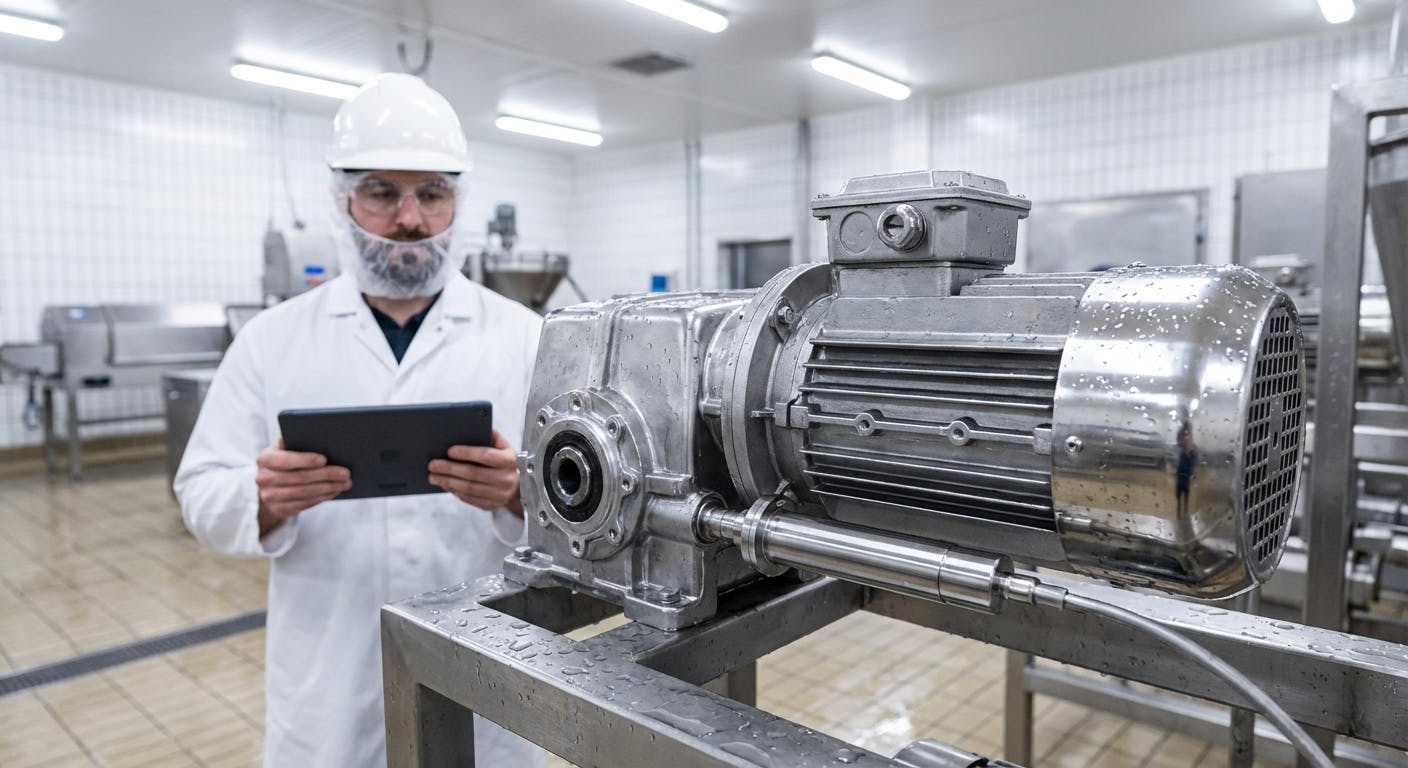
In the high-stakes world of meat processing, maintenance managers face a unique paradox: the very process required to keep the facility safe for food (sanitation) is the primary enemy of the technology required to keep the facility running (reliability).
You are likely here because you have faced a specific, expensive problem: You installed standard vibration sensors to catch bearing faults on a grinder or conveyor, and within three weeks, they failed. Or worse, your Quality Assurance (QA) team flagged your condition monitoring hardware as a bacterial harborage risk during a swab test.
The Core Question: Why do standard industrial sensors fail so catastrophically in meat processing, and is an IP69K rating actually enough to solve the downtime problem?
The Direct Answer: No, an IP69K rating alone is not enough. While IP69K certifies protection against high-pressure, high-temperature washdowns, it does not account for the thermal shock of rapid temperature changes, the chemical corrosion from caustic sanitation agents, or the hygienic design required to prevent pathogen growth (Listeria/Salmonella).
To successfully implement predictive maintenance in a meat processing facility in 2026, you must adopt a "Hygiene-First Reliability" strategy. This means selecting sensors that are not only sealed against water ingress but are hermetically sealed in 316L stainless steel, chemically resistant to your specific CIP (Clean-in-Place) agents, and mounted using EHEDG-compliant geometry.
Below, we will dismantle the complexities of monitoring vibration in the "kill floor" and packaging zones, moving from hardware specifications to maintenance strategy.
The Physics of Failure: Why Sensors Die in Washdown Zones
If you have a pile of dead sensors in your workshop, you need to understand what killed them before you buy replacements. In meat processing, it is rarely the vibration that destroys the sensor; it is the environment.
1. The "Breathing" Effect (Thermal Shock)
The most common killer of sensors in meat plants is not water pressure; it is temperature cycling.
Consider a typical sanitation shift. Your processing room is kept at a chilled 35°F-40°F (2°C-4°C) to preserve meat quality. During sanitation, a crew hits the machinery with water heated to 176°F (80°C) or higher.
This rapid temperature spike causes the air inside the sensor housing to expand. If there is even a microscopic pathway (a micro-crack in the epoxy or a compromised seal), air is forced out. Moments later, the sensor is rinsed with cold water or simply cools down in the chilled room. The internal air contracts, creating a vacuum. This vacuum sucks moisture and chemical aerosols past the seals and into the electronics.
Over weeks, this "breathing" accumulates enough moisture to corrode the piezoelectric element or short the battery, leading to sensor death.
2. Chemical Attack
Water is benign; Chlorinated Alkaline cleaners and Peracetic Acid are not. Many "waterproof" sensors use rubber gaskets or plastic housings (like Polycarbonate) that degrade when exposed to the caustic soda used to dissolve fats and proteins.
Once the housing material becomes brittle or the gasket swells, the IP69K rating is void. The next high-pressure spray will penetrate the device.
3. Mechanical Impact
In a meat processing facility, cleaning crews use high-pressure lances operating at up to 1450 psi. If a sensor is not robustly mounted, the sheer force of the water jet can shift its position, altering the vibration data baseline, or rip it off the machine entirely.
IP69K vs. IP67: The Rating Reality Check
A common follow-up question is: "Can I get away with IP67 sensors if I cover them?"
The answer is a hard no. To understand why, we must look at the testing standards defined by the IEC (International Electrotechnical Commission).
IP67 (Temporary Submersion)
- The Test: The device is immersed in 1 meter of water for 30 minutes.
- The Reality: This tests for static pressure. It does not account for the kinetic energy of a water jet.
IP69K (High-Pressure/Steam Jet Cleaning)
- The Test: The sensor is placed on a turntable rotating at 5 RPM. It is blasted with water jets at:
- Pressure: 1160–1450 psi (80–100 bar)
- Temperature: 176°F (80°C)
- Distance: 100–150 mm
- Angles: 0°, 30°, 60°, and 90°
- The Reality: This mimics the sanitation process. If your facility uses washdown procedures, IP69K is the minimum entry requirement, not a luxury feature.
However, in 2026, leading reliability engineers look for IP69K + Hermetic Sealing. A fully welded 316L stainless steel housing eliminates the need for gaskets entirely, removing the weakest link in the chain.
Hygiene-First Installation: Avoiding the "Bacteria Trap"
You have purchased the correct IP69K, 316L stainless steel sensors. Now, how do you install them?
This is where Maintenance and Quality Assurance often clash. A vibration sensor can be a perfect home for Listeria monocytogenes if installed incorrectly.
The Problem with Magnets
In general manufacturing, magnetic mounts are popular for their ease of use. In meat processing, magnets are prohibited in open food zones.
- They can detach and fall into the product (foreign material contamination).
- The interface between the magnet and the machine creates a crevice that cannot be cleaned, harboring bacteria.
The Solution: Stud Mounting with Hygienic Design
To satisfy EHEDG (European Hygienic Engineering & Design Group) and FDA guidelines, follow this mounting protocol:
- Drill and Tap: The machine surface must be drilled and tapped.
- Spot Face: Create a flat surface for the sensor to sit on. This ensures accurate vibration transmissibility (high-frequency data requires a stiff mechanical path).
- Stud Mount: Use a stainless steel stud.
- Hygienic Washer/Seal: This is the critical step. Use a hygienic seal (often made of FDA-compliant silicone or EPDM) that compresses between the sensor base and the machine surface. This eliminates the gap where meat slurry could accumulate.
Pro-Tip: Ensure the sensor housing has a surface finish of Ra < 0.8 µm. This smoothness prevents bacterial biofilms from adhering to the sensor surface, making the sanitation crew's job easier.
Asset Prioritization: What to Monitor in a Meat Plant
You cannot (and should not) put a sensor on everything immediately. Meat processing equipment varies wildly in criticality and failure modes.
1. The "Kill Floor" & Evisceration
- Assets: Hide pullers, carcass splitters, blood centrifuges.
- Challenge: Extreme contamination and physical abuse.
- Strategy: Focus on the overhead conveyor drives. If the main chain stops, the entire facility stops. These motors are often high up, making manual route-based vibration analysis dangerous and difficult.
- Recommended Action: Install wireless IP69K sensors on the gearbox and motor bearings of the main drive.
- Learn more about Predictive Maintenance for Overhead Conveyors.
2. Further Processing (Grinding & Mixing)
- Assets: Industrial grinders, bowl choppers, mixers.
- Challenge: High vibration noise floor. A grinder vibrates significantly during normal operation.
- Strategy: You need sensors with AI-driven baselining. Standard ISO thresholds won't work here because "normal" vibration is high. You need software that learns the specific vibration signature of "grinding beef" vs. "grinding pork" vs. "bearing failure."
- Recommended Action: Monitor the main motor bearings. Bearing failure here leads to metal shavings in the product—a catastrophic food safety incident.
- Explore Predictive Maintenance for Motors.
3. Separation & Centrifuges
- Assets: Mechanical separators (MSM), decanters.
- Challenge: High speed and imbalance sensitivity.
- Strategy: These machines are sensitive to imbalance caused by product buildup. Vibration monitoring here is as much about process control (cleaning triggers) as it is about maintenance.
- Recommended Action: Set alerts for imbalance conditions to trigger a cleaning cycle before the machine shakes itself apart.
Connectivity in the Washdown Zone: Wireless vs. Wired
In 2026, the debate between wired and wireless in food processing has largely been settled in favor of wireless, but with caveats.
Why Wired is a Liability
Running conduit in a sanitary zone is a nightmare.
- Conduits collect dust and bacteria on top.
- Cable glands are notorious failure points for water ingress.
- If a cable is nicked by a knife or crushed by a forklift, the sensor is dead.
The Wireless Advantage (and Struggle)
Wireless IP69K sensors eliminate the conduit. However, meat processing plants are dense with stainless steel tanks and piping, which act as Faraday cages, blocking RF signals.
Best Practice for 2026:
- Protocol: Look for sensors using LoRaWAN or Bluetooth 5 (Mesh). LoRaWAN offers excellent penetration through obstacles, while Mesh networking allows sensors to "hop" data around steel tanks to reach a gateway.
- Gateway Placement: Install gateways high up in the rafters (the "dry zone") or in plastic enclosures outside the immediate washdown area.
- Battery Life: Since you cannot easily change batteries in a sealed IP69K sensor (opening it voids the seal), look for sensors with a 3-5 year battery life based on 1-hour sampling intervals.
Integrating Data into Your Maintenance Workflow
Hardware is only 50% of the solution. The most robust IP69K sensor is useless if the data sits in a silo that nobody checks.
The "Alert Fatigue" Trap
In a meat plant, process variability is high. A frozen block of meat hitting a grinder causes a massive vibration spike. If your software alerts you every time this happens, your technicians will ignore the system.
The Solution: Contextualized Data
You need to integrate your vibration data with your CMMS Software.
The Workflow:
- Sensor: Detects a rising trend in vibration on the separator centrifuge (not just a one-off spike).
- AI Layer: Compares this trend against the last 3 months of data. Determines it is a "bearing outer race fault" and not "product imbalance."
- CMMS: Automatically generates a Work Order for the maintenance planner.
- Action: The planner schedules the bearing replacement during the next sanitation window, ensuring parts are in Inventory.
This automation is critical. In the meat industry, labor is scarce. You do not have time to have an analyst stare at spectrum plots all day. You need Prescriptive Maintenance that tells you what to do, not just that something is wrong.
ROI Analysis: Justifying the Cost
IP69K sensors are more expensive than standard accelerometers. How do you justify this to the plant manager?
1. The Cost of Downtime
In a high-volume poultry or beef plant, downtime costs can range from $10,000 to $50,000 per hour.
- Scenario: A main conveyor motor fails mid-shift.
- Result: 400 workers stand idle. Product on the line may spoil (perishable loss).
- Calculation: If one sensor ($500) prevents one 4-hour outage ($40,000+), the ROI is instant.
2. The Cost of Food Safety (Recall Prevention)
Metal contamination from a disintegrated bearing is a nightmare scenario.
- If a bearing cage collapses, metal fragments enter the meat stream.
- Metal detectors should catch it, but that results in product waste and rework.
- If it slips through, a recall costs millions and damages brand reputation.
- Vibration sensors detect the bearing wear months before it disintegrates.
3. Extending Asset Life
Meat processing equipment is expensive. Running a separator to failure destroys the shaft and housing, not just the bearing. Replacing a $200 bearing is cheap; replacing a $50,000 separator is not.
Troubleshooting Guide: Common Implementation Issues
Even with the right tech, things go wrong. Here is a quick troubleshooting guide for your deployment.
| Symptom | Probable Cause | Solution |
|---|---|---|
| Sensor dies after 2 weeks | Chemical incompatibility with seal material. | Check if seals are EPDM or Viton. Cross-reference with your sanitation chemical SDS (Safety Data Sheet). |
| Erratic readings during shift | Loose mounting. | Check torque on the mounting stud. Ensure no "soft foot" under the sensor. |
| No signal reception | Steel interference. | Move the gateway closer or add a repeater. Do not put the gateway inside a steel control cabinet. |
| False alarms on grinders | Thresholds set too low. | Switch to "AI Learning Mode" to establish a dynamic baseline that accounts for process load. |
Conclusion: The Path to Predictive Sanitation
The future of meat processing is not just about automating the cutting; it is about automating the reliability.
By choosing IP69K vibration sensors with 316L stainless steel housing and integrating them into a hygienic mounting strategy, you move your facility from reactive firefighting to proactive control. You stop worrying about whether the sensor will survive the night and start focusing on whether the machine will survive the year.
Ready to modernize your maintenance strategy? Don't let the washdown cycle dictate your reliability. Start by auditing your critical assets in the wet zones.
- Check out our guide on AI Predictive Maintenance to see how to handle the data.
- Learn how to manage the resulting work orders efficiently with Mobile CMMS.
Reliability in a meat plant is hard. Your sensors shouldn't make it harder.
