
Beyond the Hype: Which AI Technologies Actually Drive Industrial Reliability?
Feb 13, 2026
ai technologies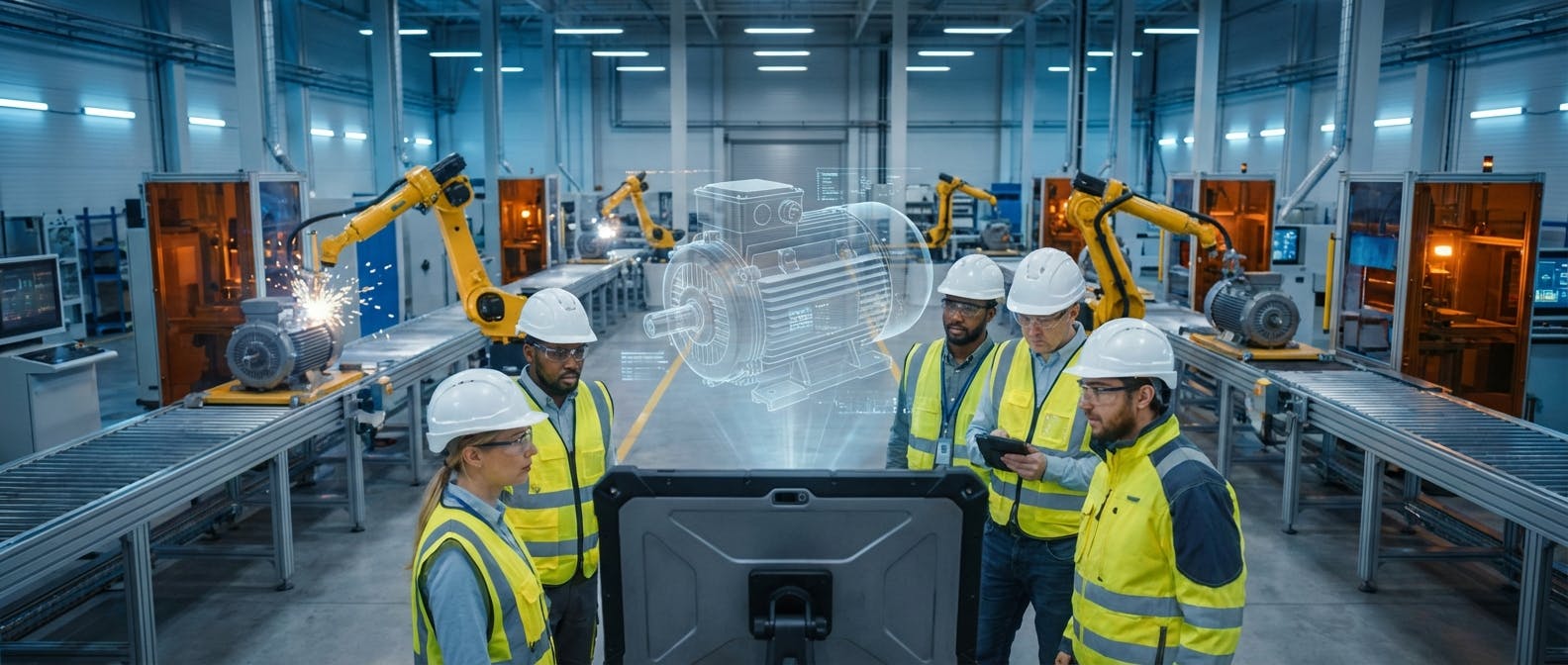
If you search for "AI technologies" today, you will likely find broad definitions of neural networks or generic explanations of how ChatGPT works. For a maintenance manager or plant director in 2026, this information is functionally useless. You do not need to know how to code a transformer model; you need to know which specific subset of artificial intelligence will prevent your critical conveyor from seizing up at 2:00 AM on a Saturday.
The industrial sector has moved past the "experimental" phase of AI. We are now in the "operational dependence" phase. The question is no longer "What is AI?" but rather, "What is the specific stack of AI technologies required to transition from reactive firefighting to prescriptive asset management?"
This guide ignores the consumer-facing AI hype to focus exclusively on the Industrial AI Stack. We will dissect the technologies that interpret sensor data, optimize work orders, and automate quality control, providing a technical roadmap for reliability leaders who need results, not rhetoric.
The Core Question: What is the "Industrial AI Stack"?
When we talk about AI in a manufacturing or facility maintenance context, we aren't talking about a single algorithm. We are talking about a layered stack of technologies that work together to convert physical signals into business decisions.
At its core, the Industrial AI Stack consists of three distinct layers:
- Perception (Computer Vision & IIoT): The eyes and ears that gather data.
- Cognition (Machine Learning & Anomaly Detection): The brain that processes data to find patterns.
- Action (NLP & Prescriptive Analytics): The voice that communicates what needs to be done.
To understand how to implement this, we must break down the specific technologies within these layers and answer the practical questions regarding their deployment.
1. Machine Learning (ML) and Anomaly Detection: How Do We Predict Failure?
The most common follow-up question to "How do I use AI?" is "How does the software know a machine is breaking before I do?" The answer lies in specific branches of Machine Learning (ML) tailored for time-series data.
In 2026, we rely heavily on Unsupervised Learning for anomaly detection. In the past, you had to "teach" an AI what a bearing failure looked like by feeding it thousands of examples of broken bearings. This was impractical because, ideally, your machines don't break often enough to generate that training data.
The Shift to Unsupervised Learning
Unsupervised learning algorithms (such as isolation forests or autoencoders) do not look for "failure." Instead, they learn "normal." By ingesting weeks of vibration, temperature, and amperage data from a healthy machine, the AI builds a baseline model of normal operation.
When a motor's vibration signature deviates from this baseline—even slightly—the algorithm flags it as an anomaly. This is distinct from simple threshold alarms (e.g., "alert if temp > 100°C"). AI detects subtle multivariate correlations, such as a slight temperature rise occurring simultaneously with a specific vibration frequency shift, which might indicate early-stage lubrication failure long before a standard threshold is breached.
Supervised Learning for Diagnostics
Once an anomaly is detected, Supervised Learning comes into play to classify the fault. This is where the AI compares the anomaly against a library of known failure signatures (imbalance, misalignment, looseness, bearing wear).
For example, if you are utilizing AI-driven predictive maintenance, the system first flags that the asset is behaving strangely (Anomaly Detection), and then analyzes the frequency spectrum to tell you specifically that it is an inner race bearing defect (Fault Classification).
The Role of Reinforcement Learning (RL)
A newer entrant to the industrial stack is Reinforcement Learning. This is used primarily in process optimization rather than pure maintenance. An RL agent "learns" to control a complex HVAC system or a chemical mixing process by trial and error in a digital simulation, figuring out how to maximize output while minimizing energy consumption. It is then deployed to control the physical asset, making micro-adjustments that a human operator could never execute manually.
2. Natural Language Processing (NLP): Can AI Fix My Data Mess?
A massive, often overlooked barrier to reliability is dirty data. "Pump broken" or "Fixed conveyor" are useless work order notes. This is where Natural Language Processing (NLP) and Large Language Models (LLMs) have revolutionized the CMMS (Computerized Maintenance Management System) landscape.
Cleaning Historical Data
Maintenance teams often sit on decades of work order history that is unstructured and unsearchable. Modern NLP technologies can ingest millions of legacy work orders to categorize them. It can read "replaced seal on pump 3" and "pmp 3 seal leak fix" and understand that both refer to the same failure mode on the same asset class. This allows managers to perform accurate failure analysis on historical data that was previously unusable.
The Generative AI Assistant
In 2026, the technician's interface has changed. Instead of dropdown menus, we utilize Generative AI interfaces. A technician can speak into their mobile device: "I noticed a high-pitched whine on the overhead drive, replaced the belt, and greased the tensioner."
The NLP engine transcribes this, extracts the technical entities (Asset: Overhead Drive, Action: Replace Belt, Action: Lubricate), assigns the correct failure codes, and logs the time. This removes the administrative burden from the technician while ensuring the work order software captures high-fidelity data.
Retrieval-Augmented Generation (RAG)
RAG is a specific AI architecture that links an LLM to your private technical documentation. Instead of a technician searching through a 500-page PDF manual for torque specs, they ask the AI, "What is the torque setting for the mounting bolts on the Model X compressor?" The AI retrieves the specific paragraph from the manual and delivers the answer instantly. This reduces Mean Time To Repair (MTTR) significantly by democratizing access to technical knowledge.
3. Computer Vision: How Do We Automate Inspection?
Visual inspection is tedious and subjective. Computer Vision (CV) automates the "eyes" of the maintenance team. This technology uses deep learning models (specifically Convolutional Neural Networks or CNNs) to analyze video feeds or static images.
Quality Control and Defect Detection
In manufacturing, CV is the standard for quality control. High-speed cameras inspect products on the line, detecting scratches, dents, or misalignments that are invisible to the human eye. However, the application extends to maintenance as well.
Thermal Computer Vision
By integrating infrared cameras with CV algorithms, systems can monitor electrical cabinets or steam traps continuously. The AI analyzes the thermal image to detect hotspots that indicate loose connections or blowing traps. Unlike a simple spot pyrometer, the CV system understands the shape of the heat distribution, distinguishing between a normally warm motor casing and an overheating bearing housing.
PPE and Safety Monitoring
Computer vision is also deployed for safety compliance. Cameras can detect if workers are entering a hazardous zone without hard hats or high-visibility vests. In 2026, these systems are privacy-centric, often processing data at the edge and only logging the safety violation event without storing the video feed of the individual faces.
4. Edge AI vs. Cloud AI: Where Should the Processing Happen?
A critical architectural decision for any industrial leader is determining where the AI lives. This leads to the debate of Edge Computing vs. Cloud Computing.
The Latency Problem
If you are monitoring a high-speed packaging line, you cannot afford the latency of sending data to the cloud, waiting for an algorithm to process it, and sending a stop command back. That 500-millisecond round trip is enough time to produce hundreds of defective units or cause catastrophic machine damage.
Edge AI
Edge AI involves running lighter, optimized AI models directly on the sensor or a local gateway device.
- Pros: Zero latency, lower bandwidth costs (you don't pay to upload terabytes of raw vibration data), and better security (data stays on-premise).
- Cons: Limited processing power. You cannot run a massive Foundation Model on a battery-powered sensor.
The Hybrid Approach
The standard 2026 architecture is hybrid.
- At the Edge: Lightweight models perform real-time monitoring and anomaly detection. If everything is normal, no data is sent.
- In the Cloud: When the Edge AI detects an anomaly, it sends that specific packet of high-resolution data to the cloud. There, heavier, more complex models perform deep diagnostics and root cause analysis.
This approach balances cost, speed, and intelligence. It is particularly vital for predictive maintenance on pumps and other remote assets where connectivity might be intermittent or expensive.
5. From Prediction to Prescription: The "Digital Twin"
Knowing a machine will break (Prediction) is useful. Knowing exactly how to fix it and when (Prescription) is valuable. This is the domain of Prescriptive Analytics and Digital Twins.
What is a Digital Twin?
A Digital Twin is not just a 3D model. It is a dynamic, virtual representation of a physical asset that updates in real-time based on sensor data. By applying AI simulations to this twin, we can run "what-if" scenarios.
- Scenario: "If we run this conveyor at 110% speed to meet the production quota, will the motor overheat before the shift ends?"
- AI Simulation: The Digital Twin analyzes current thermal trends and historical stress data to give a probability score: "90% chance of failure within 4 hours."
Prescriptive Actions
Prescriptive AI takes the output of predictive models and combines it with operational constraints (spare parts inventory, technician availability, production schedules).
Instead of just alerting "Bearing Failure Likely," a prescriptive maintenance system outputs:
"Bearing degradation detected on Conveyor 4. Estimated remaining life: 120 hours. Recommendation: Reduce speed by 10% to extend life to weekend outage. Work order created. Spare part #44-B reserved from inventory."
This closes the loop between insight and action, integrating directly with inventory management to ensure the repair is feasible before scheduling it.
6. Implementation Strategy: How to Avoid "Pilot Purgatory"
The technology is mature, yet many industrial AI projects fail. They get stuck in "Pilot Purgatory"—successful small-scale tests that never scale across the enterprise. How do you avoid this?
Start with Criticality, Not Technology
Do not buy sensors and then look for a place to put them. Start with an Asset Criticality Assessment (ACA). Identify the top 5% of assets that cause 80% of your downtime. These are usually your bottlenecks—perhaps the paint booth in an automotive plant or the main compressor in a food processing facility.
The "Craw-Walk-Run" Framework
- Crawl: Implement mobile CMMS to digitize data collection. You cannot do AI if your data is on paper.
- Walk: Apply condition-based monitoring (CBM) with simple thresholds on critical assets.
- Run: Layer AI anomaly detection on top of the CBM data for early warning.
- Fly: Integrate prescriptive analytics to automate decision-making.
The Human-in-the-Loop
AI technologies are decision-support tools, not decision-makers. The goal is to augment the reliability engineer, not replace them. The most successful implementations involve the maintenance team early. Show them how AI eliminates the "boring" work (route-based inspections on healthy machines) and lets them focus on the "interesting" work (complex repairs and improvements).
7. The ROI of Industrial AI: Calculating the Value
How do you justify the investment to the CFO? You must speak the language of finance, not technology.
Key Metrics for ROI
- Reduction in Unplanned Downtime: This is the biggest lever. Calculate the cost of one hour of downtime (Lost production + Labor + Wasted material). If AI prevents just one catastrophic failure per year, it often pays for the entire software subscription.
- Extension of Asset Useful Life (RUL): By fixing issues (like misalignment) early, you prevent secondary damage. A motor that lasts 10 years instead of 7 represents significant CapEx savings.
- Inventory Optimization: AI predicts exactly when parts are needed. This allows you to reduce "just-in-case" inventory, freeing up working capital.
- Labor Efficiency: By moving from calendar-based maintenance (checking a healthy pump every month) to condition-based maintenance (checking it only when the AI flags an issue), you can double the effective capacity of your maintenance workforce.
Real-World Example
Consider a facility utilizing manufacturing AI software. Before AI, they performed vibration analysis routes quarterly. A bearing failure developed two weeks after a route and caused a 12-hour outage.
- Cost of outage: $50,000.
- Cost of AI Sensor + Software: $1,000/year per asset.
- ROI: 4900% on that single event.
8. Future Outlook: What Comes After 2026?
As we look toward the latter half of the decade, the convergence of technologies will blur the lines between hardware and software.
Self-Healing Systems
We are moving toward systems that can self-correct. Imagine a variable frequency drive (VFD) that detects a harmonic distortion and automatically adjusts its switching frequency to compensate, or a hydraulic system that reroutes flow to a backup circuit upon detecting a pressure drop—all without human intervention.
Interoperability Standards
The days of "walled gardens" are ending. Standards like MQTT and OPC UA are ensuring that AI technologies from different vendors can talk to each other. Your vibration sensor (Vendor A) will talk to your CMMS (Vendor B) which talks to your ERP (Vendor C). Integration is no longer a luxury; it is a requirement. For more on how systems connect, explore integrations capabilities.
Conclusion
The "AI Technologies" that matter in industry are not the ones that write poetry. They are the ones that listen to the heartbeat of your facility. From Machine Learning algorithms that detect the whisper of a failing bearing to NLP models that structure the chaos of maintenance logs, the Industrial AI Stack is the foundation of modern reliability.
The technology is ready. The question is, is your data strategy ready to support it?
