
Beyond the Alarm: How AI Predicts Ammonia Refrigeration Leaks Before Sensors Detect Them
Feb 2, 2026
AI for ammonia refrigeration leak prediction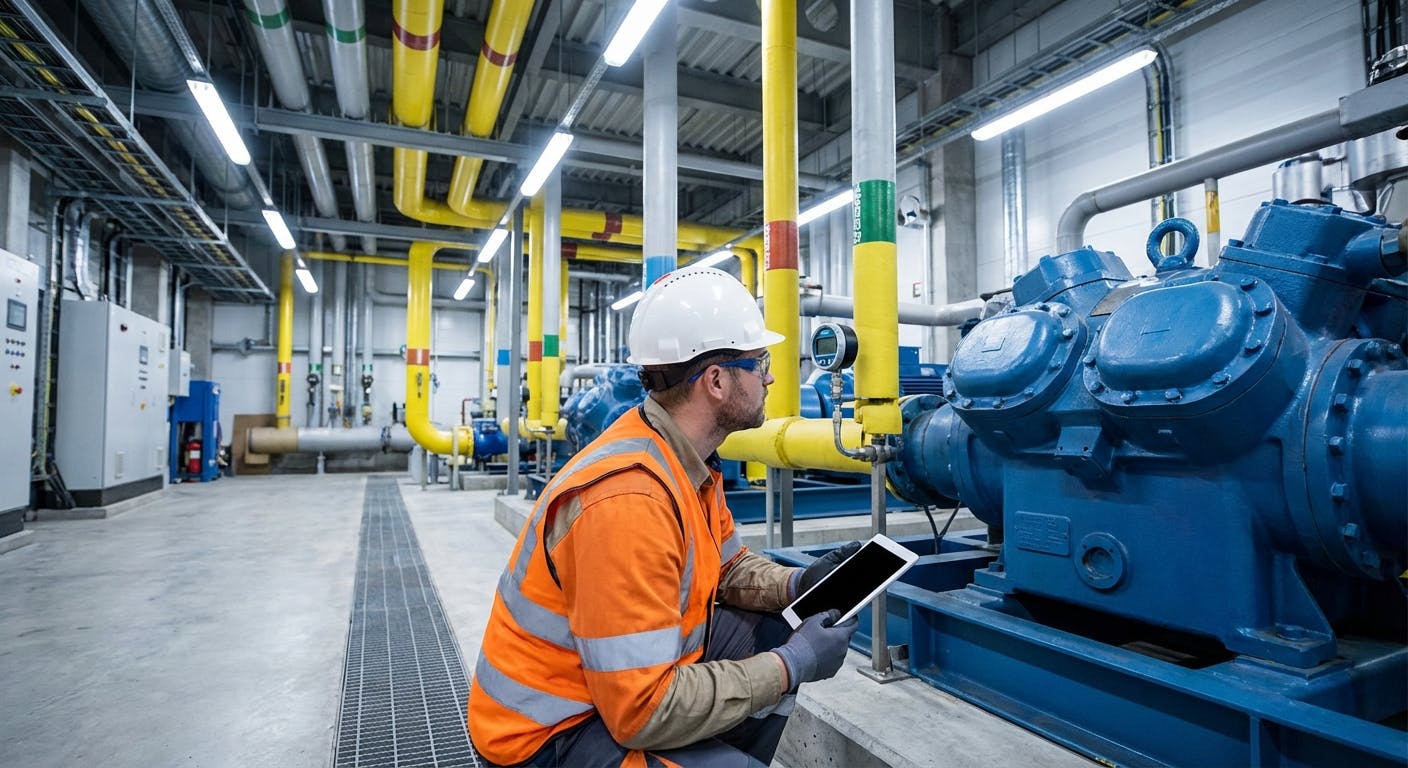
The core question every Facility Manager and Chief Engineer asks when investigating AI for ammonia refrigeration leak prediction is usually this:
"Can software actually detect a leak faster than a physical electrochemical sensor designed specifically to 'smell' ammonia?"
The short answer is yes, but not by "smelling" the air.
AI predicts leaks by creating a thermodynamic digital twin of your refrigeration system. Instead of waiting for ammonia ($NH_3$) to escape the pipe, drift through the air, and hit a sensor at a specific concentration (usually 25 ppm or higher), AI analyzes the internal physics of the closed loop. It calculates the mass balance and energy balance in real-time. If the system is consuming more energy than the cooling load requires, or if the refrigerant inventory levels in the high-pressure receiver drop faster than the current operational state can explain, the AI flags a "virtual leak."
This allows you to identify micro-leaks (0.5 lbs/day) and seal failures weeks before they trigger a catastrophic safety alarm or a reportable release.
In this guide, we will move beyond basic safety compliance and explore the operational intelligence of using AI as a "Virtual Sensor" for your ammonia loops.
How does "Virtual Sensor" technology actually work in a closed loop?
To understand how AI predicts leaks without physical sniffers, we have to look at the refrigeration cycle as a mathematical equation. An ammonia system is a closed loop. In a perfect world, the mass of ammonia inside the system remains constant, regardless of whether it is liquid in the receiver or gas in the suction line.
However, in the real world, levels fluctuate wildly based on load, defrost cycles, and ambient temperatures. A human operator looking at a SCADA screen might see the receiver level drop by 5% and assume the system is just under heavy load.
AI, specifically AI-driven predictive maintenance, sees the data differently. It uses Thermodynamic Modeling.
The Principle of Mass and Energy Balance
The AI ingests data from your existing pressure transducers, temperature sensors, and VFD speeds. It then calculates the expected state of the refrigerant based on the NIST Reference Fluid Thermodynamic and Transport Properties.
If the AI observes that the compressors are working 3% harder to maintain the same suction pressure, while the discharge temperature has risen slightly, and the liquid level in the receiver has trended downward by 0.2% over 48 hours (adjusted for temperature expansion), it recognizes a pattern.
It concludes: The mass leaving the high side is not equaling the mass returning from the low side.
This is the "Virtual Sensor." It detects the absence of refrigerant inside the pipe, rather than the presence of refrigerant outside the pipe.
The Problem with Physical Sensors
Physical sensors are vital for life safety, but they are terrible for predictive maintenance.
- Placement Limitations: A sensor only works if the ammonia cloud hits it. If a leak occurs on a roof valve and the wind blows away from the sensor, you won't know until the cloud is massive.
- Threshold Latency: Most sensors are set to alarm at 25 ppm or 35 ppm. By the time a sensor hits 35 ppm in a large engine room, you may have already lost hundreds of pounds of ammonia.
- Sensor Drift: Electrochemical sensors drift over time, requiring frequent calibration. A drifting sensor might read 0 ppm when the actual concentration is 10 ppm.
AI does not drift. It uses the physics of the equipment itself to validate integrity.
What specific data points does the AI need to predict a leak?
A common misconception is that you need to install expensive IoT vibration sensors or acoustic monitors on every valve to predict leaks. While those are helpful for predictive maintenance on compressors, leak prediction relies primarily on process data you likely already collect in your PLC or SCADA system.
To build a robust leak prediction model, the AI typically requires the following tags:
1. High-Pressure Receiver (HPR) Level
This is the "gas gauge" of your system. However, raw HPR data is noisy. Liquid ammonia expands and contracts significantly with temperature. A 90°F day vs. a 60°F night changes the volume of the liquid even if the mass is constant. AI normalizes this data, correcting for density changes to see the true mass inventory.
2. Suction and Discharge Pressures
Pressure is the heartbeat of the system. A slow, insidious drop in suction pressure that doesn't correlate with a drop in evaporator load is a classic signature of refrigerant loss.
3. Compressor VFD Speed / Slide Valve Position
If your control system is ramping up compressor capacity (increasing RPM or opening slide valves) to maintain a setpoint that was previously maintained with less effort, the system is losing efficiency. The AI correlates this energy penalty with potential mass loss.
4. Ambient Temperature and Humidity
Ammonia condensers reject heat to the atmosphere. The efficiency of this rejection depends on the wet-bulb temperature. AI must know the weather conditions to calculate how the system should be performing. If the system is underperforming relative to the current wet-bulb temperature, it indicates a potential charge issue or non-condensables in the system.
How do we distinguish a leak from a high-load event?
This is the most critical question for operational reliability. Facility managers are plagued by "nuisance alarms." If the AI alerts you every time a blast freezer goes into a heavy pull-down, you will turn it off.
The solution lies in Contextual Machine Learning.
Training the Model on "Normal"
When you deploy manufacturing AI software, there is a training period (often 2 to 4 weeks). During this time, the AI learns the "heartbeat" of your facility. It learns that at 6:00 AM, production starts and the load spikes. It learns that on Tuesdays, the defrost cycle causes a temporary dip in receiver levels.
The "Surge" vs. The "Drift"
- High Load Event: Characterized by a rapid change in suction pressure followed by a stabilization. The receiver level drops, but the liquid is accounted for in the evaporators (surge drums). The total calculated mass of the system remains constant.
- Leak Event: Characterized by a "Drift." The receiver level drops, but the liquid does not reappear in the surge drums or accumulators. The total calculated mass decreases.
By tracking the Total System Charge (TSC) dynamically, the AI filters out operational noise. It knows that moving ammonia from the receiver to the evaporator is normal; moving ammonia from the receiver to the atmosphere is a leak.
What is the ROI beyond safety compliance?
While Process Safety Management (PSM) and EPA compliance are top priorities, the ROI for AI leak prediction is often justified through Operational Efficiency and Inventory Management.
1. The Cost of Micro-Leaks
In a large system (e.g., 50,000 lbs of $NH_3$), losing 0.5% of your charge per month is often written off as "normal consumption." It is not.
- Refrigerant Cost: As of 2026, the price of ammonia and regulatory burdens for replacement are rising. A continuous micro-leak costs thousands of dollars annually in replacement fluid.
- Energy Penalty: An undercharged system is an inefficient system. If your system is low on charge, hot gas bypasses may occur, or compressors may run at higher compression ratios to achieve the same cooling effect. The International Institute of Ammonia Refrigeration (IIAR) notes that refrigeration efficiency drops significantly when charge levels are suboptimal.
2. Avoiding Emergency Shutdowns
If a leak grows large enough to trigger an engine room alarm (usually at 150 ppm for emergency ventilation), the system shuts down. Production stops. Product quality is jeopardized. AI provides a "Prescriptive Alert" (e.g., "Check Shaft Seal on Compressor 3") weeks in advance. This allows you to schedule the repair during planned downtime, utilizing preventive maintenance software to manage the work order without disrupting operations.
3. Indirect Leak Detection for Compliance
Regulatory bodies are increasingly accepting "Indirect Method" monitoring for leak detection. By demonstrating that you have a continuous mass-balance monitoring system, you provide a higher tier of due diligence than facilities relying solely on periodic manual inspections.
How does this integrate with my current maintenance workflow?
Knowing there is a leak is only half the battle. Fixing it requires a streamlined workflow. This is where the integration between the AI layer and your CMMS (Computerized Maintenance Management System) becomes essential.
The Automated Workflow
- Detection: The AI detects a mass-balance anomaly centered around the High-Pressure Receiver and Compressor 2.
- Triangulation: Based on the data, the AI predicts the leak is likely on the high side (discharge) due to temperature spikes.
- Action: The system automatically generates a work order in your CMMS software.
- Prescription: The work order includes specific instructions: "Inspect discharge isolation valve and shaft seal on Compressor 2. Verify receiver level calibration."
- Verification: Once the technician repairs the leak and closes the work order, the AI monitors the system for 24 hours to verify the "Drift" has stopped.
This closes the loop between prediction and prevention. Without this integration, the insight from the AI often gets lost in email inboxes.
What if my facility runs 24/7 with varying loads?
Facilities with constant load variations (like cold storage logistics centers or food processing plants with multiple shifts) are actually better candidates for AI than static facilities.
Why? Because human operators struggle to interpret data in dynamic environments.
If your facility runs 24/7:
- The "Steady State" Fallacy: You rarely have a "steady state" to check levels manually. You can't just "pump down" the system every day to check the charge.
- Dynamic Modeling: AI thrives on dynamic data. It uses regression analysis to correlate the variable load (production volume) with the refrigeration response.
Handling Defrost Cycles
Defrosts are chaotic events for pressure and levels. Hot gas is injected, liquid is pushed back. A basic rule-based alarm would trigger constantly during defrosts. AI models identify the "Defrost Signature"—a specific pattern of valve actuations and pressure changes—and effectively "pauses" the leak calculation for that specific circuit during the cycle, or accounts for the mass shift in the total balance.
Troubleshooting: What if the AI indicates a leak, but we can't find it?
This is a common scenario known as the "Ghost Leak." The AI insists mass is leaving the system, but your technicians with handheld sniffers find 0 ppm.
Here is the troubleshooting framework for this edge case:
1. Check the Relief Header
A common source of "invisible" leaks is a weeping hydrostatic relief valve that vents into the relief header. Since the ammonia is contained within the relief piping (venting to the roof stack or diffusion tank), a handheld sniffer in the engine room will never detect it.
- Action: Check the tell-tale indicators on your relief valves or use an ultrasonic leak detector on the relief header.
2. Check the Water Side (Heat Exchangers)
If you have a shell-and-tube heat exchanger or a plate-and-frame chiller, ammonia may be leaking into the water/glycol loop. This is dangerous and invisible to air sensors.
- Action: Test the pH of your cooling water or glycol. A rise in pH indicates ammonia intrusion.
3. Sensor Calibration Drift
Sometimes the "leak" is actually a data error. If the level probe in the High-Pressure Receiver drifts by 1%, the AI may interpret that as a loss of hundreds of pounds of ammonia.
- Action: Verify the calibration of the level probes and pressure transducers. (This is a good reminder to keep your PM procedures up to date regarding sensor calibration).
Getting Started: The "Hybrid" Approach
You do not need to rip and replace your current infrastructure to implement AI leak prediction. The most successful implementations in 2026 use a hybrid approach.
- Keep your Safety System: Keep your electrochemical sensors connected to your emergency ventilation and shunt trip. This is your "airbag."
- Layer the AI: Connect a gateway to your PLC/SCADA to read-only the thermodynamic data. This is your "collision avoidance system."
- Start with the High Side: Focus your initial modeling on the High-Pressure Receiver and Condensers, as this is where the bulk of the inventory calculation happens.
By combining the immediate safety of physical sensors with the predictive foresight of AI, you move your facility from a posture of "Compliance" to a posture of "Operational Excellence." You stop managing leaks, and start managing inventory.
